
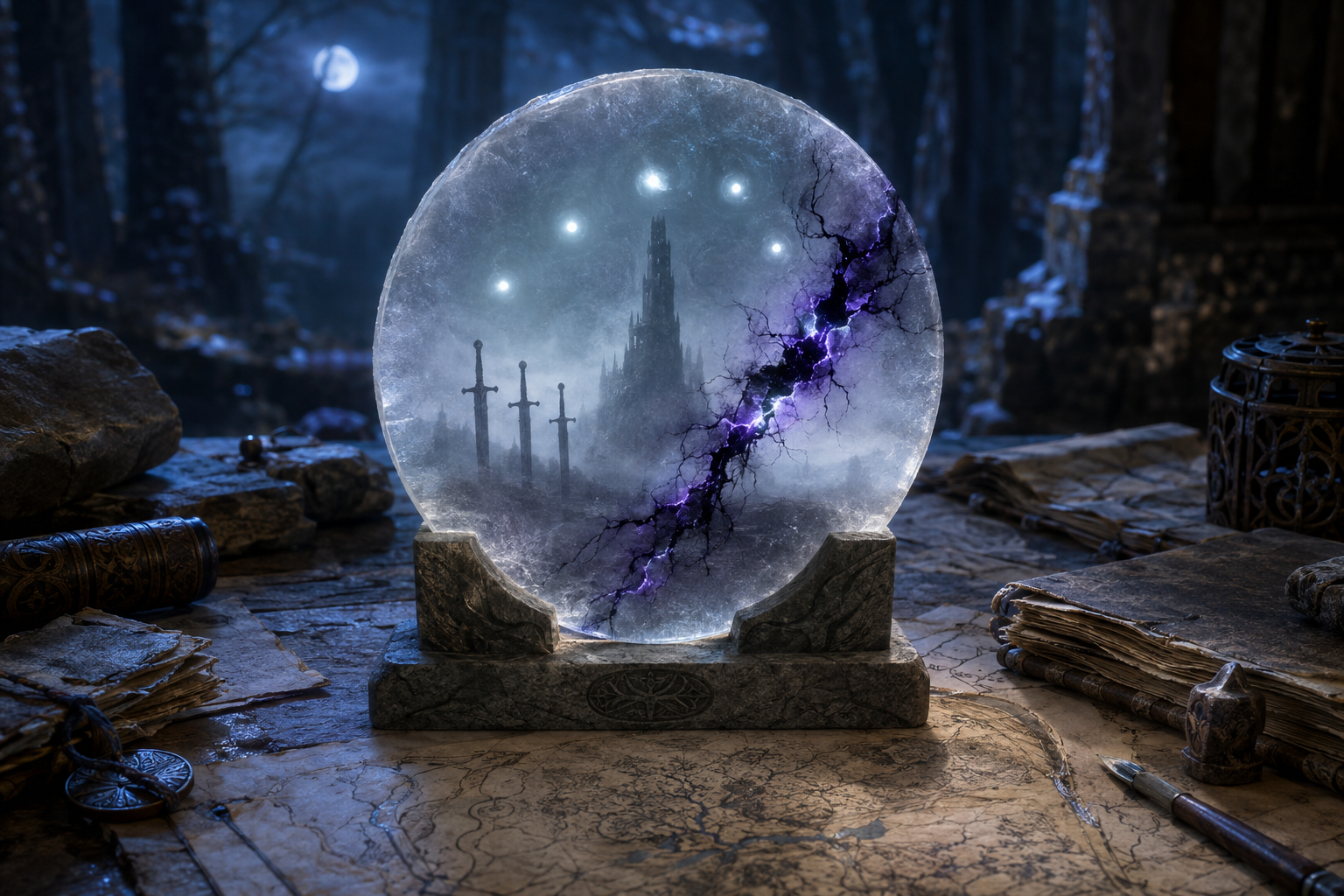
The Mist-Lamp Is Not a Lamp. It Is a Door.
Senditu’s translucent disk belongs to a family of Witnesses that let sight, speech, dream, and danger cross distances ordinary roads cannot.
The short answer
The Mist-Lamp is one member of a broader network of objects and places used by the Sithi for communication and perception across distance. These Witnesses connect to the Road of Dreams, where thought, image, memory, and hostile will can travel without following an ordinary physical route.
That makes the system closer to a family of doors than a collection of identical devices. Different Witnesses have different forms and contexts. What unites them is not appearance; it is access.
In Stone of Farewell, Amerasu uses the Mist-Lamp while explaining the history of Ineluki and the danger facing Osten Ard. Utuk’ku answers through it, interrupts the revelation, and proves that a door used for sight and speech can also expose the room on this side.
The Witness family: stones, scales, pools, and more
Senditu’s Mist-Lamp
A translucent disk from Tumet’ai. Amerasu uses it as a Door to the Road of Dreams; Utuk’ku and the Red Hand turn that opening into an attack vector.
Jiriki’s scale mirror
A scale associated with a Greater Wyrm functions as a means of seeing and communication. Simon recognizes the relationship between it and other Witnesses.
The Speakfire and singing Shard
Different objects, same larger family of long-distance contact. Their distinct materials warn against assuming every Witness is manufactured by one process.
Asu’a’s Pool
A place rather than a handheld artifact. The network can be embedded in landscape and architecture, not only carried as an object.
Later evidence describes Sithi “Stones and Scales, Pools and Pryes” as Witnesses. The wording matters because it preserves variety. A Witness is defined by what relationship it opens, not by one standardized shape.
What is the Road of Dreams?
The Road of Dreams is not merely sleep with better production design. It is a real connective medium in the series’ metaphysics, accessible through trained minds, particular substances, Witnesses, and places.
People can encounter images, presences, messages, and resistance there. Distance behaves differently. Identity and intention matter. A destination may be obscured by hostile force. A connection can be interrupted. The road can become unsafe when an enemy’s mind and hand draw closer.
That is why “magical telephone” is too small an explanation. A telephone does not normally let the person on the other end send a fiery, light-devouring entity through the receiver.
What happens during Amerasu’s Mist-Lamp scene
Amerasu distinguishes the son she remembers from the hatred sustaining the Storm King. Ineluki survived true death, but his demand to redress ancient injustice now sees the living world only through anger.
She also identifies Utuk’ku: her silver-masked great-grandmother, ruler of Nakkiga, eldest living Gardenborn and last Gardenborn, terrified of Unbeing and bound to an ancient humiliation.
Amerasu says she understands the enemy’s design.
That is precisely when Utuk’ku intervenes through the Mist-Lamp. She accuses Amerasu’s people of refusing to purge mortals and threatens death. Before Amerasu can disclose the design, the Red Hand breaches the Yásira through the connection, claims that it and its master have returned stronger from Unbeing, and ignites the living butterfly roof.
The scene withholds the complete plan, but it teaches a crucial mechanical lesson: Witnesses are reciprocal enough to be dangerous.
The network is infrastructure, and infrastructure has politics
The Sithi built systems for seeing and speaking across Osten Ard. Those systems reflect extraordinary knowledge. They also create dependencies and vulnerabilities.
A Witness can preserve relationships across distance, carry warning, and make cooperation possible. It can also be watched, blocked, imitated, or used against the person who opens it. Access is never politically neutral when hostile powers understand the network too.
That is why the Mist-Lamp belongs in Story 101 rather than a list of magical objects. The object explains how information, cultural separation, and invasion occupy the same mechanism.
What the book confirms—and what it does not
Confirmed
The Mist-Lamp is a translucent disk from Tumet’ai; it is a Door to the Road of Dreams; it belongs conceptually with other Witnesses; Utuk’ku communicates through it; the Red Hand breaches the sanctuary through the connection.
Not safely collapsed
The book does not require every Witness to share one material, one inventor, one operating ritual, or one level of two-way access. Similar function is not proof of identical construction.
Cadrach and other characters may offer theories about the Storm King’s use of such systems. Those theories matter, but a responsible explainer labels hypothesis as hypothesis instead of promoting every intelligent guess into omniscient narration.
Why this matters beyond Book 2
The series repeatedly asks who controls the channels through which a society remembers and understands itself: chronicles, songs, prophecies, dreams, archives, names, and magical Witnesses.
The Mist-Lamp literalizes that question. The same door can reveal truth and admit coercion. The same network can connect allies and expose them. Knowledge becomes protective only when people understand the route, the source, and the possibility that someone else is already standing on the road.
On the record
This explainer is grounded in the complete owner-accessed Kindle edition of Stone of Farewell, read through page 589 with its full appendix reference layer, and in the reconciled later-series terminology that identifies “Stones and Scales, Pools and Pryes” as Witnesses. Later terminology clarifies the network; it does not replace the Book 2 scene.