
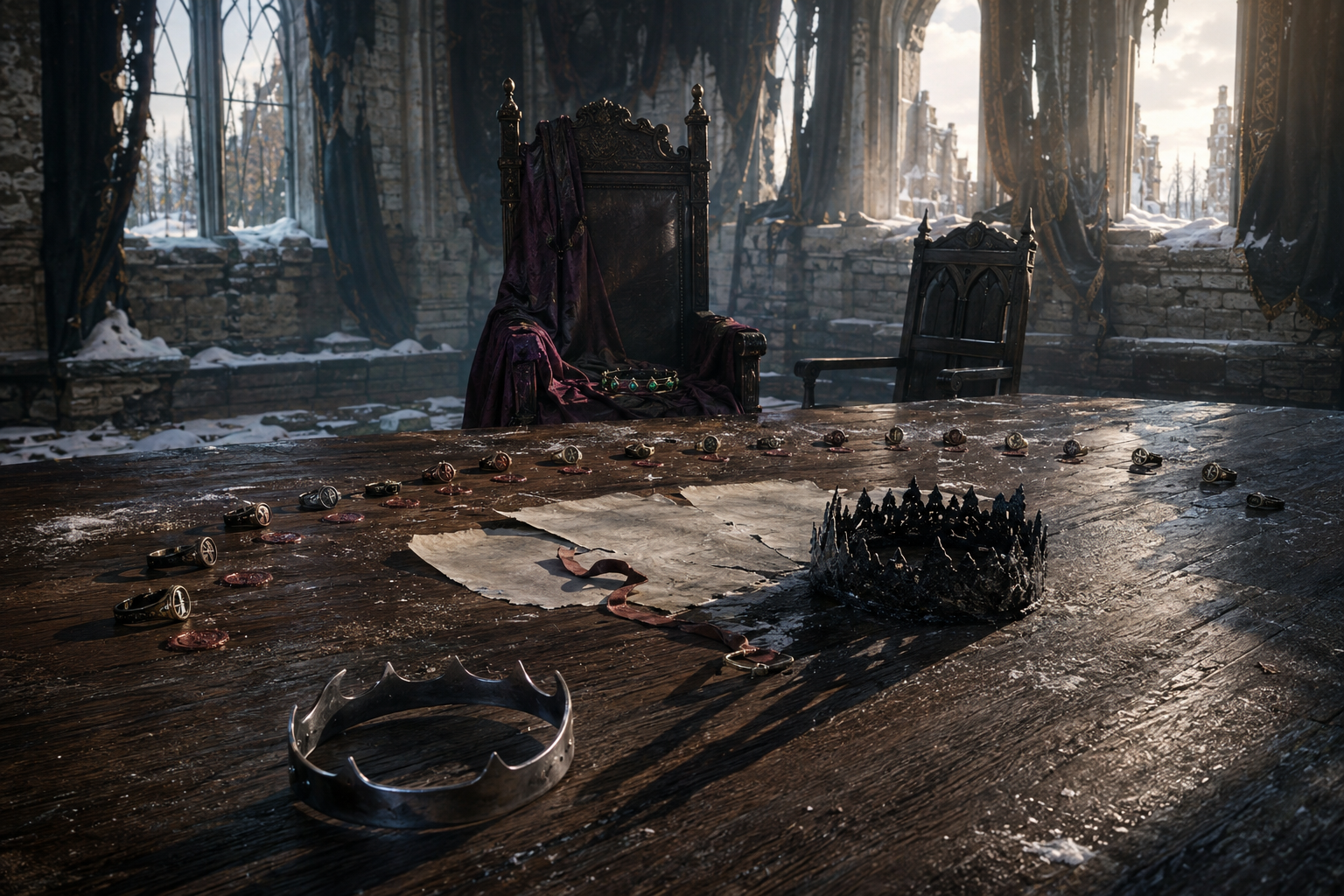
Miriamele Inherits Her Father’s Blame While Men Inherit Crowns
Elias destroys a kingdom. Aspitis manufactures a story. The barons examine the evidence and decide the suspicious person is somehow Miriamele.
Apparently guilt follows the daughter
Miriamele reaches the end of the war with an astonishing résumé: she escaped a court controlled by Pryrates, crossed Osten Ard, survived kidnapping and sexual violence, carried warnings between shattered alliances, entered the Hayholt, faced her father inside the ritual, and kept moving when every institution around her treated her body as policy.
The barons see Elias’s daughter.
His crimes become her contamination. Her disappearance becomes suspicious. Aspitis’s self-serving account becomes political evidence. Her survival choices are not proof of judgment because the people judging her preferred a princess who stayed available for placement.
The case against her is built from what men did
Elias trusted Pryrates, fractured the realm, and became Ineluki’s vessel. Miriamele tried to reach him and finally told him she crossed the world because she loved him. His failure is not hers.
Aspitis imprisoned and assaulted her, then controlled the story available to powerful men. His rumor is not hers.
The war made ordinary royal visibility impossible. Her absence is not abandonment. It is what survival and resistance looked like when the throne itself had become hostile territory.
Yet each fact arrives at the council wearing the wrong label. Male violence becomes female unreliability.
“Stability” is doing a suspicious amount of laundering
Isgrimnur’s alternative is understandable. Simon is trusted, publicly loved, connected to Eahlstan, and visibly unburdened by Elias’s reputation. The kingdom needs someone people will follow before another faction turns uncertainty into civil war.
But political usefulness does not make the underlying double standard disappear. Simon’s newly revealed ancestry can be treated as legitimacy. Miriamele’s already visible ancestry is treated as liability. His journey converts danger into credibility; hers converts danger into gossip.
The word stability makes that asymmetry sound like weather.
Simon is not the villain of this argument
He does the essential thing: he rejects blood as evidence of competence. The Eahlstan reveal explains a ring, a resemblance, and why a crown can be offered without every baron walking out. It does not create his moral worth.
He also does not accept the throne as a replacement for Miriamele’s agency. Their ending works because the romantic choice is explicit before the political settlement closes around it.
The problem is not that Simon becomes king. The problem is a council culture so comfortable with blaming a daughter that a hidden male bloodline feels cleaner than the woman who has been doing the work in front of them.
Miriamele finally speaks before policy does
She does not want the throne as compensation. She does not want another arranged husband. She wants Simon.
“Sir Seoman. My Simon. You are my love.”
That sequence matters. Miriamele chooses a person before court history can package the marriage as dynastic repair. Josua later advises them to marry and rule, but he does not invent the desire. The political union follows their decision instead of consuming it.
After a series full of men treating her as heir, treaty, hostage, temptation, scandal, and route to legitimacy, her own sentence gets there first.
Final word
Elias leaves Miriamele a devastated kingdom. Aspitis leaves her a weaponized rumor. The barons call both inheritances evidence against her.
Simon receives secret royal blood and public trust. The same council calls those inheritances evidence for him.
The ending survives this contradiction because Simon refuses the clean-blood fantasy and Miriamele refuses to disappear inside the settlement. They rule together after choosing together.
But the barons still owe her an apology large enough to seat at the Great Table.
On the record
This Rant is grounded in the complete owner-accessed Kindle reading of To Green Angel Tower, Part II, ASIN B0GYH6FNDN, through location 12,850, including the Afterword and reference layer.