
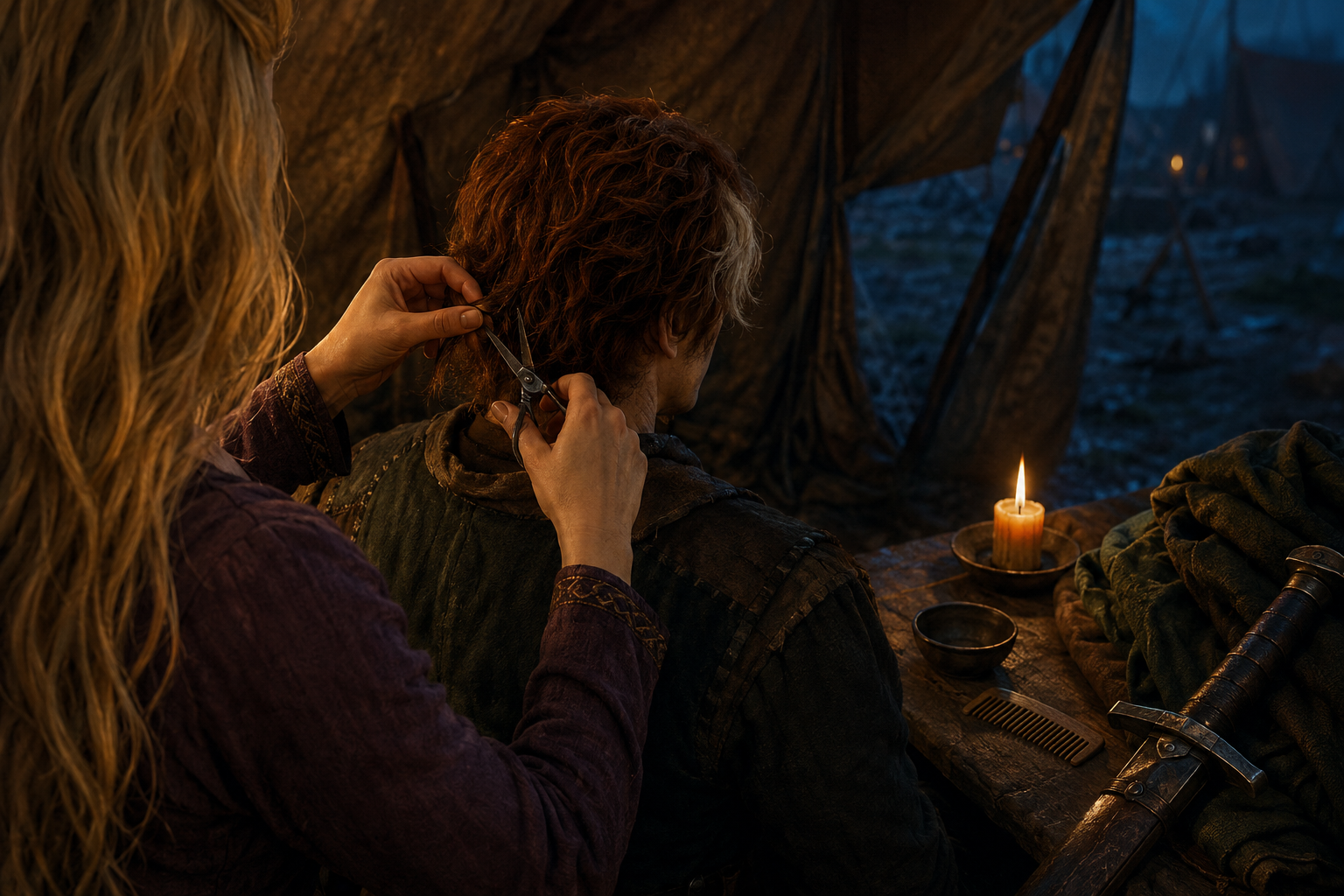
Miriamele Cuts Simon’s Hair and Uncovers Snowlock Again
She trims the road out of his curls. The white remains. Simon discovers that becoming himself and proving himself are no longer the same job.
The scene begins with two people who do not know how to stand near each other anymore
Miriamele enjoys Simon’s company. She also carries shame, anger, and a body that has learned to translate male closeness into danger before thought can intervene. Simon sees the princess he idealized and keeps missing the person trying to live inside that title.
During sword practice he closes the distance to correct her exposed guard. His height, smell, and body overwhelm her. She drops the weapon and pushes him away. Simon asks whether he hurt her; Miriamele cannot yet explain that Aspitis has made an ordinary training correction feel like confinement.
That is the emotional room the haircut enters. It is not flirtation floating above consequence. It is chosen proximity after unwanted memory has made proximity difficult.
Washing and cutting his hair makes touch practical before it becomes romantic
Miriamele controls the task, the tools, and the distance. Simon sits. She washes the road from his hair, works a comb through the copper curls, and removes what travel has made unmanageable.
The scene is intimate because it is ordinary. No court arranges it. No vow demands it. No enemy forces them into the same hiding place. Care happens through water, comb, shears, patience, and the trust required to let another person work near your face and throat.
Fantasy likes to advertise intimacy with crowns and moonlight. Tad Williams gives us a haircut in a borrowed shelter. Correct choice.
The shears uncover the part of Simon no disguise can make ordinary
As the red curls fall, the broad white streak left by Igjarjuk’s blood appears again. Snowlock is not dye, fashion, or a knight’s badge. It is the visible remainder of a moment when Simon almost disappeared into the dragon’s impossible life.
Jiriki named him after it. Sludig teased him with it. Simon has alternated between embarrassment, pride, fear, and the suspicion that a dramatic mark should somehow explain what he has become.
Miriamele’s hands uncover it without ceremony. That restraint matters. The white lock is extraordinary; the person carrying it still needs his hair washed.
Then Simon learns the White Arrow is gone—and does not collapse with it
Jiriki’s mirror shows him that the Arrow is missing. Earlier Simon treated the Sithi gift as proof: evidence that his encounter happened, that Jiriki valued him, that a castle boy could matter to someone beautiful and ancient.
Now he trusts that Binabik will preserve it if it is found. More importantly, Simon says he no longer needs the Arrow in hand to prove himself to Jiriki.
This is not indifference to a sacred gift. It is the difference between honoring a relationship and using its object as identification papers. The promise remains even when the artifact is absent.
Snowlock makes the same argument on his body. The mark exists, but Simon’s worth cannot be outsourced to it.
Miriamele is looking at the boy she remembers and the man arriving
The owned-edition bridge has already named her surprise: the kitchen boy is almost grown. Simon is leaner, scarred, sword-trained, knighted, and visibly altered. Yet his adulthood is not a costume laid over an erased child.
He remains earnest enough to promise protection in a way that irritates her, frightened enough to admit it, and tender enough to release her the instant she says no.
The haircut becomes a visual edit rather than a replacement. Miriamele removes length and dirt. The red remains. The white remains. Simon remains.
The kiss works because “no” still works
Later Miriamele admits she is lonely and wants home. Simon’s first promise to protect her makes her feel smaller, not safer. His admission that he is frightened too finally lets comfort become mutual.
They kiss gently. Aspitis’s memory turns the embrace into confinement. Miriamele says no. Simon releases her immediately.
That response is not a romantic bonus point. It is the minimum—and in this story, after men have treated Miriamele’s body as treaty, prize, and entitlement, the minimum is narratively enormous.
The haircut prepares the emotional grammar: closeness can be chosen, interrupted, and survived without punishment.
Why this moment keeps pulling
Nothing explodes. A sword does not sing. Prophecy does not deliver a footnote. Two exhausted young people share a task that is almost domestic while the world moves toward apocalypse.
The scene lets us see growth without turning Simon into a different, polished hero. He is still red hair, freckles, awkward devotion, and feelings arriving before language. He is also Snowlock, a knight, and somebody beginning to understand that identity does not require constant external certification.
Miriamele is not his reward for growth. She is the person holding the shears, setting the terms of touch, and deciding when closeness belongs to her too.
That is why the image lands: tenderness does not erase the dragon mark. It finds it and keeps going.
On the record
This React is grounded in the complete owner-accessed Kindle reading of To Green Angel Tower, Part II, through location 12,320 plus Afterword and apparatus. Its primary evidence is Chapter 4, “A Thousand Leaves, A Thousand Shadows,” locations 1,423–1,765.