
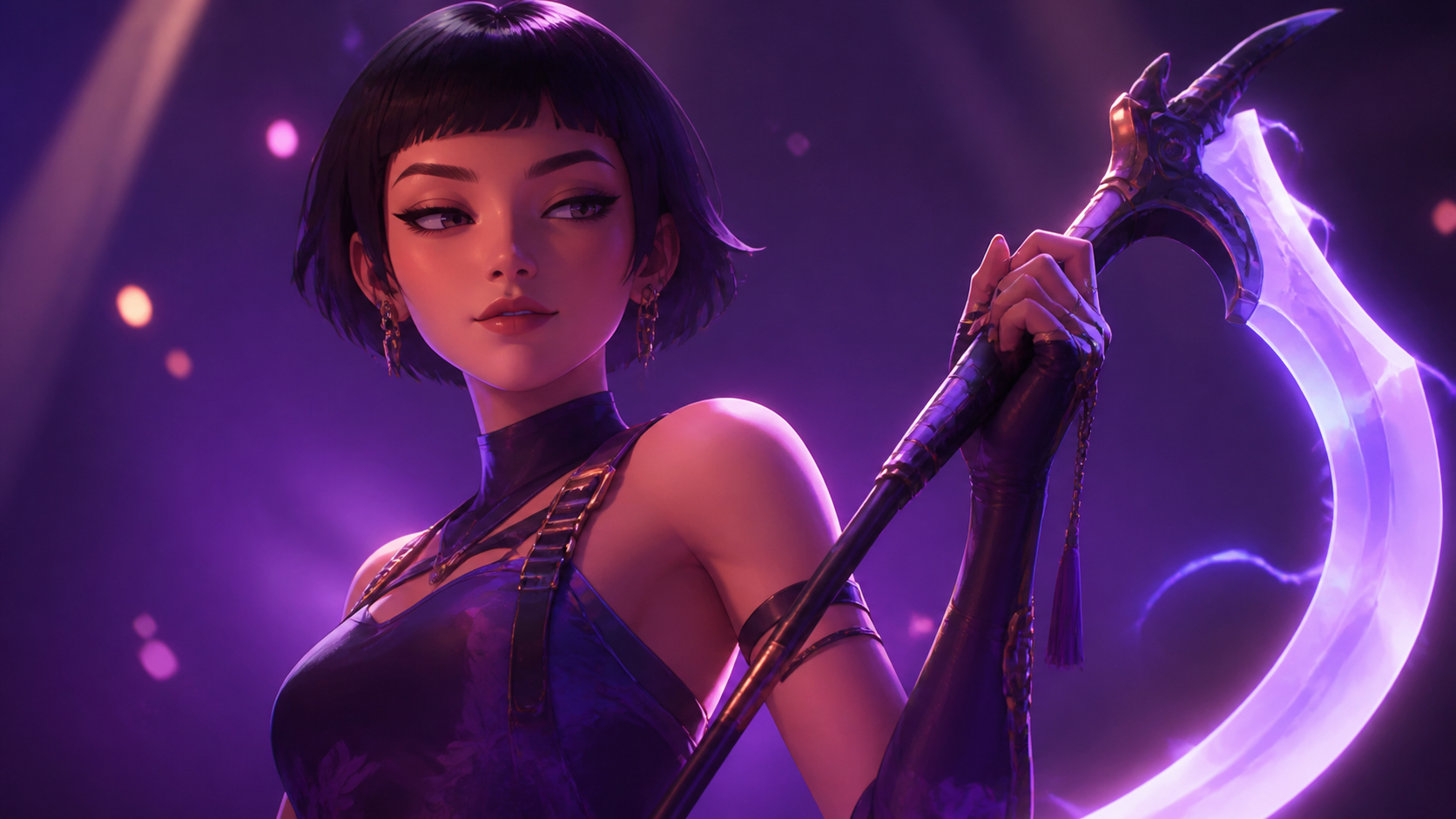
Mira in KPop Demon Hunters
Profile
| Field | Detail |
|---|---|
| Name | Mira |
| Age | 23 to 24 in Netflix’s official character file |
| Birthday | March 22 |
| Group | HUNTR/X |
| Group role | Lead dancer, visual, and choreographer |
| Hunter role | Demon hunter and close-combat specialist |
| Weapon | Gok-do, a curved blade in the film’s fantasy design |
| Speaking performer | May Hong |
| Singing performer | Audrey Nuna |
| Closest partners | Rumi and Zoey |
| Family position | Raised in a traditional family and treated as its black sheep |
| Central conflict | She wants permanent trust while preparing herself to survive betrayal |
| Status after the film | Alive, reunited with HUNTR/X, and helping create the transformed Honmoon |
Mira is the member most likely to notice the lie and the least likely to pretend noticing feels fine. She is sharp, physically fearless, funny in a dry way, and built around the idea that trust should mean something once somebody receives it. That makes her a perfect friend for Rumi and the most dangerous person for Rumi to keep in the dark.
Netflix’s official character file identifies Mira as HUNTR/X’s lead dancer, visual, and choreographer. Those positions explain more than her stage assignment. She understands formation, reads bodies, and knows when the group’s movement stops matching the explanation. Rumi can control words. Mira notices the spacing.
Her arc is not learning to care. Mira cares so deeply that betrayal activates every old reason she had for withholding trust. She has to decide whether pain proves she was foolish to build a family or proves the family needs a harder kind of honesty.
The visual file
Mira’s design gives her long, decisive lines. Her silhouette reads quickly in group action because the body carries confidence before dialogue arrives. Styling can move between polished idol glamour and a sharper physical energy that suggests she would rather confront the problem than decorate it.
Her expressions protect the character from becoming a generic beautiful fighter. Mira’s eyes can communicate skepticism before she speaks. A small mouth movement can carry an entire editorial comment. The animators allow her face to look irritated, suspicious, amused, and ridiculous without treating beauty as a fragile contract.
That flexibility matters for a character assigned the visual role inside HUNTR/X. A lesser story could make “visual” mean Mira exists to be looked at while Rumi receives narrative agency. KPop Demon Hunters gives her visual authority. Mira understands being watched and can decide what the look communicates.
The curved weapon extends her physical language. Rumi’s sword suggests direct leadership. Mira’s gok-do creates sweeping arcs and lets her control a wider path around the body. The shape looks dangerous even at rest. During motion, it turns choreography into a boundary nobody should cross casually.
Her fan art needs that same clarity. A profile image should show the face, weapon, and physical confidence without recoloring the site around one frame. Mira belongs inside CVM Sekai purple. The image does not get to redesign RaeRae’s house.
The black sheep file
Official Netflix material describes Mira as the black sheep of a traditional family. The film does not provide a complete family history, so the phrase should open analysis rather than become permission to invent cruel parents, named siblings, or a dramatic escape scene that never appears.
Being labeled the black sheep usually means a group has assigned one person to carry the discomfort everybody else avoids. Mira’s rebelliousness may be real. The family’s interpretation of that rebellion is another matter. A person can push boundaries because the boundaries are too small, then spend years wondering whether every new home will eventually reach the same conclusion.
That history explains why trust is difficult and total once granted. May Hong described Mira to Netflix as skeptical at first but bonded for life after trust forms. The combination is not contradictory. Suspicion guards the entrance because loyalty becomes expensive after somebody is allowed inside.
HUNTR/X offers Mira a chosen family where difference becomes useful. Her directness helps the group. Her physical intensity becomes choreography and defense. The traits that may have made her inconvenient at home contribute to a shared success.
That is why Rumi’s secret lands as more than one lie. Mira has used HUNTR/X as evidence that permanent belonging can exist. The revelation threatens the entire conclusion. If the leader and closest friend decided she could not be trusted with the truth, maybe the chosen family was conditional too.
Gwi-Ma enters through that old fear. He does not need to create the wound. He only has to tell Mira the wound has finally proven itself correct.
Choreographer means she reads the group through bodies
A choreographer organizes relationships in space. Who stands at the center? Who crosses behind? Which member begins the phrase? Where does the audience look when the formation opens? Mira’s group role makes her sensitive to tiny failures of coordination.
Rumi’s secrecy therefore reaches Mira in physical evidence before it reaches her as confession. Rumi protects a part of the body, shifts attention away from the throat, pushes through pain, and changes behavior around proximity. Mira may not know the reason, but she can see the formation compensating.
The role also gives Mira a responsibility beyond executing steps. She has to translate song and character into movement that all three members can inhabit. HUNTR/X succeeds because Rumi, Mira, and Zoey remain distinct inside synchronization. Mira’s job is not making them identical. Her job is making difference read as intention.
When the trio fractures, choreography loses its social foundation. They can still remember the steps, but the body no longer trusts the body beside it. The final reunion matters because formation becomes possible with new information.
The sequel should let Mira’s choreographic intelligence affect more than stage scenes. She should help redesign hunter training, combat coordination, and the Honmoon system. A woman who understands how group energy moves should have opinions about a barrier powered through group performance.
Mira and Rumi
Mira trusts Rumi’s leadership because Rumi has earned it. They have faced danger together, built a public career, and made thousands of small decisions that only work when each person believes the others will complete their part.
Rumi’s concealment does not erase that history. It changes the terms. Mira learns that a secret tied to demon ancestry, combat risk, and the Honmoon was present during every promise of openness. She is allowed to ask whether Rumi trusted her judgment or only her obedience.
The anger becomes dangerous when it turns one fact into a total biography. Rumi lied, therefore every loving act becomes suspect. That conclusion feels emotionally protective because it removes ambiguity. Mira does not have to remain vulnerable to a person who was supposedly false from the beginning.
Gwi-Ma encourages that conclusion because repair threatens isolation. If Mira can hold both truths, that Rumi caused harm and Rumi loves her, then the demon’s simple verdict loses power.
Returning to Rumi is not surrender. Mira chooses a relationship capable of accountability over a worldview that mistakes permanent suspicion for strength. The reunion would be shallow if it required her to apologize for being hurt. The film lets the group move before every conversation can happen, leaving the ordinary repair for later.
Rumi will need to answer questions after the final battle. Mira will need to listen without making anger the only proof that she respects herself. Their friendship survives because neither woman is reduced to her worst defensive strategy.
Mira and Zoey
Zoey brings warmth and quick social energy into the trio. Mira brings skepticism and boundary pressure. Those roles can look opposite, but they protect each other from extremes. Zoey prevents caution from becoming total withdrawal. Mira prevents harmony from becoming a reason to avoid necessary conflict.
Their relationship matters when Rumi’s secret emerges because neither woman should function as a prop in Rumi’s recovery. Mira and Zoey also have to decide what they owe each other. Do they reinforce the worst interpretation because shared anger feels like unity? Can one question the other without appearing disloyal?
Zoey’s fear of being replaceable may make her vulnerable to following the strongest emotional current in the room. Mira’s fear of betrayal may make certainty feel safer than discussion. Gwi-Ma can exploit both patterns.
The return to HUNTR/X requires Mira and Zoey to recover their own partnership as well as their trust in Rumi. They choose to stand together with the truth present. That choice prevents the trio from becoming one forgiven leader with two backup witnesses.
A sequel should give Mira and Zoey scenes without Rumi. Their friendship deserves its own jokes, disagreements, and shared work. A three-person family becomes convincing when every pair has a relationship.
Mira and Celine
Celine trained HUNTR/X and managed the hunter tradition around them. The film gives Rumi the most intimate connection to her, but Mira also lives under the rules Celine preserved.
Mira was taught that demons are the enemy and that the Honmoon’s completion represents safety. Learning about Rumi exposes a flaw in the doctrine. One of the most trustworthy people in Mira’s life carries the ancestry the doctrine uses as a verdict.
Celine’s secrecy also affects Mira. The mentor decided the team could operate without knowing a risk tied to its leader. That decision repeats the family structure Mira fears. Authority controls information, then expects loyalty from the person excluded.
The post-film relationship should include confrontation. Mira is well positioned to ask what Celine knew, what she promised Rumi, and why protecting the tradition mattered more than preparing the team. Her directness can perform a service Rumi may not yet be able to perform for herself.
Mira does not have to hate Celine to reject her authority. Chosen family matures when inherited titles stop ending the argument.
Mira and Bobby
Bobby manages the group’s celebrity life with the energy of a man solving five emergencies while creating a sixth. Mira likely understands his usefulness and sees through his performance faster than he would prefer.
The film leaves uncertainty about how much Bobby knows concerning demon hunting. That uncertainty creates practical questions. Does he schedule around unexplained disappearances? Does Mira invent excuses? Is he protected through ignorance or placed at greater risk by it?
Mira’s choreographer role requires negotiation with management. Rehearsal time, injuries, staging, travel, and promotional demands affect what the group can physically deliver. She should have a stronger voice in those decisions than a title card reveals.
Their comedy works because Bobby fills space with urgency while Mira can puncture urgency with one look. Underneath the joke, both are responsible for keeping HUNTR/X functional through different systems.
A future story could use Bobby as a test of the new honesty. The trio does not need to tell the entire world, but continuing to hide the job from the person organizing their bodies across a calendar may no longer be safe.
Mira and the Saja Boys
Mira is built to distrust a product that appears too perfect. That does not make her immune. The Saja Boys do not rely on one form of attraction. Their group is segmented so different fans find different routes into the performance.
Their threat also reaches her through competition. HUNTR/X has worked for its audience. The Saja Boys arrive with instant polish, irresistible music, and a supernatural advantage that makes earned success look replaceable overnight.
For somebody carrying black-sheep insecurity, replacement is not only commercial. It confirms the fear that belonging lasts until a more convenient person appears.
Mira’s skepticism can detect manipulation, but pain makes her vulnerable to the enemy’s story about Rumi. Intelligence does not create emotional immunity. Sometimes the sharpest person in the room becomes easiest to manipulate after the evidence appears to reward suspicion.
Her recovery requires recognizing that discernment and despair are different. Discernment says something is wrong. Despair says nothing trustworthy can survive the wrong.
May Hong’s speaking performance
May Hong gives Mira a voice that can cut without making every sentence hostile. The dry timing is crucial. Mira often communicates that she has already evaluated the nonsense in front of her and found it disappointing. A pause can become funnier than a louder reaction.
Hong described Mira in Netflix’s cast feature as skeptical and slow to trust, then bonded for life after trust forms. She also described the character as a burning fire whose passion is not always visible. Those ideas explain the performance’s restraint. Mira does not need to announce intensity because intensity sits under the line.
Her directness changes depending on the target. With Bobby, it can become efficient irritation. With Zoey, it softens around familiarity. With Rumi, sharpness carries the expectation that honesty should be possible. When that expectation breaks, the same voice can sound colder because warmth has been withdrawn.
The performance does not make anger ugly to protect the audience. Mira is allowed to sound hurt, unfair, frightened, and furious. That range matters because loyalty without the capacity for anger would feel decorative.
Comedy keeps the character breathable. Hong lets Mira participate in the group’s physical and conversational chaos without losing the specific personality. She can be ridiculous and still remain the person most likely to tell everybody the plan is ridiculous.
Audrey Nuna’s singing performance
Audrey Nuna provides Mira’s singing voice and contributes to the identity of HUNTR/X as a fictional group listeners can recognize without the movie playing. Her tone gives Mira a distinct edge inside the trio.
Vocal distribution has to support character. Mira’s parts should not sound interchangeable with Rumi’s leadership lines or Zoey’s younger rap energy. The group becomes credible when each performer contributes a sound that can carry individual personality and still blend when the chorus requires unity.
Audrey Nuna is also identified by Netflix as a songwriter connected to the soundtrack. That involvement matters because singing voice and song construction can inform one another. A performer who understands the phrase from the inside can shape how character attitude reaches the recording.
Mira’s voice needs confidence without emotional simplicity. Performance tracks can carry the polished control expected from HUNTR/X, while story context lets the audience hear perfectionism and the need to prove she belongs.
The final material changes that pressure. Mira sings after discovering the group was not as transparent as she believed. Returning to harmony becomes an action. Her voice does not merely decorate Rumi’s breakthrough. It proves Mira has chosen the group again with different information.
The weapon file
Netflix’s official character page identifies Mira’s weapon as a gok-do, a curved blade. The film stylizes it for a fantasy action language that needs to connect combat with choreography. A label helps identify the shape. The screen performance tells us what the shape means for Mira.
The blade creates reach and sweeping control. Mira can open space, redirect a threat, and draw a visible arc around her partners. That movement fits a choreographer who thinks in formations and pathways.
Curved weapons also make hesitation visible. A committed swing carries the whole body. Mira’s fighting style therefore supports the impression that she chooses a direction and means it.
The weapon should not be turned into a personality quiz where curved blade equals rebellious woman. Design, choreography, effects, and character performance work together. The same object could communicate differently in another hand.
Her profile image uses the weapon because face and movement identity need to arrive together. The image remains transformative fan art rather than a fake official still. Metadata states what the work is and where it belongs.
Perfectionism without the polite packaging
Mira’s perfectionism does not look like Rumi’s. Rumi turns pressure inward and attempts to hide the failure. Mira externalizes standards. She notices what needs correction and is willing to say so.
That willingness can protect the group. A choreographer who avoids criticism creates preventable injuries and weak performances. Direct feedback is not cruelty when the purpose is shared excellence and the person receiving it remains human.
The danger appears when standards become proof of belonging. Mira’s black-sheep history may teach her that exceptional usefulness is the safest answer to rejection. If the choreography is flawless, the group needs her. If she catches the threat first, nobody can call her naive. If she never needs reassurance, nobody can withhold it.
That strategy resembles Rumi’s more than either woman may realize. Both convert vulnerability into performance labor. Rumi becomes indispensable through leadership and sacrifice. Mira becomes indispensable through sharpness and control.
The final battle interrupts the strategy. Mira returns because she cares, not because returning is the flawless decision. Repair will require her to accept that family cannot be secured through permanent usefulness.
Anger is information, not a final moral verdict
Mira’s anger tells the truth about injury. Rumi withheld information that affected the entire team. Celine maintained a doctrine that made the secrecy seem necessary. Gwi-Ma exploited the fracture. Pretending Mira should have responded with immediate understanding would punish her for caring about trust.
Anger becomes dangerous when it claims authority over every meaning. In the first moment after betrayal, Mira is not equipped to measure the entire relationship fairly. The feeling is real. The conclusion can still be wrong.
The film allows her to move through that difference quickly because a feature-length climax is approaching. A longer series could spend episodes on it. The compressed arc still lands because the emotional logic is clear. Mira first treats the revelation as proof that trust failed, then recognizes that refusing repair would hand Gwi-Ma the relationship he wants to destroy.
Her return does not make anger disappear. The better reading is that anger stops making every decision. She can bring the injury back into the group and demand a different practice.
That is a useful fandom lesson too. Criticism can protect a thing we love. Total condemnation can become easier than the work of deciding what remains valuable and what has to change.
Idol labor and the visual position
Being identified as the visual can produce a strange form of labor. The title sounds like praise, but it turns appearance into a formal responsibility. Hair, skin, body, clothing, expression, angles, and public behavior become part of the group product.
Mira appears comfortable using beauty as performance. Comfort does not remove the work. A visual has to preserve recognizability across concepts while making each concept feel new. Animation can deliver impossible consistency, but the fictional character still inhabits the pressure.
Lead dancer and choreographer add physical responsibility. Mira must perform at a high level, help shape what the other members perform, and remain visually controlled while doing it. Demon hunting adds another source of injury and fatigue that management may not fully understand.
Her direct personality may protect boundaries in public, yet bluntness can also be marketed as a persona. Once the audience expects the savage comment, even honesty becomes content. Mira needs spaces where she can speak without the line becoming a clip.
A sequel should examine whether HUNTR/X can change the schedule after rejecting the old Honmoon system. New emotional honesty means little if the labor structure still rewards silence until collapse.
The ending opens a family problem
Mira helps create the transformed Honmoon and remains with HUNTR/X. She has chosen the group after receiving the truth. That decision answers the climax and opens the harder domestic question.
What does bonded for life mean after betrayal? It cannot mean nobody ever leaves, questions, or changes. Permanent loyalty becomes another prison if it requires absorbing every harm without boundaries.
Mira needs a version of family that can survive confrontation. She should be able to tell Rumi the secrecy was unacceptable without threatening the entire bond. Rumi should be able to reveal fear before it becomes a crisis without expecting Mira to respond perfectly.
The trio also needs to discuss Celine. Mira and Zoey were trained inside a system whose central purity rule endangered their leader. Continuing under unchanged authority would make the final song symbolic rather than structural.
Mira’s family of origin remains another open route. Does she want contact, distance, recognition, or nothing? The movie does not answer, and the sequel should not assume reconciliation is automatically healthier. Chosen family can be complete without winning approval from the people who called her the problem.
Questions the sequel should answer
What did Mira’s family actually reject, and how did she enter the hunter tradition? The answer should come from the film’s creators rather than fandom filling a blank with melodrama.
How much authority does she have over HUNTR/X choreography and scheduling? Official material identifies her as choreographer, which should produce decisions on screen.
What does she ask Rumi to change after the reunion? Trust repair needs behavior, not only another anthem.
How does Mira relate to Celine after learning the full history of Rumi’s marks? Her instinct for direct confrontation makes that relationship important.
Can she accept care without proving usefulness first? Black-sheep survival often makes receiving harder than giving.
What does she want beyond HUNTR/X? A complete profile needs individual desire that does not threaten the group’s bond.
How will her skepticism operate in a world where demon ancestry no longer supplies a simple moral category? Discernment must become more sophisticated than identifying species.
RaeRae’s character verdict
Mira is not the mean friend. She is the friend who believes trust creates obligations and discovers the person she trusted most was carrying an impossible secret. Her anger is the receipt that the bond mattered.
The black-sheep history gives that anger depth without excusing every conclusion. Mira has spent years preparing for the possibility that belonging will fail. Rumi’s revelation appears to reward the preparation. Gwi-Ma offers the easiest next step: close the door before anybody can hurt her again.
She returns because skepticism is not the same as hopelessness. Mira can recognize manipulation, admit pain changed her reading, and choose a family that now knows more of the truth. That choice is brave because permanent suspicion would feel safer.
May Hong’s dry, controlled speaking performance and Audrey Nuna’s vocal edge give the character continuity across dialogue and song. Choreography gives her another voice. The curved blade gives that choreography consequence.
Mira deserves a sequel that treats her as more than the person who catches Rumi’s lie. Let her build something. Let her argue with Celine. Let her make choreography carry the new Honmoon logic. Let her be loved when she is not useful, correct, or ready with the sharpest sentence.
Why Mira cannot be reduced to the tough one
Group stories love a shortcut. One woman becomes the leader, one becomes the tough one, and one becomes the cute one. The labels help an audience enter quickly, then they begin stealing oxygen if the story never challenges them.
Mira is physically formidable and emotionally guarded, but toughness is a method rather than her full identity. She uses directness to protect clarity. She uses skepticism to protect trust from being handed out carelessly. She uses choreography to turn three different bodies into a group without asking any member to disappear.
The film shows the limit of those methods. Directness cannot expose a secret Rumi has organized her whole life to hide. Skepticism cannot prevent betrayal. Physical skill cannot solve the meaning of Rumi’s ancestry. Mira reaches a crisis where the traits that kept her safe do not tell her what to do next.
Her return is powerful because she chooses tenderness without becoming less sharp. She does not have to trade the blade for a softer personality. She expands the definition of strength until repair, uncertainty, and receiving love can fit inside it.
That expansion is the character arc I want the sequel to protect. Tough women are often allowed pain only when pain makes them tougher. Mira deserves pain that makes her more specific. She can keep the sarcasm, standards, fire, and beautiful weapon while learning that a boundary can include a door.
Official sources
Netflix Tudum’s official Mira character file provides her age range, birthday, HUNTR/X positions, weapon name, speaking performer, singing performer, black-sheep family context, and story-arc outline.
Netflix’s official cast feature includes May Hong’s description of Mira as skeptical, fiercely loyal after trust forms, perceptive, and passionate beneath a controlled surface. Netflix’s soundtrack coverage identifies Audrey Nuna among HUNTR/X’s singing performers and documents the collaborative music and choreography process.
These sources establish credits and character facts. The analysis of trust, chosen family, labor, anger, and institutional change is RaeRae editorial interpretation of the completed film.