
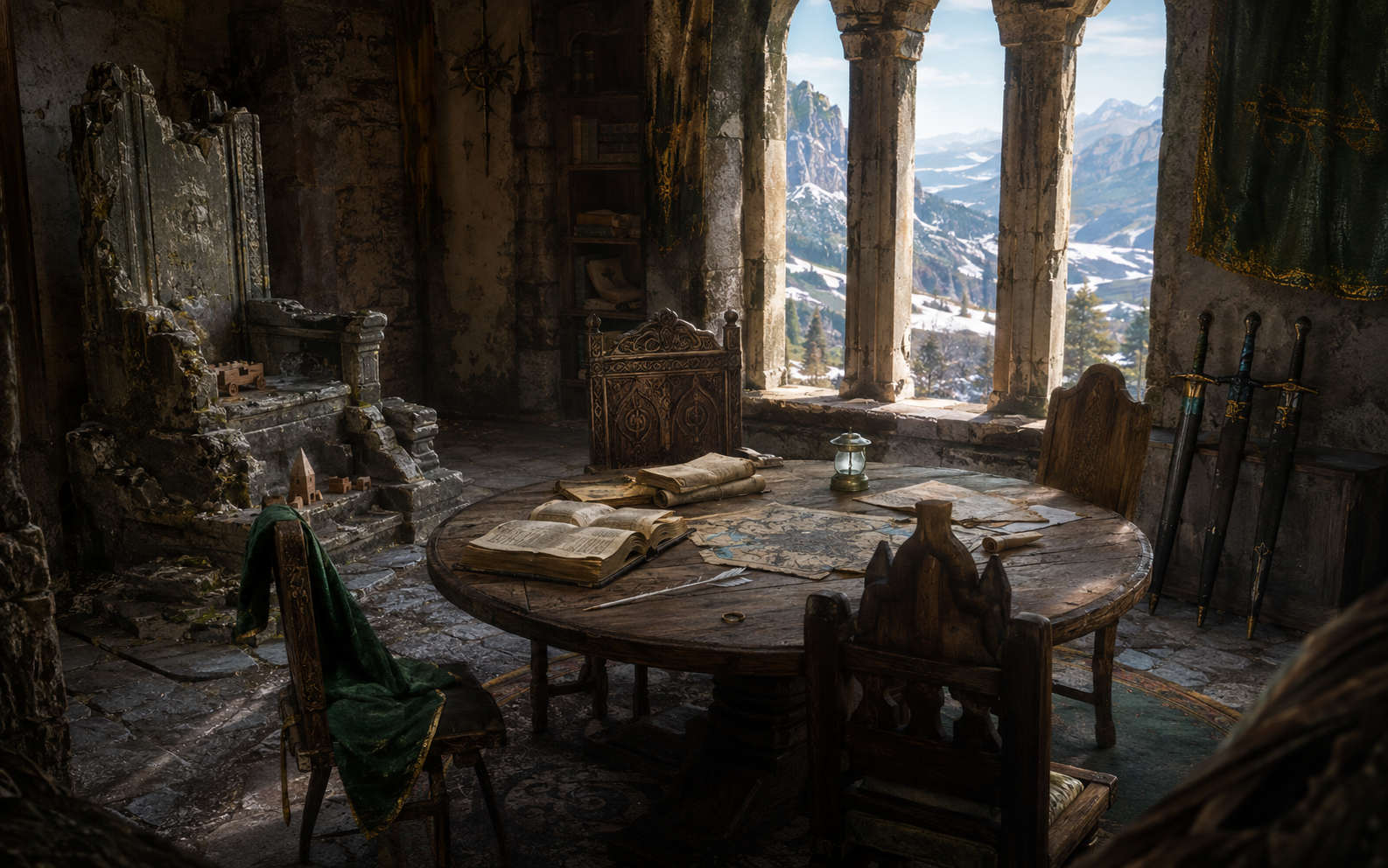
Memory, Sorrow, and Thorn: Tropes & Themes Across the Complete Series
Yes, there is a kitchen boy, a hidden heir, three magic swords, a princess in disguise, and a Dark Lord in a tower. Then the books interrogate every promise those shapes appear to make.
Trope Under Pressure
The hidden heir reveal arrives—and is denied the final word
Simon’s descent from Eahlstan satisfies one of epic fantasy’s most recognizable promises. The series then refuses to let blood turn into moral proof. Simon explicitly understands that ancestry did not make him brave, kind, or worthy. His legitimacy comes from relationships and decisions formed long before the ring and inscription can be read correctly.
The move matters because the story does not merely invert the trope for cleverness. It preserves the emotional force of lost history while rejecting purity as political philosophy.
Prophecy
The fetch quest succeeds, which is precisely the disaster
Memory, Sorrow, and Thorn are collected and brought together. The rhyme is fulfilled. The legendary weapons reach the decisive tower. Every conventional signal says the heroes have assembled the answer.
Instead, reunion is Ineluki’s mechanism. The prophecy changes Fate without promising whose victory that change will serve. This is not a last-minute gotcha; the books repeatedly show that evidence has been interpreted through hope, incomplete archives, and the desire for a usable story.
The Central Theme
Memory can be archive, prison, weapon, or hospitality
Ineluki makes memory a closed circuit: wound becomes identity, identity becomes entitlement, entitlement demands repetition. Morgenes, Amerasu, Jiriki, Binabik, Geloë, and finally Simon practice a harder form. They compare records, preserve contradiction, admit gaps, and allow the past to obligate without allowing it to dictate.
The rebuilt tower-library is therefore more radical than a new throne. It turns guarded knowledge into common infrastructure. The ending does not ask Osten Ard to forget. It asks who gets access to remembering and what the living are permitted to build from it.
Founding Myths
The shining human castle is somebody else’s occupied city
The Hayholt’s grandeur depends on a naming trick. Call Asu’a the Hayholt, call expulsion unification, call John’s rule peace, and conquest becomes architecture instead of an ongoing relationship. The books keep peeling those terms away until the human center of the map becomes visibly layered and contested.
This does not make the Sithi or Norns simple moral symbols. It makes history crowded. Every people carries internal fractures, choices, responsibilities, and losses that refuse the convenience of a single innocent side.
Social Machinery
Everybody knows the rule until somebody asks where it is written
Simon and Miriamele’s romance exposes rank as a collective performance. Servants, nobles, princes, and Simon himself anticipate the prohibition before any clear authority states it. The invisible rule works because everyone edits desire and possibility on its behalf.
Kitchen labor, childcare, healing, food stores, translation, and message networks repeatedly determine survival while court history calls the sword-bearing decisions important. The Great Table’s final openness is not sentimental decoration. It is a structural answer to who has been allowed into the room.
The Ending
Hope is not innocence recovered; it is room deliberately made
The dead stay dead. Trauma does not evaporate when Ineluki is stopped. Simon and Miriamele do not become spotless sovereigns. The series earns hope by shrinking its claim: a chair can become a toy, a tower can become a library, a ruler can ask rather than inherit, and a table can leave places for friends not yet known.
That is quieter than the restoration of a golden age—and much more demanding. Golden ages ask people to believe. Hospitality asks them to keep making room.
What the Familiar Shapes Are Doing
The series keeps the fantasy furniture and changes who gets to sit down
The coming-of-age quest remains emotionally sincere even while the books interrogate it. Simon really does leave home, gain mentors, cross wilderness, face monsters, receive a sword, become a knight, discover ancestry, and return prepared to rule. The subversion is not a sneer at those pleasures. It is an audit of what each symbol asks us to ignore. A sword can be beautiful and coercive. A castle can be wondrous and occupied. A heroic founder can be brave and still build peace from somebody else’s dispossession.
The mentor trope receives the same generosity. Morgenes, Binabik, Jiriki, Geloë, Amerasu, and Strangyeard do not form a conveyor belt of wise adults dispensing the correct answer. Each holds partial knowledge shaped by culture, secrecy, error, fear, and survival. Their disagreements teach Simon more than any single revelation. Wisdom becomes a method—compare witnesses, admit the missing piece, notice who benefits from the official wording—not a beard attached to exposition.
Freedom is not automatically waiting outside the dress
Miriamele’s cropped and dyed hair, Malachias identity, Marya identity, and invented Lady Marya protect her while also exposing how little safety a new name guarantees. Disguise changes who can recognize her; it does not erase gendered violence, class power, dynastic value, or her own incomplete judgment.
Legitimacy keeps failing the dinner test
Josua may have a better claim and better intentions than Elias, but refugees still require food, shelter, care, negotiation, and trust. The series measures sovereignty by whether people can live inside it, not whether the genealogy sounds clean at council.
Consent is one of the quiet load-bearing themes. Elias treats Miriamele’s marriage as succession policy. Fengbald treats rejection as insult. Aspitis turns courtship into acquisition and assumes social shame will finish the lock. Even Simon sometimes mistakes protection, longing, or rank anxiety for reasons Miriamele should explain herself on his schedule. The healthier relationships do not eliminate obligation; they make choice audible inside it. Sisqi can want Binabik without becoming the prize at his trial. Miriamele can love Simon and still ride away on a mission. Simon’s final champion behavior begins when he follows without claiming ownership of the secret.
Hospitality operates as political technology. Meals, fires, boats, tents, caves, kitchens, and tables repeatedly decide whether strangers become threats, guests, allies, or captives. The same outward gesture can hide opposite ethics: Jao é-Tinukai’i is beautiful refuge and controlled confinement; Aspitis offers luxury that depends on possession; Gan Itai’s care creates room for Miriamele to act. The Great Table matters because it institutionalizes the open version of hospitality instead of leaving welcome to private virtue.
The books also complicate the “elder race” trope. Sithi longevity does not produce perfect perspective. Memory can deepen wisdom, but it can also extend avoidance and make grief politically immovable. Norn cruelty is neither excused by injury nor detached from the history that shaped it. Tinukeda’ya survival refuses the tidy taxonomy both Gardenborn and humans impose. Long life, beauty, and old knowledge remain wondrous without becoming moral credentials.
Magic itself behaves like relationship rather than fuel. Witnesses connect places but permit looking back. The Dream Road offers contact while exposing the traveler. The Summer Gate aligns route, memory, season, and attention. The swords sing, choose, hunger, and compel because violence was built into resistant matter. Every mechanism asks not only “what can this do?” but “what does using it connect, awaken, obligate, or violate?”
Language becomes another contested technology. Names change political reality: Asu’a becomes the Hayholt; Seoman becomes Simon and then King Seoman; Marya and Malachias let Miriamele pass; “Storm King” packages a historical person into usable terror. Prophecy works because syntax leaves room for desire to complete the sentence. Translation can rescue evidence or flatten a people. The repeated attention to songs, manuscripts, pronunciation, titles, and contradictory records makes reading one of the series’ central moral actions.
Finally, the story rejects restoration as the automatic happy ending. Prester John’s age cannot simply return because its peace contained the original theft. Josua does not replace Elias on the same chair. Simon and Miriamele do not prove worth by perfectly reenacting an older dynasty. The tower becomes an archive, the throne becomes playground furniture, and the round table anticipates people not yet present. Fantasy’s traditional return home becomes something harder: rebuilding home so those it excluded can enter.
That is also why the series’ slowness is thematic rather than merely ornamental. Travel takes food, weather, sleep, translation, animal labor, and bodies that blister, bleed, freeze, age, miscarry, heal, or refuse. Epic distance cannot be crossed by montage without hiding who pays for it. The long road makes consequence accumulate before revelation arrives. When the final ritual tries to collapse five centuries into one reusable instant, the books oppose it with everything duration has made possible: changed loyalties, revised interpretations, practiced care, and people who are no longer emotionally available for the roles prophecy assigned them.
On the Record
Receipts, scope, and where to go next
Coverage: all four owned Kindle volumes, read front-to-back, with the original trilogy architecture preserved across four published-volume records. This page is an interpretation of the complete text, not a substitute for it.
Return to the complete series hub · Meet the full cast · Open Tad Williams’s author profile