
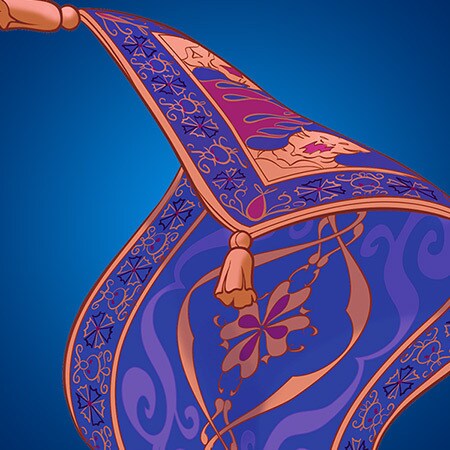
CHARACTER PROFILE · MAGIC CARPET · SILENCE IS NOT THE ABSENCE OF A CHOICE
Magic Carpet Character Profile: Flight, Consent, Aladdin, Jasmine, Genie, and a Complete Performance Without One Spoken Word
A woven rectangle gets no dialogue and still becomes rescuer, wingman, guide, friend, and one of the clearest acting performances in the entire film.
The quick file
Magic Carpet is a sentient flying carpet introduced inside the Cave of Wonders in Disney’s 1992 Aladdin. Carpet has no spoken dialogue, face, conventional limbs, or fixed upright body. Personality emerges through folds, tassels, timing, weight, hesitation, touch, and the way a woven rectangle chooses to occupy space.
Carpet becomes Aladdin and Abu’s rescuer, Genie’s magical peer, Jasmine’s guide into flight, and a continuing member of the animated family across sequels and television. The character is useful transportation and visibly a person. That combination makes every voluntary ride different from treating a magical object as equipment.
Name, nature, and pronouns
The films usually call the character Carpet or Magic Carpet. The name describes material form, much as Genie’s name describes magical category. English dialogue commonly refers to Carpet with masculine pronouns, although the character’s personhood is communicated without a human gender presentation.
The franchise does not explain who created Carpet, whether other sentient carpets exist, how long Carpet lived in the cave, or whether consciousness belongs to weaving, enchantment, or another source. A profile should preserve that uncertainty instead of converting design silence into a confident origin myth.
Life inside the Cave of Wonders
Carpet first appears trapped among treasure and magical objects inside a lethal cave. The character approaches Aladdin and Abu with shy curiosity rather than waiting to be claimed. Friendship begins through mutual recognition before the lamp grants anybody command over another magical being.
That setting suggests confinement without explaining whether the cave imprisoned Carpet deliberately. Carpet knows routes, danger, and escape well enough to help during collapse. The decision to assist strangers risks destruction and creates the first relationship in the cave based on consent rather than worthiness tests, ownership, or extraction.
Animation without a face
Carpet demonstrates character animation at its purest. Corners tilt like shoulders or brows. Tassels point, grip, recoil, plead, and celebrate. A fold can become a bow, shrug, gasp, or wounded posture. Animators rely on timing and silhouette because dialogue cannot explain the intention after the movement.
The design avoids simply drawing an invisible human inside fabric. Carpet rolls, flaps, ripples, creases, and distributes weight according to material. Human-readable emotion remains grounded in textile behavior. The achievement lies in making personhood legible while respecting the object’s physical vocabulary.
Relationship with Aladdin
Carpet helps Aladdin before receiving a promise, wish, or reward. During the cave collapse, flight turns a fatal fall into a coordinated escape. Aladdin trusts Carpet’s movement quickly because survival requires partnership. The bond forms through action rather than a contract.
Later, Carpet supports Prince Ali’s performance and the romance while retaining reactions to Aladdin’s choices. Transportation does not erase judgment. Carpet can nudge, hesitate, tease, worry, and show frustration. The character participates in plans without becoming a silent endorsement of every lie.
Relationship with Jasmine
Carpet offers Jasmine the flight at the center of “A Whole New World.” The invitation matters because her story is filled with men deciding where she should go. Carpet makes the route possible and remains responsive during it. The ride is guided companionship rather than abduction or display.
Carpet catches, steadies, and creates playful intimacy without making Jasmine passive cargo. She chooses to board and engages with the world below. The character becomes part of the romance while preserving agency more successfully than the Prince Ali lie surrounding the trip.
Relationship with Genie
Carpet and Genie are magical beings with sharply different starting conditions. Carpet appears capable of choosing whom to help. Genie is bound to the lamp’s holder. Their coexistence lets the film show voluntary and compulsory magical service without turning the comparison into dialogue.
Both characters communicate through performance, but Carpet does so without speech and Genie through relentless verbal invention. Genie can become anything. Carpet remains recognizably woven while discovering endless expression inside that form. Each expands animation through an opposite strategy.
Relationship with Abu
Abu initially treats the cave through appetite and suspicion, while Carpet approaches through curiosity. Their physical comedy grows from different bodies and competing impulses. Both are Aladdin’s close companions whose loyalty predates palace acceptance.
During danger, their cooperation becomes immediate. Carpet carries Abu, responds to his weight, and helps preserve the small family unit. The franchise can use them as comic accessories, but their choices repeatedly determine whether human characters survive.
Jafar’s attack and unraveling
Jafar captures and magically unravels Carpet during the palace takeover. The violence targets the material body through which personhood is expressed. A human character might be chained or transformed. Carpet is reduced by pulling apart the weave that lets the self move.
The scene is disturbing because the film has already taught viewers to recognize every fold as intentional. Damage to fabric reads as damage to a person. Restoration therefore returns agency and relationship, not merely a useful vehicle for the finale.
The flight sequences
Carpet’s flight combines graceful curves, sudden dives, controlled hovering, acceleration, and comedy. The movement can feel romantic, urgent, or mischievous according to posture and route. Flight is character acting rather than a neutral camera platform.
The Cave escape uses speed and obstacle response. The romantic flight uses smooth continuity and expansive geography. Television adventures use Carpet for pursuit, rescue, transport, and tactical movement. The same ability changes emotional meaning according to who chooses the destination and why.
The Return of Jafar
In the sequel, Carpet remains part of Aladdin’s household and participates in the conflict around Iago and Jafar’s return. The lower-budget production changes movement detail, but the character still provides emotional reaction without dialogue.
Iago’s attempted redemption creates a trust problem for everyone Jafar harmed. Carpet’s responses belong to that group history. A nonverbal character can remain part of moral judgment through approach, distance, assistance, and whether help is offered when danger returns.
The animated television series
Weekly television expands Carpet’s role as transportation across kingdoms, magical dimensions, ruins, and crises. The format risks treating a character with agency as the team vehicle because plots need rapid movement. Stronger episodes preserve reactions and choices around the journey.
Carpet’s mobility allows Aladdin, Jasmine, Genie, Abu, and Iago to operate beyond Agrabah. That utility makes boundaries important. A sentient companion is not a permanent public resource. The series usually assumes friendship includes willingness, while rarely pausing to ask.
King of Thieves
Carpet participates in the wedding branch and the conflict around Cassim and the Forty Thieves. The character’s presence connects Aladdin’s original magical family with the biological-family crisis arriving at the ceremony.
A wedding ride could reduce Carpet to decoration. The franchise history gives the character more weight. Carpet carried the couple through their first shared freedom and now witnesses the relationship reaching public commitment after years of danger and delayed plans.
The 2019 live-action adaptation
The remake recreates Carpet through digital animation inside photographed environments. Material simulation must support tassels, weave, weight, and flight while preserving readable intention. The technical problem differs from hand-drawn shape language but pursues the same personhood without a face.
Photoreal texture can make Carpet look more physically plausible and can reduce the exaggeration that made small gestures readable. The adaptation succeeds when simulation serves timing rather than asking detail alone to prove life.
Carpet and consent
Carpet’s importance grows when placed beside the lamp. The character offers magical labor without a visible owner contract. Aladdin can ask for help, and Carpet can respond. That ordinary exchange establishes a standard the human hero must eventually create with Genie.
Consent should not be inferred only because Carpet cannot speak. Animation supplies clear preferences through behavior. A voluntary companion does not need human dialogue to earn the right to refuse. The burden belongs to friends to notice how willingness is communicated.
Personhood and useful bodies
Fantasy often creates sentient objects whose moral value disappears behind usefulness. Carpet resists that flattening because personality arrives before the first iconic ride. Viewers meet a shy, playful being and then discover flight, not the reverse.
The order matters. If the character were introduced only as transportation, later emotion could feel decorative. By allowing Carpet to approach, joke, and risk safety first, the film frames every ride as help from somebody rather than activation of something.
Design and pattern
Carpet’s colors, border, central field, and tassels remain recognizable across movement. Pattern helps viewers understand orientation when the body flips or folds. The design must survive distance, speed, and deformation without losing identity.
The pattern also locates Carpet inside Agrabah’s generalized visual mixture. A real textile tradition cannot be reduced to one fantasy design, and the film does not name a precise weaving lineage. The character’s beauty participates in the same cultural borrowing surrounding the city.
Common fandom misconceptions
Carpet is not ordinary equipment awakened only by Aladdin. The first film presents independent behavior inside the cave. The character does not speak in the principal screen branches. Silence is not absence of language or choice.
Carpet’s friendship with Genie does not prove both magical beings share the same origin or rules. One is visibly bound to a lamp. The other is not given a comparable contract on screen. Similar magic does not establish identical metaphysics.
Why Carpet lasts
Carpet lasts because the character demonstrates that movement can carry a complete personality. No celebrity voice, face, or exposition is needed. A corner lowers and the audience knows the feeling. A tassel reaches and the audience understands the choice.
The iconic flight works because the vehicle is a friend participating in the scene. Carpet is not the platform underneath romance. Carpet is the third performer making freedom possible and deciding, fold by fold, how the world should open.
Spatial intelligence
Carpet does more than move through air. The character calculates distance, momentum, clearance, passenger balance, approaching obstacles, and the emotional tolerance of riders. The Cave escape requires immediate route changes through collapsing architecture. The romantic flight requires smooth movement that lets wonder remain in control.
That intelligence is easy to overlook because flight looks effortless. Carpet performs continuous judgment while the human characters talk and sing. A sentient vehicle is carrying responsibility for every body on board. The calm ride is evidence of skill, not absence of work.
Nonverbal language
Carpet communicates through pointing tassels, folds, distance, speed, touch, recoil, and timing. Other characters understand because they pay attention to repeated signals. The relationship demonstrates that shared language can develop without spoken vocabulary or a human face.
Misunderstanding remains possible. Friends can interpret willingness too quickly when somebody cannot answer through ordinary dialogue. Ethical companionship requires noticing hesitation as carefully as enthusiasm. Silence should increase attention rather than reduce the expectation of consent.
Material injury and repair
Carpet’s body can tear, unravel, crumple, burn, or become trapped in ways specific to textile. Those risks are not comic abstractions after the film establishes personhood. Damage affects movement, expression, and the ability to help, but usefulness should never be the reason repair matters.
A future story could explore repair as care rather than instant magical reset. Who knows how to mend a sentient weave? Does Carpet choose materials or pattern changes? Does a repaired section become scar, memory, redesign, or continuity without visible difference? The questions treat the body as lived rather than decorative.
Choreographing A Whole New World
The romantic sequence depends on Carpet making two bodies and one moving platform read as a coherent dance. Tilts bring Aladdin and Jasmine closer. Dives create shared surprise. Steady hovering gives the song room to breathe. Changes in altitude reveal geography at the emotional pace of the lyrics.
Carpet is therefore performing romance without becoming the romantic subject. The character supports intimacy and preserves safety while making choices about motion. Calling the scene a carpet ride understates how much acting and choreography belong to the being underneath the couple.
The cave as an object economy
The Cave of Wonders contains treasure, lamp, Carpet, and other objects inside one hoard. The scene encourages viewers to distinguish inert wealth from sentient magical presence. Jafar sees the cave as inventory. Aladdin and Abu gradually discover relationships inside it.
Carpet’s escape rejects the assumption that magical objects exist to be found and owned. The character leaves through alliance. The lamp leaves through extraction. Those routes create different moral histories around the two most important magical items in the film.
Carpet and the Prince Ali lie
Carpet participates in Aladdin’s royal performance and later facilitates the flight where Jasmine recognizes him. The character may not know every private promise or legal pressure, but involvement raises the same question facing Genie and Abu: how much responsibility belongs to friends supporting a harmful disguise?
The film gives Carpet reactions rather than a full moral confrontation. A deeper reading allows loyalty and discomfort to coexist. Helping Aladdin reach Jasmine does not require approving every fact he withholds. Companion characters need room for judgment or they become accessories to the hero’s intention.
Magic Carpet in games, books, and attractions
Other media frequently emphasize flight because it translates naturally into gameplay, illustration, ride design, and merchandise. Those uses can preserve recognizability while flattening personhood. A controllable vehicle feels different from a friend deciding to carry somebody.
Medium labels matter. A park attraction inspired by Carpet does not prove the screen character operates as public transportation. A game mechanic allowing repeated summons may serve play rather than establish the rules of consent in animated continuity. Official products can still be separate interpretations.
Cultural context of a flying carpet
Flying carpets belong to a broad Western popular imagination around tales associated with the Middle East, Persianate worlds, and translated collections. Individual story histories are more complicated than the generic phrase “Arabian tale” suggests. Disney uses immediate recognition without pausing to identify textual lineage.
Carpet’s pattern and magic therefore carry cultural associations larger than one invented city. Appreciation should avoid claiming the character accurately represents one named textile tradition without evidence. Production fantasy can draw from real visual histories while remaining a studio construction.
Merchandise and objecthood
Carpet is unusually easy for merchandise to return to literal object status. A blanket, rug, toy, ride vehicle, or printed accessory resembles the character’s body while existing for use. That commercial translation is predictable and philosophically strange after the film asks viewers to see fabric as a person.
The contradiction does not require banning every Carpet product. It reveals how franchises transform a story about sentient usefulness into useful objects. Fandom can enjoy the design and retain the narrative distinction between owning merchandise and imagining ownership of the character represented.
What future stories owe Carpet
A strong continuation should give Carpet preferences unrelated to transporting the main cast. Where does the character go alone? What forms of art, weather, place, or company create pleasure? Does Carpet remember the cave as home, prison, or both?
Agency becomes visible when a useful character has desires that complicate convenience. Carpet can refuse a route, choose another passenger, seek a repair, initiate an adventure, or spend time without humans. The same nonverbal animation that created personality can carry an entire plot.
Memory without narration
Carpet cannot deliver an exposition speech about the cave, Jafar, the first flight, or later battles. Memory appears through recognition and changed behavior. A familiar danger can trigger hesitation. A person once trusted receives immediate approach. A route connected to harm may alter posture before anyone else notices.
That storytelling method asks animators to protect continuity inside gesture. A fold held for half a second longer can imply remembered fear. A playful tassel touching an old companion can imply years of affection. Nonverbal memory is not vague when the visual language has been taught carefully.
Carpet as a witness
Carpet witnesses Aladdin’s hunger, the cave, Genie’s captivity, Prince Ali, Jasmine’s recognition, Jafar’s takeover, the freedom wish, and the later family branches. The character often occupies the edge of a scene while holding evidence about every major relationship.
A witness role creates narrative potential beyond transportation. Carpet can notice a repeated lie, recognize architecture from an earlier danger, or communicate that a new magical object behaves like the lamp system. The challenge becomes whether human friends slow down enough to understand the warning.
Why the face must stay visible even without a face
For Carpet, “face visible” means preserving the expressive body inside the crop. A hero image that shows only pattern without tassels, folds, or readable pose reduces the character to décor. The card and hero need enough of the full form for agency to remain legible.
Official character art works when the weave, corners, and tassels stay centered rather than stretching one decorative fragment across the frame. Visual consistency is not merely technical. The crop tells readers whether the page sees a person or a background object.
Carpet also challenges the franchise to recognize performance without celebrity. The character cannot be promoted through a famous speaking voice, quoted in dialogue compilations, or reduced to a catchphrase. Recognition comes from animation labor and the audience’s learned attention. Keeping Carpet central in directories and image cards gives nonverbal craft the same editorial seriousness granted to characters whose actors can explain them in interviews. Every readable gesture is a receipt left by artists whose names deserve to remain connected to the character’s life. That labor made silence feel specific, funny, frightened, tender, and brave without asking exposition to translate it afterward. Carpet earns the same depth as every speaking lead.
Profile conclusion
Magic Carpet is companion, rescuer, guide, animation achievement, and the franchise’s quietest argument that usefulness does not cancel personhood. Every branch should preserve the agency that made the first approach in the cave matter.
Return to the Aladdin hub for reviews, guides, films, television, rants, and the complete Agrabah character directory.
The character receipt the franchise has to keep
Magic Carpet needs a receipt, not a résumé. The central argument is communication without speech and service that still contains preference, fear, humor, and refusal. A useful profile follows that argument through choices rather than treating screen time as proof of depth. The character becomes clearest when desire collides with another person’s freedom. That collision reveals who is allowed to refuse, who controls the available information, and whose loss the story expects the audience to forget once the music rises.
The relationship map matters because Magic Carpet does not develop alone. The essential network includes Aladdin, Jasmine, Genie, Abu, the Cave of Wonders, and every rider who assumes transport is the same as consent. Each bond asks for a different kind of honesty. Loyalty to one person can become harm to another, and love can remain real while conduct remains unacceptable. The profile therefore records who challenges Magic Carpet, who absorbs the consequences, who performs repair, and which relationship changes after the apology instead of snapping back to its earlier setting.
The performance record is equally specific: the animators perform Carpet through folds, tassels, weight, timing, and posture, creating a readable character without assigning a spoken performer. Voice cannot be separated from animation here. A pause, swallowed word, burst of speed, or sudden drop in volume changes the moral temperature of a scene. The body supplies a second track through eye line, weight, gesture, costume, or movement. Reading both tracks keeps the profile from reducing performance to a cast list or mistaking loudness for emotional clarity.
The recurring evidence includes the Cave rescue, the first invitation to fly, the world tour, Jafar’s captivity, the freezing landscape, and the repeated decision to return for people Carpet chose. These moments do not all point toward one flattering conclusion. Some show generosity. Others show fear, coercion, vanity, avoidance, or the habit of letting somebody else pay. Keeping contradictory receipts is the point. Fandom does not require acquittal. The character becomes more interesting when affection survives an honest account of the choices that made the story hurt.
Agrabah also changes how Magic Carpet should be read. The city mixes regions, languages, costumes, architecture, music, and fairy-tale sources into a Western studio fantasy. That mixture can produce memorable design while blurring cultures into atmosphere. A character profile should name the production frame without pretending the fictional city is a reliable map of a real place. Representation, stereotype, beauty, and pleasure can occupy the same image and still require separate judgment.
Later branches cannot be treated as simple upgrades. Sequels, television episodes, stage productions, games, and the 2019 film give Magic Carpet different amounts of authority and different cultural framing. A change is meaningful when it reveals a new pressure or repairs an earlier limitation. More dialogue is not automatically more agency. A larger costume budget is not automatically greater specificity. The profile compares what each version permits the character to choose and what consequences survive the adaptation.
The final test for Magic Carpet is what the story remembers after the climax. Does a boundary remain? Does labor get redistributed? Does the next conversation begin with knowledge earned in the previous one? An ending can be joyful without erasing the damage that made joy necessary. That is the JIN standard here: a person with history, relationships, performance, contradictions, and a future that requires actual change, not a familiar face placed back on the shelf.
The quiet-scene test
Magic Carpet also needs one scene where nobody is asking for a performance, rescue, warning, ride, ruling, joke, or sacrifice. Quiet time reveals whether the relationships described as family can survive without extracting a service. It lets the audience see what comfort looks like, which silences feel safe, and whether the character can receive care without immediately paying it back. That ordinary evidence matters because franchise storytelling often mistakes usefulness for belonging. Magic Carpet should be allowed to exist inside the world before the next plot assigns a function.