
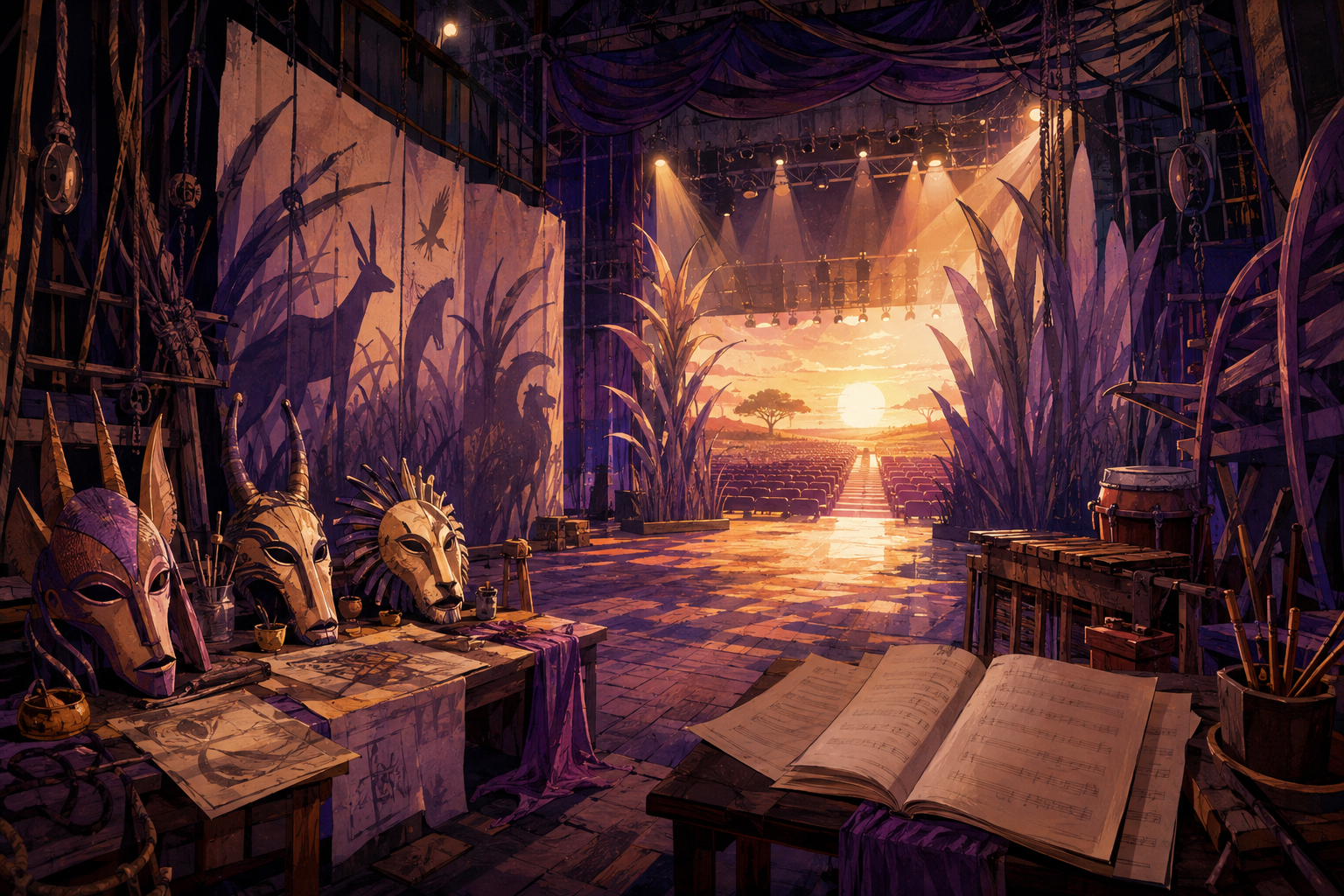
The Lion King Beyond the Screen
Stage, music, parks, games, and the people whose work keeps the Pride Lands moving.
The branch map before we enter the theater
The Lion King stopped being one animated film almost immediately. Music escaped the soundtrack. A stage production rebuilt animal bodies through human performers, masks, puppetry, light, and choreography. Parks turned songs into communal spectacle. Games asked players to move through the story instead of only watching it.
This guide keeps those forms connected without pretending they are interchangeable. A Broadway performance is not a larger movie. A parade is not a compressed musical. A game is not automatically an adaptation because a familiar lion appears on the box. Each form changes what the audience can see, do, hear, and remember.
RaeRae rule for this branch: the logo does not get credit for everybody’s labor. Directors, designers, performers, musicians, puppeteers, technicians, local casts, developers, and park crews make the franchise move. “Disney magic” is branding. Craft has names, bodies, rehearsal hours, and receipts.
The stage musical refused to put cartoon costumes on people
Julie Taymor’s production succeeds because it does not chase literal animated resemblance. D23 notes that the design made no attempt to recreate the feature’s look. Human performers remain visible while masks and puppets extend them into animal images. The audience sees actor and theatrical construction together.
That choice prevents realism from becoming the goal. A lion can be suggested through weight, rhythm, head position, costume line, and shared audience imagination. The mechanism does not hide. We watch theater make the animal and participate in completing it.
Adaptation becomes translation rather than tracing. The film controls every drawn frame. The stage shares space with breathing performers and an audience whose attention can move. Taymor builds a language for that condition instead of treating live bodies as inconvenient substitutes for animation.
Masks create double vision instead of disguise
The production’s masks frequently sit above the performer’s face, allowing human expression and animal form to remain visible at once. That arrangement rejects the idea that transformation requires erasing the actor.
Double vision fits the story’s fable structure. We know the characters are animals, people, symbols, and performers simultaneously. Mufasa can be one father and an idea about authority. Scar can be one brother and a system of appetite.
The mask also changes acting. A performer cannot rely only on facial expression. Spine, shoulders, pace, breath, and the relationship between face and sculpted form carry meaning across a large theater.
Puppetry makes labor part of the visible image
Birds fly on rods, grasslands emerge through ensemble bodies, giraffes extend performers upward, and larger animals require structures that display balance and effort. The production does not pretend the world arrives without hands.
That visibility gives the Circle of Life a different political texture. The ecosystem appears through coordinated human work. No single king creates the landscape. The ensemble literally carries it.
Puppetry also preserves abstraction. A fully concealed mechanical animal might invite comparison with wildlife realism. An openly operated puppet asks whether movement, silhouette, and intention are enough. The answer keeps changing with every performer.
Circle of Life turns the theater itself into the landscape
The opening procession enters through audience aisles, breaking the border between stage and house before the royal ceremony begins. Spectators do not simply observe animals gathering. They sit inside the route.
That staging makes scale emotional without a camera crane. Sound arrives around the body. Large forms pass near seats. The proscenium cannot contain the world yet, so the world enters from behind the audience.
The moment is famous because technique and meaning align. A story about connection begins by physically connecting performance space and spectator space. The entrance is not decoration attached to a song. It is the song’s argument made architectural.
Garth Fagan’s choreography gives the animals social systems
Movement distinguishes species without reducing performers to imitations. Weight, level, rhythm, grouping, and direction create different relationships with ground and community.
Choreography also carries politics. Scar’s world organizes bodies differently from Mufasa’s ceremony. The lionesses’ hunting and mourning show collective labor beyond the royal speeches.
Fagan won the Tony for choreography because movement is not filler between famous songs. It is one of the adaptation’s primary languages, translating drawn motion into bodies that cannot be edited into perfection.
The added songs repair people the film left too quiet
The stage production adds eight songs to the film’s five, according to D23. More music is not automatically more depth. Here, expansion gives characters and communities interior space the movie’s compact runtime could not.
“Shadowland” lets Nala’s departure carry grief, duty, and connection to the lionesses. “They Live in You” expands ancestral teaching before its later reprise. “Endless Night” lets adult Simba remain inside loss rather than rushing from recognition toward return.
The additions alter whose feelings count as main-story material. Nala, Rafiki, the lionesses, and Simba’s private grief receive time not organized solely around plot mechanics. Songs become redistributed interiority.
Rafiki’s gender change exposes how adaptation can rebalance a story
Taymor made Rafiki female for the stage, strengthening the production’s female presence without simply inventing another royal love interest. The change also foregrounds women’s spiritual and communal authority.
A gender change alone does not solve every imbalance. The lionesses still perform material labor while male succession organizes the central throne. It does, however, change who speaks ancestral wisdom and guides the returning heir.
The choice shows adaptation can identify a structural absence and respond through casting, performance, and rewritten emphasis. Fidelity is not the same as freezing every earlier decision.
The Tony Awards recognized a whole design system
The 1998 production won six Tony Awards: Best Musical, direction, choreography, scenic design, costume design, and lighting design. The list matters because no single trick explains the show’s impact.
Taymor became the first woman to win the Tony for directing a musical. Her direction and costume awards sit beside Garth Fagan, Richard Hudson, and Donald Holder, making the achievement visibly collaborative.
Awards are not proof that every choice is beyond criticism. They document how strongly the theatrical field recognized an adaptation willing to invent its own visual language rather than put a movie on legs.
Global productions translate more than dialogue
The musical has traveled through numerous countries, languages, tours, and resident companies. D23 records more than one hundred million guests worldwide by 2019. Reach at that scale creates many local Lion Kings rather than one touring artifact untouched by place.
Translation includes language, casting, vocal rhythm, rehearsal practice, audience expectation, and the practical dimensions of each theater. A production can preserve core designs while performance culture changes the energy inside them.
The global success also demands care in how African languages, music, and visual references are credited. Corporate universality should not erase the specific cultural work that made the show feel larger than Broadway convention.
The music branch began before Broadway and keeps escaping the plot
Elton John and Tim Rice’s film songs, Hans Zimmer’s score, and Lebo M’s vocal and choral work created a musical identity that could travel beyond scenes. Rhythm of the Pride Lands expanded that world before the stage adaptation.
A soundtrack can detach feeling from image. “Circle of Life,” “Hakuna Matata,” and “Can You Feel the Love Tonight” became radio, concert, school, karaoke, meme, and family memory. Each new use changes context without deleting origin.
The danger is treating African musical language as anonymous atmosphere while the corporation and famous Western songwriters remain named. Credit has to travel with admiration. Lebo M and the performers are not texture behind a logo.
Touring turns one production into repeated local labor
The North American tour began in 2002 and passed nine thousand performances across ninety-three cities by its twentieth anniversary, according to D23. Numbers that large can sound like corporate victory until we remember what keeps moving: performers, musicians, puppets, costumes, rigging, scenery, maintenance, transport, rehearsal, and local venue crews.
A tour rebuilds the same theatrical world in rooms with different loading docks, acoustics, sightlines, labor arrangements, and audiences. Consistency is not automatic. It is work repeated until the sunrise appears inevitable again.
The road also changes access. People who cannot travel to Broadway can meet the production locally, though ticket price still decides who gets through the door. Cultural reach and economic access are not the same receipt.
Localization changes rhythm even when the design remains recognizable
International productions translate language, vocal phrasing, humor, and cultural expectation. A lyric must carry plot, music, rhyme, and character at once. Literal accuracy can fail theatrical meaning.
Casting local performers changes the voices and bodies through which the supposedly universal story becomes legible. The production framework travels, but performance never becomes a photocopy.
Global success should invite attention to difference, not bragging that one corporate product conquered every market. The interesting question is what each production had to listen to before it could belong in a new place.
Festival of the Lion King turns spectators into a temporary community
Theme-park performance works under different conditions from a book musical. Audiences arrive throughout a vacation day, familiarity varies, and the show must build energy quickly without reproducing the complete plot.
Songs, acrobatics, procession, puppetry, and audience participation create a celebration rather than a condensed Broadway narrative. The form asks people to join a mood and shared rhythm.
That communal pleasure is real labor performed repeatedly. Cast members and technical crews create spontaneity on schedule, a contradiction theme parks depend on and visitors rarely need to see.
Parks turn story into place and merchandise at the same time
Attractions and shows let visitors enter a physical environment associated with the franchise. Architecture, sound, food, performance, queues, and retail extend the emotional world beyond a screen.
Immersion can deepen affection and make purchasing feel like participation. The exit shop is not separate from the magic. It is part of the business model organizing the experience.
Fans can enjoy the spectacle without pretending commerce disappeared. RaeRae can cry during the opening song and still notice where the branded plush waits. Two eyes, both open.
Games change viewers into operators
A game cannot rely only on recognition because players need rules, feedback, goals, and a relationship between action and consequence. The story becomes something navigated rather than watched.
Early platform games often translated the film into running, jumping, collecting, and boss encounters. Difficulty created a different memory from narrative. Plenty of children remember the wildebeest level through controller frustration as vividly as the movie scene.
Later games and crossover appearances treat characters as abilities, companions, or collectible identities. Adaptation succeeds when mechanics express character. A famous skin placed on unrelated play is branding with buttons.
Soundtrack albums let songs live without the picture
The original soundtrack carried Elton John, Tim Rice, Hans Zimmer, Lebo M, vocal performers, orchestras, choirs, arrangers, engineers, and producers into homes far beyond the theater.
Albums such as Rhythm of the Pride Lands expanded the musical world rather than merely repeating film tracks. “He Lives in You” later traveled into stage and sequel contexts, changing meaning each time.
Music’s mobility explains much of the franchise’s durability. A listener can encounter the story through a school performance, cast recording, concert, playlist, or family car before seeing the scene that first carried the song.
Cast recordings preserve one performance and prove performance changes
A cast album captures voices, orchestration, tempo, and arrangement while losing masks, bodies, light, audience response, and spatial movement. It is record and reduction simultaneously.
Different language recordings reveal translation choices and new vocal identities. The same melody can carry distinct emotional pressure when consonants, breath, and phrasing change.
Collectors sometimes treat one recording as definitive. Theater refuses that finality every night. The recording preserves a route, not the whole road.
School and community productions widen ownership carefully
Licensed youth and community versions allow new performers to learn the material through rehearsal rather than consumption. Singing, movement, craft, and collaboration turn fandom into practice.
Access remains structured by licensing, resources, casting, rehearsal space, and adult support. Participation is broader than Broadway and never free of institutions.
These productions matter because young people discover how much work hides behind a familiar song. The logo becomes less mysterious once somebody has to build, cue, carry, breathe, and recover.
The branch keeps raising questions about African source and corporate ownership
The franchise draws immense power from African landscapes, languages, musical traditions, performers, and visual references while ownership and profit remain concentrated inside a United States corporation. Admiration cannot make that imbalance disappear.
Specific credit is the minimum. Lebo M, South African performers, translators, musicians, designers, and cultural contributors should not collapse into an anonymous idea of atmosphere.
The global stage history creates opportunities for employment, collaboration, and cultural exchange. It also demonstrates how easily a brand can become the name remembered above the people whose cultures and labor give it life.
How to choose your route through this branch
Start with the Broadway or touring production when you want the fullest reinvention of the film. Choose a cast recording when the added songs and vocal performances are the main interest.
Choose a park show when communal spectacle matters more than complete narrative. Choose a game when you want to test how well the world survives translation into action and rules.
Then return across formats. “Shadowland” means more after seeing why Nala needed additional interior space. A park procession reads differently after studying how the stage musical used the audience aisle. Connections are the point.
What belongs on this hub going forward
New stage productions, cast recordings, substantial concert versions, narrative games, park attractions, and behind-the-scenes craft belong here when they change how the franchise is experienced.
A merchandise announcement does not need a full branch article merely because it carries a lion. Coverage should follow story, craft, performance, labor, cultural argument, or a fandom dispute worth keeping receipts for.
The hub is a map, not a warehouse. Every card should open a route with enough substance to justify asking somebody to click.
Final receipt: adaptation lives when the form argues back
The stage musical endures because it does not pretend theater is animation performed more literally. Masks, visible puppetry, choreography, added songs, and human bodies answer the film with another language.
Music, parks, and games work when they make equally specific choices. The franchise weakens when recognition replaces form and strengthens when a new medium reveals something the screen could not.
If the Pride Lands keep traveling, criticism should travel with them. Celebrate the craft, name the workers, follow the cultural sources, notice the cash register, and never let “magic” become a curtain hiding who pulled the rope.
Accessibility changes who can enter the branch
A global hit can still be inaccessible one performance at a time. Ticket price, travel, stairs, seating, captioning, audio description, sensory load, language, and performance schedules determine whether admiration can become attendance. Reach measured in millions does not prove every fan received a workable door.
Recordings, educational material, touring companies, relaxed performances, and accessible services can widen entry without reproducing the live event exactly. The point is not to rank one route as authentic. It is to recognize that fandom grows when people can choose a form their bodies, budgets, languages, and locations can actually use.
Preservation matters because performance disappears nightly
Stage performance lives in time. Designs can be archived, music recorded, blocking documented, and video captured, yet no record contains the exact exchange among performers, crew, building, and audience on one night. Longevity makes preservation more urgent, not less.
Games and park shows face another preservation problem. Hardware changes, servers close, attractions are revised, and corporate archives rarely match public access. A franchise can remain famous while individual forms become difficult to study. Fans, libraries, museums, artists, and historians often keep the missing memory alive.
The audience performs part of the meaning
A theater audience breathes, laughs, goes silent, applauds, and redirects performer energy. Park audiences sing and move. Players discover rules through action. Listeners attach songs to lives the composers never saw. These responses are not identical to authorship, but they complete how each form functions.
That is why this branch cannot be reduced to a release list. The useful record includes what artists built, how institutions sold it, and what audiences did once the work entered their bodies and routines. The Pride Lands keep changing because reception is an event too.
A franchise branch needs credits, not just applause
Marketing loves a single word such as magic because magic has no payroll, no rehearsal injuries, no overnight repair call, and no name that needs to fit on a poster. The actual branch survives through specific people doing specific jobs. Designers establish a visual grammar. Performers carry it in their bodies. Musicians maintain pulse and emotional scale. Stage managers hold the moving parts together while audiences watch somewhere else.
Credit also protects the historical record from becoming a company biography. Julie Taymor matters enormously, and so do the mask makers, puppet builders, associate artists, swings, understudies, dressers, automation teams, local crews, translators, conductors, musicians, and performers who keep adapting the production to time and place. A useful guide names leadership without pretending leadership worked alone.
The same rule applies to recordings, park shows, and games. A soundtrack is not merely a brand playlist. An attraction does not run because a character appears on a sign. A game does not become playable because the film supplied a plot. RaeRae wants the people in the credits because the credits explain why one version moves and another version feels like expensive wallpaper. That labor is the difference between a living adaptation and a logo wearing a costume somebody forgot to finish.
Sources and receipts
This guide begins with D23’s production history, official Lion King creative-team records, Tony Award documentation, and performer accounts. Those sources establish dates, personnel, awards, design approach, added music, touring reach, and the production’s own description of its craft. The analysis and opinions are RaeRae’s shelf.