
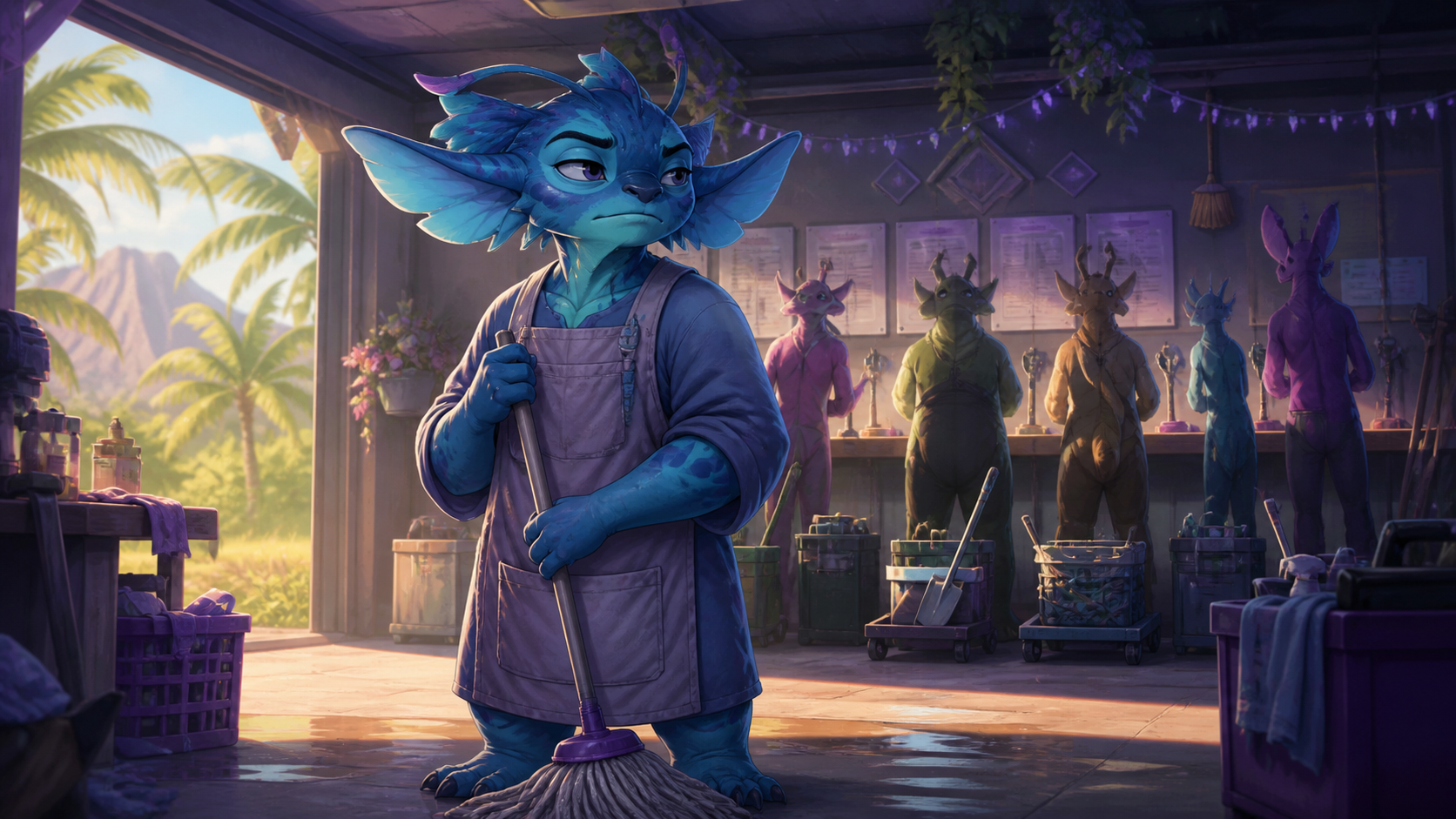
RAERAE RANT · CREATED-PERSON RIGHTS · LABOR · ʻOHANA · ICONIC BY MISTAKE FORMAT
A Job Is Not Freedom: The Experiments Deserved Choices, Wages, and the Right to Quit
Finding a good place for every experiment sounds loving until “place” quietly becomes a permanent job assignment nobody negotiated.
The joke lands because the assignment sounds harmless
At the end of many experiment stories, a creature built for destruction receives a job that converts the dangerous ability into community service. The television rhythm treats the placement like a satisfying little bow. Somebody who caused chaos now waters gardens, redirects traffic, powers machinery, or cleans a public space. The town gets help, the experiment gets belonging, and the audience gets a quick visual proof that rehabilitation worked before the credits arrive.
I understand why the formula feels warm. Work can create routine, relationships, pride, and a visible place in a community. My problem begins when the story skips every question between “you were manufactured for a function” and “congratulations, we found another function for you.” A created person does not become free because the new assignment is nicer than the old assignment. Freedom requires the power to want, refuse, negotiate, change, fail, rest, and choose again.
Jumba made weapons, not employees
The experiments enter the story carrying numbers instead of names, programmed abilities instead of childhood ambitions, and criminal files instead of legal identities. Jumba describes intended functions with the pride of an inventor explaining equipment. That origin matters because the franchise begins with ownership language even when affection later softens the household. Their first social category is product. Their second is fugitive. Personhood arrives late and unevenly.
A job placement cannot repair that history by quietly preserving the same logic. If Sparky was built to destroy electrical systems, assigning endless electrical work may look clever while still telling him that his body determines his social value. The benevolent version of a command remains a command when nobody asks what he wants. A humane story would distinguish capacity from destiny and contribution from obligation.
The good place is often a very convenient place
Lilo’s gift is recognizing a need and imagining a community role that redirects an experiment’s ability away from harm. Her choices frequently save lives. She sees possibilities that Galactic Federation officials miss because she approaches the experiments as relatives rather than evidence. That emotional intelligence deserves credit. The placements also solve practical problems for everybody around her, which makes consent easy to overlook.
A town gains free or unusually efficient labor. Jumba gains proof that his creations can behave. The Federation avoids incarceration and supervision costs. Lilo resolves the episode’s moral emergency. The experiment smiles in the final scene. Every institution benefits, but a smile cannot carry the entire ethical argument. The story rarely shows wages, schedules, ownership, accommodation, privacy, advancement, or the right to walk away.
Rehabilitation should expand a life
Real rehabilitation should increase choices. A person leaves the process with more skills, more support, more relationships, and more control over the future. Punishment disguised as rehabilitation narrows choices until compliance becomes the only route to safety. The experiments face a particularly sharp version because failure can mean capture, confinement, or exile. A cheerful assignment offered under that shadow is never entirely casual.
The strongest placements give an experiment room to transform an ability into self-authored purpose. The weakest placements simply redirect the original programming toward acceptable customers. One path says, “Your power belongs to you, and we can help you use the power safely.” The other says, “Your power belongs to us now because we approve of the task.” Those sentences produce very different versions of ʻohana.
A name should come before a job description
Lilo names the experiments, and naming becomes one of the franchise’s most tender rituals. A name interrupts the serial number. A name lets a creature enter conversation as somebody rather than something. Yet the placement scene often attaches a fresh label almost immediately: lighthouse keeper, sandwich maker, fire performer, construction helper, power source. The new identity can become another inventory entry with prettier language.
Personhood needs space beyond utility. Reuben matters when he makes a sandwich, but hunger, laziness, loyalty, annoyance, fear, taste, and choice make him a character. Angel matters beyond the song in her throat. Sparky matters beyond electricity. Stitch matters beyond strength. If everybody deserves a name, everybody also deserves a self that cannot fit on a job board.
The franchise understands coercion when villains use it
Hämsterviel and Gantu make domination obvious. They capture experiments, issue orders, exploit abilities, and treat disobedience as malfunction. The camera knows how to frame that relationship as ugly. Control rooms, cages, threats, and forced activation tell the audience that using a created being as equipment is wrong. Nobody needs a philosophy seminar to recognize the violation.
The moral picture becomes blurrier when friendly characters make assignments with hugs and upbeat music. Kind intentions change the emotional atmosphere, but kind intentions do not automatically create consent. A family can pressure somebody. A community can exploit somebody. A child can reproduce a harmful assumption while sincerely trying to help. Love deserves better than exemption from examination.
Consent needs more than one happy montage
Consent is not a frozen yes. A person can agree today and regret the arrangement later. A person can enjoy one task and hate the schedule. A person can want to help family without wanting a permanent occupation based on a biological trait. The finale image only tells us that the experiment accepted or tolerated the placement in that moment. The image cannot prove an open future.
I want the missing follow-up conversation. Who checks whether the role still fits after six months? Who protects an experiment from an employer fascinated by an unusual body? Can the experiment take a vacation, join a union, learn another trade, or quit after a terrible Tuesday? A community serious about belonging would keep asking. A community satisfied with usefulness would stop at the montage.
The threat of recapture changes every yes
The experiments do not negotiate from equal ground. Galactic authority can classify them as illegal genetic creations, seize them, transport them, and determine where they may live. Even after Earth becomes a protected home, that legal vulnerability hangs around the edges. Compliance carries safety. Disruption risks renewed attention. The power difference shapes every choice whether the script names the pressure or leaves the pressure outside the frame.
A meaningful yes requires a meaningful no. If refusing the assigned role makes somebody appear unreformed, dangerous, or ungrateful, refusal becomes costly enough to distort consent. The ethical test is not whether the experiment performs the work happily. The test is whether the household would still defend that experiment after a refusal.
Laziness can be a boundary, not a defect
Reuben complicates the franchise because he resists the demand to perform his spectacular potential. Everybody knows he possesses powers close to Stitch’s. He would rather make sandwiches. The story plays the preference for comedy, yet the choice contains a serious claim: ability does not create duty. Somebody else’s excitement about your capacity does not become your life plan.
Calling him lazy protects the social expectation from scrutiny. Maybe he avoids responsibility. Maybe he also understands that every authority figure wants access to his body as soon as he demonstrates what the body can do. Sandwich making becomes ordinary enough to belong to him. The humble preference deserves respect precisely because the universe keeps insisting that power must become productivity.
Useful is a dangerous compliment
“Useful” sounds positive until usefulness becomes the condition for remaining welcome. Created beings already carry fear that love can disappear when behavior becomes inconvenient. A placement built around service may reassure the town while teaching the experiment that belonging must be earned repeatedly through output. That lesson turns family into a performance review.
ʻOhana means nobody gets left behind. The promise should include the experiment who cannot work, refuses a role, needs care, damages something during recovery, or changes interests. Family cannot mean permanent employability. The franchise reaches its deepest emotional truth whenever somebody is loved during failure. The job-placement formula should honor that truth instead of quietly attaching terms.
Disability language sits underneath the superpowers
Many experiments have bodies and sensory systems that make ordinary environments difficult. Their abilities can resemble impairments and advantages at the same time, depending on context. A sonic power becomes dangerous in a crowded room and valuable during rescue. Extreme strength helps with heavy work and makes ordinary touch risky. The environment decides whether difference becomes access, exclusion, spectacle, or exploitation.
Good placement would start with accommodation and preference, not extraction. What conditions help the experiment regulate safely? What communication works? What hours, tools, spaces, and supports reduce harm? The franchise often jumps straight to the benefit everybody else can obtain. A rights-based approach begins with the created person’s life and lets community benefit follow.
Children are solving an adult labor system
Lilo carries responsibility far beyond her age. She rehabilitates fugitives, manages crises, protects a secret population, and invents social placements while adults react. Her creativity makes the structure charming, but the structure also uses a child to patch institutional failure. The Federation has scientists, commanders, ships, records, and legal power. Why does one grieving girl have to invent the entire community integration program?
The answer is television economy, of course. The deeper answer is that institutions in this universe remain comfortable classifying beings and uncomfortable building care. Lilo supplies imagination because bureaucracy supplies categories. Her success should embarrass the adults into creating resources, legal status, education, and voluntary placement support. Instead, the system keeps celebrating her unpaid casework.
Jumba owes more than affection
Jumba grows into family, and his affection becomes genuine. He also created hundreds of sentient beings for destructive purposes and abandoned them to storage, confiscation, or dispersal. Redemption cannot end with being funny at breakfast. Creation establishes responsibility for repair, especially when the creator designed compulsions and vulnerabilities that place each being at risk.
He owes disclosure, medical care, technical support, autonomy, and honest answers about design. He owes each experiment the chance to understand which desires came from programming and which desires developed through experience. Most of all, he owes them the humility to accept that invention does not confer ownership. A fatherly nickname cannot settle that debt.
The Federation needs a citizenship answer
A community job does not answer whether an experiment possesses rights. Can they own property? Enter contracts? Receive medical privacy? Travel? Vote in whatever jurisdiction recognizes them? Seek protection from abuse? Build families? Refuse scientific examination? The series turns legal uncertainty into background comedy because foregrounding the question would expose how precarious every happy ending remains.
Citizenship is not the only model, especially for beings created beyond Earth, but some enforceable status matters. Lilo’s promise can protect somebody emotionally. A statute, treaty, or recognized legal personhood can protect somebody when Lilo is asleep, grown, absent, or overruled. Love opens the door. Rights keep the door from depending on one good family forever.
Wages would change the meaning of the montage
Payment cannot solve every moral problem, but wages would acknowledge that service creates value. Many placements appear inside businesses or public services that would otherwise require paid workers. If an experiment produces electricity, maintains property, serves food, entertains guests, or performs rescue work, somebody benefits materially. Compensation gives the worker options beyond gratitude.
The details matter. Who holds the money? Can the experiment access an account? Does Jumba collect payment as creator or guardian? Are housing and food treated as wages already paid, which would turn family care into employer accounting? The franchise avoids those awkward questions. I want the awkward questions because exploitation survives most comfortably inside arrangements nobody writes down.
Education must exist before career choice means anything
A person cannot choose among futures nobody allows that person to imagine. The experiments arrive with programmed knowledge and specialized capacities, but education is more than operational competence. They need language, history, art, science, relationships, law, money, and the freedom to discover an interest unrelated to design. Without exposure, placement becomes sorting rather than choice.
Imagine Sparky studying marine biology, Angel learning composition without weaponizing her voice, or Reuben running a kitchen because he developed a cuisine rather than repeating one sandwich. The point is not to assign better fantasies from outside. The point is to build enough access that their own fantasies can surprise everybody.
Community service can still become community
I do not want to flatten every placement into abuse. Some roles clearly produce delight, friendship, and a safe outlet for powers that once caused distress. Work can become a chosen craft. Service can create reciprocal bonds. A town that once feared an experiment may learn trust through repeated contact. Those possibilities belong in the reading.
The distinction rests in structure. Does the experiment have choices? Does the community adapt too? Is care available outside productivity? Can the role change? Does the experiment receive the social and material value created? When the answers lean yes, a placement can become community participation. When the answers lean no, the same cheerful scene begins to resemble a softer containment program.
The cure narrative keeps trying to sneak back in
The word rehabilitation can imply that a dangerous design must be cured before the person becomes acceptable. Lilo challenges that logic when she treats each experiment as capable of relationship before perfect behavior. Still, the episodic formula often declares success once the disruptive power becomes socially useful. Difference gains permission to remain only after difference serves the town.
Acceptance should not require conversion into a public benefit. Safety boundaries remain necessary because harm is real. The boundary can target harmful action without demanding that every unusual body justify existence through labor. Stitch becomes family before he becomes dependable. The other experiments deserve the same order.
A better ending would take thirty more seconds
The show could preserve the satisfying placement without writing a labor constitution on screen. Lilo could offer two or three possibilities. The experiment could reject one, choose another, and name a condition. Jumba could promise technical support. Cobra could mention legal papers. A later episode could show somebody changing jobs without being treated as a relapse. Tiny choices would transform the moral frame.
That extra half minute would tell young viewers that belonging and autonomy can coexist. Helping people discover purpose is generous. Deciding purpose for people is control. The difference can live inside a joke, a refusal, a wage envelope, a day off, or one proud announcement: “I picked this.”
My vision is an experiment cooperative
Give them a building near the Pelekai home with workshops, classrooms, quiet rooms, a kitchen, a clinic, and a legal desk. Let the experiments govern the space together. Let them request training, trade skills, form teams, make art, launch businesses, take community contracts, or spend a season learning how to sleep without expecting capture. Let Jumba serve as technical adviser without owning the board.
Lilo can remain the emotional center without becoming everybody’s permanent manager. Nani can help build practical systems because she understands what unsupported responsibility costs. Cobra can use authority to secure status and resources rather than perform surprise inspections. Pleakley can teach, badly at first and better after listening. The town can hire the cooperative under real terms. That future turns ʻohana from a promise into infrastructure.
The journey ends where choice begins
The experiments were manufactured with purposes, cataloged by numbers, and pursued as property. Their deepest collective story should move toward self-definition. Rehabilitation is one stage because learning to live without causing harm matters. Employment can be one stage because craft and contribution matter. Neither stage should become the final definition of a life.
I want every experiment to reach the moment Stitch reaches emotionally: the knowledge that existence does not require proving usefulness. From that ground, work can become joyful instead of compulsory. Service can become reciprocal instead of extractive. A power can become a tool without becoming a sentence. The franchise already gave us the word ʻohana. Now the politics of that word need to catch up with the love.
Public safety does not require permanent extraction
Somebody will argue that extraordinary powers create extraordinary responsibilities. A being who can flood a town, reverse gravity, or shut down an electrical grid cannot move through public life without safety planning. Fair. The same fact does not entitle the public to claim endless productive use of that power. Preventing harm and demanding service are separate policies, even when officials package both policies inside one friendly placement.
Training, emergency plans, protected spaces, and mutual aid can reduce danger without turning the experiment into municipal equipment. Firefighters choose a profession and receive training, pay, rest, representation, and legal protection. A fireproof experiment should receive at least the same dignity before anybody celebrates the creature as the town’s permanent emergency resource.
The episode reset hides burnout
Episodic television loves a stable ending because next week needs a clean beginning. The experiment finds a place, everybody waves, and the camera moves on. Labor has a different rhythm. Repetitive tasks exhaust bodies. Public-facing work drains patience. Rescue roles create trauma. Even a beloved craft can become unbearable when the worker never receives relief. The reset protects viewers from seeing accumulated cost.
A deeper franchise could let placement consequences travel across episodes. One experiment might request fewer hours. Another might discover that praise feels like pressure. A third might love the work and train somebody else. Continuity would make rehabilitation feel lived instead of certified. Growth becomes more convincing when characters can revise a supposedly perfect answer.
Found family cannot become a company town
The Pelekai household provides shelter, food, emotional protection, advocacy, and access to community. When the same network also assigns work, evaluates reform, controls information, and mediates contact with galactic authority, care and governance collapse into one center. The family may act lovingly, but dependence makes disagreement difficult. Losing approval could appear to threaten every other source of safety.
Healthy found family should help members build relationships and resources beyond the household. Independent advocates, friends, schools, employers, clinics, and experiment-led councils would spread power. The goal is not to weaken ʻohana. The goal is to keep ʻohana from becoming the only institution a vulnerable person can appeal to when a family decision causes harm.
A body is not public infrastructure
The franchise repeatedly treats spectacular anatomy as a community solution. An experiment can replace a machine, perform a dangerous task, or deliver a service no human worker could match. Wonder makes the arrangement feel generous. The visual also risks collapsing a living body into infrastructure. Roads, generators, tools, and public utilities do not need privacy, leisure, medical consent, or emotional recognition. People do.
The boundary becomes especially important when the experiment’s body creates profit or saves public money. Gratitude should never substitute for a contract. Admiration should never substitute for safety rules. A celebration should never substitute for ownership of one’s own labor. The more valuable the ability becomes, the stronger the protections need to become.
Choice can include doing absolutely nothing impressive
The universe does not need every experiment to reveal a hidden vocational destiny. Some may want domestic quiet, hobbies, friendships, and ordinary routines. Some may need years of recovery before considering work. Some may never fit a conventional labor model. A story about family should possess enough imagination to treat an unproductive afternoon as part of a worthy life.
That possibility would strengthen the characters who choose demanding work because their decisions would carry weight. A heroic rescue means more when the rescuer could refuse. A sandwich means more when Reuben controls the kitchen. A song means more when Angel controls the audience. Freedom creates moral value that programming and pressure cannot manufacture.
The rant underneath the rant is about our world
The experiments exaggerate a familiar demand. People are often told to convert pain, disability, talent, identity, or survival into usefulness before society will offer respect. A child becomes inspiring only when achievement cancels hardship. A disabled person becomes welcome only when productivity reassures everybody. A worker receives the language of family while management avoids the obligations of employment. The bright alien comedy makes those habits easier to see.
I keep returning to these placement montages because the franchise nearly reaches a radical idea. Beings designed as tools become family. That premise should explode every system built around usefulness. Whenever the ending merely assigns a nicer use, the story steps back from its own courage. Whenever an experiment chooses a life, the story finally delivers the freedom hiding inside ʻohana.
The fix does not require making the franchise grim. Choice can be funny, messy, stubborn, and warm. Let an experiment quit after one shift because the uniform feels terrible. Let another negotiate snacks, music, and Tuesdays off. Let somebody choose school and somebody choose the beach. Comedy grows when characters possess preferences. So does love.
Placement needs consent, not merely a useful assignment
The series repeatedly solves an experiment crisis by discovering a socially beneficial use for the ability Jumba designed as a weapon. The formula is charming because destructive traits become sources of belonging. The problem appears when usefulness becomes the condition for personhood. An experiment earns safety by proving that a community needs the exact labor their body can perform.
That arrangement resembles employment without negotiation. Lilo and Stitch name the experiment, identify a task, celebrate the match, and move to the next cousin. The experiment rarely receives wages, rest rules, the right to refuse, or a process for changing placements later. A true place can become another assignment written by people who are confident they understand the worker after one episode.
Consent would make the premise richer rather than less tidy. Some cousins might enjoy the first placement and later want another role. Some abilities might need accommodation rather than commercial use. Some experiments could choose art, friendship, study, travel, or ordinary life unrelated to the function printed into their design. Rehabilitating a person should not mean converting dangerous productivity into acceptable productivity.
Jumba’s responsibility cannot end when a placement works. He created beings with engineered impulses, uneven information, and bodies built for coercive purposes. Repair should include education, medical support, records, housing, and the willingness to listen when a cousin says the family’s first plan was wrong. ʻOhana means nobody gets left behind. The deeper labor question is whether everybody gets to choose where the family is taking them.
The Galactic Federation also needs a status for created people that is not weapon, specimen, prisoner, or somebody’s experiment. A cousin placed in a bakery, lighthouse, rescue team, or performance venue should have the same ability to renegotiate work that any person deserves. The fact that a power fits a task does not mean the body exists for that task. The series can dramatize those choices without becoming a policy lecture. Let one cousin quit. Let another ask for help after a placement creates sensory overload. Let a third discover that the talent everybody praises feels exhausting rather than fulfilling. Lilo would have to practice the hardest form of love: believing a family member’s answer when the answer disrupts her plan. Stitch would understand because his first assigned purpose was destruction and his life became possible only after he rejected the function. Every cousin deserves that same distance between design and destiny. A true place should be a relationship capable of changing, not the last box checked on a rehabilitation form.
The franchise already believes nobody gets left behind. The labor question asks whether staying inside the family also includes the freedom to change one’s mind, reject an assignment, and remain loved when usefulness disappears.
A true place is not true when leaving that place means losing the family that assigned it.
The person comes before the placement, and family remains after the job ends.
Choice matters.
Keep exploring
Return to the Lilo & Stitch hub for the films, series, characters, reactions, and guides.