
FULL MOVIE REVIEW · FAMILY · GRIEF · HAWAIʻI · ICONIC BY MISTAKE FORMAT
Lilo & Stitch (2002) Review: Nani Did the Work, Lilo Named the Family, and Stitch Had to Learn What Staying Costs
The alien was loud. The family crisis was already there. Nani carried the labor, Lilo carried the meaning, and a creature built to destroy had to learn that belonging creates responsibilities.
Before the blue plush aisle swallowed the sisters
Lilo & Stitch became easy to remember incorrectly. Stitch is everywhere. The word ʻohana travels on shirts, mugs, tattoos, park merchandise, and corporate teamwork speeches. The 2002 film is harder than that memory. A grieving Hawaiian child faces social isolation. Her older sister is trying to prevent family separation while employment and housing collapse. A scientist created sentient life for destruction, and a galactic government responds with containment before care. The comedy works because the consequences remain real.
This review keeps Lilo and Nani in the title’s order. The analysis follows the family before the franchise, the labor before the slogan, the watercolor before the postcard, and accountability before cuteness. Affection stays in the room. So do the receipts. The household deserves more attention than the mascot because every later adventure depends on the home Nani fought to keep and Lilo refused to surrender.
The movie knows the alien is not the emergency
Lilo & Stitch opens with an intergalactic trial, a genetic experiment, a prison sentence, and an escape through space. Then the movie lands in Hawaiʻi and quietly reveals the harder crisis. Two sisters have lost their parents. Nani is trying to keep custody of Lilo while holding employment, maintaining a damaged house, feeding both of them, managing school trouble, and surviving an inspection system that can separate the only family either sister has left. Stitch arrives loudly. Grief was already living there.
That reversal is the movie’s first great decision. Science-fiction chaos gives the trailer explosions and slapstick. The family story gives every explosion a consequence. Stitch cannot wreck one more room without threatening Nani’s case. Lilo cannot miss one more social cue without adults recording another concern. Nani cannot lose one more job without Cobra Bubbles asking whether love can compensate for instability. Everybody is funny until the bills, bruises, and deadlines return.
Lilo is difficult because childhood can be difficult
Lilo hits another child, lies on the floor, shuts the door, screams, feeds a fish because she believes the fish controls the weather, takes photographs of strangers, and treats ordinary questions like personal invasions. The screenplay never turns those behaviors into proof that she is secretly bad. Lilo is lonely, grieving, imaginative, socially isolated, and furious that adults keep translating her pain into misbehavior while refusing to name the loss beneath the behavior.
The film also refuses the saintly orphan routine. Lilo can be cruel to Nani. She knows where the tender spots are and pushes directly into them. Respecting a child does not require pretending every action is harmless. The movie respects Lilo by letting her possess a full emotional range, including anger ugly enough to frighten the person working hardest to protect her.
Nani is doing the work of a whole missing village
Nani is young enough to have her own interrupted future and old enough for every institution to expect maternal perfection. She needs a job with hours compatible with childcare, transportation reliable enough for emergencies, a home repaired quickly, and a sister who can perform stability during inspections. No part of that equation recognizes grief as labor. Nani receives responsibility without the authority, money, rest, or community infrastructure that responsibility requires.
Her body carries the exhaustion. Nani runs, lifts, repairs, cooks, argues, apologizes, searches for work, and keeps returning after humiliation. Disney heroines often prove goodness through emotional endurance. Nani proves love through logistics. The practical work is why the movie hurts. Family is not a slogan in her scenes. Family is the next meal, the next interview, the broken stove, the social worker at the door, and one more promise made while terrified.
The sisters fight like people who cannot afford distance
Nani and Lilo move from yelling to reconciliation without the polished speeches another family film might demand. Their fights sound personal because both understand that separation is possible. Lilo fears abandonment and tests whether Nani will leave. Nani fears losing custody and tries to control every variable, including a child whose grief refuses control. Love increases the stakes instead of reducing the conflict.
The scene after their worst argument does not erase the damage. Apology arrives beside exhaustion. Their relationship survives through repeated return. That rhythm makes the later meaning of ʻohana more credible. Family does not mean nobody harms anybody. Family means harm creates an obligation to repair, and repair requires action beyond saying the approved words.
Cobra Bubbles is not the villain, and that makes him scarier
Cobra enters with the posture and voice of a threat, but the movie never turns him into a cartoon bureaucrat stealing children for pleasure. He sees the unsafe conditions. He hears the fighting. He knows Nani is overwhelmed. His responsibility is Lilo’s welfare, not the audience’s certainty that sisterly love will somehow solve structural instability before the deadline.
That fairness makes every visit more frightening. Nani cannot defeat Cobra through courage because he is not an enemy. She must satisfy a standard built around real risks. The film lets viewers understand both positions while still feeling the violence of possible separation. A system can have legitimate concerns and still become terrifying to a family without resources.
Stitch recognizes a family because he was manufactured without one
Experiment 626 begins as a weapon whose intelligence serves destruction. Jumba describes capabilities, durability, instincts, and design limits. Nobody describes relationships because nobody intended him to need any. Stitch understands captivity, pursuit, and utility. Care arrives as a category he has no programming language for.
Lilo adopts him under the wrong species label and the right emotional logic. She does not choose a perfect pet. She chooses the creature everybody else rejects. Stitch initially uses her as protection from capture, but survival strategy becomes attachment through repetition. Meals, records, stories, arguments, and shared trouble teach him a role no laboratory specified. Belonging becomes learned behavior rather than hidden goodness waiting for a convenient reveal.
The ugly duckling book is not subtle, and subtle would be worse
Lilo reads The Ugly Duckling to Stitch and explains the lost creature searching for family. The parallel is obvious because Lilo needs the parallel to be obvious. A grieving child is not delivering a graduate seminar on symbolism. She is using a story she knows to explain fear, loneliness, and hope to somebody who cannot yet admit those feelings.
Stitch later holds the book while confronting his isolation. The object becomes evidence that Lilo’s lesson remained after her voice left the room. The film earns the sentiment through setup and behavior. A weaker movie would make the book a cute reference. This movie lets a children’s story become the first map Stitch receives for an emotional problem his creator never imagined.
David offers help without demanding a reward
David wants a relationship with Nani, but the story does not make romance the rescue plan. He provides job leads, companionship, practical help, and space. He sees the family crisis without converting assistance into leverage. That matters because Nani already lives under constant evaluation. A boyfriend demanding emotional payment would become another institution grading her performance.
His patience does not make him empty. David gets frustrated, jokes, flirts, surfs, and keeps showing up. The movie understands that a supportive man can remain interesting without becoming a savior. Nani needs community more than a prince. David’s best quality is his willingness to join the work without announcing ownership of the family.
Watercolor makes the island feel held rather than rendered
Chris Sanders and Dean DeBlois chose watercolor backgrounds after research in Kauaʻi, returning Disney feature animation to a technique the studio had not used across an entire feature for decades. The soft washes, rounded forms, saturated vegetation, and warm atmosphere support Lilo’s child-level experience of place. The island looks tactile and remembered rather than engineered.
That beauty carries responsibility. Hawaiʻi cannot become a vacation brochure surrounding a generic family plot. The movie includes tourism labor, local roads, crowded domestic space, surf culture, hula practice, and economic pressure. The watercolor invites affection, while the story keeps interrupting fantasy with the cost of living inside the image visitors consume.
Tourism is always standing near the family crisis
Nani’s work depends on visitors who experience Hawaiʻi as leisure. Lilo photographs tourists as if documenting a species. Pleakley arrives obsessed with protecting Earth while misunderstanding almost everything nearby. The movie repeatedly places outsiders beside local people whose labor makes the destination function.
The contrast never becomes a complete political analysis, but the receipts remain visible. Paradise for one person can be an expensive workplace for another. A beach can hold beauty, grief, tourism, employment, and family memory in the same frame. The film is strongest when the alien premise makes ordinary outsider entitlement look stranger than the aliens.
Elvis gives Lilo a language for confidence and loneliness
Elvis Presley songs could have become a licensing gimmick. Instead, Lilo uses Elvis as teacher, style reference, emotional vocabulary, and shared ritual. She instructs Stitch in model-citizen behavior through a celebrity image she understands. The performance is funny because Stitch copies surfaces. The tenderness comes from Lilo genuinely believing music can teach somebody how to move through the world.
The songs also connect private grief with public performance. Lilo can sing, dance, and lecture when ordinary conversation becomes too exposed. Stitch learns imitation before empathy, then slowly discovers the feelings under the imitation. Music creates a rehearsal space where both characters can pretend confidence until some of that confidence becomes real.
The destruction is funny because the consequences are not
Stitch builds towers from furniture, attacks machinery, drives recklessly, causes public scenes, and treats domestic objects like raw material. The animation sells his weight, speed, and impossible strength with comic precision. Every gag also lands inside Nani’s collapsing stability. A broken wall is not a resettable cartoon prop when a social worker is scheduled to inspect the house.
That double register keeps the movie from becoming sugary. Children can enjoy the chaos while adults feel the invoice forming. Stitch must change because affection without accountability would leave Nani and Lilo carrying his damage. The final family works only after he begins using destructive capacity to protect rather than consume the household.
The first receipt
Lilo & Stitch survives because the movie never confuses cuteness with innocence. Lilo hurts people. Nani loses control. Stitch begins with manipulation. Cobra can separate them. Jumba created a life as a weapon. Pleakley treats a whole planet like an assignment. Everybody arrives with damage or blind spots, and the story asks what responsibility looks like after the explanation.
The answer is not perfection. The answer is return, repair, and changed behavior. ʻOhana became marketing language because the line is memorable. The film underneath the line is harder: belonging creates obligations, and the people who stay still have to learn how to stop making home unsafe.
Jumba calls creation an achievement before considering the created
Jumba treats Experiment 626 as evidence of genius. The trial focuses on legality, danger, and containment, while the emotional condition of the creature barely enters the discussion. Stitch was engineered with capacities and compulsions, then condemned for expressing the purpose built into him. The institution recognizes a weapon and refuses to recognize the person trapped inside the weapon design.
That does not make Jumba innocent because his experiment later develops feelings. Creation establishes responsibility. He gave Stitch intelligence without care, survival instincts without community, and destructive desire without an ethical world. The family on Earth performs the education Jumba omitted, and the movie never makes him fully account for outsourcing that labor to a grieving child.
The Galactic Federation has a prison answer for a care problem
The Grand Councilwoman is more measured than Gantu and more ethical than Jumba, but her system still begins with exile and ends with retrieval. Nobody asks what rehabilitation could mean for a newly created being. The Federation categorizes Stitch as contraband with teeth. Lilo changes the legal outcome by producing an adoption record, forcing the council to confront a relationship their categories did not anticipate.
The paperwork joke works because law becomes unexpectedly useful to the least powerful person in the room. Lilo cannot overpower a galactic government. She can prove that Stitch belongs inside an existing bond. The victory remains fragile, however. The same authority that nearly imprisoned him grants conditional protection. Family becomes recognized because power chooses to recognize the evidence.
Gantu mistakes obedience for moral clarity
Captain Gantu follows orders with enough aggression to turn retrieval into endangerment. His size and military confidence make him a conventional obstacle, but the problem is institutional. Gantu believes classification settles the moral question. Experiment 626 is dangerous, so force feels automatically justified. The child attached to the target becomes collateral inside a mission he considers legitimate.
That logic mirrors the earthly family crisis in an exaggerated register. Institutions see a case, category, or risk profile before seeing the relationships underneath. Cobra resists that flattening better than Gantu because Cobra watches behavior and revises judgment. Gantu keeps applying the label until the label nearly destroys the person he was supposedly protecting Earth from.
Pleakley loves Earth as an abstract endangered object
Pleakley argues for Earth’s protection through the mosquito cover story, then arrives with almost no understanding of human life. His environmental concern is sincere and absurdly misinformed. The joke lands on expertise performed without contact. He knows the policy argument and not the place.
The disguise comedy gives the movie room to play with gender presentation and outsider performance, but Pleakley also becomes part of the household labor by the ending. Curiosity moves from abstract planet protection toward actual relationships. Caring about Earth means caring about the people whose kitchen he occupies, not merely preserving a display case called a nature reserve.
The dog shelter scene is adoption and mutual misidentification
Lilo chooses Stitch because he appears unwanted, strange, and damaged. Stitch chooses Lilo because her presence makes capture harder. Both enter the relationship with incomplete information. The shelter worker interprets a dangerous alien as an unusual dog. Nani interprets the adoption as a possible emotional anchor. Everybody sees what the immediate need allows them to see.
The legal transaction matters later, but the emotional transaction begins through projection. Lilo wants somebody who cannot leave easily. Stitch wants protection. Their bond becomes real after those selfish needs collide with care. The movie understands that family can begin for imperfect reasons and still develop ethical obligations.
Scrump tells the truth before Lilo can
Scrump is visibly handmade, asymmetrical, and unsettling to the other children. Lilo presents the doll with pride and then punishes the doll when rejection becomes unbearable. The scene compresses creativity, shame, loneliness, and displaced anger into one small object. Scrump is loved until Scrump becomes evidence that Lilo does not fit.
Later imagery keeps the doll near the family rather than replacing handmade strangeness with approved prettiness. Stitch belongs beside Scrump because both fail the neighborhood’s appearance test. One was made by a grieving child and one by an irresponsible scientist, but each becomes a container for feelings the maker cannot manage directly.
Pudge controls the weather because chaos needs a schedule
Lilo feeds Pudge a peanut-butter sandwich every Thursday. The ritual sounds ridiculous until she connects weather with the death of her parents. A child faced with random catastrophe invents a task capable of preventing recurrence. Feeding the fish creates a small zone where responsibility feels possible.
The joke should never be separated from the grief logic. Adults hear eccentricity. Lilo hears a safety plan. Her insistence shows how trauma can hide inside routines that look irrational from outside. The movie trusts viewers to laugh and then realize why the laugh hurts.
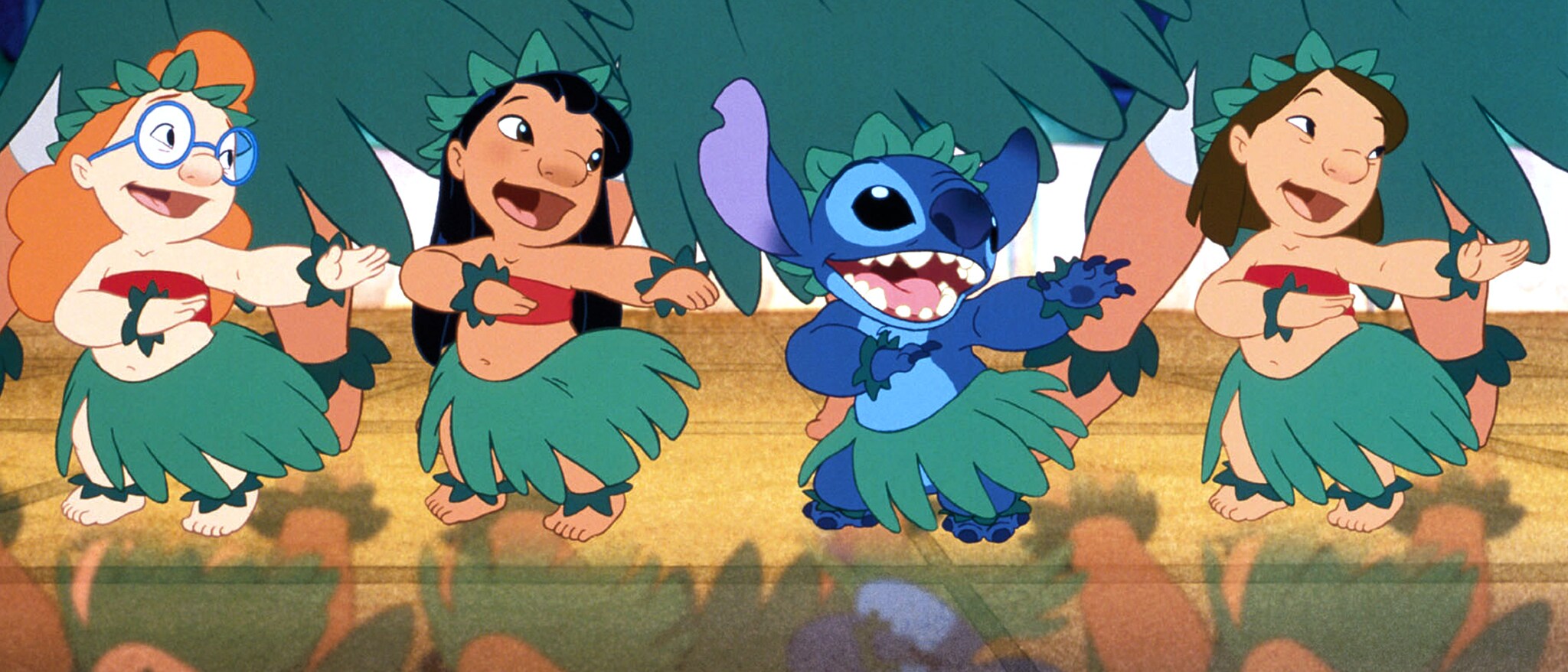
Hula is culture, discipline, and another place Lilo can be rejected
The hula class is not merely a cute island activity inserted for setting. Lilo wants participation, instruction, and belonging among peers. Her conflict with Mertle turns that space into another public test she fails. The teacher tries to maintain order, but the social wound remains larger than one disciplinary response.
The film gives hula visual respect through movement and music while still filtering culture through a studio production. Appreciation does not remove the responsibility to ask who shaped the representation, who advised the filmmakers, and which parts of Hawaiian life remain simplified for a global family audience.
Mertle is a child antagonist, not the cause of Lilo’s loneliness
Mertle mocks, excludes, and provokes Lilo. Her cruelty matters, but making one girl responsible for the entire social problem would be too easy. Lilo is already carrying grief, unusual interests, anger, and a home crisis other children cannot understand. Mertle weaponizes difference because the peer group rewards the performance.
The movie allows Lilo to fight back physically and then face consequences, which feels honest and incomplete. Adults can stop a fight without repairing the conditions that produced repeated humiliation. Mertle becomes memorable because she says the cruel thing aloud. The larger community remains mostly offscreen.
Nani losing work is not a character lesson
Family films often treat job loss as a temporary plot obstacle proving perseverance. Nani’s employment crisis is more brutal because each failed interview narrows custody options. She does not need to learn ambition. She needs an employer willing to absorb childcare complications, public chaos, and a young worker arriving under visible strain.
Stitch repeatedly worsens those encounters before understanding the stakes. Comedy follows him through restaurants, hotels, and tourist spaces while Nani experiences the scenes as doors closing. The difference in perspective creates moral pressure. His fun becomes her evidence file.
The surfing sequence gives them one breath before disaster
Surfing briefly places Nani, Lilo, David, and Stitch inside shared pleasure. The ocean becomes family memory, physical trust, and a possible picture of life beyond inspection deadlines. Movement loosens. Laughter arrives without somebody earning the right first.
Then Jumba and Pleakley’s pursuit turns the water into danger. Lilo nearly drowns, and Cobra witnesses the aftermath. The sequence is cruelly efficient because the family’s happiest visible moment produces the worst institutional evidence. Private intention cannot protect them from public appearance.
Cobra’s deadline is both compassionate and impossible
Cobra gives Nani time instead of removing Lilo immediately. That choice acknowledges the bond and offers a chance. The deadline also demands that grief, employment, housing, supervision, and a destructive alien resolve on a government schedule. Compassion administered through a countdown can still feel like a threat.
The film avoids a speech claiming Cobra has discovered love conquers policy. He continues watching until the facts change. His later flexibility comes from evidence of community, protection, and extraordinary circumstances. The story grants Nani help that real families may never receive, which makes the fantasy comforting and politically revealing.
The middle receipt
Every authority in Lilo & Stitch believes a category can make the decision easier. Dangerous experiment. Unfit home. Problem child. Illegal scientist. Protected wildlife reserve. Category becomes useful and then insufficient. The movie keeps forcing officials to look at conduct, context, and relationship after the label has already shaped the response.
That pattern gives the science fiction and family drama one shared structure. Stitch is more than his design, and Nani’s household is more than its instability. Neither claim erases danger. Recognition creates a duty to respond with more imagination than punishment alone.
Chris Sanders gives Stitch a voice built from friction
Stitch speaks through growls, clipped phrases, copied sounds, and a voice that feels physically squeezed through a body made for impact. Chris Sanders avoids giving the character an instantly clean human delivery. Language develops alongside trust. Early sounds communicate appetite, threat, and mockery. Later words carry choice because Stitch has learned that another person may need to understand him.
The vocal performance protects the design from becoming a silent mascot. Stitch is cute, but the voice keeps teeth inside the cuteness. His apology cannot sound polished because moral growth has not transformed him into a different species. The roughness makes tenderness feel chosen rather than manufactured for the final act.
Daveigh Chase lets Lilo sound young without making her simple
Lilo’s delivery jumps between confidence, suspicion, literal interpretation, theatrical storytelling, and sudden emotional exposure. Daveigh Chase gives her the unpredictable cadence of a child deciding what to reveal while speaking. Lines can become jokes because Lilo commits fully to her own logic, then become painful when the same certainty collapses.
The performance never chases generic adorableness. Lilo can sound irritating, wounded, bossy, funny, and exhausted. That range matters because the audience must believe Nani loves a real child rather than a screenplay device designed to deserve rescue.
Tia Carrere puts adulthood and interrupted youth in the same voice
Nani needs authority when talking to Lilo and uncertainty when talking to almost every adult judging her. Tia Carrere shifts between those positions without announcing the transition. Her anger often carries panic underneath. Her attempts at calm sound practiced because calm is another task she must perform for inspectors and employers.
The voice also preserves Nani’s youth. She laughs with David, argues impulsively, and occasionally sounds like the older sister she was before tragedy assigned a parental role. That unfinished quality prevents motherhood from swallowing the character whole.
Ving Rhames makes quiet observation feel heavier than shouting
Cobra Bubbles could have been played as a collection of intimidation jokes. Ving Rhames uses restraint. Pauses suggest assessment. Low volume makes Nani fill the silence with explanations. The performance allows a former-intelligence aura to coexist with social-work procedure without reducing either role to parody.
When Cobra later responds to galactic chaos, the joke confirms that his improbable background was real. More importantly, competence never cancels care. He can recognize danger, document failure, and still hope the sisters remain together.
Alan Silvestri scores collision instead of smoothing collision away
Alan Silvestri moves between orchestral science fiction, comic pursuit, island atmosphere, family tenderness, and Elvis recordings without forcing every element into one bland house style. Galactic scenes need enough scale to make Stitch’s arrival feel disruptive. Domestic scenes need enough restraint to leave room for voices and household sound.
The score helps the film pivot quickly because the story lives on tonal collision. A laser chase can give way to grief without pretending the chase never happened. Music marks the change while preserving emotional residue. That flexibility keeps the movie from splitting into an alien cartoon and a sister drama that happen to share a runtime.
Rounded character design protects the movie from its own sharp edges
Bodies in Lilo & Stitch favor rounded shapes, broad hands, soft faces, and curved silhouettes. D23 records that the filmmakers paired organic watercolor backgrounds with rounded design to create an endless-summer feeling and reflect Lilo’s perception. The visual softness makes the world inviting before the story reveals how precarious the household has become.
Stitch breaks the softness through claws, teeth, extra limbs, and sudden compression, yet his base shape remains huggable. The design makes his moral contradiction visible. A creature engineered for destruction can occupy a child’s arms without losing the capacity to destroy the room around them.
Hand-drawn movement gives chaos a body
Stitch does not merely move fast. He compresses, rebounds, digs into surfaces, shifts weight, and changes silhouette. The animation sells strength through contact with the environment. Furniture reacts. Sand moves. Machines bend. Other characters brace against forces his small body should not produce.
Nani’s movement tells a different story. She runs with purpose, carries weight, and physically manages crises. Lilo often stops, plants herself, or redirects attention through a gesture. Character animation keeps emotional roles legible even when dialogue disappears.
The Florida studio matters to the production story
The film was produced primarily through Disney’s Feature Animation operation at Walt Disney World in Florida. That fact belongs in the review because studio geography affects teams, pipelines, artistic culture, and the stories institutions choose to tell about their own labor. Lilo & Stitch was not a tiny independent miracle appearing outside Disney. The feature emerged from a major company through a production unit capable of distinct choices.
Celebrating a comparatively lean approach should not erase the workforce. Watercolor, character animation, cleanup, effects, layout, paint, editorial, sound, voice recording, and production management require many people. Simplicity on screen can be the result of disciplined complexity behind the screen.
The Oscar nomination places the film inside a changing medium
Lilo & Stitch received an Academy Award nomination for animated feature alongside a field that included Spirit, Ice Age, Treasure Planet, and eventual winner Spirited Away. The category was still new, and the nominees represented sharply different visual traditions, production models, and storytelling ambitions.
The nomination does not prove quality by itself. Awards are industry artifacts with campaigns, eligibility rules, taste, and omissions. The lineup remains useful historical context. Hand-drawn Disney animation was sharing the category with computer animation and a Japanese film whose victory widened many American viewers’ sense of what feature animation could hold.
The movie is short because the emotional architecture is efficient
At roughly eighty-five minutes, Lilo & Stitch establishes two institutions, a bereaved household, school conflict, employment pressure, adoption, pursuit, music, romance, and a rescue without feeling like a franchise outline. Scenes perform multiple jobs. The shelter advances plot and reveals character. Surfing creates joy and produces evidence against Nani. The book explains Stitch and Lilo at once.
Efficiency also leaves gaps. Hawaiian community life remains thinner than the sisters deserve. The parents survive mainly through absence. Nani’s support network appears small enough to intensify drama. A short runtime can create force and conceal what the story chose not to build.
The parents are present through the shape of every missing thing
The film does not rely on extended flashbacks explaining the accident. Family photographs, Lilo’s weather ritual, Nani’s responsibility, and the fear of separation make the parents present through consequence. Absence organizes the house. Every argument occurs inside roles created by the loss.
That restraint respects grief more than a single polished crying scene would. Bereavement changes schedules, finances, authority, memory, and the meaning of ordinary danger. The parents are not a sad prologue. Their absence remains an active condition the characters negotiate every day.
The performance receipt
Voice, score, watercolor, and character animation keep rescuing one another from sentimentality. A sweet line lands beside a rough voice. A beautiful landscape contains a job crisis. A rounded creature reveals another weapon. An Elvis performance teaches confidence and exposes imitation.
The movie’s craft works because contradiction is allowed to remain visible. Nothing needs to become ugly before the audience recognizes danger, and nobody needs to become elegant before deserving care. The visual world stays warm while the story asks hard questions inside the warmth.
ʻOhana is a relationship before becoming a slogan
The line about ʻohana became detachable from the film because marketing loves a sentence that fits on merchandise. Inside the story, the word is not decorative Hawaiian flavor pasted over a generic message. Lilo uses ʻohana to name an obligation when the household looks least functional. Family includes the people who are difficult, frightened, newly arrived, and still learning how not to harm one another.
The slogan becomes dishonest when corporations use ʻohana to demand loyalty without reciprocal care. Lilo’s definition contains the phrase about nobody being forgotten or left behind, but the film’s behavior adds conditions. Staying requires repair. Belonging does not grant endless permission to wreck the home while somebody else absorbs the cost.
The Hawaiian language cannot be treated like souvenir lettering
Any editorial discussion of Lilo & Stitch should write Hawaiʻi and ʻohana with attention rather than treating diacritical marks as optional decoration. Language carries history, pronunciation, and relationship to place. A global studio can introduce millions of viewers to one word while still narrowing the culture around that word into a portable emotional product.
The film deserves credit for centering a contemporary Hawaiian family in a major animated feature. Credit cannot close the conversation. Representation asks who wrote, advised, voiced, animated, marketed, and profited. Love for the movie should increase the willingness to examine those questions rather than making criticism feel disloyal.
Paradise imagery can hide the cost of paradise
Watercolor skies and ocean views make the island radiant. Nani’s employment problems remind viewers that beauty does not pay rent. Tourism economies sell relaxation through labor performed by people whose own lives remain subject to high costs, unstable work, and outsider expectations. The movie shows enough of that contradiction to prevent the setting from becoming completely weightless.
Yet the economic frame remains selective. We see Nani scrambling and David offering leads, but broader histories of land, housing, militarization, and colonial power stay outside the family-friendly lens. The omission does not invalidate the story. The omission defines the story’s boundary.
Lilo photographing tourists reverses the gaze for a moment
Tourists routinely photograph places and local people as part of consuming a destination. Lilo turns the camera back. Her collection makes visitors look like the unusual creatures passing through her environment. The joke gives a child control over who becomes the object of observation.
Photography also fits Lilo’s need to organize a world that feels unpredictable. A photograph freezes strangers into something she can study later. Family photographs preserve people she cannot recover. The camera holds both comedy and grief, which is why the hobby feels specific rather than randomly quirky.
Nani is parentified, but parentification is not the same as parenting badly
Nani assumes a parental role because catastrophe leaves no safe alternative visible. The responsibility exceeds what an older sister should have to carry alone. Calling that parentification names the unfair transfer of adult labor. The word should not become another accusation directed at Nani for failing to perform the impossible gracefully.
She makes mistakes, loses her temper, and cannot stabilize every condition. None of that proves Lilo would be better without her. The film asks whether support can reach a struggling family before separation becomes the only intervention. That question remains more useful than grading Nani against an imaginary caregiver with unlimited money and sleep.
Lilo also performs emotional labor for the adult household
Lilo is the child, but she repeatedly interprets family meaning for Stitch and sometimes for Nani. She brings the concept of ʻohana into the story’s moral center. She initiates adoption, teaches stories, and tries to make a creature less dangerous. Those actions show intelligence and create another burden.
A grieving child should not need to rehabilitate a weapon so the household can survive. The movie turns that labor into friendship, which is emotionally satisfying. The editorial receipt remains: Lilo’s care changes Stitch because adults failed to teach him care before placing everyone in danger.
Stitch cannot be excused by design forever
Jumba programmed destruction, but Stitch improvises. Intelligence means he can observe consequences and eventually choose differently. The early manipulation of Lilo as a shield is not erased by later affection. Growth becomes meaningful precisely because his first actions were self-serving.
The story gives him accountability through sacrifice and changed use of power rather than a long confession. He returns for Lilo, protects the family, and accepts belonging as responsibility. A cute face does not earn forgiveness. Behavior earns another chance.
The house keeps score
Walls, furniture, appliances, doors, and photographs absorb the plot. The home is not a neutral set reset between sequences. Damage accumulates until the physical structure mirrors Nani’s custody case. Love may exist inside the house, but inspectors must evaluate whether the house can safely contain a child.
The ending montage shows repair and adaptation instead of magically replacing the family with a palace. Galactic technology joins ordinary maintenance. The repaired home becomes evidence that community can redistribute labor. The fantasy solution matters because the original problem was partly material.
The rescue works because everybody contributes a different competence
The climax does not ask one chosen hero to solve the crisis alone. Stitch supplies strength and flight. Nani brings determination and knowledge of Lilo. Jumba brings technology created inside the same system that caused the problem. Pleakley participates. David helps. Cobra manages earthly authority. The Grand Councilwoman ultimately changes the legal outcome.
That distribution completes the film’s argument about family. Community is not a group photograph. Community is coordinated labor during an emergency. The rescue also forces Stitch to use every dangerous capacity in service of somebody else, turning design into choice without pretending the design disappeared.
Lilo’s capture makes institutional violence literal
Gantu places Lilo inside a containment process meant for Stitch. A child becomes cargo because the officer refuses to slow down and recognize the error. The sequence externalizes the fear already surrounding social-service removal. Lilo has spent the film under threat of being taken from home; now an alien authority physically takes her.
The parallel is not exact, and Cobra should not be equated with Gantu. The emotional rhyme remains intentional. Adults with authority keep deciding where Lilo belongs. The climax finally lets the family organize around returning her rather than debating her placement.
The adoption paper is comedy, law, and Lilo’s receipt
Lilo produces the shelter paperwork when the Grand Councilwoman prepares to take Stitch. A mundane local document interrupts galactic power. The joke depends on bureaucracies respecting one another just enough for a child’s purchase contract to matter.
More deeply, the paper proves Lilo acted. She did not merely declare love after the adventure. She chose Stitch, paid for him, named him, and assumed responsibility before understanding his origin. Her record changes the legal category from escaped property to family member, exposing how much categories depend on whose document reaches the room.
The Grand Councilwoman grants an exception instead of changing the system
The council allows Stitch to remain through a legal interpretation and supervised arrangement. That outcome saves the family. Nothing suggests the Federation has created a humane policy for future experiments. Jumba’s broader ethical failures receive limited structural response.
Fairy-tale endings often solve the protagonist’s case while leaving the institution intact. Lilo & Stitch does the same with unusual warmth. The exception is emotionally right and politically narrow. Viewers can celebrate the family without pretending every created being now receives care.
Cobra becoming part of the support network changes the meaning of oversight
Cobra does not vanish once the household receives galactic protection. The montage places him near the family, suggesting accountability can become relationship rather than permanent surveillance from outside. His competence and connections become resources instead of threats.
That shift is the ending’s most hopeful institutional claim. A worker charged with evaluating danger may also help build stability. The film does not explain policy mechanics, but the emotional movement matters: support arrives before judgment needs to become separation.
The ending montage is the actual happily ever after
The final photographs show birthdays, holidays, repairs, beach days, mischief, and new routines. No single ceremony closes the story. Family becomes a sequence of ordinary days held together by many hands. Stitch’s belonging appears through participation instead of a crown or romantic kiss.
Photographs return as a form Lilo already trusts. Earlier pictures documented strangers and preserved lost parents. The closing collection records a family changing shape without erasing the dead. Memory expands rather than being replaced.
The political receipt
Lilo & Stitch argues that unstable families need material help, patient oversight, and community before removal becomes inevitable. The movie cannot build a public-policy program inside eighty-five minutes, and the galactic solution is fantastical. The argument remains visible beneath the comedy.
Love matters because love motivates work. Love alone does not repair walls, create jobs, supervise children, or stop armed officers. The happy ending arrives when more people join the work. That distinction keeps ʻohana from collapsing into a decorative word.
The opening trial makes Stitch somebody else’s paperwork
The council chamber frames Stitch through charges and technical description before audiences know his inner life. His body is restrained, his language dismissed, and his future decided by officials. The scene is funny because he disrupts decorum. The scene is also the first example of a system knowing facts about somebody without knowing the person.
That pattern follows him to Earth, where the shelter misclassifies him as a dog and Lilo classifies him as family. Every label produces different treatment. The film keeps asking which label creates enough room for change.
The arrival on Earth turns spectacle into inconvenience
Stitch crashes through a science-fiction escape and lands in traffic, mud, animal-control procedure, and a shelter. Cosmic danger becomes municipal paperwork. The scale change punctures his self-image. Earth does not greet him as the ultimate weapon. Earth puts him in a kennel.
Comedy begins the rehabilitation by making destruction socially awkward instead of glorious. Stitch can survive almost anything and still has no idea how to behave in a waiting room. Power without relationship looks ridiculous.
The record player scene understands imitation before understanding
Stitch uses his mouth and body to reproduce music, showing intelligence through performance. Lilo delights in the trick because she values unusual competence. The scene builds connection without requiring a moral breakthrough.
Imitation becomes an early bridge. Stitch can copy sounds and poses before he can interpret grief or loyalty. The film treats performance as practice for empathy, not proof that empathy has already arrived.
The Elvis makeover is a failed citizenship curriculum
Lilo teaches Stitch to resemble her idea of a model citizen through Elvis. Hair, movement, guitar, and charisma become a child-designed social program. Stitch masters the external signals and still creates public disaster because style cannot replace ethical judgment.
The failure is affectionate rather than cynical. Culture can offer scripts for confidence, but nobody becomes trustworthy through costume alone. Stitch needs consequences, attachment, and choice. The jumpsuit cannot perform that work for him.
The laundry and kitchen scenes are where family becomes believable
Domestic details prevent the story from floating away inside adventure. Clothes need washing. Food needs preparing. Appliances break. Doors slam. Bodies occupy small rooms while emotions become too large for the available space.
These scenes also show who performs labor. Nani carries the largest share, Lilo creates and resists routines, and Stitch initially consumes household capacity. The ending feels earned because labor finally becomes more distributed.
The photograph of the parents refuses replacement
The family image is not removed once Stitch arrives. New belonging does not require pretending the original family never existed. Lilo and Nani remain daughters as well as sisters. Their parents remain part of the household’s emotional architecture.
That choice matters in adoption stories, where new bonds can be framed as replacements for old ones. Lilo & Stitch allows grief and expansion to coexist. The family gets bigger around the absence.
The film knows Stitch is merchandise-shaped
Large ears, compact proportions, broad expressions, and a blue palette make Stitch immediately marketable. The design invites plush toys before the character learns tenderness. Disney’s later commercial saturation proves how efficiently the shape travels without the story.
Merchandise does not cancel character achievement. The problem begins when the cute object replaces Nani, Lilo, grief, Hawaiʻi, and accountability in cultural memory. Stitch without the sisters becomes the exact creature the opening created: capability separated from relationship.
Nani deserves more cultural memory than the franchise usually gives her
Stitch dominates products, parks, memes, and sequels. Lilo remains recognizable. Nani often becomes the responsible older sister standing behind the brand’s central friendship. That imbalance repeats the labor politics inside the film. The person keeping the household alive becomes less marketable than the creature making the mess.
A serious franchise hub must correct that memory. Nani needs full character treatment across animation and live action, not a paragraph attached to Lilo. Her work is the condition that lets every later adventure happen.
The film’s gender politics are quietly stronger than the premise suggests
Two sisters anchor the emotional narrative. Neither needs romance to validate the family. Nani’s body is athletic and functional rather than designed around princess delicacy. Lilo is allowed anger, oddness, physical aggression, imagination, and grief.
The movie still places enormous care work on women and girls. The strength of the portrayal does not make that burden fair. Representation can honor female competence while exposing how quickly institutions depend on that competence.
The body designs resist one narrow template
Nani, Lilo, tourists, neighbors, and officials occupy different shapes. Rounded anatomy supports the watercolor world and gives local characters physical presence beyond a single imported beauty standard. Nani looks strong enough to surf, carry, and work.
Visual difference becomes part of the movie’s emotional generosity. Bodies are designed for personality and movement. The approach remains stylized, but the stylization makes room instead of sanding everyone into one silhouette.
Hawaiian representation should be discussed with humility
A reviewer outside the culture should not treat one successful emotional response as authority over Hawaiian history or language. The proper stance is research, attribution, careful wording, and attention to criticism from Native Hawaiian voices. The movie can be beloved and still remain a Disney construction.
Humility does not require silence. Silence leaves marketing language unchallenged. The work is to distinguish documented production decisions, visible textual choices, and editorial interpretation while refusing to speak over people whose home became the setting.
The final critical receipt
The movie gives contemporary Hawaiʻi unusual visibility inside Disney animation, uses watercolor with purpose, builds two unforgettable sisters, and makes an alien redemption story depend on domestic accountability. The same movie packages ʻohana for global consumption, narrows structural history, and lets fantasy resources solve conditions real families face without galactic assistance.
Both truths belong in the review. Criticism should not punish affection, and affection should not demand silence. Lilo & Stitch earns lasting love because the story contains enough honesty to survive examination.
The franchise begins by making monstrosity a point of view
The Galactic Federation sees an abomination. The shelter sees a malformed dog. Mertle sees Lilo as the strange girl. Employers see Nani as trouble arriving before the interview finishes. Every major character enters somebody else’s definition of unacceptable. The film does not claim every judgment is equally harmful or equally false. Stitch is dangerous. Nani’s house is unstable. Lilo does hit people. The moral pressure comes from asking whether a fact becomes the whole person.
Monstrosity therefore depends on who controls the description. Jumba is proud of the traits the council condemns. Lilo is fascinated by the traits the shelter rejects. Nani fears the behavior because she must absorb the consequences. Stitch changes without becoming visually normal, allowing belonging to alter the judgment rather than altering his body into something respectable.
Lilo buying Stitch is funny until ownership language becomes uncomfortable
The shelter transaction protects Stitch at the climax, but the idea of one sentient being owning another should remain uncomfortable. Lilo understands the purchase through pet adoption. Stitch possesses intelligence, language, and agency beyond any dog. Galactic law treats him even more explicitly as property produced by Jumba.
The story escapes the worst implication through relationship. Lilo never succeeds by controlling Stitch as an object. He stays because he chooses the family, and the council respects the adoption because the bond is visible. Ownership paperwork becomes a bridge toward personhood, which is legally clever and ethically messy.
Jumba and Pleakley bring queer-family energy without a clean label
Their disguises, domestic bickering, shared mission, and eventual place inside the household have encouraged queer readings for years. Pleakley enjoys clothing coded feminine by the human setting, and the movie treats his presentation primarily as comedy without punishing him for continuing. Jumba and Pleakley become an odd co-parenting pair around the family edges.
A reading is not the same as explicit representation. The film never names either character through a human identity category. Viewers can recognize queer-family resonance while acknowledging that corporate ambiguity allows a studio to benefit from interpretation without making a direct commitment.
Nani and David model romance after the emergency, not above the emergency
David does not become the story’s final reward, and Nani does not abandon family responsibility to prove romantic readiness. Their connection fits around childcare, work, surfing, and crisis. The relationship remains possible because David respects the priority order rather than competing with Lilo.
That structure feels refreshingly adult. Attraction can survive unfinished logistics. Support can exist without a proposal. A young woman may deserve romance and still refuse to make romance the central solution to a family threatened by separation.
The film uses slapstick without pretending bodies are invulnerable
Stitch survives trucks, falls, explosions, and impact because his engineered body can. Human characters remain vulnerable. Lilo can drown. Nani can be injured. The animation shifts stakes depending on whose body receives the gag.
That distinction prevents the action from becoming meaningless. Stitch’s durability creates comedy and tactical advantage, but attachment teaches him to fear harm happening to others. Invulnerability becomes emotionally useless once somebody vulnerable matters.
Fire destroys the illusion that the household can keep absorbing damage
The house fire represents the point where hidden instability becomes undeniable. A damaged home can be patched before an inspection. A burned home forces the crisis into public view. Nani and Lilo lose the physical evidence that they can maintain safety, even though the fire emerges from alien conflict no normal guardian could anticipate.
The scene is devastating because institutions evaluate outcomes more easily than causes. Cobra sees a child outside a ruined house. Nani knows every impossible circumstance leading there. Both views contain truth, and the family has run out of time to reconcile them.
Stitch leaving is an attempt at accountability and another abandonment
When Stitch walks away with the Ugly Duckling book, he recognizes that his presence has harmed the family. Leaving appears responsible because distance may protect them. For Lilo, another loved figure disappearing repeats the wound she fears most.
The movie refuses an easy rule that staying is always love or leaving is always harm. Context decides. Stitch needs to stop causing damage, but isolation cannot teach him how to live differently. He eventually returns with a changed purpose rather than simply returning for comfort.
Lost remains the word under every adventure
Stitch calls himself lost after learning the concept through Lilo’s book. The admission is small because vocabulary remains new. Emotional recognition is enormous. A creature designed with coordinates, tracking systems, and survival intelligence finally names a condition no navigation device can solve.
Lilo has been lost inside her own home since her parents died. Nani has been lost inside a role she did not choose. Their family does not rescue one lost creature from a stable position. They recognize one another while all are still searching.
The council scene works because Lilo argues from relationship, not innocence
Lilo does not prove Stitch never caused harm. The destroyed house and pursuit make that impossible. She proves he belongs to her family and that belonging has begun changing his choices. The argument rests on responsibility accepted after wrongdoing.
Redemption stories need that separation. Innocence would erase the plot. Relationship creates a future that must still be supervised, repaired, and practiced. The council’s decision acknowledges possibility without declaring risk magically gone.
The montage gives Stitch chores, not a halo
Closing images place Stitch inside repairs, celebrations, and ordinary mess. He is not transformed into a calm angel. Mischief remains, but mischief now happens within reciprocal care. The family has rules, helpers, and memories larger than one crisis.
A chore is an underrated redemption image. Work shows that belonging has entered the body. Stitch does not merely feel grateful. He contributes to maintaining the home he once endangered.
The film’s emotional engineering is visible and still effective
Ugly Duckling imagery, dead parents, a threatened separation, a child captured by aliens, Elvis songs, and the final family photographs are carefully arranged to produce tears. Recognizing the machinery does not invalidate the response. Craft is the arrangement of feeling through choices.
Manipulation becomes cheap when a story skips consequence or uses suffering without character truth. Lilo & Stitch keeps returning emotion to behavior. The book matters because Lilo taught Stitch. The photographs matter because she has been taking pictures all along. The family line matters because people finally act like family.
The scene-by-scene receipt
The film rarely wastes an object or location. Pudge carries grief. Scrump carries rejected creativity. The adoption paper carries legal recognition. The family photo carries memory. The house carries material stability. The beach carries work and freedom. The book carries a language for being lost.
That density explains why the movie feels larger than the runtime. Emotional meaning accumulates in objects instead of waiting for speeches. The audience learns to read the household the way Lilo reads her collections: every strange thing belongs to a story somebody else overlooked.
What the sequels inherit from the first film
The original leaves several strong franchise engines. Stitch’s experiment number implies a larger catalog. Jumba and Pleakley can remain on Earth. Galactic authorities can return. The household can absorb new creatures. Lilo can apply her belief in family to beings designed for other functions. Every later branch can expand mythology without abandoning the domestic center.
The risk appears immediately: collecting experiments can turn family into a formula. A new creature arrives, causes behavior linked to programming, receives a place, and joins the roster. Later stories must keep asking what care costs or the original ethical discovery becomes a weekly sorting mechanism.
Stitch! The Movie turns one relationship into an experiment archive
The 2003 film functions as a bridge toward the television series by revealing Jumba’s other experiments. The premise makes literal what the number 626 promised. Stitch is no longer the single mistake or miracle. He belongs to a population of created beings whose purpose and personhood require attention.
That expansion changes Jumba’s responsibility. One reckless creation could be framed as extraordinary arrogance. Hundreds establish a system of manufacturing life for functions. The franchise gains comedy, powers, and collectible characters while creating a much larger ethical debt.
The series tests whether ʻohana scales
A television structure can ask whether the family principle survives repetition. Each experiment needs identification, containment, moral interpretation, and a place where abilities can become useful. Lilo and Stitch become community matchmakers for beings the galaxy categorized as dangerous.
The best version of that formula treats purpose as something a person may reinterpret. The weakest version assigns everybody a tidy job and calls placement healing. Belonging should create choice, not a nicer form of programming.
Stitch Has a Glitch makes the body remember the laboratory
The 2005 sequel returns the conflict inside Stitch. A malfunction threatens his behavior and life, complicating the assumption that love permanently rewrote design. Lilo experiences his regression as relational harm before learning the physical cause.
That premise belongs naturally beside disability, illness, trauma, and caregiver fear, though none of those frameworks maps perfectly onto fictional programming. The emotional value comes from asking whether family remains when changed behavior becomes frightening and explanation arrives late.
Leroy & Stitch asks what happens when creation repeats without learning
Leroy mirrors Stitch’s destructive design while the expanded experiment family faces organized threat. Repetition gives the franchise a final comparison between engineered function and chosen affiliation. The difference between Stitch and Leroy cannot rest only on color or who issued commands.
The film also turns the experiment roster into collective force. Community built across episodes becomes capable of defending itself. The television formula pays off when former cases act as relationships rather than inventory.
Anime and donghua branches relocate the cultural center
Stitch! places the alien in Japan with Yuna, while Stitch & Ai relocates the partnership to China with Wang Ai Ling. Those branches prove the character can travel and also raise a serious question: what remains Lilo & Stitch when Lilo and Hawaiʻi leave the center?
Stitch remains portable because his design and lost-creature arc survive translation. The original story’s specific power came from two Hawaiian sisters, tourism labor, grief, and a household under custody pressure. A franchise guide must treat international branches as distinct continuities rather than replacements for the cultural foundation.
The live-action remake inherits a dangerous assignment
A remake can reproduce plot beats and still miss the relationship between watercolor, hand-drawn bodies, comic violence, and child perception. Live action changes how viewers read physical danger, household damage, social services, and a digitally rendered Stitch sharing space with a real child actor.
The new version also arrives after decades of merchandise made Stitch larger than the sisters in public memory. A responsible remake must restore Nani and Lilo rather than letting brand recognition swallow them. Technical realism means little if the family becomes thinner.
The franchise should never become only 626
Stitch is the commercial engine, but the title contains two names for a reason. Removing Lilo changes the moral structure. Without her, Stitch can remain funny, loyal, and visually appealing. The argument about a grieving child choosing another rejected being disappears.
Nani’s absence would hollow the structure further. Lilo can offer belonging because Nani keeps building the material conditions for belonging. The franchise needs all three positions: child, caregiver, and created outsider. Anything less becomes a mascot adventure borrowing ʻohana as a password.
Who should watch the 2002 film now
Children can enter through chaos, music, and a creature who turns bad behavior into physical comedy. Older viewers may find the custody story newly brutal. Caregivers may recognize Nani’s panic. Adults who were once labeled difficult may recognize Lilo. Anybody who has joined a family late may recognize Stitch’s uncertainty about whether belonging can survive failure.
The film also deserves a critical rewatch from viewers who remember only the slogan. Watch the labor. Watch who repairs damage. Watch tourists in the background. Watch Nani’s face during jokes centered on Stitch. The movie has been carrying more than the plush aisle remembers.
What the movie earns
Lilo & Stitch earns tears because the family never begins as emotionally clean. Love exists beside shouting, manipulation, fear, and material instability. The characters do not discover that family is pleasant. They discover that family is work worth redistributing.
The film earns its visual reputation through watercolor that supports story rather than performing nostalgia. The island glows, and the glow never completely hides the job search or damaged house. Beauty holds pressure instead of denying pressure.
What the movie still owes
The film owes Hawaiian culture more than a globally portable word and scenic affection. Viewers and franchise stewards should keep listening to Native Hawaiian criticism, preserve language carefully, and resist treating place as intellectual property belonging to a studio because a beloved movie used the setting.
The story also owes Nani lasting recognition. Every future hub, review, profile, and remake conversation should name her labor. Stitch became good inside a household a young woman fought to keep alive.
Final review verdict
Lilo & Stitch remains one of Disney animation’s strongest family stories because the science fiction never replaces the domestic crisis. Alien technology makes the plot larger. Grief, money, custody, work, and sisterhood make the plot matter. The watercolor invites viewers into paradise, then Nani’s exhaustion refuses the postcard.
The movie is funny without treating pain as imaginary and sentimental without requiring anybody to become perfect. Stitch does not save an already healthy family. Lilo does not cure a monster through sweetness. Nani does not prove love by doing everything alone. They survive because the circle expands and the labor finally stops belonging to one frightened young woman.
My verdict is a full recommendation with receipts attached. Keep the Elvis chaos. Keep the ugly doll, the weather fish, the adoption paper, and the repaired photograph. Keep ʻohana inside the responsibilities the story gives the word. Most of all, keep Lilo and Nani in the center whenever a cute blue face tries to walk away with the entire franchise.
Easter eggs and production receipts worth watching for
The Dumbo doll in Lilo’s room acknowledges another Disney feature built around a vulnerable outsider with large ears, a comparatively restrained production, and watercolor backgrounds. The reference works as affection and lineage rather than a random brand cameo. Both films understand that a small story can carry enormous feeling when design and character remain focused.
Look for how pathways shape Lilo’s freedom. The filmmakers drew inspiration from Hanalei and Hanapepe and designed a town navigable through back roads, paths, and a storm pipe. The geography supports a child who moves independently while adults struggle to track every decision. Place becomes part of characterization.
Watch Stitch’s number before the expanded franchise makes the implication obvious. Experiment 626 tells viewers that Jumba has a history larger than one illegal creation. The original movie does not need to unpack the archive, but the number leaves a door open wide enough for sequels and a television series.
A note about release memory
The film opened on June 21, 2002, during a period when American feature animation was shifting rapidly toward computer-generated production and Disney’s hand-drawn identity no longer guaranteed dominance. Lilo & Stitch looked backward through watercolor and traditional drawing while feeling contemporary through setting, family structure, and comic pace.
Later popularity can make the release seem inevitable. The Oscar nomination, strong box office, home video, television continuation, international branches, parks, and merchandise accumulated over time. Cultural permanence is built through repetition. The original film remains the reason repetition had emotional material to draw from.
Why the title order matters
Lilo appears before Stitch in the title. The order places the Hawaiian child before the marketable alien and frames the story as a relationship rather than a creature showcase. Franchise culture often reverses that priority without changing the printed words.
Returning to the title restores the ethical center. Lilo is not the human assistant in Stitch’s origin story. Stitch enters Lilo’s already complicated life. He learns family from her, endangers her household, and becomes accountable to a bond she initiated. The story belongs to both because transformation travels in both directions.
A review cannot end at cute
Cute explains why Stitch crossed into global merchandising. Cute does not explain why adults cry when he says he found his family. The emotional force comes from the movie spending most of its runtime showing how fragile that family is and how badly Stitch initially misunderstands the cost of his behavior.
The cute design invites care before the character deserves trust. The narrative then asks whether care can become a structure for accountability. That question is more demanding than the plush version and more generous than a punishment story. Stitch receives boundaries, consequences, rescue, and a place to practice being different.
RaeRae’s last word before the credits
Nani should have had help before a blue alien fell through the roof. Lilo should have received grief support before adults reduced every symptom to behavior. Stitch should have received care before a scientist congratulated himself for building destruction. The movie solves these failures through found family because fantasy can deliver the community reality withheld.
That fantasy still tells the truth. People do better when responsibility stops being solitary. Children do better when adults look beneath behavior. Caregivers do better when help arrives as labor instead of advice. Dangerous people do better when explanation comes with accountability rather than becoming an excuse.
Lilo & Stitch is not perfect, polished family propaganda. The movie is bruised, loud, culturally specific, commercially complicated, and sincere enough to keep arguing with its own brand. That is exactly why the story still works.
Sources and production credits
Production dates, directors, cast, runtime, Florida studio credit, score credit, and sequel chronology were checked against the D23 film archive. Watercolor history, the Kauaʻi research trip, Hanalei and Hanapepe inspiration, rounded design, and the Dumbo reference were checked against D23’s release history and the Disney Animation Research Library production-art feature. Award placement was checked against the Academy Awards database. Cultural commentary and close reading are original CVM Sekai editorial analysis.
Keep exploring
Return to the Lilo & Stitch hub for character profiles, sequel reviews, rants, franchise branches, and guides.