
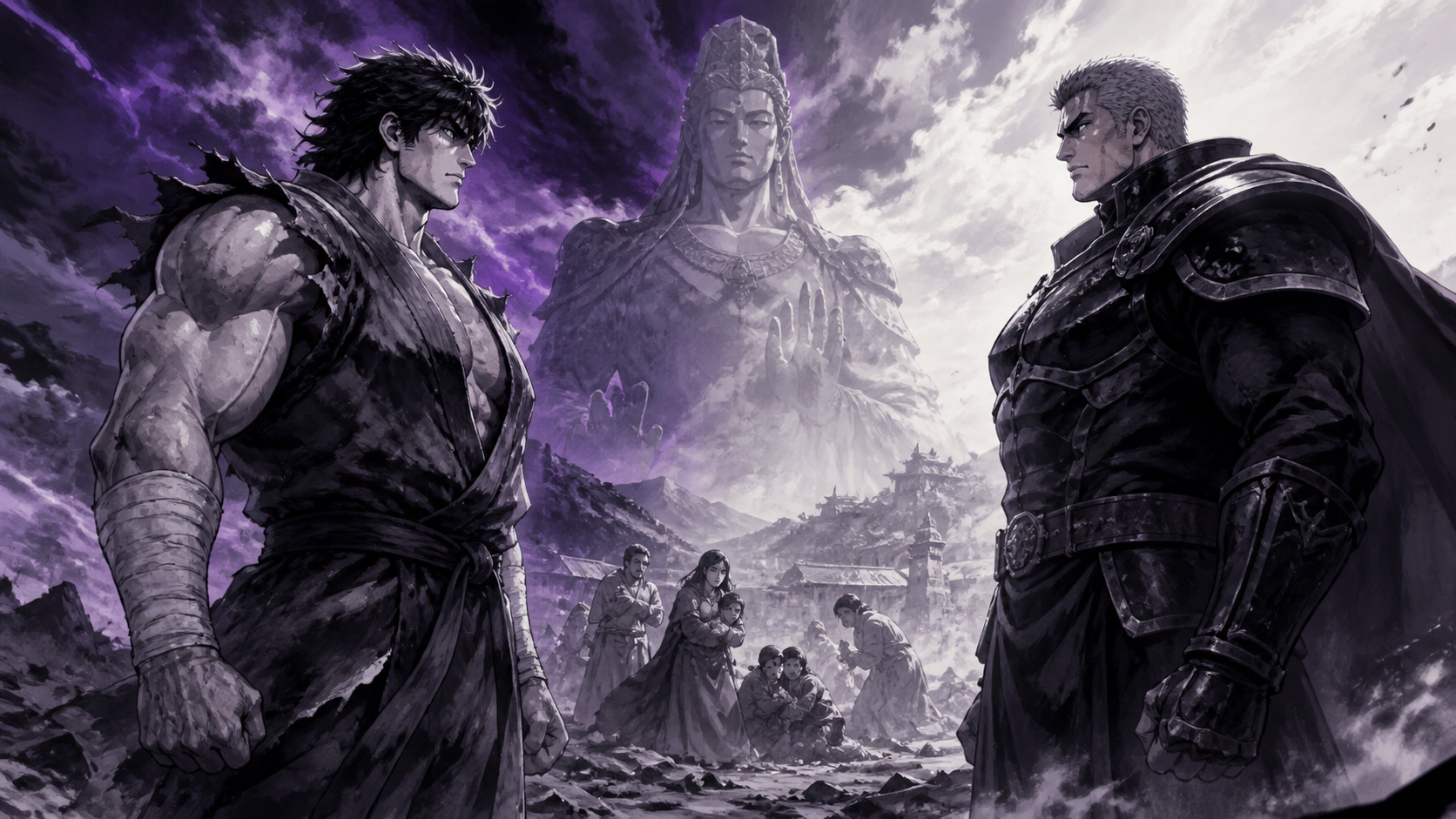
Raoh—Chapter of Fierce Fight Review: The King Who Finally Met His Fear
Raoh spent a lifetime making fear somebody else’s problem. Raoh—Chapter of Fierce Fight forces the conqueror to discover fear inside himself, then asks whether facing it makes him wise, tragic, redeemed, or simply more honest at the end of an empire.
Spoilers: This Review discusses the complete movie, including Yuria’s identity, Fudoh, Musō Tensei, Raoh’s final duel, and his death.
The 2007 theatrical chapter returns to the saga’s most famous final duel and moves deeper inside Raoh
The official Hokuto no Ken archive identifies the film as the third work in the five-part Legends of the True Savior cycle, released theatrically in Japan in April 2007. It revisits Kenshiro and Raoh’s final struggle with newly added scenes and an explicit interest in feelings the original narrative left less fully spoken.
The film adds Giraku as Raoh’s chief strategist, returns Reina from Chapter of Death in Love, and gives Balga and Red Orca important functions around the final campaign. Those additions widen the command structure around Raoh. The emperor does not move through fate alone; advisers, loyalists, soldiers, rivals, and captives turn his private crisis into public consequence.
A powerful finale finds moral truth in Raoh’s fear and remains too enchanted by the king to count every cost
The movie understands that invincibility is emotionally fragile. Once Kenshiro’s sorrow opens Musō Tensei, Raoh discovers a strength his philosophy cannot produce through conquest. His terror is not humiliation added to diminish him. It is reality entering a self-image that has treated every limit as an enemy.
The result is moving because Raoh finally faces himself without easy escape. It is incomplete because self-knowledge arrives after armies, ruined communities, coerced loyalty, and Yuria’s captivity. A magnificent death can reveal character. It cannot retroactively ask the people beneath an empire to reinterpret domination as the necessary road to one man’s enlightenment.
The Last General cannot remain a prize exchanged between men whose emotions receive more room than her will
Yuria’s identity as the Last General turns her into the political and emotional center of competing futures. Kenshiro loves her, Raoh desires her, the Five Chariot Stars protect her, and armies reorganize around access to her. This importance can paradoxically erase agency when the story treats her body as the place where male destiny is decided.
Her compassion and illness matter, but gentleness should not be confused with passivity. The crucial questions are what she knows, what she chooses, whom she protects, and how she interprets men willing to reshape the wasteland around possessing or saving her. A person can be symbolically central and narratively confined at the same time.
Kenshiro reaches the ultimate technique by carrying the dead rather than pretending he surpassed dependence
Musō Tensei converts sorrow into a form of movement Raoh cannot initially touch. Its power is not simply another level on a martial ladder. Kenshiro’s body becomes available to relationships with the dead, including people who opposed, taught, protected, and loved him. Mastery arrives through acknowledged dependence.
Raoh has also known grief, but his political identity forces grief into hierarchy. The dead become proof of strength, fuel for ambition, or private wounds guarded from the army. Kenshiro allows sorrow to dissolve the rigid self long enough for others to move through him. The ultimate technique therefore makes relationality, not isolation, the franchise’s highest strength.
The king’s terror matters because it exposes the lie that fear belonged only to people below his horse
Raoh has organized his rule by producing fear while declaring himself beyond it. Kenshiro’s transformed presence breaks that division. The conqueror sees a force he cannot dominate through familiar certainty, and his body responds before imperial pride can rewrite the evidence. Fear becomes shared human information.
His shame reveals how deeply masculinity has confused courage with emotional exemption. Courage does not require never feeling fear. It requires acting without forcing other people to absorb fear so the leader can remain pure. Raoh’s late reckoning begins when he recognizes terror as something inside him rather than a weakness displayed by inferiors.
The gentle giant defeats Raoh’s philosophy before their bodies finish the argument
Fudoh frightens Raoh because his enormous strength serves children, home, and protection rather than supremacy. The contradiction attacks the emperor’s worldview at its foundation. If a powerful man can become safe enough for vulnerable people to approach, then terror is not the only language through which strength creates order.
Raoh’s confrontation with Fudoh is therefore less a side battle than a philosophical trial. He wants to destroy the memory of fear by defeating its object. Fudoh’s courage shows why that cannot work. Fear returns whenever the self encounters a truth it cannot own, and killing the witness does not make the truth false.
Their trust measures strength more honestly than an army’s obedience
Children gather around Fudoh because he makes space where vulnerability does not invite exploitation. Their proximity is freely chosen in a world where children are frequently kidnapped, enslaved, orphaned, or used to motivate heroic men. Trust becomes an achievement more demanding than submission.
Raoh commands multitudes who may obey through belief, fear, necessity, or calculation. Fudoh’s household exposes the difference between being followed and being safe. A king can compel bodies to move in formation. He cannot command the unguarded ease with which a child approaches an adult known to protect rather than possess.
The strategist shows how an empire teaches advisers to protect the ruler’s image instead of the ruler’s judgment
Giraku operates near the gap between Raoh’s private uncertainty and the public certainty Ken-oh must project. Such proximity creates influence without requiring the strategist to bear the final symbolic burden. Advice can manipulate the ruler precisely because maintaining the sovereign image already narrows what information may be spoken directly.
His role prevents the campaign from looking like pure destiny. Decisions pass through a political apparatus where incentives matter. A counselor may amplify aggression to secure position, conceal risk to avoid blame, or tell the king what imperial masculinity permits him to hear. Raoh remains responsible because choosing an institution means choosing the predictable distortions it produces.
Her loyalty now carries evidence from the earlier chapter and should be judged by what it changes
Reina has already witnessed Raoh’s vulnerability around Souther and sought Toki when command proved insufficient. Returning her creates continuity across the Legends project and gives the audience a person capable of reading the man beneath the final campaign. That emotional access remains dramatically valuable.
The harder question is whether knowledge changes her relationship to his rule. Devotion that merely recognizes suffering can become maintenance for power. Devotion that names limits, protects others, or refuses destructive commands becomes moral agency. Reina should not exist to make the king’s ending more beautiful at the cost of her own judgment.
Loyal men complicate the fantasy that Raoh’s world consisted only of enemies and faceless soldiers
Balga and Red Orca connect the final conflict to people whose histories extend beyond the central duel. Their presence gives allegiance texture and shows that Raoh’s command attracts capable men with memories, families, and ideas about order. An empire built by real loyalty is more believable than one built by anonymous villainy.
Real loyalty also makes consequence harder. Devoted followers can suffer exploitation, enforce harm, and mistake proximity to greatness for participation in justice. Naming them should widen the moral field rather than certify Raoh’s worth. The question remains what their service allows other people to keep or forces other people to surrender.
Two bodies settle a succession conflict while the moral difference lies in what each man believes victory authorizes
Kenshiro and Raoh’s last battle carries brothers, teachers, rivals, Yuria, and the accumulated dead into every exchange. The duel works because it is not a technical demonstration alone. Each man tests a way of relating to strength: sovereignty through supremacy against mastery opened by sorrow and connection.
Kenshiro’s victory does not authorize him to inherit Raoh’s empire. This refusal is the most important political result. The stronger man does not become the next king simply because combat proved superiority. Power remains available for protection without becoming a permanent claim on the lives that witnessed it.
The raised fist is iconic because it declares completion, but completion belongs to his self-understanding, not his victims
Raoh’s final gesture gives his life a visual sentence no narrator could improve. He meets defeat, recognizes Kenshiro, refuses diminishment, and directs the last of his power toward the sky. The image makes death look like chosen conclusion rather than collapse, which explains its extraordinary hold on franchise memory.
Iconic dignity must not become moral bookkeeping. Raoh can die honestly without having repaired what conquest destroyed. His final clarity belongs to him, while survivors retain their own interpretations. Respecting a formidable death does not require surrendering judgment about the life that produced it.
Raoh becomes most human when he no longer controls how other people see him
For much of the saga, Raoh manages perception through spectacle, victory, punishment, and disciplined speech. Defeat removes that infrastructure. Kenshiro has seen his fear, Fudoh has contradicted his philosophy, and Yuria cannot be converted into proof that desire guarantees possession. The king must exist without controlling the frame.
His acceptance is meaningful because masculinity finally separates dignity from dominance. He does not need to pretend the loss never happened or destroy every witness. Yet the lesson arrives at life’s edge. The tragedy is not simply that Raoh dies; it is that a more truthful relationship to vulnerability becomes possible only when he can no longer govern through it.
The official archive anchors release, additions, and story structure; CVM Sekai owns the criticism
The Hokuto no Ken official movie and OVA archive identifies the April 2007 theatrical release, the final Kenshiro–Raoh struggle, newly explored Raoh material, Giraku, Reina, Balga, Red Orca, Yuria’s identity, Musō Tensei, and the Fudoh confrontation.
All analysis of empire, fear, masculinity, grief, captivity, loyalty, spectatorship, political authority, and accountability is independent CVM Sekai editorial criticism. Official facts establish the work’s production and plot. They do not determine the verdict.
Yuria’s political title makes her important to every faction and risks making her unavailable to herself
The Last General functions as hope, lineage, strategy, and emotional promise. Those meanings gather around Yuria before the film permits her ordinary personhood equal space. Men hurry toward her, armies mobilize because of her, and the future appears to depend on who reaches her first. Symbolic value becomes another form of enclosure.
A title meant to protect the world can still consume its bearer. Yuria’s illness intensifies that danger because other people may treat limited time as permission to decide quickly on her behalf. Compassion should include the right to define the terms of one’s remaining life, not merely the privilege of being cherished by powerful men.
The movie becomes ethically stronger whenever Yuria reads Raoh instead of merely being read by him. Her insight into his fear and sorrow matters because it denies the conqueror exclusive authorship of the encounter. Even in captivity, interpretation can preserve a self the captor has not successfully possessed.
Raoh’s love fails its own claim the moment protection requires taking Yuria’s choice
Raoh may believe he can preserve Yuria, honor her significance, or secure a future that chaos would otherwise destroy. None of those beliefs turns capture into consent. Love does not become more legitimate because the person imposing it feels intensely or because a rival relationship threatens his emotional certainty.
The film’s romance-adjacent framing can tempt viewers to evaluate which man loves Yuria most. The prior question is whether love recognizes her freedom. Kenshiro’s bond has meaning only insofar as Yuria chooses it; Raoh’s bond becomes domination when his power makes refusal materially irrelevant.
This does not make Raoh’s feeling fake. Genuine emotion can motivate coercion, especially when a person confuses desire with destiny. The tragedy lies precisely there. He has enough love to recognize Yuria’s value and not enough humility to let value exist beyond his ownership.
Devotion to Yuria can protect her and still reproduce the habit of speaking around her
The Five Chariot Stars organize defense around the Last General, giving loyalty a collective and martial form. Their sacrifice demonstrates that Yuria inspires more than romantic competition. She represents a humane order threatened by Raoh’s consolidation of the wasteland.
Protection nevertheless carries paternal risk. Guardians may treat danger as proof that the protected person should receive less information, fewer choices, and no authority over acceptable sacrifice. The institution can defend Yuria’s body while converting her will into a mission brief interpreted by men.
A better reading values the Stars while asking whether their loyalty creates agency or replaces it. The same question applies throughout the franchise. A person surrounded by devoted protectors may remain profoundly alone if everyone assumes devotion eliminates the need to listen.
Raoh fears the gaze because it contains judgment without the submission he knows how to command
Kenshiro’s sorrowful eyes unsettle Raoh more than ordinary aggression. Hatred would confirm the emperor’s world: two forces clash, one dominates, and the survivor becomes truth. Sorrow refuses that arrangement. It sees the conqueror’s strength and the suffering strength failed to prevent.
The gaze offers recognition without admiration. Raoh cannot dismiss it as weakness because Musō Tensei gives sorrow physical authority. He also cannot absorb it into his hierarchy because the dead moving through Kenshiro answer relationships beyond imperial control.
Fear therefore begins as a crisis of interpretation. Raoh sees himself reflected not as the strongest man awaiting one final measurement, but as a grieving human whose methods have narrowed his world. The body reacts because the ideology has no prepared defense against being understood without being obeyed.
Domestic safety becomes revolutionary in a world where rulers turn every relationship into rank
Fudoh’s home demonstrates strength through atmosphere. Children can rest, approach, complain, and trust that his size will not become a threat. This ordinariness constitutes a political achievement. Safety is not announced through banners; it is felt in bodies no longer preparing for harm.
Raoh’s army also promises safety, but its safety depends on location within hierarchy. Protection flows downward at the ruler’s discretion and can reverse when obedience fails. Fudoh’s care does not require children to become soldiers in his image or monuments to his goodness.
The confrontation therefore compares two infrastructures of masculinity. One organizes thousands around the fear of a singular body. The other organizes a small household around confidence that a powerful body will remain controlled. Scale favors Raoh visually; ethical durability favors Fudoh.
Raoh’s order to kill Fudoh exposes how quickly fear converts leadership into a demand that subordinates protect the leader from truth
The planned execution makes soldiers responsible for preserving Raoh’s self-image if he cannot complete the victory. This is institutional cowardice disguised as discipline. The ruler stages a test of courage while arranging for other men to erase evidence of his failure.
Subordinates face a corrupt bargain. Obedience proves loyalty but makes them participants in killing a man whose moral victory is already visible. Disobedience may invite punishment and fracture the army’s organizing myth. Systems built around one leader’s invulnerability force everyone below him to manage emotions he refuses to name.
Raoh’s later response cannot remove the fact that the order existed. Character growth deserves recognition, but accountability includes the mechanisms activated before growth arrived. A king’s private breakthrough does not automatically resurrect the person his institution was prepared to sacrifice.
Manipulation thrives when advisers learn that telling the truth is less valuable than predicting the sovereign’s shame
Giraku reads Raoh’s vulnerability as an opportunity within the command structure. He does not need to overpower the king. He needs to frame information so that imperial pride selects the desired action. This is how concentrated authority becomes strangely governable by people who understand its emotional triggers.
The adviser can later be blamed as corruption surrounding an otherwise noble ruler, but that explanation is too convenient. Raoh created or accepted a system where strategy travels through deference, image management, and fear. Giraku exploits conditions the emperor’s own theory of rule makes predictable.
Political responsibility therefore cannot end with exposing the manipulator. A wise leader builds channels where unwelcome truth can survive and where no adviser benefits from escalating violence to protect masculine theater. Raoh’s model cannot do that consistently because uncertainty itself threatens legitimacy.
Love becomes complicity when recognizing the wound repeatedly substitutes for confronting the weapon
Reina understands Raoh with unusual depth. She sees fear, loneliness, remembered home, and the person submerged beneath Ken-oh. This knowledge gives her scenes emotional gravity and prevents the final campaign from becoming abstract strategy.
Understanding can also become a loop. The more harm Raoh produces, the more tenderness Reina may feel toward the suffering that supposedly produced it. Attention travels inward toward the powerful man while people outside the circle receive the effects. Empathy then protects the person best equipped to change conditions.
Her strongest possible role is not abandoning compassion but attaching it to a demand. Love must be able to say that captivity remains captivity, that soldiers are not emotional armor, and that fear cannot be cured through Fudoh’s death. Otherwise devotion keeps the king human without helping his subjects remain free.
Musō Tensei rejects the fantasy that strength means becoming untouched by everyone one has lost
Kenshiro’s ultimate state carries relationships rather than sealing them away. The dead do not disappear into motivational abstraction; their techniques, grief, challenges, and love remain active within his movement. He becomes harder to strike because the isolated self no longer defines the whole body.
This is a radical answer to the succession system that produced the brothers. Martial inheritance often imagines one winner standing above discarded rivals. Musō Tensei turns those relationships into shared presence. The successor becomes strongest by refusing the emotional extinction competition supposedly required.
Raoh can imitate technique only after entering sorrow differently. The lesson does not deny his losses. It denies his attempt to make loss validate supremacy. Grief produces transcendence when it opens the self toward others, not when it becomes a private certificate of exceptional pain.
Kenshiro and Raoh know one another most completely through force because their world denied them safer languages
The final duel contains recognition no ordinary conversation could hold. Each man reads the other’s history through stance, hesitation, contact, and the techniques inherited from their shared formation. Violence becomes intimate because their bodies carry what masculine discipline made difficult to speak.
That intimacy is emotionally truthful and politically tragic. Brothers should not need lethal combat to admit fear, respect, grief, and love. A tradition that treats tenderness as weakness compresses emotional communication until only impact feels honest enough.
The movie can honor the duel while exposing its poverty. The fight gives Raoh clarity, but clarity at the edge of death leaves no time to practice a different relation. The audience receives catharsis where the characters receive an ending.
Limited time should increase her authority over her life, not increase everyone else’s urgency to possess the remaining days
Illness often makes a character symbolically luminous while reducing practical agency. Other people decide what is safe, where she travels, what truth she can bear, and which future serves her best. Concern becomes a socially acceptable route around consent.
Yuria’s condition intensifies the emotional stakes between Kenshiro and Raoh, but she cannot be merely a deadline attached to their rivalry. Her desires matter precisely because time is scarce. Every day taken through capture carries a cost no later tenderness can return.
The story’s humane promise lies in recognizing that care listens. Protection should create conditions where Yuria can choose company, risk, movement, and meaning. A powerful man who loves her must accept that her best life may not center his need to be loved back.
A sovereign’s final transcendence leaves thousands of followers with ordinary decisions he trained them not to make
Raoh’s death resolves the contest of ultimate strength and destabilizes an organization built around his embodied certainty. Soldiers, officers, suppliers, families, and occupied communities remain. Some will grieve sincerely, some will fear retaliation, and some will discover that obedience no longer provides identity.
An empire centered on one irreplaceable man avoids succession by imagining the man will not lose. When he does, followers inherit no shared practice of legitimate disagreement. The raised fist may complete Raoh’s self-story while leaving everyone below it inside an institutional vacuum.
Kenshiro’s refusal to seize command is ethically necessary and administratively demanding. Freedom now requires former subjects and soldiers to negotiate futures without the champion deciding. The movie prefers symbolic closure, but its world will be shaped by that unshown work.
Mourning Raoh does not betray his victims if mourning refuses to erase them
Raoh’s death is designed to move viewers, and it succeeds. He is a brother, rival, lover, leader, frightened child, disciplined adult, and destructive sovereign. Grief acknowledges the loss of a human being whose possibilities exceeded the life he chose.
The ethical problem begins when mourning demands absolution. People harmed by his army do not owe the audience a softened verdict because his ending was magnificent. Their anger, relief, indifference, or complicated sorrow belong beside Reina’s grief and Kenshiro’s recognition.
Mature fandom can hold both. We may mourn the man who finally saw his fear and condemn the system that made other people live inside it. Complexity does not mean judgment disappears. It means judgment includes everything rather than selecting the most beautiful final image.
Centering Raoh can turn every supporting life into evidence that the king deserved a grand ending
Fudoh demonstrates the moral strength Raoh lacks, Yuria reveals the limits of possession, Reina discloses tenderness, Giraku exposes command vulnerability, and Kenshiro supplies the opponent worthy of recognition. Each character can begin to orbit Raoh’s completion.
This gravity is understandable in a film carrying his name. It becomes distorting if their independent lives matter only insofar as they improve his tragedy. Fudoh protects actual children, Yuria owns finite time, Reina possesses judgment, and Kenshiro carries relationships no imperial story can absorb.
The best viewing practice resists the throne even when the camera loves it. Raoh’s ending becomes more meaningful, not less, when the surrounding people remain fully real. A king should have to share narrative humanity with everybody his legend used.
Kenshiro wins because his strength can survive relation; Raoh loses because supremacy cannot survive equality
Raoh understands conflict vertically. Another strong person must be surpassed, recruited, contained, or destroyed. Even love becomes difficult because genuine love recognizes a center of value outside the self. Yuria cannot be fully loved and treated as a possession at the same time.
Kenshiro’s relational strength lets rivals, teachers, and the dead remain distinct while influencing him. He does not become smaller because others matter. Musō Tensei literalizes a self spacious enough to carry them without ownership.
The final duel settles this philosophical difference through bodies. Raoh’s late recognition grants dignity because he finally accepts a truth he cannot dominate. Kenshiro’s victory grants responsibility because the technique exists to protect a world he refuses to rule.
Yuria’s diagnosis makes every man hurry and makes listening to her more important than ever
Limited time changes the moral meaning of delay, travel, danger, and separation. Kenshiro wants reunion, protectors want safety, and Raoh wants possession before mortality closes the possibility. Their urgency is emotionally understandable. It becomes coercive when the scarcity of Yuria’s time is treated as scarcity of everyone else’s opportunity to claim it.
Illness often invites benevolent control. People hide information, decide acceptable risk, and frame obedience as rest. The sick person becomes a container for other people’s fear. Yuria’s quiet manner makes this especially dangerous because silence can be interpreted as agreement by anyone already convinced that protection justifies command.
A humane response would increase her authority. If time is finite, the right to choose how it is spent becomes more urgent, not less. Love should help Yuria speak, travel, refuse, rest, or accept danger according to values she names. No martial title can replace that ordinary sovereignty.
Defensive strategy reveals how protecting a symbol can turn the protected person into infrastructure
The Southern resistance organizes around a fortress, routes, guards, and secrecy intended to keep the Last General beyond Raoh’s reach. These precautions respond to a real threat and therefore cannot be dismissed as needless confinement. Safety requires planning in a world where cavalry can turn desire into military fact.
Yet defensive structures can reproduce the logic they oppose. Yuria becomes the strategic center whose movement is restricted, information filtered, and identity managed for collective morale. The resistance protects freedom through a person who may experience very little of it.
This contradiction deserves more than blame. Oppressed communities often face choices where every option carries coercive residue. The ethical standard is whether emergency restrictions remain accountable to the person most affected, whether she can question them, and whether protectors remember that survival exists for life rather than life for the strategy.
The memory of a wild man becoming a caregiver destroys the claim that nature makes domination inevitable
Fudoh once embodied terrifying force without moral direction. His transformation matters because it refuses biological destiny. Size, appetite, rage, and capacity for violence do not require a man to become a ruler through fear. Relationship can reorganize strength without making strength disappear.
Raoh encounters Fudoh as living evidence against the political story he tells about the wasteland. If a feared man can become safe through care, then post-apocalyptic cruelty is not simply realism. It is one choice among alternatives, and the emperor’s insistence on domination begins to look less like necessity than preference.
The children around Fudoh do not weaken him. Their trust gives his strength purpose and discipline. Raoh’s fear recognizes this integration before his ideology can name it. Fudoh possesses a wholeness the king cannot achieve while dividing tenderness from authority.
A ruler who asks soldiers to shoot his fear has transformed an army into emotional waste disposal
Raoh’s order surrounding the Fudoh confrontation makes the institution responsible for deleting any result imperial pride cannot absorb. The soldiers must act not because Fudoh remains a public danger, but because Raoh cannot allow his own failure to remain visible. Violence protects the symbol rather than the population.
This is the logical endpoint of charisma-based rule. When legitimacy resides in one body’s invincibility, every subordinate becomes maintenance staff for that body’s image. Truth becomes treason if it weakens awe. Soldiers learn that loyalty may require killing the person who exposed reality rather than helping the leader revise himself.
Raoh’s eventual recognition carries emotional weight, yet recognition comes after the mechanism has moved. Accountability must include the order, the people pressured to obey, and the life placed beneath imperial shame. A breakthrough inside the king does not automatically repair what his institution did outside him.
The army’s anonymity hides separate moral crises created by one man’s need to appear beyond fear
A firing line looks unified, but each soldier occupies a distinct relationship to the command. One may believe Fudoh threatens order, another may fear punishment, another may worship Raoh, and another may recognize murder while lacking a safe path to refusal. Uniforms compress these differences into visual obedience.
The film spends little time inside those decisions because the king’s crisis dominates. A political reading restores them. Empires distribute responsibility downward while concentrating glory upward. The ruler receives the tragic close-up; subordinates receive the burden of making his contradiction material.
Judgment should remain graduated rather than sentimental. Fear does not make every action innocent, and rank does not make every refusal equally possible. The important point is that Raoh’s system predictably manufactures compromised people, then uses their compromised obedience as evidence that his rule commands loyalty.
The story should mourn the caregiver without turning his murder into a useful stage in Raoh’s growth
Fudoh’s confrontation changes Raoh by exposing fear and a form of strength grounded in care. That dramatic function risks instrumentalizing the person who produced it. Fudoh has children, relationships, history, and a future not reducible to becoming the final teacher in an emperor’s emotional education.
When a good person’s death mainly improves the man connected to the violence, narrative attention begins rewarding the wrong center. Raoh’s insight may be genuine, but the children’s loss is not a tuition payment owed toward his enlightenment. Their grief remains a separate moral fact.
The film’s most responsible moments preserve that separation. Fudoh can inspire the king, strengthen Kenshiro’s understanding, and remain irreplaceable to people whose daily safety depended on him. No iconic ending elsewhere balances that account.
Compassion becomes radical when it perceives the frightened man without consenting to the conqueror’s claim
Yuria’s ability to recognize pain beneath Raoh’s command is often presented as evidence of her near-sacred gentleness. The insight should not be mistaken for romantic availability. Understanding another person’s wound creates no obligation to become the medicine he demands.
Her compassion can instead function as judgment. She sees the fear he tries to destroy through Fudoh, the loneliness discipline cannot admit, and the attachment conquest cannot secure. To see these things accurately is to know why possession will fail even if the army succeeds.
This gives Yuria a form of power different from combat, though the narrative must avoid sanctifying women into endless emotional labor. She should not be required to absorb every violent man’s pain because she can name it. Compassion needs boundaries or it becomes another resource men seize.
His relationship with Yuria remains morally distinct only when reunion does not become entitlement
Kenshiro’s long search and grief make reunion emotionally overwhelming. The story positions their bond as authentic against Raoh’s coercive desire. That contrast holds because Kenshiro does not treat superior martial strength as proof that Yuria belongs to him.
Still, canonical romance can become possessive through narrative assumption even when the hero behaves gently. Viewers may stop asking what Yuria chooses because destiny appears to have answered already. The film must preserve her active consent rather than using mutual love as a shortcut around personhood.
Kenshiro’s best quality is his refusal to govern the people he saves. The same principle should shape intimacy. Love is not conquest rewarded to the more ethical fighter. It is a relationship whose legitimacy continues through reciprocal choice after the duel ends.
The dead remain companions rather than trophies inside Kenshiro’s ultimate movement
Every rivalry in Kenshiro’s life could have become evidence that he alone deserved succession. Musō Tensei refuses that lonely triumph. Rei, Toki, Shu, and others remain active presences whose losses changed the way he inhabits strength. The self becomes porous without becoming incoherent.
Raoh’s political model collects people too, but as subjects, opponents, and symbols ordered around his central will. Kenshiro carries difference without converting it into rank. This relational architecture explains why sorrow produces a technique domination cannot initially reach.
The visual abstraction of the move can appear mystical, yet its emotional mechanism is concrete. Grief stops being a private possession. The dead influence present conduct, and survival becomes accountable to lives that made it possible. Transcendence is memory refusing to become monument.
Accessing the same technique does not erase the different roads the brothers took toward it
Raoh eventually reaches Musō Tensei through acknowledged sorrow, proving he was never incapable of relational depth. The achievement gives his final duel equality at the level of spiritual technique and prevents Kenshiro’s victory from feeling mechanically predetermined.
Equality of technique is not equality of history. Kenshiro’s sorrow repeatedly opens him toward vulnerable people. Raoh’s sorrow has often been contained within a project of supremacy. A late breakthrough matters precisely because it contradicts established practice; it does not rewrite that practice as secretly compassionate.
The moment should therefore be read as possibility arriving under extreme pressure. Raoh could relate differently because he finally does. Tragedy arises from timing and choice: the capacity appears after the empire has already made countless strangers carry the cost of its absence.
Two women near Raoh expose different costs of being asked to understand a powerful man
Reina knows Raoh through shared childhood, military service, and sustained loyalty. Yuria encounters him as captor, rival beloved, and wounded sovereign. Both can perceive vulnerability that the public image hides, but their positions are not interchangeable.
Reina’s proximity may create influence while entangling her identity with his project. Yuria’s captivity makes every compassionate response vulnerable to misreading as consent. The film should not combine their attention into a chorus declaring Raoh worthy. Each woman owns a distinct judgment shaped by unequal exposure to his power.
Their presence also reveals a recurring gendered demand: women translate male pain so audiences can locate humanity beneath violence. A deeper adaptation lets them ask what understanding costs, when empathy becomes dangerous, and whether the man being understood will extend equal imagination toward them.
A loyal commander’s later life shows that service beneath a legend can continue as burden after the legend ends
Balga’s importance reaches beyond battlefield utility because he connects Raoh’s rule to human continuity. An officer survives campaigns, carries institutional knowledge, and must decide what loyalty means when the sovereign is gone. The empire’s emotional aftermath lives in such figures.
Service may produce pride, grief, guilt, dependency, and practical skill at once. A follower can love the leader and recognize harm only after distance becomes possible. The story’s moral world grows richer when loyalty is treated as a relationship requiring interpretation rather than a permanent certificate of the leader’s goodness.
Balga also challenges the idea that the final duel closes Raoh’s political account. People formed beneath his command remain. Their choices will determine whether the old hierarchy reproduces itself through nostalgia or whether devotion can be translated into protection without renewed conquest.
Piracy, mobility, and allegiance complicate the territorial certainty of land-bound kings
Red Orca brings another form of organized power into the story. A maritime force navigates routes and loyalties that imperial cavalry cannot simply map onto territory. Mobility creates independence, but it can also support raids, bargains, and its own violent hierarchy.
His involvement reminds viewers that the wasteland contains more political arrangements than Raoh’s empire and Southern resistance. People survive through fleets, settlements, families, informal networks, and temporary alliances. The central duel matters enormously without exhausting the world.
This wider field makes Raoh’s claim to universal order less inevitable. Alternatives already exist, compromised and incomplete. The question after his death is not who inherits the single world he made. It is how multiple communities negotiate without another man declaring diversity a problem only conquest can solve.
The ending creates a perfect image of self-possession at the moment Raoh finally releases possession of the world
Raoh’s final posture refuses collapse and turns death into authorship. He acknowledges defeat without begging, directs his remaining force upward, and declares a life without regret. The image works because the man who tried to own every horizon chooses how to leave the last one.
Its beauty can obscure the irony. Self-possession becomes possible only after he can no longer possess Yuria, defeat Kenshiro, erase fear through Fudoh, or command the future. Release arrives when control has exhausted every route. The ending is liberation for Raoh and consequence for everyone else.
Iconography compresses contradiction into one unforgettable silhouette. Responsible remembrance must expand it again. The raised fist contains courage, pride, recognition, denial, love, violence, and unfinished accounts. Great images survive because they do not settle into a single moral caption.
A man may experience his life as complete while other people retain every right to name what completion cost
Raoh’s claim that he has no regrets belongs to his interior truth. It expresses coherence rather than objective acquittal. He accepts the path, the loss, and the final hierarchy established by combat. The declaration protects dignity from pity.
Victims are not required to adopt his evaluation. Regret is not the only measure of responsibility, and a wrongdoer’s emotional peace cannot close accounts held by other people. Someone may die convinced that every choice belonged to destiny while survivors continue rebuilding what those choices destroyed.
The film’s maturity depends on letting both truths stand. Raoh’s ending can be magnificent without being sufficient. Kenshiro can honor his brother without endorsing his empire. The audience can grieve without surrendering judgment. No-regret masculinity becomes bearable only when it stops demanding no-memory politics.
Raoh’s refusal to regret protects coherence and may also protect him from naming people harmed along the way
Regret can become cheap when a story uses one tear to settle years of domination. Raoh avoids that sentimental shortcut. He does not disown the ambition, discipline, attachments, or violence that formed his life. The consistency makes his death feel truthful rather than rewritten for applause.
Consistency is not the same as moral completion. Refusing regret can mean accepting consequences, or it can mean keeping the self central until the final breath. The difference appears in whether Raoh recognizes specific harm beyond the fact that his path ended in defeat.
A full reckoning would not require groveling or denying every relationship formed under his rule. It would require acknowledging that other lives possessed purposes unrelated to his ascent. The raised fist declares ownership of his story; it cannot declare ownership of their verdicts.
The victor’s refusal to become emperor is the political climax hiding beneath the martial one
The logic of conquest says the man who defeats the king should receive the kingdom. Kenshiro refuses that succession. He takes responsibility for stopping Raoh without treating the capacity to stop him as evidence that governing everyone is now his right.
This distinction preserves the moral structure of Musō Tensei. A technique built from relationships with the dead would become grotesque if used to install a new personal hierarchy. Kenshiro carries others within him and therefore cannot plausibly reduce the living to subjects beneath him.
Refusal creates uncertainty, which authoritarian stories often treat as weakness. Communities must now negotiate, distribute resources, restrain former officers, and protect themselves without one body supplying order. That difficulty is not an argument for a new king. It is the work freedom was supposed to make possible.
Everyone watching the last duel brings a different stake that the language of destiny threatens to flatten
To Kenshiro and Raoh, the battle resolves brotherhood, succession, grief, and the meaning of strength. To Yuria, it concerns two men she knows and a future constrained by illness. To soldiers, it may determine survival, employment, identity, or retaliation. To occupied communities, it may mark the end of immediate imperial threat.
Calling the duel destiny gives these unequal stakes one grand vocabulary. The word produces scale, yet it can make ordinary concerns look small beside legendary completion. A mother deciding whether roads are safe after Raoh matters as much to political reality as the exact technique that ended him.
The film’s best images let collective witness complicate rather than certify the duel. People do not simply confirm which man became strongest. Their presence reminds viewers that private rivalry has been fought across public lives.
Raoh’s enormous physical certainty finally encounters limits that cannot be disciplined away
The character’s body has always served as political architecture. Height, mass, posture, armor, and Kokuoh make supremacy visible before he speaks. Followers can believe in order because the king looks like an answer large enough to occupy the horizon.
Fear, injury, and defeat expose the body as mortal without making it small. This is crucial. Humanity does not arrive through humiliation or feminization. Raoh remains physically formidable while acknowledging experiences his ideology classified as weakness.
The final battle therefore dismantles an image without mocking the man inside it. Raoh’s dignity survives because limitation does not erase courage. The political lesson should travel outward: if the strongest body can remain worthy after fear, then no ruler needs to build authority by punishing fear in others.
The horse carries the visual myth of solitary kingship while embodying a relationship Raoh cannot reduce to command
Kokuoh enlarges Raoh’s silhouette and gives conquest motion. Together they appear less like rider and animal than a mobile monument crossing ruined land. The image suggests nature itself recognizes the king.
Yet the bond also complicates sovereignty. Trust from an animal cannot be secured through political propaganda in the same way as military obedience. Kokuoh’s presence hints that Raoh can sustain attachment requiring attention beyond human hierarchy.
That capacity again raises accountability. A man who understands partnership with a powerful living being can understand that relation differs from possession. The audience should not use the bond to prove goodness automatically. It proves Raoh knows another grammar and repeatedly chooses when not to speak it.
Resistance cannot become morally pure merely because Raoh’s empire is the clearer threat
The Southern forces organize around protection of Yuria and opposition to conquest, giving them an ethical purpose Raoh’s campaign lacks. Still, armies concentrate authority, demand sacrifice, and may conceal information from the people whose freedom they claim to defend.
A serious political reading does not flatten both sides into equivalence. One force pursues domination while another resists it. The imbalance is real. Scrutiny asks how resistance can avoid carrying emergency hierarchy into the peace it hopes to create.
Yuria’s agency provides the test. If the army fights in her name while denying her choices, it preserves a symbolic freedom at the expense of a person. Liberation becomes credible when means already contain some practice of the future being promised.
The duel becomes emotionally complete because opposition never erased kinship, even when kinship failed to prevent war
Kenshiro and Raoh know each other through shared training, succession, rivalry, loss, and radically different conclusions about power. Brotherhood makes every strike intimate. Neither man is merely defeating a stranger’s technique; each confronts a life built from some of the same materials.
Kinship does not make the conflict a private family tragedy. Raoh’s choices became armies and occupied lives. Kenshiro’s response matters because family loyalty cannot require silence toward public harm. Love for a brother may deepen grief while leaving intervention necessary.
The final recognition works because Kenshiro does not need to dehumanize Raoh to defeat him. Judgment survives relationship. This is harder and more humane than pretending violence becomes righteous only when the opponent contains nothing worth mourning.
A culture that forbids fear does not eliminate fear; it pushes fear into violence, secrecy, and subordinate bodies
Raoh’s empire treats visible fear as disqualification from leadership. The standard sounds demanding and produces catastrophic incentives. Uncertainty must be concealed, advisers must guess around shame, and soldiers must enact solutions the sovereign can claim were chosen from strength.
Fudoh exposes this mechanism because Raoh experiences terror and immediately seeks a confrontation capable of deleting it. The goal is not public safety. It is restoration of an identity. When the confrontation fails to restore certainty, the execution order asks others to complete the emotional task.
A healthier courage would name fear, gather information, accept contradiction, and act without transferring panic downward. Raoh reaches part of that understanding at the end. The film’s tragedy is institutional: the army learned the earlier lesson much longer than it witnesses the final one.
Her mourning deserves an identity beyond serving as the audience’s permission to mourn Raoh
Reina carries a lifetime of attachment unavailable to strangers and rivals. Her grief therefore has specificity: remembered childhood, service, frustration, protection, and the knowledge of a man hidden beneath office. The film can use her face to make Raoh’s death emotionally accessible.
That function risks consuming her again. If Reina exists primarily to validate the king’s tenderness and then to mourn him beautifully, her own future disappears into his ending. Grief should change the person who survives, not freeze her as a shrine.
The most meaningful continuation would let her decide what parts of loyalty remain ethical after the sovereign is gone. She could preserve memory without rebuilding hierarchy, care for former soldiers without sanctifying conquest, and judge Raoh in a language spacious enough for love and truth.
Survival should return her to life rather than keeping her as the sacred object that completed two men
Once the duel ends, Yuria still possesses illness, desire, fatigue, memory, and whatever time remains. The narrative temptation is to treat reunion with Kenshiro as complete restoration. Love matters, but it cannot return stolen days or dissolve the political uses attached to her title.
Recovery may require privacy from the symbolism everyone has placed upon her. The Last General, beloved, captive, and moral witness are roles; none exhausts the person. Ordinary choices about rest, travel, conversation, and silence become radical after so many institutions decided that her existence belonged to history.
Kenshiro’s love proves itself by allowing that ordinary life. He must protect without turning protection into another mission that defines her from outside. The savior’s gentleness matters most when the saved person no longer has to perform salvation’s meaning.
A perfect final image can make viewers stop thinking exactly where the political questions begin
Raoh’s death offers composition, gesture, language, and emotional recognition so complete that continuation can feel disrespectful. The image asks to become the last word. Fandom repeats it because repetition preserves the sensation of meeting a life larger than ordinary measure.
Politics begins after the frame. Soldiers disperse or reorganize, children grieve Fudoh, Yuria lives with illness, communities assess danger, and former subjects decide whether Raoh’s symbols remain sacred. None of this weakens the ending. It reveals what endings do not contain.
Criticism should resist confusing aesthetic closure with social repair. The sky may answer Raoh’s fist with light, but the ground remains inhabited. A ruler’s story can end perfectly while the world he ruled remains unfinished.
Raoh achieves recognition and dignity; redemption would require repair the movie cannot honestly supply
Redemption is often used loosely to describe any moment when a feared character becomes emotionally understandable. Raoh already possessed humanity. The final film reveals and concentrates it through fear, sorrow, Yuria, Fudoh, Reina, and Kenshiro. Recognition is real.
Repair is different. It would involve relinquishing domination while alive, restoring autonomy, changing command structures, acknowledging harms, and accepting responses not centered on his dignity. Death prevents that future. The film can offer tragic reconciliation between brothers without claiming the empire has been morally repaid.
This distinction protects the power of the ending. Raoh does not need a sanitized record to remain unforgettable. His magnitude includes failure. Calling every moving death redemption reduces accountability and also reduces tragedy, because tragedy depends on possibilities that arrived too late.
Restraint gives the final chapter weight when it distinguishes controlled feeling from emotional absence
The Legends-era cast approaches familiar characters with a different sonic texture from the long television run. Kenshiro’s gravity, Raoh’s command, and Reina’s intimate knowledge need to carry accumulated history within a compressed theatrical structure.
Raoh’s performance works when certainty develops tiny fractures before the body openly admits fear. A breath, pause, or change in pressure can reveal what the imperial vocabulary cannot say. Kenshiro’s quiet must feel receptive rather than vacant, because Musō Tensei depends on a self shaped by other voices.
Yuria and Reina face another burden. Their performances must preserve judgment beneath scripts that position them around Raoh’s emotional completion. Warmth should not erase boundaries, and sorrow should not erase agency. Vocal nuance becomes the place where a woman can understand a king without surrendering to his preferred meaning.
The film gains ritual force by concentrating the ending and loses social texture by moving quickly past the people beneath it
A feature can build toward Fudoh, Musō Tensei, Yuria, and the final duel with an intensity weekly television distributes across many episodes. Motifs echo tightly, visual scale remains consistent, and Raoh’s emotional crisis possesses a clear trajectory.
Compression asks recognition to fill gaps. Returning viewers bring histories of the Five Chariot Stars, Yuria, Fudoh, Kokuoh, and the brothers. New additions such as Giraku compete with canonical material for limited attention. The king’s interior naturally wins because the film names him.
The cost is civic life. Communities appear as stakes more often than agents, and aftermath becomes implication. A longer form could show how political structures respond to Raoh’s defeat. The theatrical form chooses mythic completion, and criticism must account for what myth leaves offscreen.
Raoh’s final honesty earns grief, Kenshiro’s relational strength earns victory, and neither fact erases the people outside their duel
Chapter of Fierce Fight works because it understands fear as the crack through which Raoh finally encounters equality. Fudoh proves care can organize strength, Yuria exposes possession as love’s failure, and Kenshiro turns sorrow into a technique that carries rather than rules the dead.
The film remains too attracted to imperial tragedy to fully inhabit the social world Raoh damaged. His advisers, soldiers, loyalists, and victims orbit the final self-recognition. The raised fist supplies unforgettable closure while repair stays below the frame.
That imbalance should sharpen rather than cancel admiration. Raoh becomes most compelling when humanity increases the precision of judgment. We can honor courage in defeat, mourn the brother Kenshiro loses, and insist that a king’s beautiful ending is not the same thing as justice for everyone who survived him.
The people who trusted the gentle giant inherit grief no philosophical victory can make useful
Fudoh’s children lose more than a protector in combat. They lose the adult whose controlled strength made ordinary life possible. Meals, sleep, conflict, play, and the expectation of tomorrow all rested on a relationship the imperial crisis invaded. Their grief cannot be reduced to proof that Fudoh was morally superior.
A heroic narrative may assure viewers that Kenshiro or surviving allies will protect them, but replacement is not restoration. Children know the texture of a particular voice, routine, and body made safe through familiarity. Justice begins by acknowledging irreducibility rather than claiming another strong man can fill the same shape.
Raoh’s final growth must remain answerable to that absence. If the king learns courage because Fudoh died, the story should not imply the children received an equal benefit from the lesson. Enlightenment purchased through somebody else’s bereavement creates a debt, not a balance.
Raoh’s followers must decide whether loyalty means repeating his rule or learning from the truth he reached too late
When an absolute leader dies, followers inherit contradictory memories. They remember protection, food, comradeship, discipline, fear, atrocities, and the feeling of belonging to history. No single verdict will organize them automatically. Some may cling to symbols because symbols protect identity from moral confusion.
Raoh’s final recognition could become permission for change if followers understand that fear did not disqualify him and defeat did not erase dignity. It could also become a new myth proving the king was perfect even in loss. Institutions often neutralize a leader’s late insight by turning it into ceremonial praise.
The ethical legacy would not be another army under his banner. It would be former soldiers learning to protect communities without demanding submission, accepting testimony from those they harmed, and building authority that can be questioned without violence. Admiration must change conduct or remain nostalgia.
Hokuto’s winner-takes-all inheritance creates the emotional grammar Raoh later scales into empire
The brothers learned within a tradition where one successor receives legitimacy and rivals face sealed fists, exile, or death. That structure teaches extraordinary discipline while framing plurality as danger. Raoh’s imperial politics extend the same lesson outward: one ultimate authority must order every competing strength.
Kenshiro breaks the pattern incompletely but meaningfully. He accepts technical succession without converting it into political kingship, and Musō Tensei restores excluded rivals inside the successor’s movement. The lineage becomes relational after an institution tried to make it singular.
Raoh’s defeat therefore concerns more than personal pride. A worldview trained to interpret equality as succession crisis finally encounters strength that does not need exclusive ownership. Kenshiro wins and leaves difference alive. That refusal is the future-facing act beneath the famous fist.
She does not owe either man a complete explanation of her heart simply because their lives revolve around it
Stories often make a compassionate woman transparent. Her motives must remain legible so male rivals can receive closure, and her suffering must illuminate their growth. Yuria’s quiet then becomes an invitation for everybody else to interpret rather than a boundary deserving respect.
Personhood includes the right not to translate every feeling for people with power. Illness, captivity, and symbolic office already expose her life to scrutiny. She may hold contradictory love, fear, anger, tenderness, and exhaustion without resolving them into a lesson for Raoh or Kenshiro.
Protecting that opacity does not make criticism impossible. It changes the burden. Viewers should judge coercive actions through observable conduct instead of inventing Yuria’s hidden consent. A captor cannot claim that deep understanding made refusal unnecessary. Silence remains silence, not imperial authorization.
Their sacrifices should remain relationships around Yuria, not collectible proofs of Kenshiro’s final power
The fallen defenders help form the emotional world through which Musō Tensei becomes intelligible. Their distinct commitments to Yuria and resistance give sorrow political direction. They did not die simply so Kenshiro could level up; they acted within struggles already carrying their own purposes.
When the dead move through a hero, remembrance risks appropriation. The survivor may become the sole visible owner of many lives. Kenshiro avoids some of this because his technique dissolves individual hardness rather than displaying trophies, but the audience must still recall names, choices, and communities beyond his body.
Memory becomes ethical when it creates obligations the dead would recognize. Protect Yuria’s agency, oppose domination, care for children, and refuse to rebuild the hierarchy they resisted. Spectral presence means little if the living repeat the same political structure with a kinder face.
Removing the manipulative adviser cannot purify a command system designed to reward manipulation
Stories often preserve the grandeur of a ruler by locating ugly decisions in a scheming subordinate. The adviser whispers, distorts, or acts beyond instruction, allowing the sovereign’s essential nobility to survive. Giraku’s role invites this familiar cleanup.
Raoh remains responsible for the environment in which advice travels. He values control, punishes weakness, and makes certainty integral to legitimacy. Those conditions create a market for people who can convert shame into strategy while insulating the king from ordinary accountability.
The lesson extends beyond identifying a bad counselor. A healthier institution distributes authority, protects dissent, records orders, and makes consequences visible to people beyond the throne. Raoh’s empire cannot perform that reform because the leader’s image is its constitution.
Loving the brother does not require forgiving the emperor on behalf of people Kenshiro cannot represent
Kenshiro’s final recognition is intimate and deserved. He understands Raoh’s discipline, fear, sorrow, ambition, and the extraordinary path that brought them together. Grief honors a relationship that conflict never erased completely.
He cannot grant universal absolution because he does not own everybody else’s injury. Communities conquered by Raoh, soldiers coerced by commanders, and Fudoh’s children possess separate moral claims. The hero’s tenderness should not silence them simply because the camera remains close to the brothers.
This limit makes Kenshiro’s compassion credible. He can mourn without issuing a political pardon. Mature love does not demand that every witness adopt the lover’s verdict. It preserves the dead person’s humanity and the living person’s right to judgment.
Fear begins as Raoh’s humiliation and becomes the route toward his most dignified truth
The film refuses to leave fear coded as weakness. Raoh’s initial response is shame, aggression, and a desire to eliminate the witness. Fudoh’s courage reveals that fear can coexist with action, care, and moral clarity. Kenshiro’s sorrowful presence makes fear a response to truth rather than an insult.
By the final duel, Raoh no longer needs to pretend the body never trembled. Acceptance creates a dignity conquest could not supply. He faces equality knowing the outcome may destroy him, which is closer to courage than the earlier certainty built from overwhelming advantage.
The transformation remains personal rather than institutional. His soldiers learned for years that fear invites domination. The movie’s emotional victory would become political only if survivors reject that lesson in how they treat weakness, uncertainty, and dissent after him.
Love exposes every ruler because affection reveals whether another person can remain an end rather than become a possession
Raoh’s feelings for Yuria, Reina’s feelings for Raoh, Kenshiro’s bond with Yuria, and Fudoh’s care for children create different political forms. Emotion alone does not distinguish them. The distinction lies in whether love expands the other person’s freedom or recruits that person into one’s own completion.
Fudoh’s love creates shelter and does not require children to prove his greatness. Kenshiro’s love seeks reunion but must remain accountable to Yuria’s choice. Reina’s loyalty contains agency only where it can judge. Raoh’s love becomes tragic because possession repeatedly outranks reciprocity.
The film’s moral intelligence rests here. A powerful man may feel sincerely and still fail love through structure. The depth of the emotion makes coercion more painful, not more acceptable, because it proves freedom was visible and denied anyway.
Death clarifies character while threatening to end accountability exactly when change becomes imaginable
Fudoh dies after demonstrating a humane strength, and Raoh dies after recognizing fear, sorrow, and Kenshiro’s superiority. Both endings give life a concentrated meaning. The contrast is severe: one man’s death results from protecting others, while the other’s arrives at the end of a project that made others carry his ambition.
Death prevents hypocrisy, regression, and the difficult work of repair. A character can reach perfect clarity because no ordinary tomorrow will test it. This is why magnificent final scenes should be interpreted carefully. They prove what a person understood at the edge, not what he would have practiced afterward.
The living inherit the test. Kenshiro, Yuria, Reina, soldiers, and communities must translate revelation into arrangements. If nothing changes below the symbolic level, death produced catharsis without justice.
The film photographs kingship beautifully and asks criticism to remember who stands outside the composition
Raoh’s scale, Kokuoh’s movement, military formations, fortresses, and the final skyward gesture make authority sensually persuasive. The movie does not pretend domination lacks beauty. Its imagery explains why people might attach identity to a man who seems capable of forcing chaos into shape.
Fudoh’s beauty works differently. His size becomes a shelter, and children alter the meaning of the frame around him. Kenshiro’s most powerful visual state contains absence and memory rather than accumulation. The film offers competing aesthetics of strength even when Raoh receives the grandest finish.
Viewers complete the visual argument by noticing edges: soldiers awaiting orders, children behind Fudoh, Yuria within guarded space, and communities beyond the duel. A frame centered on the king should provoke curiosity about everyone it pushes outward.
Ending Raoh opens a field of choices the movie’s mythic closure cannot responsibly pretend are already solved
Former territories need food, routes, dispute resolution, and protection from commanders who may become local warlords. Raoh’s logistical systems may contain useful capacities built through coercion. Communities must decide what to dismantle, repurpose, or place under shared control.
The Southern resistance faces its own transition. Emergency command cannot become permanent simply because it opposed the worse empire. Yuria’s symbolic authority, if retained, should not prevent public participation or hard questions about sacrifice made in her name.
Kenshiro’s wandering removes a possible new dictator and also removes the easiest coordinating force. That ambiguity is the price of freedom. The future will look less dramatic than the duel and require more people to matter at once.
The movie earns high marks for myth, performance, and emotional architecture while leaving civic life underwritten
The final Raoh chapter knows its iconography and builds toward it with disciplined thematic echoes. Fear begins as a crack, Fudoh gives the crack moral form, Yuria gives it intimacy, and Musō Tensei makes sorrow physically decisive. The conclusion feels earned rather than merely inevitable.
Character work succeeds most clearly around Raoh and Kenshiro. Reina and Yuria contribute crucial perception, though the film still uses women to translate male interiority more often than it gives them independent aftermath. Fudoh’s children embody the stakes without receiving comparable narrative space.
Political depth remains partial. The movie exposes the fragility of absolute rule but finds the ruler’s fragility more cinematic than the lives his structure shaped. That limitation does not cancel achievement. It identifies the point where editorial scrutiny must continue after the credits.
Kenshiro and Fudoh offer convincing alternatives to domination; the film does not fully distribute their humanity across the world
Fudoh proves strength can create safety, and Kenshiro proves victory need not become sovereignty. These are powerful ethical claims inside a genre saturated with hierarchy. Yuria’s refusal to be emotionally reducible further challenges possession even where the script confines her.
The film weakens its ethics when Raoh’s late honesty draws attention away from specific harms. Spectators may leave remembering the beautiful fist more vividly than Fudoh’s children or the soldiers pressed into execution. Emotional magnitude reproduces political rank.
The responsible verdict holds both. Raoh’s growth is real, grief is appropriate, and accountability remains. Ethics does not demand flattening a beloved character into a monster. It demands refusing to make love for the character more important than freedom for the people around him.
The king finally meets fear, equality, and death; the audience must meet the world his ending leaves behind
Raoh—Chapter of Fierce Fight delivers the emotional ending its central rivalry deserves. Musō Tensei turns memory into strength, Fudoh destroys the equation between power and terror, Yuria exposes possession, and Raoh reaches a dignity possible only after supremacy stops organizing every truth.
The ending is not redemption in the material sense. It contains no time for restitution, institutional reform, or consent restored through practice. Raoh recognizes enough to die honestly. Survivors retain the harder assignment of living beyond a man who made himself their horizon.
This is why the film remains worth examining at length. It can make us cry for a conqueror without requiring us to excuse conquest. The raised fist deserves its place in anime history; Fudoh’s children, Yuria’s choices, former soldiers, and ordinary communities deserve the rest of the sky.
New Raoh material succeeds when it deepens responsibility rather than decorating inevitability
The film revisits a conclusion already protected by decades of affection. New scenes could easily become ornamental proof that Raoh was always more tender, more strategic, and more worthy than the older telling had time to show. The additions earn their place when they create consequences for interpretation.
Giraku exposes institutional weakness, Reina exposes the restricted circle of intimacy, and Fudoh exposes fear beneath supremacy. These are not simply extra facts about a beloved king. They explain how real attachment and real vulnerability can coexist with coercive power.
The adaptation’s duty is therefore asymmetrical. It may enlarge Raoh without shrinking Yuria, Fudoh, children, soldiers, and conquered people into instruments of that enlargement. The movie sometimes meets this standard and sometimes lets imperial gravity pull every life toward the final fist.
Charisma deserves analysis precisely because loving the character can make viewers reproduce his hierarchy of attention
Raoh is built to dominate memory. His scale, voice, horse, certainty, rivalry, fear, and death create a character more vivid than entire fictional governments. Admiration is not a moral failure. It becomes one only when the pleasure of his magnitude makes surrounding lives feel negligible.
Fans can resist that pull without pretending the iconic moments are ineffective. The more completely we love the character, the more seriously we can ask what his rule means. Criticism is not an attempt to make the king boring. It is a refusal to let charisma decide whose humanity receives full accounting.
The movie gives viewers the tools for that refusal. Fudoh’s household, Yuria’s constrained position, Reina’s emotional labor, and the firing line all reveal costs outside Raoh’s self-story. The fandom choice is whether to look where the king looked or where his power landed.
Raoh’s legend belongs partly to people who admired him and partly to people who survived what admiration enabled
Reina and loyal soldiers may preserve stories of courage, discipline, protection, and final honesty. Conquered communities may preserve stories of fear, dispossession, and relatives who never received an iconic farewell. Both archives describe the same historical force from unequal positions.
No official monument should erase that plurality. Memory becomes just when people can disagree about the dead without renewed punishment. A former subject does not dishonor grief by refusing praise, and a former follower does not necessarily endorse every conquest by mourning.
Kenshiro’s refusal to become sovereign leaves room for this contested memory. He honors his brother personally while declining to impose a universal verdict. That restraint may be the most important inheritance he gives the world after the duel.
Watch the ending for its extraordinary emotional architecture and keep watching, in your mind, after the king leaves the frame
Raoh—Chapter of Fierce Fight earns recommendation through the precision of its central collapse. Raoh meets fear, Fudoh reveals protective strength, Yuria exposes possession, and Kenshiro’s sorrow turns relationship into the ultimate technique. The final duel carries philosophy inside every impact.
The film also demands resistance to its own beauty. Raoh’s death is not restitution, Yuria is not a prize, Fudoh’s children are not teaching aids, and soldiers are not extensions of imperial emotion. The cinematic center is not the whole moral world.
The best response holds grief and judgment together. Mourn Raoh, admire him, understand him, and refuse to excuse what his empire required. His last honesty is powerful because it arrives after a life of contradiction. The survivors’ future matters because honesty alone cannot rebuild what power broke.
The final measure: Raoh becomes worthy of grief when he stops requiring the world to protect him from fear, but he does not become innocent. Kenshiro becomes worthy of victory because he refuses to convert victory into a crown. Yuria remains worthy of freedom whether either man understands her completely. Fudoh remains worthy of remembrance beyond the lesson his death teaches the king. The film reaches greatness when all four truths remain visible at once. It becomes smaller whenever the raised fist crowds them out. That tension is not a reason to reject this chapter; it is the reason the chapter can sustain examination after its famous ending has finished doing the easy work of making us cry.