
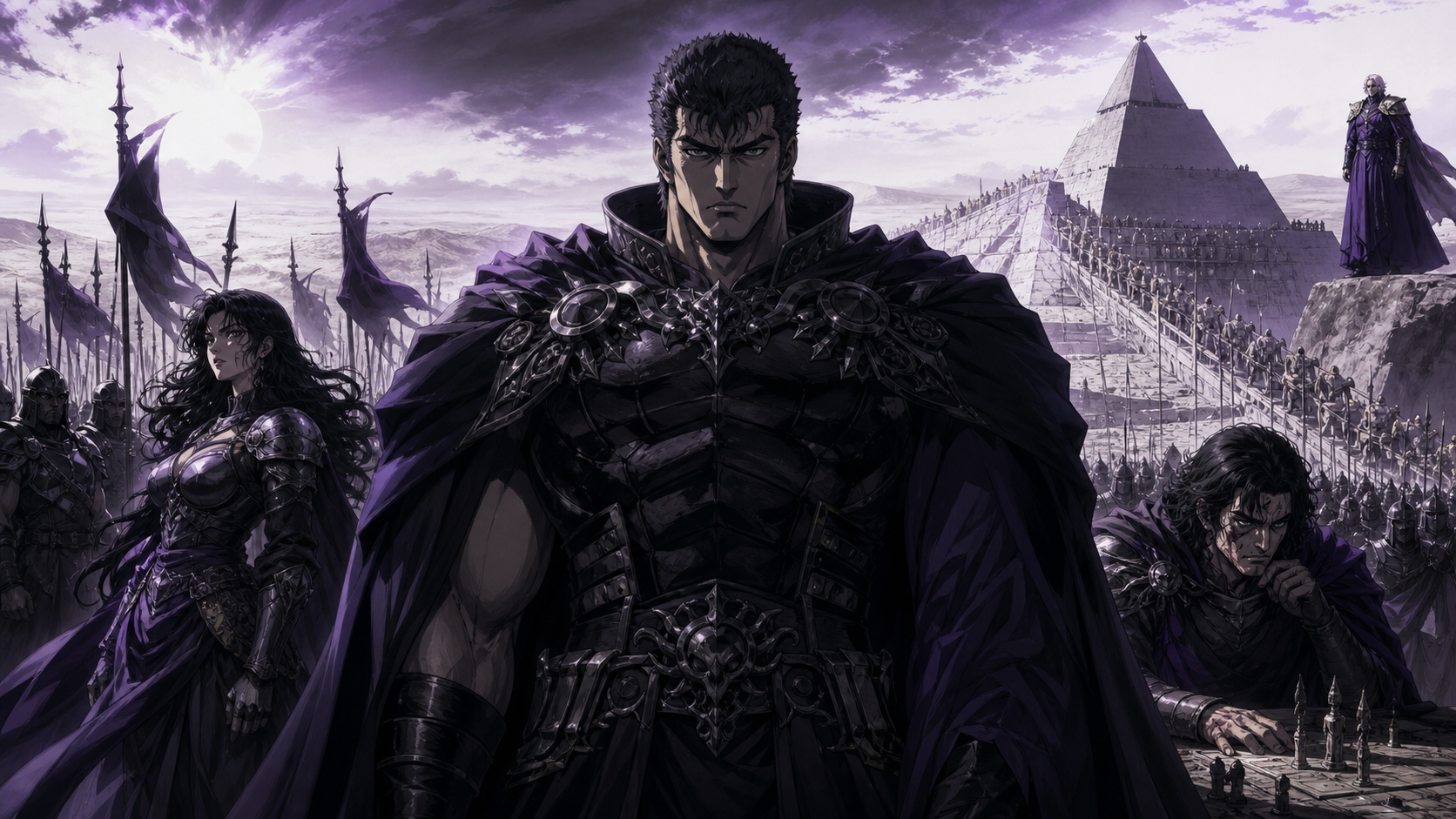
Raoh—Chapter of Death in Love Review: Tenderness Does Not Absolve an Empire
Raoh can love people and still build a world that consumes them. That is the uncomfortable promise inside Raoh—Chapter of Death in Love, the first theatrical chapter of Legends of the True Savior. The movie opens Raoh’s private life through Reina and Souga while Kenshiro confronts Souther, another ruler who converts a wounded heart into public cruelty.
Spoilers: This Review discusses the complete movie, its additions to the Souther conflict, and the moral cost of asking tenderness to rehabilitate conquest.
A 2006 theatrical return revisits Souther through two saviors and one question the franchise cannot dodge
Released theatrically in Japan in March 2006, the film began a five-part movie-and-OVA cycle that revisited major events from the manga while adding new scenes and characters. The official archive describes Kenshiro’s portion as largely faithful to the original Souther story, then identifies Raoh’s childhood companions Souga and Reina as the route into suffering, conduct, and love that the manga left outside the frame.
That construction makes the movie more than a polished recap. It stages two kinds of authority around the same crisis. Kenshiro walks into captivity because another person is being hurt. Raoh commands an army, understands Souther’s danger, and weighs intervention against ambition. The film asks viewers to feel the burden of rule without letting rule become an alibi.
The movie makes Raoh more human and therefore more accountable, not less
The added intimacy works whenever it sharpens contradiction. Reina can see the boy, brother, and wounded man beneath Ken-oh, but the people beneath his cavalry still experience an empire. Souga’s loyalty gives conquest a family vocabulary, yet loyalty does not turn annexation into consent. Private love proves Raoh possesses moral imagination. It cannot prove he uses that imagination for strangers.
This is why the film remains compelling even when its reverence threatens to soften its judgment. Raoh and Souther both convert injury into hierarchy. Kenshiro also carries unbearable grief, but he repeatedly interrupts violence without claiming ownership of the rescued. The difference between these men is not who suffered most. It is what each man believes suffering permits him to do.
The Holy Emperor builds a child-sized argument against every romantic fantasy of absolute power
Souther’s pyramid is not background spectacle. Children drag stone toward a monument to a man who insists love made him weak. Their labor transforms his private wound into a public system where the vulnerable must materialize his denial. Every block says the same ugly thing: because I was hurt, your body now belongs to my explanation.
The film understands that Souther’s secret body is less important than the political secret hiding in plain sight. His empire functions because guards, prisoners, frightened communities, and martial myth cooperate around his claimed exception. Kenshiro’s task is not merely to discover a pressure-point reversal. It is to make the suffering that imperial theater calls necessary impossible to ignore.
A father loses sight and then life while refusing to let children become scenery
Shu gives the Souther story its moral center because his sacrifice never asks admiration to replace responsibility. He remembers the child Kenshiro, recognizes the adult he might become, and organizes resistance around lives the empire treats as expendable. His blindness does not reduce perception. It exposes how much sight powerful men waste when looking only at rivals.
The final burden placed on Shu is hideous precisely because Souther choreographs it as ceremony. A ruler turns execution into architecture and demands that witnesses confuse inevitability with order. Shu’s endurance matters, but the children watching matter just as much. Heroic sacrifice should not make their terror decorative; it should condemn the system that required a good man to become its last load-bearing stone.
He fails, learns, returns, and never calls domination leadership
Kenshiro’s first defeat preserves an essential feature of his heroism: strength does not exempt him from incomplete knowledge. Souther’s reversed physiology breaks the expected mechanism of Hokuto Shinken, and confidence cannot substitute for attention. Kenshiro survives because relationships carry information that solitary masculinity cannot produce on command.
When he returns, his victory contains grief rather than triumph alone. He reads Souther’s body and also reads the abandoned child still governing the emperor’s cruelty. Compassion lets him understand his enemy; it does not require him to excuse the prison, the forced labor, or Shu’s death. The franchise is strongest when mercy and judgment occupy the same fist.
The conqueror watches another empire and sees both a warning and a competitor
Raoh knows Souther cannot be attacked casually, and the knowledge frustrates the image of effortless supremacy that Ken-oh must maintain. Strategy is not cowardice, but an empire built around invincibility makes ordinary caution politically dangerous. Reina notices the strain because she belongs to the shrinking private circle where Raoh may be uncertain without immediately losing symbolic power.
The movie uses that access to make him emotionally legible. Legibility is valuable, but it can seduce criticism into grading a tyrant on interiority rather than consequence. Raoh does not become ethical because the audience sees him ache. He becomes tragic because he understands love well enough to need it and power poorly enough to keep arranging the world around possession.
A woman inside the war machine can reveal its damage without becoming its certificate of goodness
Reina commands Raoh’s guard and carries history from the Land of Shura, giving her competence, loyalty, and emotional authority. Her movement toward Toki is an act of judgment as well as devotion: she recognizes that raw force and strategic waiting cannot answer the human crisis gathering around Raoh. Seeking care is not betrayal. It is an admission that conquest has no medicine for its own wounds.
The danger lies in using her love as moral laundering. A powerful woman choosing Raoh cannot make every choice he imposes on powerless people consensual. Reina is most interesting when her loyalty contains perception, frustration, and limits. She should not exist merely to whisper that the emperor is secretly soft. She reveals exactly how expensive loving him becomes.
The loyal strategist exposes the family structure that makes empire feel intimate from the inside
Souga’s relationship with Raoh and Reina gives the army a remembered homeland and a language older than conquest. That history explains why service can feel like kinship rather than employment. People do not always enter violent institutions because they adore violence. They may enter through debt, survival, affection, shared exile, or belief that one formidable person can impose order on catastrophe.
Explanation must not dissolve agency. Souga helps make Raoh’s project possible, translating desire into strategy and strategy into other people’s conditions of life. His loyalty becomes morally serious only when the story lets us ask what it costs those who never joined the family. An empire always looks warmer at the command table than beneath the horse.
Souther abolishes love; Raoh hoards it; Kenshiro lets it create obligations
The three central men do not divide neatly into feeling and unfeeling. Souther feels love so intensely that loss convinces him to persecute vulnerability. Raoh preserves select bonds while making hierarchy the governing principle outside them. Kenshiro permits grief and love to widen the circle of lives for which he accepts responsibility without demanding those lives become subjects.
This distinction makes the title’s “death in love” more than romantic tragedy. Love can die when a teacher chooses a final lesson, when a ruler treats attachment as weakness, or when devotion survives only by refusing to judge its object. The film’s mature claim is that emotion has no automatic politics. Love becomes humane through the arrangements it creates around other bodies.
The pyramid measures the distance between ruler psychology and ordinary pain
Genre stories often make dictatorship legible through one spectacular villain and one spectacular defeat. Souther’s labor system resists that simplification because the violence repeats before any duel begins. Children wake, lift, fear, obey, and watch adults disappear. The empire occupies time as much as territory. Its cruelty is administrative, scheduled, and reproduced by people below the throne.
That daily structure should govern how viewers evaluate every sovereign in the film. A ruler’s loneliness matters, yet laborers cannot eat his complexity or shelter beneath his tragic backstory. When criticism spends more time decoding a conqueror’s hidden heart than naming the people his order crushes, the criticism begins reenacting the hierarchy it claims to study.
Large images give myth weight while compression threatens to turn suffering into connective tissue
Theatrical animation allows the desert, cavalry, pyramid, and martial bodies to carry monumental scale. That scale suits a franchise where men repeatedly try to make private conviction visible across an entire horizon. The film can move between intimate faces and mass formations, showing how one person’s wound becomes an environment for thousands.
Reassembly creates pressure. Familiar story beats must arrive, new Raoh material must justify itself, Souther requires psychological context, and Shu’s sacrifice needs room to hurt. The movie sometimes asks recognition to perform emotional labor that sustained scenes should perform. Its finest passages slow down long enough for a look, burden, or silence to remain morally unresolved.
The Japanese performances distinguish wounded control from empty invulnerability
Hiroshi Abe’s Kenshiro is restrained and grave, emphasizing a traveler whose compassion moves through physical decision rather than constant speech. Takashi Ukaji gives Raoh mass and strain, particularly when command must conceal hesitation. Kou Shibasaki’s Reina brings warmth without making military competence disappear. The casting creates a deliberately different sonic era from the television classic.
That difference works best when performance serves the movie’s ethical contrast. Kenshiro’s quiet makes space for other people’s pain. Raoh’s quiet protects the sovereign image even among intimates. Souther’s theatrical certainty tries to erase the abandoned child within him. Similar masculine stillness can therefore conceal radically different relationships to power.
The official archive anchors production and story facts; CVM Sekai owns the judgment
The Hokuto no Ken official movie and OVA archive identifies the March 2006 theatrical release, the Souther conflict, Kenshiro and Raoh viewpoints, and the newly added Souga and Reina material. It also provides the official story framework for Reina’s search for Toki and Kenshiro’s first defeat against Souther.
All analysis of empire, forced labor, love, gender, grief, masculinity, complicity, and political responsibility is independent CVM Sekai editorial criticism. Production facts establish what the movie made. They do not decide what its choices mean.
The movie becomes morally honest only when the children remain people after the symbolism lands
Souther uses children because their vulnerability enlarges his power and because their presence desecrates every claim that the pyramid represents civilization. The camera can turn them into an instantly readable sign of evil, though. Once an audience understands that forced child labor is monstrous, the children risk disappearing into proof supplied for Kenshiro’s righteousness.
A deeper reading asks what each child loses beyond safety: parents, play, education, trust, bodily development, and the belief that adults will prevent the strong from owning the weak. Liberation cannot be measured only by whether the pyramid stops rising. It must include whether these children regain time that no hero can punch back into existence.
Architecture remembers the violence that rulers prefer to call destiny
Souther wants stone to stabilize a story about himself. The pyramid should outlast witnesses, converting commands into landscape and coerced labor into apparently completed greatness. Monumentality performs an old political trick: once the structure exists, viewers are encouraged to admire scale before asking who carried it, who died beneath it, and who decided it deserved resources.
Shu’s body interrupts that trick. By making the final stone inseparable from a murdered person, the film refuses clean architectural awe. The monument cannot become neutral heritage because its completion contains an accusation. Every ruler in this world wants history to remember the fist at the summit; the movie briefly makes history remember the shoulders underneath.
A remembered act of mercy matures because its beneficiary finally understands the debt without trying to repay it mechanically
Shu’s earlier sacrifice for the young Kenshiro establishes a relationship that predates the current rebellion and exceeds tactical alliance. He did not preserve a future champion because a contract guaranteed repayment. He recognized possibility and accepted injury so that possibility could live. The adult Kenshiro cannot undo that cost, and the story wisely refuses a simple exchange of saved lives.
Instead, inherited mercy becomes an obligation toward people beyond the original giver. Kenshiro honors Shu by confronting the system harming children, not by treating Shu’s death as a private score with Souther. That distinction matters. Revenge circles two men. Justice remembers why the dead resisted and tries to leave the living with more freedom than the dead possessed.
A retelling earns its place when new material changes judgment rather than merely changing camera position
Audiences familiar with the manga or television story already know Souther’s secret, Kenshiro’s defeat, Shu’s burden, and the emperor’s final emotional collapse. Recognition supplies anticipation, but anticipation alone cannot justify a theatrical cycle. The film must create friction between what viewers remember and what the Raoh additions ask them to reconsider.
The new viewpoint succeeds when Raoh’s response makes the political field larger. Souther is not an isolated monster waiting for a hero; he is a rival sovereign whose existence shapes another army’s calculations. The revision weakens when extra sympathy functions mainly as prestige lighting around Raoh. A new angle matters only if it exposes responsibility that the old angle could not see.
Souther and Raoh disagree about love while agreeing that strength should arrange everybody else
Souther announces his rejection of love because love once made him vulnerable. Raoh keeps love guarded among a chosen few because public tenderness threatens the image supporting his rule. Their emotional styles differ, yet both make private management of feeling into a social hierarchy backed by force. One burns attachment; the other rations it.
This parallel prevents Raoh from becoming the reasonable emperor merely because Souther behaves more grotesquely. A less sadistic conqueror remains a conqueror. Comparative villainy can clarify degrees of harm, but it should not reduce ethics to choosing the man whose inner circle receives better treatment. The people outside both circles need a politics that does not depend on imperial mood.
Her search for Toki recognizes that care has authority conquest cannot manufacture
Reina turns toward Toki because the situation demands a person whose power is inseparable from healing, perception, and restraint. In a story crowded with men who prove truth through impact, seeking a healer becomes an intellectual act. She understands that Raoh’s crisis cannot be resolved by adding another layer of command around him.
Toki’s presence also complicates the franchise’s gendered distribution of care. Reina performs emotional recognition, carries concern, and risks herself to find help; Toki possesses the specialized wisdom that legitimizes care within the martial hierarchy. The film gains depth if both are understood as agents. It loses depth if Reina merely delivers vulnerability to a man authorized to interpret it.
A child’s aid quietly rebukes every ruler who mistakes vulnerability for uselessness
Lin helps the wounded Reina reach Toki, creating a chain of care outside military hierarchy. She does not possess an army, secret body, throne, or legendary title. She notices need and acts. In a film obsessed with which powerful man can defeat which powerful man, this practical compassion offers a smaller and more durable model of social life.
The scene also reverses the logic of Souther’s pyramid. His order extracts strength from children to enlarge himself. Lin uses her limited strength to preserve another person without demanding ownership afterward. The contrast does not require sentimental claims that children are naturally pure. It shows that power can be measured by what a person makes possible for somebody else.
Souther’s bodily secret turns certainty into a liability and observation into survival
Hokuto Shinken normally promises intimate knowledge of the body, a map precise enough to end conflict through targeted contact. Souther’s reversed organs disrupt that mastery. The shock is not simply that a technique fails. A system of inherited expertise encounters a body whose difference refuses the expected map, and Kenshiro pays for assuming universality too quickly.
His recovery depends on investigation and relation, not louder insistence. That movement gives the battle intellectual force. The superior fighter is not the one who never lacks knowledge; it is the one capable of revising knowledge without treating difference as an insult. Souther hides behind exceptional anatomy, but Kenshiro’s adaptability prevents exception from becoming divine right.
Understanding the abandoned child inside Souther does not erase the children outside his throne
Souther’s history with Ogai gives emotional shape to his rejection of love. A child forced to kill the person he trusted experiences attachment as a trap whose final lesson is unbearable. The revelation explains why the adult builds identity around invulnerability. It deserves grief, especially because the original injury was engineered through a cruel succession ritual.
Yet explanation cannot reverse direction and make enslaved children responsible for the wounded child inside their enslaver. Compassion that moves only upward toward the powerful becomes another extraction from victims. Kenshiro’s final recognition works because he can mourn what happened to Souther while ending what Souther is doing. Mercy names the whole truth; acquittal deletes half of it.
The film stages three ways men answer pain and refuses to admit that stoicism is only one thing
Souther turns pain into contempt for dependency. Raoh turns it into a guarded command structure where affection survives under discipline. Kenshiro turns it into attention toward the suffering of others, though his silence can still isolate him. Shu accepts pain to protect children, a choice that reveals strength without requiring supremacy.
These models matter because the franchise’s enormous bodies can make all masculinity look visually synonymous. Muscle, stillness, impact, and low voices repeat across moral positions. The ethical differences appear in relationship: who may speak, who receives protection, whether weakness invites care or exploitation, and whether grief widens responsibility or narrows it to the self.
Adding Reina creates possibility, but the movie still lets men own most public consequences
Reina can fight, command, decide, travel, and read Raoh in ways his soldiers cannot. Those capacities distinguish her from a passive witness. At the same time, much of her narrative value remains attached to translating the conqueror’s hidden interior for the audience. She risks becoming the evidence that a difficult man deserves fuller sympathy.
The solution is not to deny her love or demand that every woman abandon compromised people instantly. It is to take her judgment seriously enough to ask where loyalty stops. What does she challenge, what harm can she name, and whose safety outranks Raoh’s emotional protection? Agency becomes visible at the point devotion acquires conditions.
Uniform ranks hide thousands of separate bargains with fear, hunger, and belief
Raoh’s forces often appear as mass, a visual extension of his will crossing the wasteland. That image produces grandeur and makes sovereignty instantly legible. It also hides the social composition of an army. Some soldiers may believe in order, some may fear rivals, some may need food, and some may discover that belonging to violence feels safer than standing beneath it.
A serious account of empire cannot let the ruler’s psychology substitute for all those lives. Orders travel through people who interpret, enforce, hesitate, profit, and suffer. Reina and Souga give two figures inside that machinery names, memories, and reasons. Their presence should encourage viewers to imagine the unnamed rather than accept that only intimates possess inner worlds.
Scarcity makes domination persuasive because exhausted people may accept order before they can evaluate its price
The wasteland is more than masculine scenery. Destroyed infrastructure, scattered settlements, and constant threat shrink the horizon of political choice. Under those conditions, a disciplined army can look like safety even when its safety requires submission. Souther and Raoh both exploit the gap between desperate need and meaningful consent.
Kenshiro’s wandering offers an alternative with severe limits. He can break a local regime and continue moving, refusing to become the next sovereign. That refusal protects communities from his ownership, but it also leaves institution-building largely offscreen. The franchise repeatedly trusts liberated people to organize afterward. Trust is admirable; showing their work would make freedom concrete.
A devastating strike means little if the frame forgets the bodies that made it necessary
The combat delivers pressure-point reversals, heavy impacts, and clashes designed for theatrical scale. Spectacle matters in Fist of the North Star; the series communicates philosophy through bodies testing what conviction can survive contact. Dismissing action as decoration would miss the form’s central language.
Still, spectacle becomes ethically empty when the audience remembers the finishing move more clearly than the people under the regime. This movie avoids that fate through Shu and the children, though not consistently. The strongest action sequence carries a visible chain from abuse to intervention to aftermath. Force becomes morally legible because somebody’s life, rather than a hero’s brand, defines the stakes.
The story understands that unprocessed grief does not stay private when the grieving person commands institutions
Souther’s loss becomes doctrine, labor policy, military practice, and architectural ambition. Raoh’s buried attachments shape whom he trusts, what weakness he fears, and how tightly the sovereign persona must be defended. Their emotions are political because their power allows emotion to redesign everyone else’s environment.
This insight reaches far beyond the wasteland. Leaders often present personal injury as proof that they alone understand danger, then build systems requiring others to live inside their defensive reflex. The film’s challenge is to recognize the wounded person without treating the wound as a mandate. Pain can explain a politics; it cannot democratically authorize one.
A tear, confession, or beloved witness cannot perform the material work of repair
Stories frequently redeem powerful men by revealing that someone loved them or that they loved someone once. The revelation reassures viewers that cruelty never consumed the entire person. That may establish moral capacity, but redemption requires more: stopping harm, surrendering entitlement, repairing what can be repaired, accepting judgment, and changing the structures that amplified private failure.
Raoh’s tenderness therefore raises the standard by which he should be judged. A man capable of recognizing Reina’s devotion can imagine how attachment matters to conquered families. A man who understands Souga’s loyalty can imagine the terror of coerced service. Interior richness removes excuses. It proves the emperor has emotional knowledge available and chooses where not to apply it.
The quiet revolutionary leaves the deepest mark because his strength does not need everybody beneath it
Raoh carries the new dramatic material, Souther supplies theatrical excess, and Kenshiro delivers the decisive confrontation. Shu nevertheless governs the movie’s conscience. He understands that children cannot wait for perfect strategy, that resistance may require sacrifice, and that a future he will not see still deserves his body’s protection.
His greatness should not be romanticized into a demand that oppressed people die beautifully. The point is not that martyrdom is noble. The point is that Shu’s world has made survival and protection incompatible for him, and he chooses the children. The tragedy condemns the conditions. It does not recruit the audience to admire those conditions for producing a magnificent death.
Humanizing a conqueror can deepen criticism when the camera remembers every person outside his heart
The film refuses the easy claim that evil belongs only to people incapable of love. Raoh’s bonds are real, Souther’s childhood attachment was real, and both men remain responsible for orders built around domination. This is psychologically stronger than treating cruelty as emotional emptiness because it recognizes how affection and violence coexist inside ordinary human arrangements.
It also preserves Kenshiro’s distinctiveness without making him naive. He can understand grief, discover bodily truth, accept help, and strike decisively. His compassion is not passivity. It is the discipline that keeps strength attached to the vulnerable rather than to self-image. The movie’s best moral contrast lives there, beneath all talk of destiny and succession.
Do not ask viewers to examine Raoh’s humanity while treating everybody else as evidence
A Raoh-centered revision naturally spends time near the ruler, his confidants, and the decisions that trouble him. The danger is gravitational. The closer a narrative moves to power, the more every surrounding person can become a device for revealing power’s complexity. Reina loves, Souga advises, soldiers obey, and civilians suffer so that Raoh may look tragically complete.
The answer is not less complexity for Raoh. It is equal seriousness for the lives affected by him. Who receives food, who buries relatives, who changes allegiance, who fears the next cavalry column, and who rebuilds after champions leave? Humanity is not a scarce resource that the most charismatic man gets to monopolize.
A beautiful, uneasy revision succeeds when its love story becomes an indictment rather than a pardon
Raoh—Chapter of Death in Love gives the Souther arc renewed scale and makes Raoh’s interior life visible through Reina and Souga. The additions create genuine dramatic tension because they refuse to reduce conquest to cartoon appetite. Raoh feels, hesitates, remembers, and depends on people whose loyalty matters to him.
None of that absolves his empire. It makes the empire harder to dismiss and more urgent to judge. Souther shows what happens when grief declares war on love; Raoh shows what happens when love remains private property; Kenshiro and Shu show love becoming obligation toward people who cannot repay it. That distinction is why the movie still cuts after the fists stop moving.
Surviving proximity to power should create a future larger than continuing to interpret Raoh
Reina’s value cannot end when the audience finally understands that Raoh is capable of receiving love. She has crossed military and emotional terrain, recognized a crisis his command structure could not solve, and sought Toki through danger. Those decisions produce knowledge about care, loyalty, and the limits of imperial confidence that should alter her subsequent choices.
A richer future would let her ask what leadership means when it is not merely service to a singular man. Could she redirect soldiers toward protection, refuse orders that convert civilians into strategic material, or build relationships not organized by Raoh’s destiny? The film plants those questions even when the larger cycle may answer them imperfectly. Love becomes adult when it can survive judgment or accept the separation judgment requires.
Chosen family can sustain people inside violent systems and still make departure feel like self-erasure
Souga belongs to a small circle formed before Ken-oh became an imperial identity. That history makes loyalty emotionally credible. Leaving would not mean switching employers; it could mean abandoning the people, memories, language, and survival promises through which he understands himself. Institutions exploit this fusion between belonging and obedience because criticism begins to feel like betrayal of family.
The moral demand remains. If intimacy makes responsibility harder, it also makes influence possible. Souga knows Raoh as a person rather than a symbol and therefore has access unavailable to ordinary subjects. The question is whether he uses that access to limit harm or primarily helps the sovereign manage obstacles. Loyalty that never risks displeasing power eventually becomes another name for permission.
The succession lesson that destroys Souther confuses mastery with the murder of dependence
Ogai’s final test turns the teacher-student bond into a trap and asks a child to interpret devastating violence as proof of advancement. The ritual imagines adulthood as the ability to kill the person whose care made growth possible. Souther does not merely lose someone he loves; he learns that institutions may weaponize love and call the resulting wound destiny.
His conclusion remains wrong, but the lesson deserves scrutiny. Martial traditions that demand emotional severance often manufacture the instability they claim to prevent. A successor who cannot acknowledge dependency becomes easier to control through shame and more likely to control others through the same mechanism. Kenshiro breaks that cycle because inherited technique does not require him to deny the relationships that give technique purpose.
Scars, blindness, reversed organs, and exhausted muscles keep histories that imperial speeches cannot erase
The film writes politics across bodies. Shu’s blindness remembers a decision to save Kenshiro. Souther’s anatomy becomes both tactical secret and sign of a life organized around exceptionalism. The children’s exhaustion records an economy of coerced labor. Reina’s wounds reveal how even elite proximity cannot guarantee safety inside competing empires.
These bodies challenge the rulers’ preferred narratives. A pyramid may announce greatness, but bent backs describe its actual production. An army may announce order, but wounds describe who absorbs disorder. Hokuto Shinken literalizes reading the body as truth, yet the movie’s ethical task is broader: viewers must read ordinary fatigue and fear with the same attention granted to legendary pressure points.
His refusal of the throne protects freedom and leaves a recurring institutional silence
Kenshiro enters, witnesses abuse, learns the enemy, destroys the violent center, and moves onward. This pattern preserves his moral distinction from men who equate capacity with entitlement. He will not claim a population because he saved it. Gratitude does not become a title deed, and protection does not automatically become permanent authority.
The unresolved question concerns what follows. Former guards, resource distribution, traumatized children, damaged settlements, and competing local interests remain after the emperor falls. The film does not need Kenshiro to administer every village, but it needs communities to appear as political actors rather than grateful scenery. Liberation is more persuasive when ordinary people visibly practice the freedom the hero refused to own.
Love dies in this story whenever a man mistakes feeling for possession or pain for permission
The title can describe Souther’s attempt to murder love after Ogai, Raoh’s fear that affection compromises sovereignty, Reina’s dangerous devotion, or Shu’s death while enacting love as protection. These are not equivalent tragedies. Some people die because they care for others; others make people die because caring once hurt them.
That distinction prevents melancholy from flattening moral responsibility. A sad ruler and a sacrificed resister may share emotional intensity without sharing ethical position. The movie’s imagery sometimes places powerful men in similarly noble frames, tempting viewers to consume sorrow as greatness. The content underneath the sorrow matters: whose life does this love enlarge, and whose life does it demand?
Recognition can invite an audience home while reverence quietly lowers the standard of judgment
Returning viewers bring memories of music, television performances, manga panels, and the first time Shu or Souther broke through the franchise’s surface brutality. The 2006 film benefits from that stored emotion. A familiar silhouette can arrive already carrying decades of meaning, allowing theatrical compression to feel fuller than the minutes alone would support.
Nostalgia becomes dangerous when familiarity protects a beloved conqueror from questions a new character would face immediately. Raoh’s iconic status should increase curiosity about his rule, not place his rule beyond ordinary ethics. Loving the franchise means taking its ideas seriously enough to examine them. Reverence without examination turns a story about inherited technique into inherited exemption.
What does a powerful man owe strangers once the audience knows he can love his friends?
This film gives Raoh a private circle so viewers can see tenderness beneath the armor. The revelation is moving because the armor has never been empty. Yet the stranger remains the decisive test. Most people in an empire never become childhood companions, trusted commanders, brothers, healers, or worthy rivals. They meet policy, soldiers, scarcity, and rumor.
If love remains available only to those near the throne, it functions as privilege rather than liberation. Kenshiro’s wandering compassion matters because strangers can interrupt his path and become morally binding without earning intimacy first. Raoh’s tragedy is not that he feels too little. It is that he makes a vast human capacity obey a narrow political circle.
Ogai teaches Souther that love and mastery are enemies, then the adult builds a nation around the mistake
Souther’s defining wound begins inside education. Ogai does not simply die; he designs a final examination in which the student’s success destroys the relationship that made learning possible. The ritual makes affection look like an obstacle to legitimate succession. It tells a gifted child that the proper response to dependence is not gratitude, mourning, or mutual transformation, but mastery proven through irreversible separation.
The adult Souther universalizes that lesson. He treats tenderness as a vulnerability enemies may exploit and makes domination the only safe form of contact. His citizens enter a school where obedience replaces learning and pain replaces correction. The pyramid becomes a curriculum in stone: powerful people define reality, weaker people carry it, and any desire for care proves unfitness to rule.
Kenshiro defeats more than a physiological mystery when he recognizes the child beneath the emperor. He rejects the premise that understanding another person requires submitting to that person’s damage. His compassion reads Souther accurately while his fist ends the public lesson. A humane teacher would have helped the child survive grief; a humane opponent refuses to let the grieving adult keep teaching cruelty.
The rebels demonstrate that political knowledge grows among people who cannot afford heroic abstraction
Shu’s network knows routes, risks, hiding places, and the daily consequences of Souther’s rule. Their intelligence differs from the secret martial knowledge prized by legendary fighters. They understand which families vanished, which guards can be distracted, when labor columns move, and how long frightened children can travel before exhaustion. Revolution depends on those details more than on slogans.
The movie gives limited room to this collective capacity because its theatrical spine moves toward individual combat. Shu becomes the visible representative, and Kenshiro becomes the force capable of breaking the emperor. Yet neither man invents resistance at the moment he enters the frame. People have already refused, concealed one another, shared resources, and accepted danger before a champion can make their struggle spectacular.
Remembering that work changes the meaning of Kenshiro’s arrival. He is not delivering freedom to passive recipients. He is joining a struggle whose participants lack his bodily power but possess moral and local knowledge he needs. The strongest version of the savior myth does not erase collective resistance; it lends force to a freedom people have already begun practicing.
The crowd is not there merely to verify which fighter deserves the title of strongest
Public combat in Fist of the North Star often creates witnesses who translate force into political legitimacy. People see a tyrant bleed, discover that fear was not natural law, and revise what they believe possible. Souther understands this mechanism, which is why punishment becomes ceremony. He wants every child and prisoner to learn that resistance ends beneath architecture.
Shu’s death nearly completes that lesson. The burden, ascent, and final strike display an order capable of converting even noble defiance into material for the emperor’s monument. Kenshiro’s response interrupts the interpretation Souther planned. The same witnesses can now understand Shu’s endurance not as proof of imperial inevitability, but as evidence of a moral world the emperor cannot fully control.
Viewers occupy another witnessing position. We can consume sacrifice as a gorgeous franchise moment, admire the score, and proceed to the finishing move. The movie deserves more. Witnessing creates responsibility to remember the political content of what looked spectacular: children were enslaved, a resistance leader was executed, and victory matters because those facts must stop recurring.
Caution becomes a crisis when a ruler has taught everyone that his certainty is the source of order
Raoh’s reluctance to confront Souther without understanding his secret is strategically rational. Charging into unknown technique would risk his army, his project, and the image holding that project together. The problem is not that he thinks. The problem is that his political identity leaves little room for thinking to look like anything except invincibility already in possession of the answer.
Reina sees the strain produced by that performance. A ruler who cannot publicly admit uncertainty must process fear inside a tiny circle, which gives intimates enormous emotional labor and gives flatterers enormous opportunity. Imperial masculinity therefore creates bad information. Subordinates learn to protect the leader’s image, inconvenient truth arrives late, and ordinary hesitation becomes a threat to the state.
Kenshiro’s defeat offers the opposite model. His error is visible, his body falls, and his return depends on learning. He does not need supporters to pretend the first encounter was secretly victory. Vulnerability becomes compatible with authority because his authority rests on conduct rather than an uninterrupted performance of supremacy.
Military competence does not erase the coercive institution in which competence operates
Reina’s leadership of Raoh’s guard matters because it grants her skills and responsibility beyond romantic attachment. She can assess danger, give orders, fight, and move within a hierarchy that would otherwise be entirely male. That visibility is meaningful, especially in a franchise where women are too often positioned as moral destinations rather than political actors.
Representation inside an army does not make the army emancipatory. The question is what the guard protects, whose movement it restricts, and which ruler’s will its competence enforces. Reina’s achievement can be real while the institution remains coercive. Treating those facts as mutually exclusive would flatten both gender and power into a checklist.
Her most revealing choice may be leaving the expected route to seek Toki. She uses command-trained judgment against the limitations of command itself. The action suggests that competence includes recognizing when the institution supplying one’s status cannot solve the crisis. That is richer than simply proving she can fight beside men.
Difference becomes a shield for exceptionalism only because secrecy and power organize how difference is read
Souther’s reversed organs do not make him morally reversed. Anatomy has no politics by itself. His unusual body matters because he surrounds it with mystery and uses opponents’ expectations against them. The secret allows him to perform divine exemption from a martial system whose precision normally appears absolute.
The danger in the trope is treating bodily difference as evidence of monstrosity. The film can resist that implication by locating evil in policy and choice: enslavement, execution, conquest, and the deliberate conversion of grief into doctrine. Kenshiro’s investigation should demystify technique, not normalize the idea that an atypical body signals an atypical soul.
Once understood, Souther becomes vulnerable to the same intimate knowledge Hokuto Shinken applies elsewhere. The resolution should not mean normal bodies are readable and abnormal bodies must be corrected. It means no sovereign gets to transform a difference into permission to dominate. Knowledge ends the false miracle while judgment remains fixed on what he did with it.
Shu’s earlier mercy proves that the future savior was once radically dependent on another person’s choice
Kenshiro’s adult competence can make salvation look like an essence he always possessed. The memory of Shu punctures that fantasy. The future hero once stood vulnerable before a stronger adult whose decision determined whether his possibility survived. History could have ended there, long before destiny acquired a famous scar or a legendary phrase.
That dependence is not an embarrassment the adult must outgrow. It is the foundation of his ethics. Kenshiro knows, in his body, that strength exists because somebody once refused to use strength for domination. Shu’s mercy travels forward through him, making every rescued stranger part of a relationship whose original giver may never receive equal repayment.
Raoh’s ideology emphasizes self-mastery and conquest, but no martial artist creates himself. Teachers, rivals, caregivers, communities, and accidents shape every supposedly solitary man. The film’s deepest rebuttal to imperial individualism may be the simple fact that even the savior owes his life to another person’s undeserved compassion.
Souther’s rule survives because terror reorganizes ordinary calculations before soldiers arrive
Fear is not merely an emotion produced by punishment. It becomes an economy. Parents weigh resistance against a child’s survival, laborers conserve strength rather than risk a guard’s attention, and potential allies avoid one another because trust could expose everyone. The emperor’s most efficient command is the action people stop considering without being directly ordered.
The pyramid concentrates this economy into a visible project, but the real structure extends across every private decision. A family that hides food, a prisoner who looks away, and a guard who performs extra cruelty to prove loyalty all inhabit incentives designed by power. Destroying Souther ends the apex; recovery requires changing the expectations circulating below it.
Kenshiro can create a decisive break by proving the emperor mortal. Shu can preserve moral knowledge by refusing inward surrender. Neither act instantly restores trust between people trained to survive through suspicion. The film’s catharsis is necessary, but the political aftercare would be slow, local, and mostly unglamorous.
The film recruits our desire to find softness inside power and then tests whether we confuse discovery with forgiveness
Audiences enjoy privileged access. We see Reina’s concern, Souga’s history, and moments when the conqueror’s public mask loosens. Ordinary people under Raoh do not receive that access. They encounter banners, soldiers, demands, and the consequences of resistance. The dramatic intimacy can therefore produce a judgment unavailable to those bearing the political cost.
That gap is not a reason to reject interior storytelling. It is the reason to handle it responsibly. Knowing more about Raoh should help viewers understand how domination sustains itself through real attachment, loyalty, and fear. It should not encourage us to scold fictional civilians for failing to perceive the tenderness a film disclosed only to us.
The ethical test is simple. After learning that Raoh can love Reina and Souga, do we become more curious about the strangers he rules, or less concerned about them? If sympathy narrows attention toward the emperor, the narrative privilege has done imperial work. If it sharpens contradiction, the film has earned its revision.
Souther can expose Raoh’s restraint without becoming a moral measuring stick low enough to flatter him
Placing two rulers in tension encourages comparison. Souther enslaves children openly, builds a monument to himself, and celebrates lovelessness. Raoh appears disciplined, bonded to trusted companions, and capable of strategic concern. Beside spectacular sadism, controlled conquest can resemble responsible leadership.
This is a false binary. The absence of Souther’s worst behavior does not establish justice. A ruler may avoid theatrical cruelty while still denying consent, centralizing force, and treating communities as territory. Ethical evaluation must compare each order against the freedom and safety people deserve, not merely against the most grotesque alternative available.
Kenshiro’s presence prevents the comparison from closing. He wields greater intimate violence than most rulers and still refuses to make rescued people his subjects. His example demonstrates that power does not naturally require empire. Once that alternative exists, Raoh cannot claim domination as the only serious answer to chaos.
A score can open grief honestly or instruct viewers to pardon before the argument is complete
Music performs crucial interpretive labor in a compressed theatrical retelling. It can restore the ritual scale fans associate with Shu, underline Souther’s buried child, or give Raoh’s private scenes a tenderness his severe face withholds. Sound invites the body to feel before analysis catches up.
That invitation becomes ethically risky around powerful men. A swelling cue may make sorrow feel like redemption even when no repair has occurred. The audience experiences emotional release and mistakes its own softened response for evidence that the character’s obligations changed. Beautiful grief is still grief; it is not restitution.
The strongest musical moments deepen unresolved feeling rather than closing the moral account. We can mourn Souther’s childhood and condemn his empire, feel Reina’s devotion and question its cost, recognize Raoh’s loneliness and reject his entitlement. Art matures when it lets multiple truths remain audible without blending them into innocence.
The franchise speaks through combat, but not every fist says the same thing
Souther uses violence to prove exemption. Raoh uses it to consolidate order around his supremacy. Shu accepts violence against himself to protect vulnerable people. Kenshiro uses it to interrupt systems that refuse every other answer. The bodies may be similarly monumental, yet purpose, target, timing, and aftermath create different sentences.
This does not make Kenshiro’s violence pure or consequence-free. Lethal power deserves scrutiny even when directed at tyrants. The world often supplies enemies so irredeemably active that force appears unavoidable, protecting the hero from harder choices about detention, rehabilitation, and collective judgment. Genre clarity can become moral convenience.
Still, the film preserves one essential boundary: Kenshiro does not turn successful violence into ownership. He does not claim the pyramid, absorb Souther’s prisoners, or demand worship from the liberated. His fist ends an immediate capacity to harm and then relinquishes the political capital victory could produce.
Healing, carrying, hiding, warning, and remembering keep people alive between the famous battles
Reina seeks help, Lin assists her, Toki heals, resistance members shelter one another, and children endure through fragments of mutual support. These acts lack the visual climax of pressure-point combat, but they create the continuity without which no liberating strike would matter. A society survives through care before it can celebrate a champion.
The film’s title foregrounds love while its genre foregrounds fists. Care work connects them. Love becomes politically meaningful when it changes who receives water, medicine, rest, information, and protection. Without those material forms, love remains a feeling powerful people discuss while other bodies carry stones.
Raoh’s challenge is therefore not proving he feels. It is allowing attachment to reorganize what his power provides to people who cannot offer intimacy in return. The movie reveals the beginning of that capacity and the severe limits around it. Reina cannot complete the transformation on his behalf.
Freedom begins when the monument stops and becomes real when the former laborers control what happens next
Souther’s defeat leaves a workforce, materials, routes, guards, and a partially completed structure whose future remains undecided. The liberated could dismantle it, repurpose stone for homes, preserve part as evidence, or leave it unfinished as a warning. Each choice would reveal whether they possess authority over the world their labor created.
Justice might also require naming the dead, finding families, treating injuries, and deciding how collaborators reenter community life. None of this offers the clean visual satisfaction of an emperor falling. It is nevertheless the substance of liberation. A society ceases to be Souther’s when ordinary people can disagree about rebuilding without another fist settling the argument.
The film closes before such work can dominate its story, which is understandable and revealing. Savior narratives love the moment possibility opens. Political adulthood begins the next morning, when possibility requires meetings, distribution, memory, compromise, and vigilance against the next person who promises order through ownership.
It wants Raoh’s heart to surprise us while the franchise has always shown that grief and brutality can occupy one body
Raoh’s affection is not alien to the wider story. His relationships with brothers, rivals, Yuria, and the ideal of strength already suggest a person whose emotional life is enormous but disciplined into hierarchy. Reina and Souga give that life new witnesses and history. The film’s novelty lies less in discovering a heart than in staging who has access to it.
This matters because audiences often treat tenderness as hidden truth and cruelty as surface performance. The reverse may be equally accurate: conquest is the public truth that determines most lives, while tenderness is a genuine but restricted private practice. Neither cancels the other. Character depth exists in their coexistence.
The movie succeeds when it lets contradiction remain painful. It falters whenever revelation encourages a shortcut from “Raoh loves” to “Raoh is therefore just.” A heart is not a government. Feeling creates capacity for ethics, but institutions reveal whether that capacity reaches beyond the beloved.
The film makes an old arc newly useful by asking what fandom does with the humanity of its favorite tyrant
A straightforward remake could deliver larger animation, familiar deaths, and updated voices. This film takes a more dangerous route by moving Raoh closer to the emotional center. It knows the character’s charisma and invites fans to inhabit the space behind his certainty. That invitation exposes our own habits of judgment.
We often demand exhaustive reasons for a powerful man’s cruelty while accepting the suffering of unnamed people as self-explanatory scenery. We call interiority complexity and consequence plot. The movie can reproduce that imbalance, but it also gives viewers enough evidence to notice it. Reina and Souga humanize the command tent; Shu and the children demand equal attention below it.
The resulting tension makes the film worth sustained criticism. It does not resolve the ethics of Raoh by adding love. It demonstrates why love alone has never resolved the ethics of anybody with power. The audience must decide whether intimacy expands accountability or merely makes domination more attractive.
The people closest to Raoh know most about his humanity and carry the greatest responsibility for what that humanity permits
Reina and Souga are not ordinary subjects. Their history gives them access to uncertainty, memory, and affection hidden from the army. That privilege helps them survive the sovereign image, but it also places them near decisions that become somebody else’s fear. Intimacy with power creates opportunities for intervention as well as incentives for silence.
Complicity does not mean every subordinate possesses equal freedom or equal guilt. Refusal may cost belonging, safety, or life, and institutions distribute knowledge carefully so that nobody below the leader can see the complete consequence. Serious judgment measures capacity, information, alternatives, and action rather than announcing that everyone near wrongdoing is identical.
The film’s additions matter because they allow this graduated inquiry. Souga translates ambition into strategy; Reina commands and seeks care; both understand Raoh beyond the myth. Their loyalty can be emotionally honorable and politically dangerous at once. The harder question is not whether they love him. It is what that love enables them to stop.
Changing viewpoint changes whose pain receives explanation, even when the plot events remain familiar
A retelling never merely transfers content into newer animation. Selection creates an argument. Time spent with Raoh’s confidants is time not spent with an enslaved child, a resistance organizer, or a family beneath Souther. The new material tells viewers which unknowns deserve answers and which lives may remain collective background.
Choosing Raoh is defensible because the character’s power shapes the entire political field. Understanding his calculations reveals why Souther remains unchallenged and why conquest can look disciplined from inside its own command structure. The adaptation earns that focus when new knowledge increases the ruler’s accountability instead of treating hidden tenderness as a coupon redeemable against public harm.
Faithfulness also requires judgment. Kenshiro’s storyline may remain largely aligned with the source while pacing, framing, performance, and juxtaposition alter its meaning. Placing Raoh’s private sorrow beside Shu’s public sacrifice asks an ethical comparison the original arrangement did not emphasize in the same way. The film must own that comparison rather than hiding behind canonical events.
Knowing Souther’s secret changes suspense from discovery into dread about when knowledge will arrive too late
Returning fans are unlikely to experience the reversed-heart revelation as pure surprise. They watch Kenshiro approach a trap whose mechanism they already understand. Suspense moves away from “what is wrong with Souther?” and toward “how much will happen before Kenshiro can revise the inherited map?” Prior knowledge makes the cost, not the answer, the dramatic center.
The same shift applies to Shu. Viewers may recognize the outline of his fate from the moment he appears, which can either deepen every quiet exchange or make the film rush through assumed emotion. Theatrical retelling works when recognition slows attention: we notice how he speaks to children, carries memory, and makes choices long before the famous burden arrives.
Raoh’s new scenes disturb that settled memory productively. They introduce uncertainty into a known arc, not about who defeats Souther but about how another ruler interprets the crisis. The film uses canon as fixed terrain and adds political weather. The destination remains familiar while the moral atmosphere becomes less comfortable.
Isolation may be a consequence of power without becoming proof that power deserves sympathy first
Absolute rulers often appear lonely because genuine disagreement becomes dangerous and affection becomes suspect. Raoh cannot easily know whether loyalty belongs to the man, the promise of order, or fear of his strength. Souther solves the uncertainty by denying love altogether. Both arrangements impoverish the ruler, but they impoverish subjects more.
Stories love sovereign loneliness because it places emotional vulnerability at the top of a visually grand hierarchy. One sad face can eclipse a thousand unnamed people. The loneliness is real, yet it is partly produced by systems these men maintain. A ruler who requires obedience cannot be shocked when intimacy becomes difficult to trust.
Reina offers Raoh something empire cannot manufacture: recognition grounded in shared history. Her gift deserves respect precisely because it is freely given. If he wants the rest of the world to relate through anything other than fear, he must surrender the conditions that make free relation impossible. Loneliness ends through reciprocity, not more perfect control.
His care for children rejects the idea that fatherhood means owning the future
Shu’s paternal energy is protective without becoming possessive. He does not ask children to embody his legacy, avenge his humiliation, or prove his worldview. He works so they may outlive the political structure deciding their bodies are construction material. The future matters even when it refuses to reproduce him.
Souther’s relationship with Ogai provides a distorted contrast. A father-teacher makes succession dependent on devastating obedience, turning love into a test owned by tradition. The child inherits technique alongside an emotional catastrophe. Shu offers inheritance differently: mercy passes to Kenshiro and the resistance as an obligation to protect lives that remain their own.
This is why Shu’s death hurts beyond the loss of a capable fighter. A form of authority dies that did not require supremacy. Kenshiro’s task is not to replace him as patriarch of the liberated. It is to honor a politics where strength creates room for children to become people no elder has already scripted.
The survivors need more than victory; they need a way to remember without letting the emperor keep organizing their lives
The pyramid presents a difficult object after liberation. Destroying it might reclaim material and reject Souther’s intended immortality. Preserving it might document forced labor and prevent denial. Either choice risks centering the emperor again if the names and experiences of laborers remain absent. Memory must return authorship to people the monument treated as tools.
Ritual could help survivors mourn Shu and others without romanticizing their deaths. A community might record testimony, mark the unfinished stones, or transform the site into something chosen collectively. Such acts would reverse the original political direction: instead of one man commanding thousands of bodies to express his grief, thousands decide how a ruler’s violence will be remembered.
The film does not supply this aftermath, but its imagery makes the question unavoidable. Spectacle leaves residue. The audience should not mentally demolish the pyramid as soon as Souther falls. Those stones remain heavy, and freedom begins by deciding together who will move them now.
The movie looks for majesty in men whose politics require viewers to distrust majesty
Broad desert vistas, armored ranks, enormous bodies, and monumental architecture make domination visually seductive. Raoh on horseback can occupy the horizon with an authority ordinary civic life will never match. Souther’s pyramid is horrifying and magnificent in scale. The form knows that power attracts before the script explains why attraction is dangerous.
This tension is not a flaw to eliminate. Political art becomes sharper when it admits that unjust power can be charismatic, organized, beautiful, and emotionally rich. If tyrants looked ridiculous at every moment, people would rarely follow them. The challenge is ensuring aesthetic awe does not become the final judgment.
Shu and Kenshiro redirect spectacle by attaching bodily grandeur to service. Their strongest images matter because protection, grief, and refusal move through them. Even then, the camera must return to the vulnerable. Heroic beauty becomes ethical only when it keeps the person being protected visible inside the composition.
Animation, character, politics, and emotional truth do not receive the same grade
As a theatrical return, the film possesses scale, seriousness, and a clear reason to revisit familiar material. The expanded Raoh viewpoint creates a genuine interpretive lens rather than a cosmetic subplot. Shu remains devastating, Souther remains psychologically legible without becoming innocent, and Kenshiro’s combination of learning and judgment survives compression.
The political grade is more uneven. The film understands forced labor and imperial trauma but remains magnetized by sovereign interiority. Reina and Souga expand Raoh while ordinary members of his army remain mass. Children make Souther’s evil visible yet receive little individuated aftermath. Reconstruction stays outside the heroic frame.
The emotional grade is strongest when contradictions remain open. Reina’s love does not solve Raoh, Ogai’s love does not excuse Souther, and Kenshiro’s compassion does not prevent decisive force. The weakest temptation is treating visible feeling as moral progress. Emotion becomes progress only when conduct and material conditions change.
Seeing Souther fall should teach him that buried tenderness eventually governs the empire from underneath
Souther constructs his entire order against a grief he refuses to integrate. The denial does not remove love; it gives abandoned love unrestricted political power. Every enslaved child lives inside his response to Ogai. Raoh, who guards tenderness rather than abolishing it, can recognize the danger while still believing his own compartment is stable.
The warning is precise. Private emotion will shape public rule whether the ruler acknowledges it or not. Fear influences strategy, attachment determines exceptions, rivalry sets priorities, and shame limits advice. A sovereign who imagines himself above emotional dependence becomes easier, not harder, for unexamined emotion to govern.
Reina and Souga offer Raoh routes toward recognition, while Toki represents a strength capable of naming vulnerability without contempt. Whether Raoh truly learns depends on more than admitting love. He must understand that other people possess equally binding attachments which conquest tears apart. The lesson becomes ethical only when it leaves the command tent.
Technical revision and moral memory converge in a victory no solitary genius could have produced
Kenshiro cannot defeat Souther through inherited confidence alone. He needs failure, observation, information, and the remembered relationship with Shu. His mastery becomes credible because it remains teachable. The successor does not honor tradition by pretending its first application was complete; he honors it by revising technique in service of lives tradition exists to protect.
Emotion also changes the fight. Shu’s death could narrow Kenshiro into revenge, making Souther the sole object and personal satisfaction the endpoint. Instead, grief clarifies the human stakes. The finishing confrontation belongs to every child carrying stone and every resister denied a future, even though one legendary body delivers it.
This is why Kenshiro’s quiet differs from Raoh’s. Both men contain feeling, but Kenshiro lets relationship alter judgment without converting relationship into possession. He remains open enough to learn from the dead and disciplined enough not to make their death a throne for himself.
A tyrant’s defeat can reopen imagination, but adults still owe them a world where survival does not depend on the next hero
The children witness terrifying lessons under Souther: strength owns labor, monuments matter more than bodies, resistance ends in public death, and adults may be unable to protect them. Kenshiro’s victory breaks the claim that these arrangements are inevitable. Shu’s sacrifice proves an adult can value their future above his safety.
Neither lesson repairs trauma automatically. Children may remain hypervigilant, distrust authority, fear construction, or believe attachment guarantees loss. Healing requires stable care, food, play, explanation, and participation appropriate to their age. A liberation narrative that ends at cheering leaves its youngest survivors carrying invisible stones.
The franchise’s savior should therefore be understood as an opening rather than a complete social program. Kenshiro makes another future possible. The adults who remain must make that possibility ordinary enough that children no longer need legendary intervention to be treated as human.
Watch it for the argument hiding beneath the updated myth, then refuse the pardon its beauty may tempt you to grant
This movie deserves attention because it does not simply redraw a famous fight. It places Raoh’s intimate circle beside Souther’s public atrocity and asks whether a conqueror’s capacity for love changes how we understand him. The honest answer is yes: it makes him more human, more tragic, and more responsible.
Shu provides the standard the rulers cannot meet. His strength protects people who offer no throne, his memory creates obligations rather than ownership, and his death indicts the conditions that demanded it. Kenshiro carries that standard forward by learning, grieving, striking, and leaving freedom unclaimed.
Raoh—Chapter of Death in Love works best as an examination rather than a coronation. Its emotional additions enrich the saga because they make easy moral categories impossible. They do not make judgment impossible. Tenderness reveals the man inside the empire; justice still asks what the empire does outside his heart.
A serious Raoh story must notice how easily charisma reserves individuality for people near the throne
Raoh, Reina, Souga, Souther, Shu, Toki, Lin, and Kenshiro arrive with names, histories, relationships, and choices. The laboring children usually arrive as a group. That imbalance is partly a consequence of feature length, yet it mirrors the politics onscreen: rulers and elite fighters become singular people while those carrying their decisions become population.
Criticism should push against that hierarchy. The unnamed are not less complex because the screenplay cannot stop for every biography. Each child possesses attachments, habits, fears, humor, and a future unrelated to the symbolic function the movie assigns. Remembering that unseen specificity prevents Shu’s sacrifice from becoming merely fuel for a famous man’s anger.
Reina and Souga prove the adaptation knows how much a name can change judgment. Once Raoh’s soldiers gain childhood memories, loyalty stops looking automatic. The same imaginative generosity belongs to people beyond his army. Human depth cannot remain a privilege distributed according to proximity to power.
The movie passes the emotional test more decisively than the institutional one
Emotionally, the film refuses simple monsters. Souther’s childhood explains his defensive theology, Raoh’s intimates expose strain beneath command, and Kenshiro’s grief remains compatible with mercy. These choices make every confrontation heavier because violence emerges from relationships rather than from empty appetite alone.
Institutionally, the picture is thinner. Souther’s labor regime is vivid, but the mechanics of liberation and recovery receive little time. Raoh’s army appears organized and loyal without sustained attention to conquest from the subject’s perspective. Powerful men receive interior causation while damaged communities receive the promise that their suffering has ended.
The imbalance does not destroy the film. It identifies where its worldview remains attached to heroic monarchy even while criticizing cruel monarchy. Kenshiro supplies a moral exception because he refuses rule, yet the narrative still depends on exceptional bodies more confidently than ordinary political agency.
Reina does not prove Raoh is good; she proves goodness remains intelligible to him
That distinction carries the entire revision. A man incapable of recognizing affection might appear trapped beyond moral language. Raoh recognizes Reina’s loyalty, understands Souga’s bond, and knows Toki’s significance. He therefore possesses the emotional vocabulary required to imagine why other people value brothers, homes, autonomy, and safety.
His failure to extend that recognition becomes a choice rather than an absence. This makes him harsher and more tragic at once. He is not a machine accidentally producing conquest. He is a person who distributes humanity unevenly, granting full moral reality to a chosen circle while arranging strangers through hierarchy.
Reina’s narrative importance survives only if viewers preserve this edge. Reducing her to the woman who discovers softness would waste her judgment. She reveals a capacity in Raoh that raises the standard he must meet and exposes the distance between private tenderness and public justice.
Love is not what Raoh feels when the door closes; love is what his power allows other people to keep
The wasteland makes possession look practical. Armies promise protection, emperors promise order, and monuments promise meaning after catastrophe. The film places love inside those promises and asks whether feeling can redeem the structures carrying it. Souther answers by outlawing attachment. Raoh answers by protecting attachment selectively. Both answers leave strangers vulnerable to the ruler’s wound.
Shu and Kenshiro offer a harder definition. Love protects a future it does not own, accepts knowledge from others, and refuses to turn rescue into permanent authority. It may require force against people actively destroying the vulnerable, but it does not worship force once the immediate danger ends.
That is the standard by which this chapter should be remembered. Raoh’s heart matters because other hearts matter equally. The film becomes profound wherever it makes that equality visible and evasive wherever grandeur pulls attention back toward the throne. Tenderness begins the examination. It never ends the account.
The lasting verdict: the film earns its sorrow by refusing to pretend that Souther was born empty and earns its relevance by revealing that Raoh was never empty either. Both men possess histories, attachments, intelligence, and enough emotional knowledge to choose differently. Their humanity is not a defense submitted against judgment. It is the evidence that judgment applies. Kenshiro and Shu matter because they endure grief without demanding that weaker people carry it for them. Reina matters because her devotion makes the limits of Raoh’s moral circle visible. The children matter because every theory of strength becomes fraudulent when their bodies pay its price. A viewer can love Raoh as a character, admire the grandeur, ache for the frightened boy inside Souther, and still refuse to let beautiful pain outrank ordinary freedom. That refusal is not hostility toward the movie. It is the fullest way to take the movie seriously.