
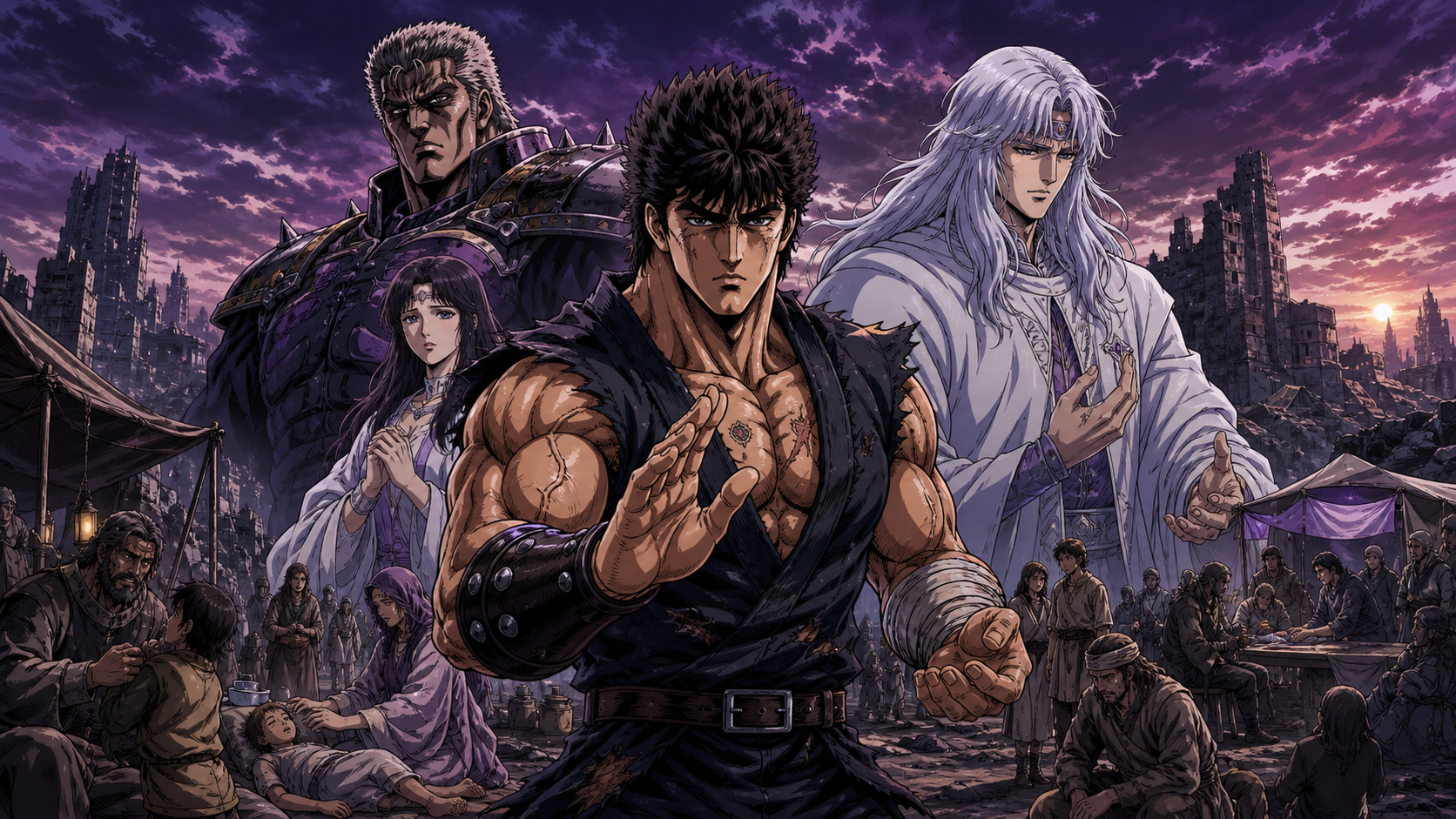
Legends of the True Savior Review: Five Stories Arguing Over Who Gets to Be Human
Retelling a legend is an argument about who was denied enough life the first time. Across three theatrical films and two OVAs, Legends of the True Savior revisits familiar events through Raoh, Yuria, Toki, and a not-yet-complete Kenshiro. The project adds feeling, history, women, caregivers, advisers, prisoners, and political machinery—then repeatedly risks pulling all that new humanity back toward the most powerful man in the frame.
Spoilers: This Review discusses all five works, their endings, and the complete adaptation strategy.
Five works released from 2006 to 2008 rebuild a known saga through missing viewpoints and original connective tissue
The official Hokuto no Ken archive presents the sequence as Raoh—Chapter of Death in Love, Yuria Legend, Raoh—Chapter of Fierce Fight, Toki Legend, and Kenshiro Legend. The cycle alternates theatrical films and OVAs while moving between retelling, added perspective, and completely original story.
The design matters more than release format. Raoh receives two theatrical chapters, Yuria and Toki receive interior OVAs, and Kenshiro closes the project with an original bridge before the manga’s beginning. Narrative scale already expresses hierarchy. The king receives the broadest spectacle; caregivers receive intimate correction; the savior receives formative explanation.
The cycle adds genuine humanity, produces major critical insight, and remains unable to stop prestige from flowing uphill
Legends is worthwhile because it refuses to treat canonical events as emotionally complete. Reina and Souga expose Raoh’s private circle, Yuria’s OVA gives her a life beyond waiting, Sara makes Toki’s medicine relational, and Gesso City turns Kenshiro’s public responsibility into a choice rather than an essence.
The same additions reveal the project’s gravitational problem. Women, healers, children, soldiers, and ordinary residents often become instruments for explaining legendary men. The retelling redistributes attention and then recenters charisma. Its best moments resist that motion; its weakest call the return “depth.”
The first chapter proves Raoh can love and therefore raises, rather than lowers, the standard of judgment
The Souther conflict already contains forced child labor, Shu’s sacrifice, Kenshiro’s defeat, and the emperor’s wounded rejection of love. Adding Reina and Souga lets the film examine Raoh as a person navigating another sovereign’s atrocity rather than an abstract rival waiting elsewhere.
Private tenderness cannot absolve public empire. Raoh’s capacity to value childhood companions proves he understands attachment and could imagine what conquest destroys for strangers. The film becomes powerful when intimacy sharpens that contradiction and indulgent when intimacy behaves like moral credit.
The OVA repairs perspective while revealing how easily agency becomes sacred passivity
Yuria’s childhood, unwanted foresight, relationship with Kenshiro, captivity under Shin, apparent fall, rescue, and acceptance of the Last General identity give her a chronology not reducible to absence. Meetings with Rei and Toki place her within the political journey occurring behind Kenshiro’s road.
The repair remains incomplete wherever compassion becomes her primary technology and destiny still tells her who she must be. A woman can be symbolically central while possessing little authority over movement, information, or the sacrifices made in her name. Perspective does not automatically equal freedom.
Raoh meets fear and equality in a beautiful ending whose political accounts remain open
Musō Tensei, Yuria’s identity, Fudoh’s protective masculinity, Giraku’s manipulation, Reina’s return, and the final duel create the cycle’s mythic center. Raoh discovers fear inside a body that built legitimacy by producing fear in others.
His final dignity is real. Redemption in a material sense is not. Fudoh’s children, former soldiers, occupied communities, and Yuria retain claims no raised fist can settle. The film’s greatness lies in making viewers grieve without giving grief the authority to erase consequence.
The healer’s OVA asks whether sacrifice is moral strength or a system that consumes the good first
Toki’s childhood, illness, relation to Ryuken, journey with Sara, healing work, and promised confrontation with Raoh turn the gentlest brother into the center of his own tragedy. Medicine appears as organized knowledge rather than mystical personality alone.
The OVA values care and risks sanctifying depletion. Toki’s goodness repeatedly expresses itself through accepting pain and shortening a life already constrained by illness. Sara can expose the limits of that ethic if her medical judgment matters beyond validating the beautiful sacrifice.
The final film turns inherited strength into public vocation by placing the successor beneath slavery and hostage rule
Set after Shin’s victory and before Bat and Lin, the original story wounds, captures, enslaves, and publicly punishes Kenshiro in Gesso City. The Yaman family, Dan, Fugen, Jugai, and Siska force him to decide whether future destiny justifies abandoning reachable people.
The choice to remain defines the savior more convincingly than another technique could. The film remains answerable to residents whose suffering becomes his moral education. A true savior enables their authorship and leaves without converting gratitude into a new kingdom.
Reina, Yuria, and Sara expand the saga and inherit disproportionate responsibility for translating male pain
Reina reads Raoh beneath Ken-oh, Yuria perceives wounded men while carrying prophecy, and Sara witnesses Toki’s illness and care. Each woman brings competence, knowledge, and emotional judgment absent from the masculine public image.
The cycle repeatedly asks them to make powerful men understandable. Their own agency depends on whether perception leads to choices, boundaries, and futures not organized by the man being interpreted. Emotional labor becomes narrative exploitation when understanding substitutes for being heard.
Every chapter tests whether attachment creates freedom, possession, sacrifice, or a private exception inside domination
Souther abolishes love after Ogai, Raoh rations it to an intimate circle, Shin possesses Yuria, Fudoh protects children, Toki heals strangers, Sara cares for the healer, and Kenshiro lets loss widen responsibility. Emotion has no automatic politics.
The cycle’s strongest claim is that love becomes humane through material arrangements. Who may move, refuse, rest, receive medicine, keep family, and survive disagreement? Feeling matters because power turns feeling into somebody else’s conditions.
The official archive anchors the five-work structure; the overall judgment remains independent
The Hokuto no Ken official movie and OVA archive establishes the release order, formats, story placement, new characters, and principal narrative additions across all five works from 2006 through 2008.
All comparative analysis of adaptation, gender, empire, medicine, slavery, grief, masculinity, consent, sacrifice, political authority, and reconstruction is independent CVM Sekai editorial criticism.
The cycle assumes familiar events were not empty but unevenly illuminated
Retelling through another character can recover motives, labor, and consequences hidden by the original protagonist’s route. Yuria’s meetings, Toki’s healing, and Raoh’s command circle all enlarge the saga without denying that Kenshiro’s journey already carried emotional truth.
Repair becomes meaningful when the new viewpoint changes judgment. Knowing that Reina loves Raoh should make conquest more accountable, not merely make the conqueror more attractive. Knowing Yuria acted behind the scenes should increase attention to her choices, not only explain how she waited correctly.
The project repeatedly reaches this threshold and retreats. It sees the missing person, gives them a voice, and sometimes uses the voice to deepen the legend who already possessed the center.
Theatrical scale flows toward Raoh and Kenshiro while Yuria and Toki receive intimate OVA correction
Format does not determine worth automatically, yet the distribution creates an argument. Raoh’s love and final battle receive cinemas, monumental compositions, and the broadest cultural ritual. Yuria’s prophecy and Toki’s care arrive through direct-to-video intimacy.
The difference can suit subject. Healing and interior memory benefit from closeness, while armies and final duels invite scale. Still, a franchise that photographs kings as landscape and caregivers as private feeling risks reproducing its hierarchy through aesthetics.
An overall judgment must ask what appears worthy of the largest frame. The answer remains power more often than care, even though the cycle’s ethics repeatedly insist that care defines true strength.
Yuria’s foresight and title make her central to history while allowing history to speak over her
Unwanted foresight isolates Yuria as a child and turns perception into burden. Later, the Last General identity converts her body into strategic meaning for resistance, Raoh, Kenshiro, and the Five Chariot Stars.
Destiny can dignify a character by placing her at history’s center. It can also make consent appear irrelevant because the role supposedly preceded choice. Accepting destiny becomes admirable only where refusal was imaginable and information was honestly available.
The OVA tries to write acceptance as agency. The wider cycle complicates that achievement whenever protectors, captors, and lovers continue arranging Yuria’s movement as though symbolic importance grants them jurisdiction.
Toki and Sara create the project’s clearest alternative to domination and expose how care can consume caregivers
Pressure-point healing reorients martial knowledge toward relief rather than victory. Toki reads bodies to reduce pain, while Sara supplies medical attention, companionship, and judgment around the healer’s own illness.
This pair gives the cycle an institution not organized by conquest. Patients approach with need, knowledge travels through treatment, and strength becomes the capacity to preserve another person without owning the result.
The danger is sacrifice worship. Toki’s goodness can become indistinguishable from endless depletion, and Sara can become the woman who witnesses a man choosing noble death. Care is sustainable only when healers remain entitled to care, limits, and futures.
Every major man suffers; the political difference lies in who must live inside his response
Souther makes grief into child labor and monumental denial. Raoh makes grief part of disciplined empire. Kenshiro lets grief widen obligation. Toki turns mortality into healing work, though his self-sacrifice raises its own ethical questions.
The cycle is strongest when it refuses to use pain as acquittal. A wounded ruler remains responsible for the systems his wound builds. A compassionate hero remains responsible for whether intervention transfers danger onto residents.
Grief becomes moral through direction, not intensity. The person who suffered most does not automatically deserve command. The important question is whose freedom expands or contracts around the grieving body.
The five works distinguish stoicism by what it protects, conceals, or permits other people to say
Raoh’s restraint guards the sovereign image. Kenshiro’s restraint increasingly creates attention. Toki’s softness resists the idea that gentleness weakens technique. Souther’s theatrical certainty tries to murder the dependent child inside him.
Similar bodies and low voices can therefore carry opposite ethics. Masculinity is not judged by whether a man cries, shouts, or remains still. It is judged by relationship: can he receive help, admit fear, honor refusal, and wield strength without converting gratitude into rank?
The project’s best answer is Fudoh. His size becomes shelter, children approach freely, and fear coexists with courage. The king spends an entire film learning what the caregiver already lives.
Yuria, Toki, Kenshiro, children, prisoners, and hostages reveal that domination works by controlling relation
Captivity across the cycle is not only walls and chains. Shin controls Yuria through possession, Souther controls children through labor, Raoh controls movement through military power, and Siska controls residents through detained families.
Each system weaponizes attachment. Escape becomes morally complicated because another person may pay. The captive is denied not merely space but authority over the meaning and consequence of connection.
Liberation therefore requires more than opening a door. People need restored relationships, information, resources, and the right to make choices without secret retaliation. The cycle often excels at the opening and compresses everything afterward.
Reina, Souga, Sara, Dan, Fugen, Jugai, and others test whether expansion creates lives or explanatory devices
Original additions allow the cycle to enter spaces the manga did not inhabit. Reina and Souga reveal Raoh’s private history, Sara accompanies Toki’s medical path, and Dan and Fugen challenge Kenshiro inside Gesso City.
Their success depends on independent trajectory. If Reina exists to prove Raoh can love, Sara to make Toki’s sacrifice sadder, or Dan to prepare Kenshiro for Bat, then expansion extracts humanity from new characters to enrich canonical ones.
The strongest additions resist that use. They possess knowledge the legend lacks, make choices he cannot own, and leave futures that remain imaginable after his chapter closes.
Young bodies become the project’s quickest proof of evil and its most demanding test of aftermath
Souther’s laborers, Fudoh’s household, Yuria’s wounded childhood, and children under Gesso City’s hostage system give vulnerability immediate form. Adults’ politics become undeniable when children carry stones, fear separation, or learn that love creates leverage.
The cycle risks making children symbolic evidence rather than people. A rescue scene can end while trauma, lost education, grief, and distrust continue. Heroic victory does not restore childhood automatically.
Fudoh offers the right standard. Protection succeeds when children can approach, rest, and grow without performing the protector’s greatness. The future is free when it no longer needs legendary intervention to remain ordinary.
Legends turns loss into technique, destiny, motivation, and spectacle while asking whether memory preserves difference
Shu, Ogai, Toki, Fudoh, Raoh, and many unnamed victims organize the living world after death. Musō Tensei makes relational memory physically decisive, a beautiful rejection of the isolated successor.
Memory can also appropriate. The dead may become achievements inside Kenshiro, lessons inside Raoh, or reasons Yuria accepts a role. Their independent purposes risk collapsing into the survivor’s development.
Ethical remembrance creates obligations the dead would recognize and retains names beyond usefulness. It asks how survivors live differently, not merely how beautifully loss was framed.
Raoh receives the cycle’s greatest attention because charisma keeps making power feel like the deepest place to look
Two theatrical films, recurring Reina material, Yuria’s relation to him, Toki’s promise, and Kenshiro’s final rivalry make Raoh the project’s gravitational center. The cycle wants to know what conquest costs the conqueror.
That is a legitimate psychological question and a political trap. Attention can imply that the ruler’s hidden pain is more complex than the visible pain of people beneath his army. Prestige flows toward the man already controlling the world.
The best Raoh material reverses the flow. His capacity for love proves accountability, fear proves common humanity, and final dignity remains separate from repair. Depth should increase judgment, not suspend it.
Kenshiro becomes distinct because he interrupts domination without claiming permanent ownership of the rescued
The cycle begins by placing him opposite Souther and ends by showing a wounded predecessor to the familiar wanderer. Across the project, Kenshiro learns, loses, receives care, fails, and repeatedly chooses people beyond private destiny.
Strength alone cannot define the savior because Raoh and Souther possess strength. The distinction lies in what victory authorizes. Kenshiro does not inherit Souther’s pyramid, Raoh’s army, or Gesso City as personal property.
This refusal leaves difficult aftermath and creates the cycle’s most democratic possibility. Communities must govern without a superior body settling every disagreement. The hero opens freedom and accepts that freedom will not belong to him.
Toki demonstrates that the strongest fist may be the one refusing to make another body into an enemy
Toki’s technique remains formidable, but his public vocation centers diagnosis and relief. He understands bodies intimately without treating knowledge as permission to dominate. This makes him the project’s ethical counterweight to martial sovereignty.
Illness complicates the image. Toki’s body needs care, and the franchise’s admiration for self-sacrifice can make receiving help look secondary to giving it. Sara’s presence should correct that imbalance.
The healer becomes fully human when limits matter. A politics of care cannot depend on one dying man exhausting himself beautifully. Knowledge must circulate, patients become participants, and caregivers remain worthy of survival.
Yuria’s ability to perceive suffering cannot become a sentence requiring endless emotional availability
Yuria recognizes wounded men, political danger, and futures others cannot see. Such perception gives her unusual authority and makes people seek meaning from her presence.
The gift becomes exploitation when everyone assumes she must understand captors, lovers, protectors, and rulers without demanding equivalent understanding from them. Compassion turns into unpaid governance of male emotion.
Agency requires opacity and boundaries. Yuria may withhold, refuse, misjudge, change her mind, or choose ordinary life over symbolic duty. A true savior respects those rights even when prophecy does not.
Reina tests whether competence inside empire can produce judgment strong enough to oppose imperial harm
Reina commands, fights, travels, seeks Toki, and reads Raoh’s private crisis. She expands the military world beyond anonymous men and gives loyalty a history rooted in the Land of Shura.
Representation inside hierarchy does not make hierarchy just. Her competence may enforce conquest while her love protects the conqueror’s emotional legibility. The character becomes most interesting where those facts conflict.
Agency appears when loyalty gains conditions. Can Reina name captivity, refuse destructive orders, or redirect military capacity toward protection? Without that possibility, armor becomes another costume for emotional service.
Sara can turn care from Toki’s personal virtue into a relationship with knowledge, disagreement, and limits
Sara sees the healer as a patient. That reversal matters because Toki’s moral image encourages everyone, including himself, to value the relief he provides over the body providing it.
Medical judgment may conflict with heroic destiny. Rest, treatment, and finite capacity can appear less noble than a promised duel. Sara’s authority becomes real when the story allows her disagreement to remain rational even if Toki chooses otherwise.
Her future should exceed mourning. A medical practice, transmitted knowledge, and independent work among survivors would make care institutional rather than dependent on one saintly man.
The cycle uses fists as philosophical language and sometimes lets philosophical clarity hide lethal convenience
Hokuto and Nanto techniques embody different relationships to knowledge, discipline, body, and inheritance. Combat is not decoration; ideas become visible through what fighters do under pressure.
The genre frequently supplies enemies whose continuing violence makes lethal intervention appear necessary. This protects heroes from longer questions about restraint, detention, rehabilitation, and collective judgment.
Precision remains the ethical standard. Force should distinguish commanders from coerced soldiers, stop immediate harm, and relinquish authority afterward. A spectacular death means little if the frame forgets the people it was supposed to protect.
Every chapter is more confident about ending domination than showing freedom become routine
Souther’s pyramid stops, Yuria accepts resistance leadership, Raoh dies, Toki’s care continues through memory, and Gesso City loses its coercive center. Each ending opens possibility.
Possibility needs institutions: water and food distribution, medical training, testimony, childcare, guard accountability, shared decisions, and memory that does not restore the ruler through nostalgia. These tasks rarely receive comparable screen time.
The absence reflects the savior form. Exceptional intervention produces climax; collective maintenance produces life. The project becomes most mature when viewers keep imagining the second after the first ends.
Recognition supplies emotional density and can protect beloved hierarchies from questions new stories should ask
Returning viewers bring attachment to Shu, Yuria, Toki, Raoh, Kenshiro, famous techniques, and iconic deaths. The cycle can compress because audiences already know what a look or name carries.
Nostalgia becomes conservative when it treats canon as morally settled. A new viewpoint should disturb familiarity, not simply add beautiful scenes around the same ranking of importance.
The project succeeds where memory becomes evidence under reconsideration. It weakens where reverence decides that humanizing Raoh is automatically deeper than individualizing the people his rule affects.
The sequence moves from a king’s hidden love toward a savior’s chosen obligation and never fully escapes the king’s shadow
Death in Love opens Raoh’s private circle. Yuria Legend restores the woman around whom men mobilize. Fierce Fight completes Raoh. Toki Legend centers care. Kenshiro Legend turns strength toward strangers.
This progression can be read as ethical decentralization. The project travels from imperial interiority through prophecy and healing toward public responsibility. Yet Raoh remains the largest emotional and theatrical reference.
The overall achievement lies in the argument between those motions. The cycle loves the king and slowly discovers that the savior is defined by refusing kingship.
The brothers embody two responses to exceptional strength: organize the world beneath it or place it beside the suffering
Raoh turns capacity into sovereignty. His body, army, advisers, and emotional discipline make order appear to radiate from one irreplaceable center. Toki turns capacity into treatment. He approaches bodies as lives requiring relief rather than territory requiring command.
Both models contain danger. Raoh’s is obvious: domination, fear, and dependence on a ruler’s private stability. Toki’s danger is depletion, where goodness consumes the caregiver and communities depend on one saintly body.
The sustainable alternative combines Toki’s purpose with institutions he does not have time to build. Knowledge must circulate, care must include the caregiver, and strength must remain accountable without becoming a throne.
Two women understand Raoh from unequal positions and should not be blended into proof that he deserved love
Reina shares childhood history and military service, giving her access to a man hidden beneath Ken-oh. Yuria encounters Raoh through rivalry, captivity, desire, and her political role as Last General. Their compassion arises within different power relations.
Reina’s loyalty may create influence while entangling her in empire. Yuria’s captivity makes every gentle response vulnerable to being misread as consent. Neither woman’s understanding grants Raoh ownership of the meaning.
The cycle becomes reductive if both exist to certify hidden goodness. Their judgments matter independently, including where love, pity, anger, fear, and refusal contradict the emotional conclusion the king wants.
One powerful man makes children safe enough to approach; another weak ruler makes families afraid enough to obey
Fudoh’s strength becomes atmosphere. Children rest around him because the body capable of violence remains predictably controlled. Safety is freely recognized rather than commanded.
Siska lacks comparable martial greatness and still controls a city through hostages, guards, records, and fear. His weakness does not protect anyone because institutions multiply private insecurity into public harm.
Together they dismantle the equation between physical dominance and authority. The moral measure is not how impressive the ruler looks. It is whether vulnerable people can live without becoming leverage.
Souther monumentalizes forced labor while Siska hides coercion inside administrative space
Souther wants atrocity visible. Children carry stone toward a structure meant to preserve his greatness beyond death. Violence becomes ceremony and architecture.
Gesso City’s cells operate differently. Hostages may remain unseen while forced soldiers perform apparent loyalty in public. Coercion works through private knowledge and the threat of consequences elsewhere.
The cycle therefore presents two political aesthetics: spectacle and secrecy. Liberation must expose both. Destroying the monument names visible power; opening records and cells reveals the hidden relationships that made obedience possible.
Both forms of mastery depend on relational knowledge, but one receives mythic glory while the other becomes quiet service
Musō Tensei emerges through sorrow carried across relationships with the dead. Kenshiro becomes difficult to strike because the isolated self no longer defines his movement. Mastery is collective memory.
Toki’s medicine also reads bodies relationally. Knowledge adjusts to pain, illness, circumstance, and the person receiving care. The healer’s success belongs partly to the patient’s continued life rather than to a public victory.
The franchise grants the ultimate combat technique greater spectacle, yet medicine may represent the deeper social future. A community needs healing every day; it should need Musō Tensei almost never.
The spectacular emperor and the ordinary general prove tyranny does not require one personality type
Souther builds ideology from grief, exceptional anatomy, martial power, and monumental ambition. Siska relies on hostages and administration. One wants history to worship him; the other wants compliance sufficient to maintain control.
Comparing them prevents viewers from locating oppression only in charismatic monsters. Institutions can make a mediocre man devastating, while charisma can make devastating rule feel profound.
Kenshiro’s opposition must therefore address actions and structures rather than aesthetics. The less impressive tyrant does not deserve less scrutiny, and the more psychologically rich tyrant does not deserve more forgiveness.
Two elders advise Kenshiro through sacrifice and strategic restraint, complicating what responsible mentorship means
Shu once saves the young Kenshiro through bodily sacrifice and later leads resistance against Souther. Fugen warns the wounded successor to preserve himself for a future larger than Gesso City.
Their counsel points in different directions. Shu demonstrates that reachable lives may require immediate cost. Fugen demonstrates that irreplaceable capacity can be wasted through impulsive martyrdom.
Kenshiro matures by carrying both. Responsibility cannot be reduced to always staying or always retreating. It requires honest assessment, collaboration, and ownership of consequences no teacher can eliminate.
Teachers shape political futures when succession rituals teach students what dependence means
Ogai’s final lesson turns Souther’s love into traumatic proof that attachment and mastery are enemies. Ryuken’s succession structure forces brothers into a hierarchy where one inherits and others must accept sealing or exclusion.
Neither educational system remains private. Souther builds a loveless empire, Raoh scales winner-takes-all succession into conquest, Toki renounces personal claim, and Kenshiro struggles to inherit without ruling.
The cycle’s politics begin in pedagogy. A school teaches more than technique; it teaches whether another person is rival, caregiver, subject, or partner. Future institutions grow from those relational assumptions.
Women beside legendary brothers can become witnesses, collaborators, critics, or emotional infrastructure
Reina operates inside Raoh’s military world and knows his private pain. Sara operates beside Toki’s healing journey and knows his medical vulnerability. Both possess specialized competence beyond romance.
The stories risk using them to translate men whose silence otherwise blocks access. Reina humanizes conquest; Sara makes sacrifice intimate. Their narrative labor can eclipse their own projects.
Agency appears when knowledge changes action. Reina should be able to challenge imperial harm, and Sara should be able to shape care beyond Toki. Understanding a man is not a complete life.
The cycle repeatedly shows attachment weaponized and must distinguish protection from possession
Shin takes Yuria because desire becomes entitlement. Raoh later captures her within another claim to love. Siska detains families to command residents. Scale and intimacy differ, but each system makes refusal ineffective through control of a valued person.
Protectors can reproduce the pattern more gently when they hide information or restrict movement “for safety.” The Last General’s guardians face this risk, as does any savior deciding what a vulnerable person should endure.
Protection becomes ethical through consent, transparency, and the ability to question the protector. Otherwise love remains another hostage technology with better dialogue.
Two choices leave expected roles because command structures cannot answer the human crisis
Reina leaves the straightforward military route to seek Toki when Raoh’s command cannot heal its own vulnerability. Kenshiro rejects Fugen’s strategic escape because future destiny cannot justify abandoning present captives.
Both acts recognize limits inside institutions that otherwise supply identity. The guard commander seeks care beyond the army; the successor chooses strangers beyond lineage.
The cycle’s moral movement often begins at such departures. A person acts ethically when loyalty, strategy, and title stop being complete answers and another life becomes binding.
Vulnerability becomes transformative only where the powerful man stops forcing other people to erase it
Raoh responds to fear by confronting Fudoh and arranging lethal protection for his image. Kenshiro responds to failed assassination through endurance, learning, and renewed responsibility inside Gesso City.
Both men experience threats to masculine certainty. The difference lies in transferred cost. Raoh initially asks soldiers and Fudoh to solve his shame. Kenshiro’s failure already endangers residents and should make him more attentive to shared strategy.
The cycle rejects invulnerability as the basis of strength. Growth begins when failure becomes information rather than an insult requiring somebody else’s body.
Beautiful endings can reveal truth and prevent the harder proof of living differently tomorrow
Raoh reaches fear, sorrow, equality, and dignity at the edge of defeat. Toki’s illness and promised confrontation make mortality central to his healing ethic. Both deaths concentrate a life into iconic meaning.
Death removes the possibility of regression and material repair. Raoh cannot dismantle empire; Toki cannot build sustainable care that protects healers. The final image can therefore feel more complete than the social world remains.
The living inherit the test. Reina, Sara, Kenshiro, patients, soldiers, and communities must translate revelation into structures. Otherwise death creates catharsis without continuity.
Original settings broaden the world when they create social histories rather than exotic backdrops
Reina and Souga’s shared origin gives Raoh’s inner circle memory older than conquest. Gesso City gives Kenshiro a political environment not directly inherited from the manga’s famous beginning.
World-building earns depth through institutions and people: how loyalty formed, how trade moves, how hostages are recorded, how residents survive, and what choices remain after leaders leave.
The cycle sometimes gestures toward these histories more than it inhabits them. Original places should not exist solely to explain canonical men. Their inhabitants deserve futures beyond franchise function.
Supporting men widen political scale when loyalty and local knowledge remain more than service to the hero
Balga and Red Orca connect Raoh’s final campaign to military and maritime networks beyond the duel. Dan connects Kenshiro to the lived map of captivity.
Each figure shows that legendary action depends on people who know routes, institutions, and survival conditions. Power without such knowledge is blind.
The narrative risk is absorption. Their expertise may become another asset credited to Raoh or Kenshiro. A fuller world remembers their motives, judgments, and post-legend choices.
Kenshiro Legend owns its invention while the other chapters negotiate with canonical expectation
The first four works revisit established lives and scenes, adding viewpoints around known destinations. Their suspense concerns interpretation: how will new knowledge alter meaning?
The fifth work invents a destination inside a canonical gap. Its burden is different. New suffering cannot rely on nostalgia, and new characters must feel consequential without breaking later continuity.
Together the formats show two adaptation strategies. Retelling tests memory; interquel tests plausibility. Both succeed only where additions create responsibility rather than decorative completeness.
New performances create a distinct project identity while asking audiences to hear familiar restraint differently
The Legends cycle does not merely reproduce the television era’s sonic memory. Its casting and theatrical/OVA production establish another register for Kenshiro, Raoh, Yuria, Toki, and the added characters.
Differences should be judged by function rather than loyalty contests. Kenshiro’s quiet must carry receptivity, Raoh’s command must fracture around fear, and women’s warmth must preserve judgment.
A cast reset becomes valuable when it clarifies the project’s viewpoint argument. It becomes superficial when prestige voices only make already powerful men feel more important.
Updated compositing and theatrical polish modernize bodies while ethical modernity depends on viewpoint, not texture
The cycle arrives decades after the television classic with new visual tools, release formats, and audience expectations. Cleaner surfaces, large-scale effects, and revised designs announce contemporaneity.
Modern appearance does not guarantee modern politics. Women can remain emotional infrastructure, children can remain symbols, and kings can remain the deepest people in a digitally polished frame.
The meaningful update occurs when perspective redistributes agency and consequence. A new cut matters less than a new question about who carried the old scene’s cost.
The cycle can welcome viewers through spectacle and should route them toward the people spectacle usually leaves behind
Raoh’s films provide familiar battles and iconic closure, making them powerful gateways. Yuria and Toki’s OVAs invite deeper interest in characters often discussed through their relationships to central men.
Kenshiro’s original finale creates another route by asking how the savior identity formed. As an ecosystem, the five works encourage movement between ruler, prophet, healer, and captive.
The best fandom design mirrors this structure with separate Reviews and Reacts, character profiles, voice actors, and lore. No post should stand alone because the project’s own value lies in relational reading.
The cycle coheres when every added viewpoint challenges ownership and fragments when humanization becomes an end itself
Across the works, powerful people repeatedly claim bodies, futures, knowledge, and meaning. Souther, Raoh, Shin, Siska, martial schools, and even protectors organize relation through hierarchy.
Yuria’s choice, Toki’s healing, Fudoh’s household, Kenshiro’s refusal of kingship, and residents’ survival suggest another model. Strength creates space for lives that remain their own.
This is the connective thesis capable of making the cycle whole. If humanization stops at understanding the powerful man, the anthology flatters. If understanding increases accountability and returns agency outward, the retelling earns its title.
The cycle becomes ethically serious when understanding a powerful man increases precision instead of dissolving judgment
Souther’s childhood, Raoh’s intimate circle, and Kenshiro’s defeat all invite empathy. Each addition explains how a person arrived at conduct the audience might otherwise classify through simple heroism or villainy.
Explanation becomes absolution when attention to injury replaces attention to consequence. The children beneath Souther’s pyramid do not become responsible for healing Ogai’s student. People beneath Raoh’s army do not owe special patience because Reina knows his heart.
The project’s finest moments hold both directions. A person can be wounded, loving, charismatic, accountable, and dangerous simultaneously. Complexity should make judgment more exact, not impossible.
Shu and Toki inspire because they give themselves, while the world they protect cannot depend on good people disappearing
Shu accepts death to protect children and preserve resistance. Toki spends a shortened life healing and approaches a promised duel with Raoh. Their sacrifices reveal values larger than self-preservation.
The franchise’s admiration risks turning depletion into the moral tax of goodness. Communities then learn to consume caregivers and resisters while calling the consumption noble. Sara and the surviving children expose the cost left behind.
Sustainable ethics asks how knowledge, protection, and responsibility circulate before one irreplaceable person collapses. A society should honor sacrifice by making the next sacrifice less necessary.
A role can carry genuine purpose and still become coercive when the person cannot meaningfully refuse it
Yuria’s Last General identity, Kenshiro’s succession, Toki’s promise, and Raoh’s self-appointed kingship all connect personal life to larger history. Destiny gives suffering a frame and action a direction.
The concept becomes dangerous when disagreement appears childish or impossible. Yuria may “accept” a role after protectors control information and alternatives. Kenshiro may be preserved for future lives at the expense of people suffering now.
Consent requires knowledge, alternatives, and the ability to revise. A chosen vocation remains alive; a predetermined identity turns the person into infrastructure for everybody else’s meaning.
New material should alter interpretation without pretending the original lacked every cause it now supplies
Reina, Souga, Sara, Dan, Fugen, and Gesso City enter a story whose iconic characters were already emotionally legible. The additions can reveal missing social worlds and give motives more texture.
The risk is retroactive vanity: the new project announces that it finally explains why Kenshiro cares or why Raoh feels. Original work had already created those truths through different means.
The best invention is additive and modest. It gives viewers another route into established behavior while allowing the older story to remain complete. Memory gains a layer rather than receiving a correction certificate.
Musō Tensei changes a fighter; freedom requires systems that remain after transcendent fighters leave
Kenshiro’s ultimate technique embodies relational sorrow and defeats the isolated sovereignty Raoh represents. The breakthrough resolves a martial and emotional conflict with extraordinary elegance.
No technique distributes food, trains healers, records testimony, protects children from retaliation, or teaches former soldiers to disagree without command. The social world needs repeatable practices rather than one sublime body.
The cycle repeatedly ends at transcendence because myth favors visible completion. Its politics begin where myth stops. A true savior makes institutions less dependent on saviors.
The camera’s distribution of faces tells viewers which suffering deserves individuality
Raoh, Kenshiro, Yuria, Toki, Reina, Sara, and major rivals receive expressive attention. Armies, laborers, patients, hostages, and residents often appear collectively. This difference shapes empathy before dialogue begins.
Collective representation is unavoidable at scale, but it can reproduce political hierarchy. The ruler’s fear becomes intricate while the crowd’s fear becomes atmosphere.
Added viewpoints should push the camera downward as well as sideways. A retelling that humanizes only secondary elites has widened the throne room, not the world.
The project grants iconic endings more readily than ordinary recovery
Raoh receives a completed death, Toki receives a tragic arc, Souther receives childhood explanation, and Kenshiro receives the road ahead. Fudoh’s children, freed laborers, patients, and Gesso City residents receive implication.
Aftermath is where ethical claims become testable. Can survivors make choices, care for one another, judge collaborators, and remember the dead without rebuilding hierarchy?
The cycle’s omissions do not invalidate its victories. They reveal its preference for personal completion over social duration. Criticism must keep the unfinished lives visible.
Raoh’s private tenderness shows that empire can protect an inner circle while treating strangers as categories
Reina and Souga receive memory, affection, trust, and access to doubt. Their presence proves Raoh’s rule is not built by an emotionally empty machine.
The exception becomes indictment. A man who understands loyalty and loss within the command circle can imagine what soldiers and conquered families experience. Selective humanity is a political choice.
Kenshiro’s savior ethic differs because strangers can become binding before intimacy forms. Love expands obligation rather than functioning as privilege distributed near the throne.
Toki, Sara, Fudoh, Yuria, the Yaman family, and Dan reveal that survival is organized between battles
Healing, sheltering, warning, carrying, feeding, hiding, and sharing information keep people alive while legendary men prepare for confrontation. These acts rarely receive the largest frames.
Care is political because it determines who has the bodily capacity to act and whether vulnerability becomes dependence on a ruler. Shared care can build horizontal trust where empire builds vertical permission.
The project’s ethical center may therefore lie outside its advertised spectacle. The savior is produced by a network of care long before the finishing blow makes liberation visible.
Yuria and Toki show how limited time invites other people to claim decision-making in the name of protection
Toki’s diagnosis influences succession and his own sacrificial choices. Yuria’s illness intensifies the urgency around reunion, captivity, secrecy, and the Last General role.
Concern can become control when caregivers and protectors decide what the ill person may know, risk, or refuse. Limited time should increase personal authority over remaining life, not transfer authority outward.
Sara’s medical voice and Yuria’s perspective can resist this pattern if the story lets them shape decisions. Illness does not turn a person into a moral resource for healthier people.
Raoh, Gesso City, and Souther demonstrate different ways fear travels through a population
Raoh produces fear as proof of order and later discovers it inside himself. Siska individualizes fear through hostages. Souther performs fear publicly through forced labor and execution.
These systems work because fear changes decisions before direct force arrives. People self-censor, comply, mistrust allies, and protect relatives within rules designed by power.
Liberation must restore the right to feel fear without surrendering dignity. Courage becomes collective when people can name danger, share information, and act without one person’s shame becoming everybody else’s punishment.
The five works compete over what the franchise remembers and whose memory becomes official
Raoh’s raised fist, Shu’s burden, Yuria’s waiting, Toki’s gentleness, and Kenshiro’s scars already occupy fandom memory. The Legends cycle adds hidden meetings, new companions, medical labor, and formative captivity.
Official memory can absorb additions selectively. Reina may remain as proof of Raoh’s love while ordinary soldiers remain unnamed. Sara may remain as proof of Toki’s path while patients disappear.
A richer archive remembers relationships without letting legends monopolize them. The person who carried the stone or opened the cell deserves history even when no iconic silhouette follows.
Reversed organs, radiation illness, scars, blindness, restraint, and muscular scale turn anatomy into contested meaning
Souther’s body disrupts expected technique, Toki’s body limits vocation, Kenshiro’s scars preserve defeat, Shu’s blindness records mercy, and Raoh’s size functions as political architecture.
The cycle can treat difference as tactical mystery, tragedy, evidence, or spectacle. Ethical reading locates moral judgment in conduct rather than anatomy. An unusual or ill body does not signify a corrupt soul.
Hokuto’s intimate bodily knowledge becomes humane where it heals or stops active harm. It becomes another sovereignty if the knower assumes every body exists to be mastered.
Pyramids, fortresses, clinics, cells, deserts, and homes show what power lets bodies do
Souther’s pyramid consumes labor, the Southern fortress protects and confines Yuria, Toki’s care spaces invite patients, Gesso City’s cells weaponize family, and Fudoh’s home permits children to relax.
Architecture materializes political relationships. A gate may secure safety or prevent escape; a monument may preserve memory or erase labor; a clinic may distribute knowledge or depend on one healer.
The cycle’s visual world becomes most meaningful when space changes after intervention. Freedom is visible when people cross boundaries by choice and occupy places no ruler controls privately.
Kenshiro’s wandering refuses sovereignty and risks leaving reconstruction underdeveloped
The hero enters, recognizes abuse, learns, acts, and moves onward. Departure prevents rescue from becoming ownership and distinguishes him from rulers who equate ability with title.
Leaving too quickly can abandon people inside the vacuum intervention creates. Former guards, scarcity, rival claims, and trauma remain after the tyrant falls.
The ethical departure supports transition without permanent command. It leaves resources, information, and local capacity strong enough for residents to choose futures Kenshiro does not script.
Intimacy gives Yuria and Toki space while limiting the scale at which their social worlds can unfold
The OVA format can concentrate viewpoint without fitting every moment into theatrical escalation. Yuria’s foresight and Toki’s care benefit from quieter attention.
Shorter scope also compresses institutions around them. The Last General’s resistance and Toki’s medical networks remain less developed than individual feeling.
The format is not an excuse or a defect by itself. It reveals production priority: interior repair receives room, but collective practice still competes with canonical milestones.
Raoh’s chapters show why power attracts even when the story knows attraction needs judgment
Armies, Kokuoh, monuments, final techniques, and skyward death create images designed to outlive argument. The films understand charisma sensually before they critique it intellectually.
This contradiction is productive. Tyranny that looked ridiculous would teach little about why people follow. Beauty becomes dangerous where awe closes inquiry.
The audience must perform the final ethical cut: admire the composition and look toward the bodies at its edge. The grandest frame should generate more questions, not the final pardon.
Artistic success and ethical success produce different orders
Fierce Fight delivers the strongest mythic completion, Death in Love creates the sharpest imperial contradiction, Toki Legend offers the clearest care ethic, Yuria Legend performs necessary perspective repair, and Kenshiro Legend makes public responsibility formative.
The order changes depending on measure. A film may be emotionally overwhelming and politically incomplete. An OVA may be ethically ambitious and structurally compressed.
The overall project should not collapse into one numbered list. Its value lies in how weaknesses in one chapter become questions another chapter can answer.
Yes, but attention moves sideways among major figures more reliably than downward toward ordinary people
Yuria and Toki receive centered works, Reina and Sara gain meaningful roles, and Kenshiro’s original film foregrounds prisoners and a city under hostage rule. The saga becomes broader.
Raoh remains the emotional and theatrical center, while laborers, patients, soldiers, and residents rarely receive equal individuality. The project repairs secondary centrality more than social hierarchy.
This partial success matters. The cycle opens doors later criticism and fandom can walk through. It does not finish the redistribution it begins.
The title belongs least to the strongest man and most to the practice of returning people to themselves
Raoh seeks order through ownership, Souther seeks invulnerability through domination, and Siska seeks survival through leverage. Their systems make other lives extensions of private need.
Toki heals, Fudoh shelters, Yuria resists reduction, and Kenshiro repeatedly refuses the throne victory offers. These actions create space where another person remains an end.
The cycle’s final definition is therefore relational. A savior is not the person everybody needs forever. A savior helps build a world where needing him becomes less necessary.
The cycle opens with its sharpest contradiction and nearly lets reverence solve it too easily
The first film successfully makes Raoh emotionally legible without denying Souther’s public atrocity. Reina and Souga give empire an intimate interior, while Shu and the children keep consequence visible.
Its strongest argument is that tenderness proves moral capacity. Its recurring weakness is the temptation to treat capacity as progress before Raoh changes what strangers experience.
Artistically, the chapter gives the project immediate scale and purpose. Ethically, it sets a standard later works must defend: the ruler’s heart matters because every other heart matters equally.
Necessary perspective repair creates a life behind waiting and remains constrained by sacred femininity
The OVA restores childhood, unwanted foresight, meetings, political observation, and acceptance of the Last General role. Yuria becomes more than the absent beloved toward whom Kenshiro travels.
The repair remains gendered. Compassion, prophecy, and quiet endurance define her more readily than anger, refusal, ordinary desire, or control of risk. Destiny provides agency through acceptance while limiting the imaginable terms of rejection.
The work is indispensable to the cycle because it changes the map. It is incomplete because being placed at history’s center does not automatically give a woman authority over history’s use of her.
The artistic peak gives Raoh the ending he deserves and leaves the empire’s survivors beneath the frame
Fear, Fudoh, Musō Tensei, Yuria, Reina, Giraku, and the last duel create the project’s most concentrated emotional architecture. Raoh’s final dignity feels earned because denial has finally become impossible.
The chapter understands recognition better than restitution. Fudoh’s children, soldiers, occupied communities, and Yuria retain moral claims that the raised fist cannot settle.
As myth, it is the strongest work. As politics, it remains magnetized by the king. That combination explains both its power and the need for criticism after tears arrive.
The ethical center of care remains vulnerable to a franchise that loves healers most when they die beautifully
Toki’s OVA expands childhood, illness, medical practice, Sara’s support, Ryuken’s succession decision, and the promised confrontation with Raoh. Healing becomes a vocation with relationships and cost.
The work challenges dominance by making bodily knowledge restorative. It risks turning sacrifice into the natural endpoint of goodness and Sara into a witness whose own future remains secondary.
Its value exceeds action ranking. Toki provides the social purpose the cycle’s martial philosophy needs: strength should reduce suffering without making the relieved person a subject.
The original finale gives the savior a credible political threshold and underwrites the city that supplies it
Gesso City places Kenshiro inside slavery, hostage government, failed rescue, public punishment, and dependence on strangers. His choice to stay transforms succession into obligation.
The film’s original characters and residents sometimes function as curriculum for the future icon. Dan, Fugen, the Yaman family, coerced soldiers, women, and children need more independent aftermath.
The chapter remains a worthy conclusion because it ends on public responsibility rather than ultimate combat. Kenshiro becomes the savior by refusing to let private destiny make reachable people expendable.
The cycle gives women perspective and competence while repeatedly assigning them responsibility for male emotional legibility
Yuria receives a centered OVA, Reina commands and acts, and Sara brings medical knowledge. These are meaningful expansions in a franchise where women often become destination, motive, or grief.
Each remains pulled toward a legendary man. Yuria interprets captors and lovers, Reina translates Raoh, and Sara witnesses Toki. Their insight risks becoming infrastructure supporting masculine complexity.
The ledger is mixed rather than empty. The project opens space and stops short of equal authorship. Fandom and criticism should continue where the screen retreats.
Kings and martial elites receive interiority while laborers, patients, captives, and soldiers carry systems collectively
Souther’s children, Raoh’s ranks, Toki’s patients, and Gesso City’s residents establish every political stake. Their bodies materialize scarcity, empire, illness, captivity, and war.
The cycle gives major figures names, histories, and contradictions more consistently than people below them. This is normal dramatic economy and also the hierarchy being criticized.
A retelling devoted to missing viewpoints could have moved further downward. Its partial redistribution remains valuable because it makes the absence newly visible.
The people who heal, shelter, carry, warn, and remember create more survival than the people who receive the final applause
Toki, Sara, Fudoh, Yuria, the Yaman family, Dan, Lin, and resistance networks keep bodies alive between celebrated clashes. Their work accumulates quietly.
The cycle often frames care as character virtue rather than infrastructure. That makes goodness beautiful and fragile, dependent on exceptional individuals who may die or move onward.
The lasting lesson should be institutional. Train healers, distribute knowledge, protect caregivers, and build communities where help does not require worship. Care is the true continuity between the five works.
Raoh’s interior growth is extensive; the material account of conquest remains deliberately unpaid
Two films explore love, hesitation, fear, advisers, loyalty, Yuria, Fudoh, and final recognition. Few villains receive comparable opportunity to become human without becoming harmless.
This attention removes excuses. Raoh can understand attachment, loss, fear, and dignity. The strangers his empire organizes as territory possess the same capacities.
The project should be praised for complexity and refused as absolution. A complete man can still build an unjust system. Completeness makes responsibility harder to evade.
Kenshiro earns moral authority where he refuses political ownership and remains vulnerable to hero-centered aftermath
He learns from defeat, accepts care, revises knowledge, carries the dead, stops tyrants, and repeatedly leaves liberated people outside his command. These habits distinguish strength from sovereignty.
His presence can still crowd residents out. The world waits for exceptional intervention, communities celebrate, and reconstruction remains implied. A savior story naturally centralizes the savior.
The corrective lies inside Kenshiro’s own ethic. Make local agency visible, leave practical capacity, and accept that freedom may produce choices he would not make. The true savior decentralizes his necessity.
The cycle documents one era’s attempt to modernize Hokuto no Ken without replacing the earlier forms
New casting, digital production, theatrical scale, OVA intimacy, and original connective material create a distinct artifact from the manga, television series, and 1986 film.
Preservation matters because adaptation history reveals changing assumptions about audience, gender, violence, prestige, and emotional explanation. Differences should not be flattened into a contest for definitive status.
Local metadata, source records, and clear work-by-work routing support that historical reading. A fandom ecosystem should help people compare rather than declare one version allowed.
No single Legends work functions as a perfect introduction, but the sequence rewards structured movement
Death in Love and Fierce Fight rely on familiarity while delivering immediate spectacle. Yuria and Toki’s OVAs deepen figures viewers may know incompletely. Kenshiro’s finale occupies a canonical gap.
First-time viewers may understand plot and miss accumulated emotional weight. Veterans may supply so much recognition that weaknesses become invisible.
The best route pairs the branch guide with separate Reviews and Reacts, then connects characters, voice actors, lore, and the original series. Fandom depth comes from navigation, not infinite scrolling.
The cycle improves when watched comparatively because motifs correct one another across works
Raoh’s private tenderness changes after Yuria’s perspective, Toki’s care changes the meaning of strength in Fierce Fight, and Gesso City changes how Kenshiro’s refusals read.
Rewatching exposes patterns that individual chapters hide: women translating men, children carrying political stakes, death preventing repair, and care making spectacle possible.
The project’s unevenness becomes productive. One work’s omission becomes another work’s question. The overall Review exists to keep those questions in conversation.
This dark cycle rarely offers relief, and relentless solemnity can make every feeling sound equally monumental
Hokuto no Ken has always used tonal variation, absurd scale, tenderness, and occasional humor to keep tragedy from becoming one continuous register. Legends leans heavily toward prestige seriousness.
Solemnity suits illness, slavery, forced labor, captivity, and death. It can also make ordinary people feel like witnesses in a cathedral built for famous men.
Small human rhythms—teasing, frustration, routine, awkward care—would deepen rather than cheapen darkness. Humanity includes more than the capacity to suffer beautifully.
Five compressed works repeatedly ask canonical recognition to supply development that new material still needs to earn
Known milestones arrive with stored emotion, allowing films and OVAs to move quickly. New companions and institutions compete against scenes audiences already anticipate.
Compression often favors the icon. Raoh’s ending, Yuria’s title, Toki’s duel, and Kenshiro’s future receive guaranteed destination. Original lives may be hurried toward usefulness.
The cycle remains coherent because thematic repetition supplies continuity. Its social worlds would benefit from more duration after the famous decision rather than more explanation before it.
The cycle recognizes consequences and still relies on spectacular force as the cleanest route through political complexity
Forced labor, hostages, illness, grief, and fear give combat material stakes. Kenshiro’s precision often directs violence toward active rulers rather than indiscriminate populations.
Finishing blows simplify transition. They remove a central threat and let stories close before questions of detention, collaborator judgment, and institutional reuse become unavoidable.
This is genre form, not automatic failure. The ethical requirement is honesty about what force can and cannot complete. A fist can open a future; it cannot govern that future justly by itself.
Every addition should answer whether people beyond the central legend become more real or merely make the legend richer
Reina and Souga pass when their histories expose complicity and fail when they function as certificates of Raoh’s softness. Sara passes when medical judgment has authority and fails when she only beautifies Toki’s sacrifice.
Dan and the Yaman family pass when care and local knowledge shape liberation and fail when they disappear into Kenshiro’s origin. Yuria’s OVA passes when choices become visible and fails when destiny absorbs them.
This test gives the overall Review its organizing standard. Humanization is not measured by added minutes. It is measured by redistributed moral reality.
“True Savior” should describe a relationship to freedom, not a bloodline or ranking of fists
Raoh can impose order, Toki can heal, Yuria can guide, Fudoh can shelter, and Kenshiro can interrupt domination. Salvation appears across different practices.
The title narrows around Kenshiro because he integrates strength, grief, learning, care, and refusal of rule. Even then, no one person saves a social world alone.
The truest savior is the network that returns people to agency and makes exceptional rescue less necessary. Kenshiro matters because he can join that network without claiming it.
A bold, uneven adaptation cycle becomes essential where it argues against the hierarchy its own beauty keeps rebuilding
Legends of the True Savior expands the saga through missing viewpoints, original companions, medical care, imperial intimacy, prophecy, fear, slavery, and formative failure. It gives old events new ethical pressure.
The project remains fascinated by Raoh and distributes full humanity unevenly across gender and class. Its most beautiful endings arrive before repair, and its most humane figures often spend themselves for others.
The cycle deserves deep recommendation because these contradictions are productive rather than empty. It loves the king, centers the healer, restores the woman, wounds the savior, and finally suggests that strength becomes true only when nobody is owned.
Watch the cycle for a fuller man and refuse the shortcut from full humanity to innocence
Two theatrical chapters and recurring relationships give Raoh fear, tenderness, strategy, memory, rivalry, and final dignity. The expansion is emotionally satisfying because the emperor never becomes a flat obstacle.
The correct response is not automatic pardon. A man capable of loving Reina, trusting Souga, fearing Fudoh, desiring Yuria, and recognizing Kenshiro possesses a rich moral vocabulary. His empire distributes that vocabulary selectively.
Raoh fans receive the best material when admiration and accountability remain together. The character grows larger when consequences remain visible, not when they are removed to protect the icon.
The OVA restores a life behind absence and should be read against every later scene that restricts her
Yuria’s childhood, foresight, meetings, rescue, political observation, and Last General identity create chronology beyond waiting for Kenshiro. Her perspective changes the saga’s map.
Viewers should still ask whether destiny offered real alternatives and whether compassion becomes an obligation to understand men who control her movement. Sacred centrality can coexist with practical confinement.
The work becomes liberating where Yuria chooses and limited where acceptance is the only respected form of agency. Her life deserves ordinary desires as much as prophetic importance.
The healer receives deserved focus and remains trapped inside the franchise’s love of noble self-erasure
Toki’s OVA clarifies training, illness, succession, medical practice, Sara, and the promise to Raoh. Care becomes the strongest philosophical alternative to conquest.
The tragedy should not teach that good people prove goodness by disappearing. Toki’s patients, Sara, and future healers need knowledge and institutions capable of surviving him.
Admire the sacrifice and interrogate the system that made sacrifice appear inevitable. The true continuation of Toki is not another beautiful death; it is care that no longer depends on one dying body.
The final film gives the wandering savior an ethical origin without claiming one missing chapter explains everything
Defeat, dependence, slavery, friendship, failed rescue, and Gesso City’s hostage system turn Kenshiro’s public vocation into a series of choices. He does not begin fully formed.
The original story works because it adds behavioral memory rather than a secret technique. Later attention to Bat, Lin, villagers, and coerced people can feel grounded in experience of needing strangers himself.
The limitation belongs to the residents whose suffering builds his formation. Kenshiro earns the road only where their freedom remains more important than his legend.
Use Legends as a set of perspectives, not a substitute for every version of the saga
The five works assume emotional and narrative knowledge they often compress. A newcomer can follow major conflicts while missing why Shu, Fudoh, Yuria, Toki, Raoh, and Musō Tensei carry decades of weight.
The cycle offers a compelling route into character questions: love and empire, prophecy and consent, medicine and sacrifice, captivity and public duty. Those questions should encourage movement toward the manga, television series, and other adaptations.
No definitive version needs to exist. Different forms reveal different relationships. Fandom becomes deeper when comparison replaces replacement.
Let familiarity increase scrutiny instead of filling every gap with affection
Veterans bring stored emotion capable of making compressed scenes land immediately. Recognition is one of the project’s greatest resources.
It can also shield beloved structures. Raoh’s charisma, Yuria’s sacred gentleness, Toki’s sacrifice, and Kenshiro’s centrality may feel natural because audiences have practiced those readings for years.
The new viewpoints invite a harder return. Ask whose labor supported the iconic scene, whose choice remained unheard, and what life continues after the famous ending.
It makes interiority more distributed among major characters and makes the remaining social imbalance impossible to ignore
Raoh gains intimates, Yuria gains chronology, Toki gains medical relationship, and Kenshiro gains formative captivity. The saga no longer looks like one solitary route through fixed supporting functions.
That expansion reveals another boundary. Laborers, patients, soldiers, hostages, children, and residents remain collective more often than the elites whose stories now deepen.
The cycle changes fandom usefully because partial repair exposes the next repair. Viewers can no longer claim the missing viewpoints were invisible; they must decide whether to follow them further.
It retains the franchise’s conviction that sorrow can humanize strength without requiring strength to become softness
Kenshiro, Raoh, Toki, Shu, and Fudoh remain physically formidable. Emotional depth does not arrive through humiliation or rejection of martial identity.
The distinction lies in relation. Sorrow can build empire, create care, open memory, or protect children. Strength becomes humane where feeling changes conduct toward other people.
This preservation matters. The cycle does not apologize for action. It asks action to answer a more demanding question than who wins.
Women’s emotional labor, class hierarchy, and missing aftermath remain structural rather than accidental problems
Yuria, Reina, and Sara receive meaningful space but remain heavily organized around male pain. Ordinary people provide stakes without equivalent interiority. Communities become free at the moment reconstruction begins offscreen.
These limitations recur across formats and cannot be blamed on one rushed chapter. They reflect what the project considers dramatic: famous feeling receives duration, collective maintenance receives implication.
The failure is not total. The cycle provides enough care, captivity, and resistance to reveal what is missing. Criticism completes no repair by itself, but it prevents absence from masquerading as resolution.
Humanization is ethically successful only when it increases what the audience believes a character owes
Raoh’s love means he can imagine attachment beyond himself. Yuria’s insight means protectors should hear her judgment. Toki’s healing means care must protect caregivers. Kenshiro’s captivity means strangers cannot remain abstract.
Each added layer creates obligation. If viewers use added depth only to soften judgment, the adaptation has produced prestige around power rather than moral understanding.
The overall Review therefore treats sympathy as a beginning. The final question is always material: what does this person’s power allow somebody else to keep?
The five works repeatedly approach one definition of justice: people are no longer instruments inside another person’s wound
Souther turns children into stone-carriers, Raoh turns territory into proof of supremacy, Shin turns Yuria into possession, and Siska turns families into military leverage.
Toki heals without ownership, Fudoh shelters without demanding worship, Yuria resists reduction, and Kenshiro leaves liberated people outside his command. These practices return ends to themselves.
Freedom is not gratitude toward the correct powerful man. It is the ability to live, refuse, remember, disagree, and organize without somebody else’s pain deciding the boundaries.
The project deserves an ecosystem because its meaning lives between works, characters, performances, and political questions
A single page cannot contain three theatrical Reviews, two OVA Reacts, the overall verdict, character profiles, Japanese voice actors, and lore without becoming a wall of disconnected links.
Image-led shelves and clear branch routing let viewers enter through Raoh, Yuria, Toki, Kenshiro, release order, or theme. Static cards make depth visible without infinite horizontal scrolling.
Navigation is editorial. Separating Reviews from Reacts tells readers whether they are entering completed judgment or immediate episode-level feeling. No post should stand alone because the cycle itself argues through relationship.
Keeping local canonical art, metadata, sources, and distinct pages protects interpretation as well as files
Each work needs a stable visual identity across featured image, hero, branch card, and social metadata. Consistency makes the route recognizable and avoids reusing one image until separate arguments blur together.
Source metadata preserves factual lineage while generated fan art remains clearly local and original. Official facts should anchor release history without dictating editorial verdict.
Preservation becomes useful when future editors can tell what belongs where, why a page exists, and how it connects. Filing is part of scholarship, not administrative garnish.
The title is earned collectively, not because the project proves one man was always destined to deserve it
Kenshiro integrates inherited strength, sorrow, learning, care, and refusal of sovereignty more completely than any rival. The final film makes that integration chosen rather than automatic.
He reaches the role through people who save, teach, warn, heal, resist, and survive. Yuria, Toki, Fudoh, Shu, Dan, the Yaman family, children, and communities participate in the vocation.
The “true” savior is therefore not a solitary biological answer. It is a relationship where exceptional capacity returns people to freedom and then accepts that their freedom no longer belongs to the rescuer.
Watch all five in release order, keep the individual Reviews and Reacts separate, and refuse to let the king consume the whole conversation
Legends of the True Savior is a bold, uneven, emotionally serious adaptation cycle. Its best work enlarges beloved characters by making responsibility harder. Its weakest work confuses added interiority with completed justice.
The cycle offers extraordinary material on love, empire, prophecy, medicine, fear, grief, slavery, masculinity, and vocation. It also leaves women, ordinary people, and reconstruction asking for more than prestige sympathy.
That tension makes the project worth getting lost inside. Love Raoh without pardoning conquest. Center Yuria beyond waiting. Honor Toki without worshiping depletion. Follow Kenshiro because he learns that the strongest fist is legitimate only when it gives the world back.
A deep fandom route should increase attention rather than bury characters beneath volume
More pages do not automatically create depth. Depth comes from relationships that let a reader move from Raoh’s Review toward Reina’s judgment, from Toki’s OVA toward Sara and medical ethics, or from Kenshiro’s captivity toward Gesso City’s residents.
Static image cards make those paths visible and finite. The reader can choose a branch, finish it, return, and understand where the next layer belongs. Infinite scroll turns curiosity into consumption without orientation.
The editorial standard mirrors the cycle’s best ethic. No post becomes property of the hub; every page keeps a distinct identity while participating in a larger world.
Completed judgment and immediate encounter should inform one another without pretending to be the same voice
The three theatrical Reviews examine complete films through research, structure, politics, and aftermath. The two OVA Reacts preserve chapter-specific response, surprise, frustration, and emotional cadence.
Combining them would flatten both. A React can admit what a moment feels like before every implication settles. A Review must return with evidence and judge what the whole work actually built.
The overall Review completes the triangle by comparing forms. Readers can move between immediacy, completed judgment, and franchise synthesis without one page impersonating all three.
Profiles should consolidate eras while preserving how each adaptation changes appearance, voice, and moral emphasis
Kenshiro, Raoh, Toki, Yuria, and others cross manga, television, films, OVAs, and the Remake. One profile should hold that continuity unless a version becomes fundamentally different.
Images can show older and newer designs without letting artwork dictate site colors. Japanese voice-actor changes should be explicit by era, and fan art should support interpretation rather than masquerade as official production imagery.
The Legends cycle matters within those profiles because it supplies specific additions: Reina and Souga around Raoh, Sara around Toki, Yuria’s hidden journey, and Gesso City within Kenshiro’s formation.
Japanese performance history deserves its own people-centered path rather than footnotes beneath characters
A character crosses eras because performers make different choices about breath, restraint, command, tenderness, and age. The Legends cast establishes a distinct sonic project beside earlier television and film performances.
Voice-actor profiles should remain real-person pages with clear Japanese credits and face-visible photography. A performer’s career is not reducible to serving one franchise.
Connecting characters to actors helps readers hear adaptation as interpretation. The route becomes another way to understand why familiar stillness can feel receptive in one version and imperial in another.
World, technique, and political guides should answer consequences that character-centered films leave between scenes
Musō Tensei, Hokuto succession, Nanto titles, imperial armies, prophecy, medicine, slavery, and postwar settlement all deserve explanation beyond plot recap. Lore becomes useful when it clarifies systems.
A guide should ask what a technique assumes about the body, what a title authorizes, how an army maintains supply, or how a city recovers after hostages are freed. Facts become doors into meaning.
This approach prevents the lore shelf from becoming trivia storage. The world matters because people must live inside its rules after famous fighters move on.
Rants and Tea should say plainly what reverent Reviews may need more space to prove
The cycle invites sharp positions: Raoh’s tenderness does not absolve empire, Yuria is not a prize, Toki’s death should not make depletion aspirational, and Gesso City owes Kenshiro no crown.
Editorial formats can isolate those arguments, add humor, and challenge fandom habits without repeating a ten-thousand-word Review. Their freedom depends on accurate research and visible evidence.
Tea earns its place when there is an actual receipt, contradiction, or fandom behavior worth examining. One good Tea is better than a shelf filled to satisfy symmetry.
Five stories earn their ecosystem when every route returns to the same nonnegotiable truth: no person is material for somebody else’s legend
Souther’s laborers, Yuria, Raoh’s followers, Toki’s patients, Fudoh’s children, Gesso City’s hostages, and every supporting character possess lives before a hero notices them. The cycle’s politics rise or fall according to whether the camera remembers that fact.
Raoh becomes deeper because love and violence coexist. Yuria becomes deeper because destiny and choice conflict. Toki becomes deeper because care and mortality strain each other. Kenshiro becomes deeper because dependence turns strength toward strangers.
The project earns recommendation where added humanity moves outward and deserves criticism where prestige pulls it back. A true savior does not make everybody part of his story. He protects the conditions under which they can keep writing their own.
The final verdict: Legends of the True Savior deserves to be watched as one sustained argument whose contradictions remain visible. It humanizes Raoh and makes his empire more accountable. It restores Yuria’s journey while showing how sacred roles can constrain women. It honors Toki’s medicine while revealing the danger of treating depletion as goodness. It wounds Kenshiro until inherited strength learns dependence, local knowledge, failure, and public obligation. The project does not distribute humanity evenly; kings and famous fighters still receive the richest interiors, while laborers, patients, soldiers, hostages, and residents carry political meaning in groups. That imbalance is the central criticism, not a footnote. Even so, the cycle moves the franchise toward a powerful definition of salvation: strength becomes legitimate when it interrupts ownership, returns people to agency, and refuses to turn rescue into a crown. Watch all five, follow every branch, admire the mythic beauty, and keep looking past the throne. The people at the edge of the frame are not evidence for someone else’s legend. They are the reason a savior matters.
That is why this cycle remains alive after its endings: every recovered perspective creates another responsibility, and every responsibility leads fandom away from worship and toward relationship.