
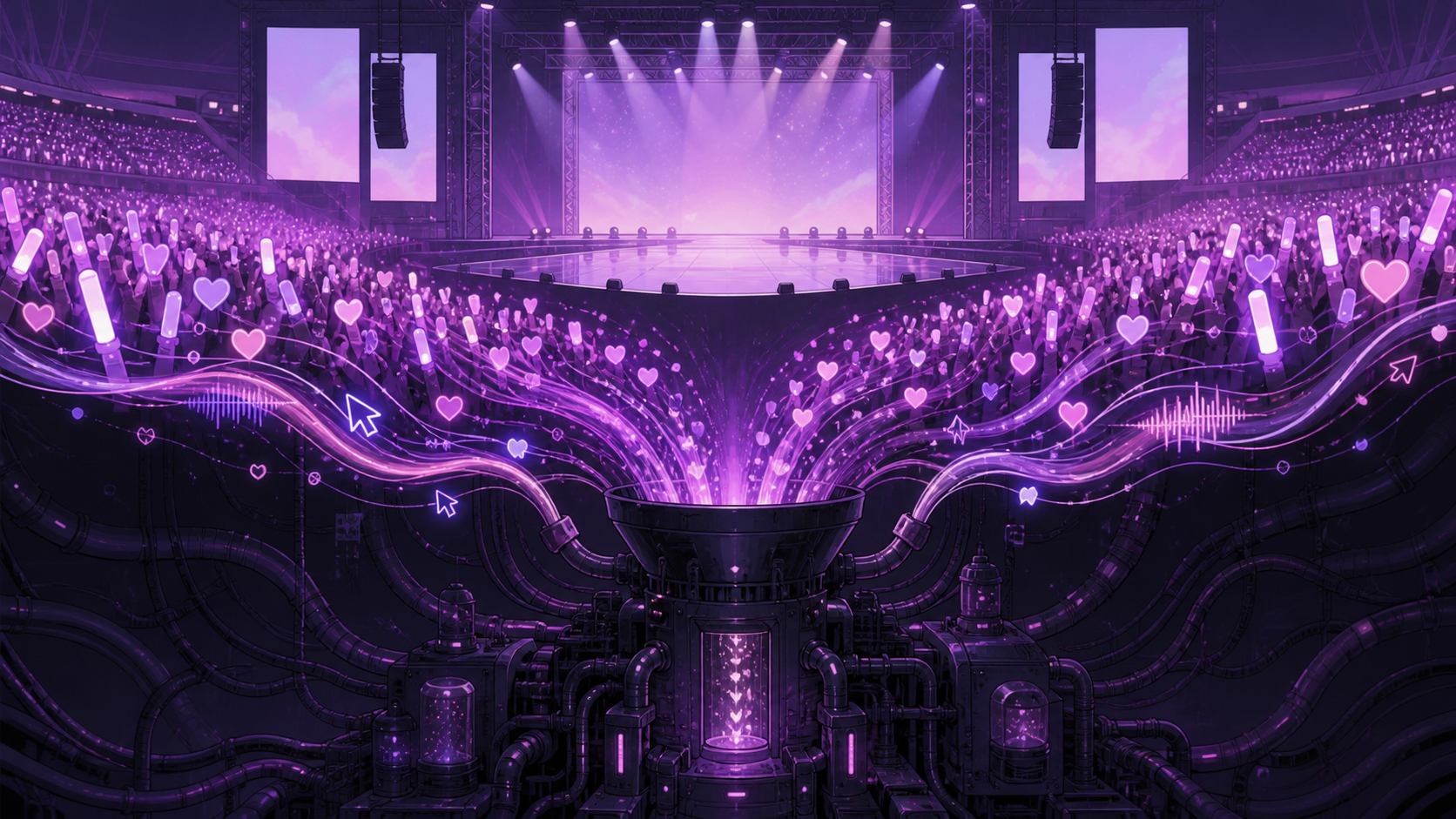
The Saja Boys Did Not Steal Attention. The System Taught Them How to Harvest It.
The Saja Boys are demons, which is rude but refreshingly honest once the faces change. The system around them is harder to spot because it looks normal. Debut. Teaser. Challenge. Chart. Fandom name. Rivalry. Awards stage. Repeat the hook until attention feels like proof of love and the person collecting that attention no longer has to explain what it is for.
Gwi-Ma does not invent fandom. He studies the machinery and removes consent from it. The Saja Boys offer irresistible personas, polished music, and the feeling of joining something together. Fans believe they are participating in a relationship. Gwi-Ma sees a delivery route.
That is why “they stole HUNTR/X's fans” is too small. Attention is not a purse sitting unattended near the chart. Fans move because the Saja Boys give them something engineered to move toward. The crime is not persuasion. The crime is converting affection into fuel while hiding the beneficiary.
“Soda Pop” is bait that knows it tastes good
“Soda Pop” works because the film does not make evil music boring. The sweetness is precise. The choreography, styling, voices, and member personas create a product people would reasonably enjoy before they know the supernatural contract underneath it.
Calling listeners foolish would let the system escape. The performance is designed by people who understand how hooks, repetition, visual focus, and group chemistry move through an audience. Pleasure is not evidence of moral failure.
The Saja Boys weaponize quality. The song does not distract from the plot. It demonstrates how extraction becomes easier when the offer is genuinely appealing.
Manufactured sweetness is still real work
The Saja Boys' image is artificial in the literal sense: demons construct human idol personas to accomplish a plan. Yet the performance requires labor. Choreography must align. Vocal parts must land. Styling differentiates five members quickly enough for fans to choose favorites.
The movie understands that manufactured does not mean effortless. A persona can be strategically designed and still require skill to perform.
The ethical problem begins when labor serves a hidden structure that treats the audience as a resource. Artificiality is not the crime. Deception about the exchange is.
Five personas turn one group into multiple entry points
Jinu leads with heartthrob authority. Abby offers exposed strength. Mystery uses concealment. Romance performs flirtation. Baby weaponizes cuteness. Each persona gives a different viewer somewhere to attach.
That range is not accidental decoration. Idol groups often distribute recognizable positions and energies so the collective can reach people through different preferences. The Saja Boys turn that familiar architecture into supernatural targeting.
Gwi-Ma does not need every fan to desire the same thing. He needs every desire to lead toward the same collection system.
Bias culture becomes dangerous only after ownership enters
Choosing a favorite member can be playful, social, and creatively rich. Fans notice voices, gestures, style, humor, or a quality that feels personally resonant. The attachment belongs to the fan.
Gwi-Ma's plan treats that choice as consent to surrender. He converts preference into access and access into ownership. The fan believes she selected a bias. The hidden system believes it acquired a soul.
The movie is not condemning attachment. It is asking who benefits when an industry encourages identity-level devotion and whether the fan can still control the boundary.
The Pride sounds like community because community is the product
The Saja Boys' fandom receives the name The Pride. A fandom name tells scattered listeners they belong to one another. It can turn private enjoyment into jokes, projects, friendships, and collective celebration.
Gwi-Ma wants the collective feeling without the mutual care. The name gathers people into a recognizable body he can harvest. Community language becomes a funnel.
The manipulation works because belonging is valuable. People are not weak for wanting it. The villain is the authority that offers belonging while designing the room as a feeding mechanism.
Attention is labor even when the fan is having fun
Fans stream, share, subtitle, explain, clip, vote, buy, organize, defend, and keep the conversation alive between releases. Much of that work feels enjoyable because it grows from affection and community.
Enjoyment does not make the output imaginary. Attention creates visibility. Visibility affects charts, coverage, opportunities, and the perceived size of a market. The industry can profit from actions it never directly paid to produce.
Gwi-Ma's supernatural feast makes the invisible extraction visible. The souls are exaggerated. The underlying question is familiar: who owns the value fans create together?
A chart records movement without explaining the relationship
Bobby checks charts because rankings affect HUNTR/X's career. The numbers can show that attention shifted toward the Saja Boys. They cannot explain whether the shift came from curiosity, genuine enjoyment, manipulated exposure, fandom competition, or demonic influence.
Metrics flatten different human actions into comparable units. One stream becomes equivalent to another even when the listener's reason differs completely.
Gwi-Ma loves that flattening. A system focused only on volume will celebrate growth while ignoring where the attention ultimately goes.
The sudden rise becomes its own advertisement
Once the Saja Boys begin climbing, success makes them more visible. People encounter the group because other people are encountering the group. The chart does not merely report popularity. It helps produce more popularity.
Momentum can become circular evidence. They are important because everyone is watching, and everyone should watch because they are important.
The demonic plan accelerates through a mechanism the industry already rewards. Nobody has to ask whether the underlying relationship is healthy before offering the next stage.
Rivalry gives both fandoms more reasons to work
The Saja Boys' arrival threatens HUNTR/X professionally and supernaturally. The rivalry encourages comparison, defense, argument, and urgency. Every response generates more attention around the contest.
Fans may believe they are protecting their chosen group. The platform and industry receive increased activity either way. Gwi-Ma benefits when the emotional temperature rises high enough to make attention constant.
The enemy is not one fandom caring too much. It is a structure capable of monetizing and weaponizing conflict while pretending it is merely observing preference.
HUNTR/X cannot solve extraction through a better diss track alone
“Takedown” makes sense as a hunter response. Identify the demons, attack the threat, and mobilize the group's strength through music. It also keeps HUNTR/X inside the rivalry's terms.
If the problem is attention being harvested, producing a more aggressive competitive spectacle can feed the same environment. Winning the chart would not automatically return agency to fans.
The group needs truth, not only superiority. The final song succeeds because it changes the relationship with the audience rather than merely defeating the rival performance.
“Your Idol” removes the sweetness and keeps the contract
Netflix's official soundtrack guide explains that “Your Idol” prepares fans for Gwi-Ma to feast. The black hats, demonic styling, and hypnotic performance reveal the destination hidden beneath “Soda Pop.”
The earlier song invites. The later song claims. What sounded like flirtation becomes command, and what felt like community becomes surrender.
The transition is effective because the contract did not suddenly appear. It was built through repeated attention while the audience believed the exchange remained entertainment.
The word idol becomes literal at the worst possible time
Pop culture uses idol as a professional category. “Your Idol” activates the older religious meaning of worship and devotion. Gwi-Ma wants the metaphor to become infrastructure.
Fans are encouraged to place feeling above themselves, toward figures designed to appear worthy of surrender. The villain waits behind the figures as the authority receiving the offering.
The film does not argue that admiration is worship by default. It shows how someone can manipulate the language of admiration until boundaries disappear.
Gwi-Ma understands scalable intimacy
The Saja Boys perform as though each fan receives something personal. Camera angles, gestures, lyrics, and member archetypes create the feeling of direct recognition across a massive audience.
That feeling is not automatically fake. Art can reach an individual through a screen. The danger comes when the system uses intimacy to demand actions the artist cannot reciprocate or even see.
Gwi-Ma scales the sensation and centralizes the benefit. Millions feel individually addressed. One demon receives the combined energy.
Parasocial does not mean stupid
People use parasocial as an insult whenever fans care about someone they do not personally know. That shortcut avoids examining how modern entertainment deliberately produces familiarity.
Artists speak to cameras, share routines, perform vulnerability, and maintain recurring contact. Fans respond to the relationship format offered to them. Most understand that the relationship is mediated and unequal.
Gwi-Ma's scheme works by breaking the remaining boundary. He treats emotional response as proof that the fan has surrendered ownership. The fan's intelligence is not the missing safeguard. Consent is.
The Saja Boys are workers inside the extraction system too
Jinu and the other members serve Gwi-Ma. Their personas help capture souls, but their own souls are also owned. They participate in harm from inside coercion.
That position does not erase responsibility. It does complicate the clean division between exploitative artist and exploited fan. Both can be used by an authority controlling the larger structure.
Jinu's eventual resistance matters because he stops accepting victimhood as permission to keep creating victims.
Jinu designed the strategy and remains accountable
Jinu proposes using a rival boy band to weaken HUNTR/X and reach fans. He understands performance, attention, and the vulnerability of the Honmoon. The plan requires intelligence and active participation.
Gwi-Ma owns his soul and manipulates his shame. Jinu still makes choices inside that coercion, including choices that hurt Rumi and the audience.
The film allows both truths. Accountability without context becomes punishment theater. Context without accountability becomes another excuse for the extraction to continue.
The other four Saja Boys are not empty accessories
Abby, Mystery, Romance, and Baby receive less interior development than Jinu. Their stage functions still reveal how the system distributes desire. Each member performs a role larger than the individual information viewers receive.
That imbalance is part of the scheme. Fans can feel they know a persona before knowing a person. The image is detailed enough to support attachment and incomplete enough to hold projection.
A sequel or additional story could examine whether the members possessed histories and choices beyond service. The first film does not provide enough evidence to invent them.
Cuteness is not innocent when it becomes camouflage
Baby Saja's bottle, small cap, surprise rap, and spice-challenge victory create an adult performer using toddler-coded gestures as a concept. The persona is funny because he commits completely.
The scheme turns cuteness into lowered defenses. Fans read harmlessness while the group participates in soul theft.
That does not make cute concepts morally suspicious. It demonstrates that any aesthetic can become camouflage when the audience is encouraged to treat appearance as evidence about intention.
Mystery sells access by withholding it
Mystery Saja's face remains hidden behind long hair. Concealment creates curiosity and invites fans to search for the reveal. Absence becomes content.
The persona demonstrates that attention does not require constant disclosure. A system can generate activity by controlling scarcity and promising access later.
Fans perform the interpretive labor, filling the gap with theories, art, and desire. Gwi-Ma receives value from what he refuses to provide.
Romance turns affection into a repeated gesture
Romance Saja uses hand hearts and flirtation to make intimacy instantly legible. The gesture is designed for cameras, clips, and fan memory. It can be repeated endlessly without belonging to one relationship.
That repeatability is the point. Scalable affection feels personal while remaining efficient enough for mass distribution.
The ethical line appears when the gesture becomes evidence of a debt. Fans can enjoy the fantasy without owing the performer, company, or hidden demon unrestricted access to their attention.
Abby proves the body can become a marketing sentence
Abby's exposed torso and muscular design communicate his concept before he speaks. The body becomes a fast promise about strength, confidence, and visual pleasure.
Fans are not wrong for noticing. The system arranged the image to be noticed. Pretending desire appeared spontaneously would erase the design labor behind it.
The problem is not looking. It is a structure that treats every look as material available for collection beyond the viewer's chosen exchange.
Fan service can be generous or extractive
Fan service is not automatically manipulation. A callback, gesture, costume detail, or moment of direct acknowledgment can reward attention and strengthen community. The artist gives fans something legible because the relationship matters.
Extraction begins when every gift hides an escalating demand. Watch again. Buy again. Defend harder. Prove loyalty. Keep the metric moving or accept that you failed the people you love.
The Saja Boys collapse that progression into supernatural horror. Their service creates pleasure while moving fans toward a feast they never agreed to join.
The airport and schedule chaos reveal another attention economy
HUNTR/X already lives inside constant visibility before the rival group appears. Travel, performance, public recognition, and Bobby's frantic management show that audience demand has physical consequences.
Attention creates opportunity, but it also compresses time. The group must remain available to the next stage while secretly fighting for the safety of the people requesting access.
The film understands fame as labor before Gwi-Ma weaponizes it. That groundwork prevents the supernatural plot from feeling pasted onto K-pop decoration.
Bobby manages demand without controlling its source
Bobby can schedule, negotiate, bring tea, and push the group through a crisis. He cannot decide how many people suddenly want HUNTR/X or how a rival changes the market around them.
His breathlessness makes demand visible. Every number on the chart becomes another conversation, and every public reaction becomes a problem the manager must translate into action.
The Saja Boys increase that pressure intentionally. Bobby responds with ordinary professional tools to a supernatural system built to make ordinary response insufficient.
Rumi's crisis becomes content before it becomes care
Public figures rarely receive private breakdowns. A strained voice, missed appearance, or visible mark can become speculation immediately. The audience and industry ask what happened before the person has language for the answer.
Gwi-Ma benefits from that speed. Rumi's secret can be framed, exposed, and circulated in a way that maximizes shame. Attention lands on the revelation before care can form around the person.
The system does not have to hate Rumi. It only has to find her crisis engaging.
Outrage and devotion feed the same dashboard
Fans supporting HUNTR/X and fans attacking them may believe they are doing opposite things. Platforms can count both as activity. Argument keeps names visible, clips circulating, and rivalry emotionally urgent.
Gwi-Ma's scheme understands that negative feeling remains usable. He controls through misery as readily as desire. A person does not have to love the Saja Boys peacefully to remain trapped in the attention loop.
That is why “ignore them” can be strategically sensible and emotionally impossible once identity and community attach to the fight.
The awards stage centralizes attention by design
An awards show gathers artists, fans, rankings, spectacle, and industry authority into one event. It is the perfect place for the Saja Boys to convert accumulated attention into mass capture.
The stage promises recognition. Who won? Who belongs at the center? Which fandom can demonstrate the greatest power? Gwi-Ma turns those questions from promotional drama into supernatural infrastructure.
The location works because competition already taught everybody to look in the same direction at the same time.
Black hats turn styling into ritual architecture
The “Your Idol” performance uses black hats and demonic visual language that Netflix's soundtrack feature describes as paranormal spectacle. Styling stops being an accessory and becomes part of the mechanism.
Repeated shapes organize bodies, hide faces, and create collective identity. The audience does not simply hear a command. It enters a visual environment built to make surrender feel grand.
This is why animation matters. Color, silhouette, camera movement, and choreography can show attention being organized before the plot explains what the organization serves.
The camera teaches viewers where desire should land
K-pop performance is built for cameras as well as stages. Close-ups assign emphasis. Formation changes move status. Editing converts simultaneous choreography into a sequence of individual invitations.
The Saja Boys exploit that grammar. Each member receives moments designed to activate a different kind of attachment, while the group image remains coherent.
Viewers do not passively discover charisma. The production directs the encounter with extraordinary precision. Gwi-Ma's crime is hiding ownership behind the direction.
“What It Sounds Like” breaks the extraction loop
HUNTR/X's final song does not win by offering a more perfect version of the same idol bargain. Rumi, Mira, and Zoey sing from fracture, accountability, and renewed relationship.
The audience's response is not harvested upward toward a demon overlord. Feeling circulates between artists, friends, and listeners. The group offers truth, and fans contribute belief without disappearing inside it.
Reciprocity changes what attention can do. It becomes support rather than surrender.
Honest art still influences people
Rejecting manipulation does not require pretending art should leave audiences unmoved. “What It Sounds Like” is designed to produce feeling. HUNTR/X needs listeners to respond.
The difference is not influence versus no influence. It is whether the relationship preserves agency and tells the truth about what participation serves.
Fans can be moved, persuaded, and gathered without becoming property. Emotion is not a consent form for everything that follows.
The final audience is allowed to give rather than be taken
Gwi-Ma treats souls as resources he can seize through engineered devotion. The finale allows the audience to offer energy through chosen connection.
Giving and taking may produce similar visual power, but the ethical structure is opposite. One recognizes the participant. The other recognizes only the yield.
The movie's optimism depends on believing mass feeling can remain communal even after a manipulator proves how easily it can be captured.
Fandom literacy is a better defense than fandom shame
Mocking fans for caring will not make the machinery disappear. Shame can drive participation underground, where boundaries become harder to discuss and exploiters face less scrutiny.
Fandom literacy asks practical questions. Who created this request? What does the metric measure? Is urgency real? What happens if I do not participate? Does the community allow rest, disagreement, and multiple interests?
Gwi-Ma wants fans too ashamed or overwhelmed to examine the exchange. Clear language returns choices to them.
No artist is owed proof through exhaustion
Fans often organize because they want an artist to receive recognition. That desire can become a demand aimed sideways at other fans. Stream harder. Vote longer. Buy another copy. If the result fails, somebody did not love enough.
The Saja Boys' supernatural system makes the endpoint obvious, but ordinary pressure can already consume time, money, sleep, and joy.
Support should not require self-erasure. An artist worthy of affection does not become the owner of every available hour.
No fandom is a single obedient body
The Pride appears as a powerful collective, but every fandom contains different ages, resources, cultures, motivations, and levels of participation. Treating the group as one body makes it easier to command.
Metrics encourage that flattening. A fandom becomes a number competing with another number. Individual consent disappears inside the aggregate.
Healthy community leaves room for the casual listener, the intense archivist, the artist, the critic, the person taking a break, and the fan who says no.
HUNTR/X also benefits from fan labor
The moral distinction between HUNTR/X and the Saja Boys should not hide the fact that HUNTR/X's career also grows through attention. Fans help make “Golden” powerful in both chart and supernatural terms.
The group protects listeners and does not intend to feed them to a demon. That matters enormously. Reciprocity still deserves examination. Protection cannot become an excuse to demand endless devotion from grateful fans.
The transformed Honmoon should support a healthier relationship, not simply declare one group worthy of the same extraction.
The industry will imitate what succeeds
The Saja Boys rise quickly because their package produces results. An entertainment system following metrics would respond by requesting similar concepts, promotional strategies, and engagement patterns without knowing the supernatural source.
That imitation is how harmful design outlives one villain. A technique proves profitable, so the machinery preserves it after forgetting why it appeared.
A sequel could explore the residue of the Saja Boys phenomenon. Defeating Gwi-Ma does not automatically teach executives or platforms to stop rewarding captured attention.
The artists need boundaries from the system too
Jinu and the other Saja Boys are perpetrators inside Gwi-Ma's ownership. HUNTR/X is also pushed by mission, management, fans, and inherited expectation. Different forms of power act on both groups.
Artists need the ability to refuse access, pause performance, and exist beyond the persona. Otherwise the system consumes them while asking them to smile at the people it is also consuming.
Bobby can become part of that defense if his management protects people rather than only opportunities.
A sequel should ask what happened to The Pride
Fans manipulated by the Saja Boys do not stop existing when the battle ends. They may remember devotion, fear, missing time, public behavior, or grief for performers revealed as demons.
The story owes them more than background recovery. What does accountability look like when the artists were also controlled? How does a community rebuild after discovering its belonging was designed as a trap?
Those questions would let the franchise treat fans as characters in the world rather than a magical battery that changes color after the heroes sing.
The Saja Boys should not return only because fans want the faces
The group became enormously popular outside the film. That popularity creates pressure to restore them in a sequel. The irony is perfect and dangerous.
Bringing them back can work if the story addresses ownership, responsibility, and identity beyond the concepts. A reset that restores the pretty personas without consequences would repeat Gwi-Ma's logic: attention is valuable enough to erase what happened.
Fan desire deserves acknowledgment, not automatic obedience from the story.
Popularity is evidence of connection, not moral innocence
The Saja Boys' songs are effective, the designs are appealing, and the personas inspire real creativity among viewers. None of that makes the fictional scheme harmless.
Likewise, a popular real-world strategy is not ethical simply because many people participate. Scale can demonstrate pleasure, need, marketing power, or social pressure. It cannot settle the moral question by itself.
Charts tell us where attention went. Criticism asks what happened to the people who gave it.
RaeRae's verdict
The Saja Boys did not sneak into a fandom bedroom and steal attention from a jewelry box. They walked into a system built to reward engineered intimacy, urgency, competition, repeated proof, and scalable devotion. Then Gwi-Ma attached a soul funnel to it.
I am not blaming fans for liking “Soda Pop.” The song did its job so well that half the audience would have joined The Pride before HUNTR/X finished identifying the threat. That is the point. Pleasure is not consent to hidden extraction.
The ending works because HUNTR/X changes the exchange. “What It Sounds Like” does not ask fans to surrender harder to the correct idols. It allows truth to move outward and support to move back without ownership. Keep that relationship in the sequel. Let fandom be loud, creative, ridiculous, and intense. Just let the people inside it remain people.
Official production sources
Netflix Tudum's official soundtrack guide explains the narrative roles of “Soda Pop,” “Your Idol,” and “What It Sounds Like,” including that the Saja Boys prepare fans for Gwi-Ma to feast during “Your Idol.” Netflix's official cast guide identifies Gwi-Ma's plan to use Jinu as a Trojan horse and credits the Saja Boys as a demonic rival group created to challenge HUNTR/X.
Netflix's official Baby, Romance, Mystery, and Jinu character files establish the Saja Boys' personas, relationships, voice performers, service to Gwi-Ma, fandom name, and key appearances. Netflix's official film guide documents HUNTR/X's premise, the creative team, the chart-screen reference, and the film's music-centered production.
Those sources establish production facts. The analysis of fandom labor, scalable intimacy, chart feedback, platform incentives, consent, parasocial language, collective identity, and sequel accountability is RaeRae editorial interpretation of the completed film.