
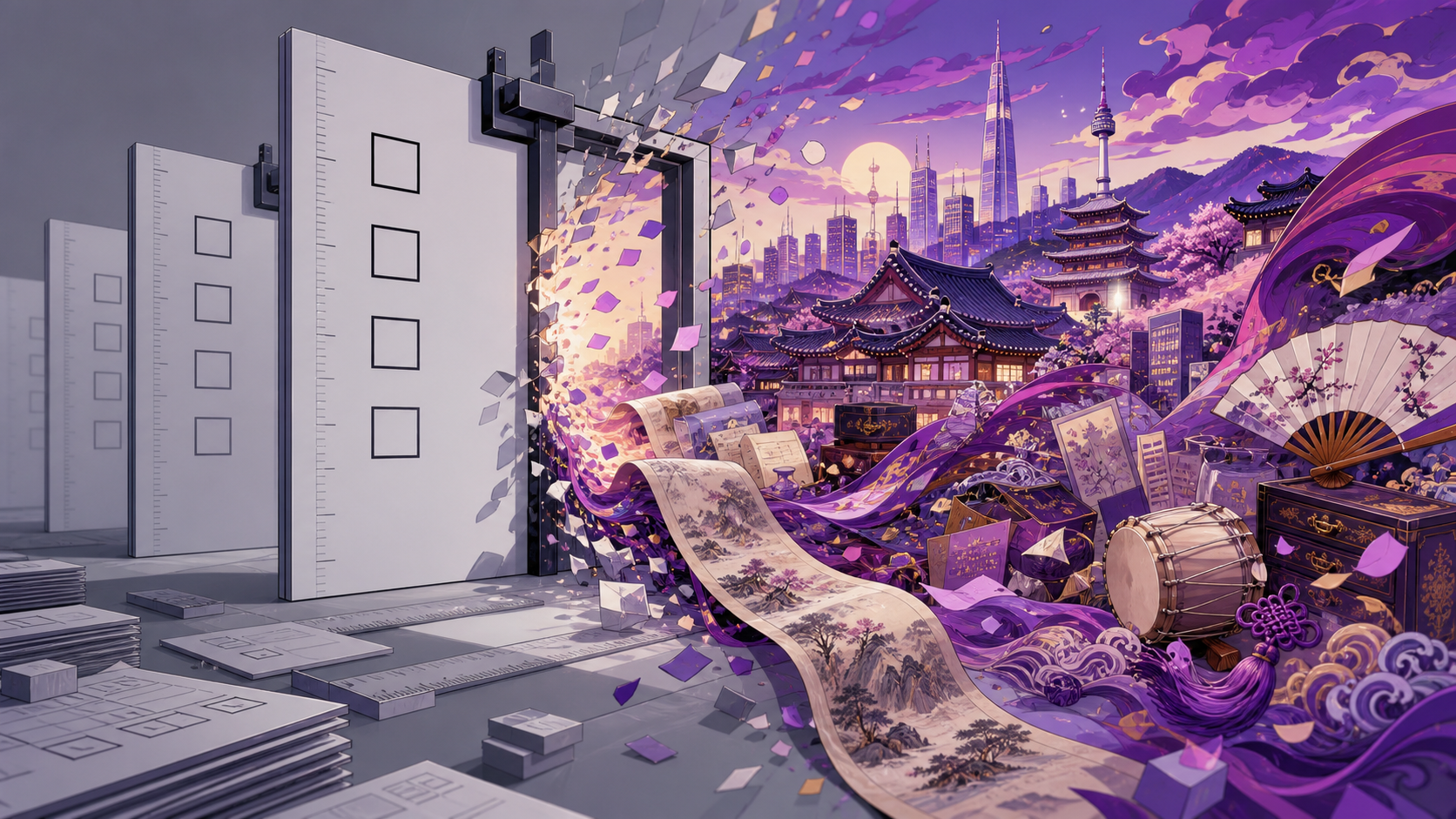
Stop Making Culturally Specific Stories Pass an Extra Test
Some people meet a Korean animated movie and immediately reach for a clipboard. Is it universal enough? Did it explain every object? Will somebody in another country understand the joke? Is the mythology accurate to one clean source? Should the food, language, clothing, music industry, spiritual imagery, and Seoul streets wait politely while an imaginary default audience receives orientation?
Nobody asks culturally generic stories to justify every unspoken rule before the plot begins. A castle can exist. A prom can exist. A superhero city can blow up for the seventh time. The audience is trusted to learn through context or remain briefly confused. KPop Demon Hunters deserves the same trust.
The Korean details are not homework pasted around a universal story. They are how this particular story thinks. Remove them and the plot does not become more accessible. It becomes less itself.
Specificity is not a barrier somebody forgot to remove
The film locates HUNTR/X inside Korean popular culture, visual tradition, food, language, architecture, and supernatural imagination. Those choices are not obstacles between the audience and the characters.
Specificity gives viewers something solid enough to enter. Rumi is not a blank motivational heroine. She leads a K-pop trio, inherits a Korean-coded hunter tradition, moves through Seoul, and fights a demon whose name and imagery participate in a particular cultural vocabulary.
Audiences understand emotion through detail all the time. Confusion about one reference does not cancel recognition of shame, friendship, ambition, grief, or a song that hits too hard.
“Universal” often means familiar to the person holding the budget
The word universal sounds neutral until we examine which stories receive the label automatically. Familiar Western structures are allowed to appear without explanation because decision-makers already know the shorthand.
A Korean detail may be treated as narrow simply because the evaluator has to learn something. The burden moves from the unfamiliar viewer to the story, which is ordered to become less specific rather than trusting curiosity.
That is not universality. It is familiarity wearing a more respectable outfit.
The movie explains through action, not a cultural tour guide
KPop Demon Hunters rarely stops so one character can lecture another about the world they both inhabit. The Honmoon, weapons, music, food, performances, and city spaces gain meaning through use.
Viewers learn that songs strengthen a barrier because they watch it happen. They understand the tiger and magpie as supernatural companions before knowing every artistic reference behind them. Context arrives in layers.
This is ordinary storytelling competence. Demanding a glossary before allowing the plot to move would make the film less inviting, not more.
The tiger and magpie can be funny before you know the painting tradition
Maggie Kang has discussed Korean folk-art influence on the tiger and magpie. Viewers familiar with minhwa may recognize a deeper visual conversation. Other viewers meet an expressive tiger and a sharp little bird whose behavior communicates immediately.
Both experiences are valid. Cultural knowledge adds texture without functioning as an entrance exam.
The extra-test mindset assumes a reference fails unless every viewer receives identical information. Art has never worked that way. Recognition can arrive now, later, or during the fifth search tab after the movie ends.
Curiosity is part of pleasure, not evidence of exclusion
I do not need a movie to answer every question before I am allowed to enjoy it. Sometimes the unanswered question is what keeps the story alive after the credits.
Why that hat? What does the name mean? Is the creature connected to an older image? Which food did they just destroy in three seconds? Curiosity turns viewing into relationship.
Treating every search as remediation misunderstands fandom. We look things up because attention created appetite, not because the story failed a standardized test.
Korean food is character behavior before it is cultural information
The official Netflix food guide catalogs ramyeon, snacks, drinks, kimbap, soup, and other items moving through the film. Onscreen, food first tells us how HUNTR/X lives.
They eat with urgency, pleasure, exhaustion, and group familiarity. The choices establish routine around people whose lives include stadiums and demon attacks. Food makes the extraordinary characters physically ordinary.
A viewer does not need a recipe to understand hunger after work. The specific dish deepens the moment rather than blocking it.
K-pop is not glitter placed over a fantasy template
The songs perform narrative work. “How It's Done” introduces competence. “Golden” carries aspiration and Rumi's impossible demand. “Soda Pop” packages seduction. “Your Idol” reveals consumption. “What It Sounds Like” rebuilds connection.
The industry structure also creates the plot's public stakes. Charts, fandoms, performances, personas, and awards are mechanisms Gwi-Ma can exploit because they already organize attention.
Replace K-pop with generic celebrity and the story loses both its musical grammar and its sharpest metaphor.
The camera understands how idol performance communicates
Formations, close-ups, styling, gesture, member position, and rapid shifts between group and individual focus make K-pop legible through images. Animation exaggerates that language without treating it as parody.
The camera tells viewers where charisma lands and how a group creates one identity from distinct people. The Saja Boys use the same grammar for manipulation.
This is cultural specificity operating as cinematic structure. It cannot be removed while leaving the story untouched.
The Korean language does not owe every viewer invisibility
Names, signage, lyrics, honorific relationships, and small verbal textures help locate the characters. Translation can support access without pretending the source language is noise to be cleaned away.
Global audiences already watch stories containing invented languages, technical vocabulary, and unexplained slang. Korean words are not uniquely threatening.
The audience can read context, use subtitles, and learn. Respect does not require instant mastery.
A mixed audience will never know the same things
One viewer recognizes K-pop industry details. Another knows Korean folk imagery. Another arrives through animation. Another understands the family shame before any lore. Somebody else came because the soundtrack refused to leave the chart.
No version of the film can equalize those starting points. Trying would flatten every detail into a generic explanation nobody needed in the same way.
Good storytelling creates multiple routes through the work. It does not force every viewer onto one guided path.
Korean viewers are not cultural consultants sitting inside the audience
A Korean viewer can laugh, cry, dislike a song, question a choice, or enjoy a demon tiger without producing a public lesson for everyone nearby.
Representation discourse sometimes turns the represented audience into unpaid interpreters responsible for validating each detail. That is another extra test.
People deserve to encounter a story connected to their culture as viewers first. Explanation can be generous. It should not become an obligation attached to recognition.
Accuracy is serious, but culture is not one frozen answer key
Creators should research. Critics should identify harmful invention, lazy conflation, and false claims. Cultural respect matters.
Respect does not mean every artistic choice must reproduce one uncontested version of tradition. Folklore, religion, popular culture, design, and family practice contain variation. Animation also transforms sources through character and story.
The responsible question is what the film draws from, how it changes the material, and whether it admits invention. The lazy question is whether one website can certify the whole thing.
The Honmoon is invented, and that is allowed
The Honmoon functions as the film's supernatural barrier strengthened through song. It draws on Korean visual and spiritual cues without presenting itself as a documented ritual audiences should copy.
Confusing invented mythology with cultural fraud leaves no room for fantasy. The film can build a new system from specific artistic influences.
Criticism should maintain the boundary clearly. Explain what production sources identify. Avoid turning the fictional barrier into a claim about all Korean belief.
Gwi-Ma participates in language without becoming a folklore worksheet
Netflix's Korean-spirit guide notes that gwi is a root associated with ghosts or malevolent spirits and connects the name Gwi-Ma to that broader vocabulary. The film's demon remains its own character.
We can recognize the linguistic resonance without claiming every aspect maps neatly onto a traditional being. Names can evoke a field of meaning rather than provide a taxonomy label.
The extra-test approach wants a one-to-one answer because ambiguity feels unsafe. Art often works through resonance instead.
Cultural specificity does not guarantee cultural perfection
A story can be deeply specific and still deserve criticism. Korean creators are not automatically beyond error. Representation can include exclusions, simplifications, or commercial compromises.
The point is not to protect KPop Demon Hunters from analysis. It is to stop demanding that it prove the right to exist before receiving the ordinary range of analysis granted to other popular films.
We can praise the tiger, question the hunter doctrine, love the songs, and ask for more history about Celine in the same conversation.
The film should not have to represent every Korean story
One movie cannot contain an entire country, diaspora, industry, spiritual tradition, gender experience, and generational argument. Demanding total representation turns specificity into another impossible performance.
KPop Demon Hunters tells a story about these characters through selected cultural forms. Its success can create appetite for more work rather than allowing the industry to declare the category completed.
The answer to limitation is more stories, not forcing one franchise to become an encyclopedia.
Diaspora recognition can be intimate and incomplete
Viewers outside Korea may recognize family pressure, food, language fragments, music, or the experience of translating oneself across audiences. Recognition does not require every detail to match one household.
Diaspora is not a single distance from an authentic center. People carry culture through different languages, generations, migrations, and levels of knowledge.
A movie can open a door without certifying who belongs on either side of it.
Rumi's mixed identity makes cultural purity a dangerous demand
Rumi is both human and demon. The hunter system responds by asking her to hide the demon part and imagine its eventual removal. The personal conflict mirrors the extra cultural test in an uncomfortable way.
Both demand a cleaner identity before acceptance. Be legible. Be safe. Remove the part that requires the audience or institution to revise its categories.
The finale rejects purity as the price of protection. Criticism should not reinstall purity as the price of representation.
The movie trusts Korean women to be funny and furious
Rumi, Mira, and Zoey are not arranged as flawless ambassadors. They eat wildly, argue, misread each other, perform confidence, become jealous, hide, panic, and fight beautifully.
That mess is representation too. Marginalized characters are often asked to remain admirable because one bad decision may be treated as evidence about an entire group.
HUNTR/X receives the freedom to be specific people instead of a respectable presentation deck.
Mira does not have to explain why her directness is acceptable
Mira's confidence and sharpness are allowed to create friction. The story gives her family wounds and loyalty without turning every edge into a lesson about the correct way to be Korean or feminine.
She can be wrong in the crisis and still return. She can read people well and miss the secret closest to her.
Complexity is the opposite of representation built only to avoid criticism.
Zoey complicates belonging across cultures
Zoey's Korean American identity gives her another route into the group's cultural world. Her warmth, language, and insecurity do not reduce to a simple bridge for Western viewers.
She belongs inside HUNTR/X while sometimes feeling too much and not enough. That tension resonates beyond one cultural category without becoming generic.
The specificity gives the emotion shape. It does not trap the emotion inside one audience.
Celine carries history without becoming an exposition machine
Celine is a former idol, hunter, trainer, manager, adoptive mother, and link to Rumi's biological mother. Her presence tells us the tradition has passed through Korean women across generations.
The first film leaves much of that history unstated. I want more. Wanting more is different from declaring the existing character inaccessible.
A sequel can deepen the old group's music, clothing, hunter practice, and relationships through story rather than making Celine recite a cultural manual.
The Saja Boys use tradition and modernity in the same frame
Jinu's Joseon-era history, demonic realm, contemporary idol styling, and modern Seoul career do not belong to separate cultural shelves. The film allows them to collide.
That collision reflects how culture actually moves. History survives through image, language, memory, reinvention, and commercial form. Modern pop does not erase tradition, and tradition does not make modern performance less authentic.
The extra test often demands one clean time period. KPop Demon Hunters is more interested in what old shame does inside a new industry.
Jinu's bipa does not need to become a lecture
Netflix's food guide identifies the traditional instrument Jinu plays while struggling to support his family. The bipa locates his musical life before the bargain and connects talent to a history older than idol fame.
The object carries narrative meaning even if a viewer does not know its name during the first watch. He makes music with the one possession available to him. Gwi-Ma turns that vulnerable craft into a promise of status.
Learning the instrument's name later adds knowledge without retroactively rescuing a failed scene.
Historical poverty is not decorative tragedy
Jinu's family story uses deprivation to explain the opening Gwi-Ma exploits. The demon tells him he is not good enough for his mother and sister, converting material conditions into shame.
The historical setting matters because access to power, food, and mobility shapes the bargain. Fame appears as escape from a social position, not merely personal vanity.
Flattening the scene into a universal “be careful what you wish for” tale would lose the pressure that makes the wish understandable.
Modern Seoul is allowed to be fantasy space
Western cities regularly host superheroes, monsters, portals, and apocalypses without anyone worrying that fantasy use makes them less real. Seoul deserves the same imaginative freedom.
The city can be recognizable and stylized, everyday and supernatural. Transit, rooftops, streets, stages, bathhouses, and homes become part of an animated action world.
Representation is not limited to realist drama designed to educate outsiders about ordinary life. Korean settings can hold nonsense, spectacle, romance, and demon choreography.
The bathhouse joke works through situation before explanation
HUNTR/X charges into a men's bathhouse while pursuing demons. The scene uses space, embarrassment, action, and timing. Viewers understand the collision without needing a documentary interruption.
The location also gives the fight texture unavailable in a generic warehouse. Bodies, modesty, steam, tile, and cultural expectations all shape the comedy and movement.
Specific space produces specific action. Removing it for supposed accessibility would make the sequence less readable because the joke depends on where everyone is.
The food comedy refuses delicate representation
HUNTR/X eats like people who fought demons and missed a meal, not like ambassadors posing beside cuisine for a brochure. The speed and appetite are funny because the characters abandon performance polish.
That choice matters for young women in a story about idol image. Food is pleasure and fuel, not a moral test attached to femininity.
The cultural detail remains present without requiring reverence. Affection can include mess.
Music translation does not require emotional translation
Songs may move among Korean and English lyrics, global pop structures, and culturally specific references. Listeners will catch different layers depending on language and context.
Emotion still travels through melody, performance, story placement, and visual rhythm. Translation can deepen access, but the original does not have to disappear for feeling to become legible.
The film trusts the audience to hear before it understands every word. Pop music has crossed borders that way for generations.
Global success did not prove specificity was secretly universal
The film's enormous international response is sometimes used to argue that the story succeeded because its themes were universal after all. That compliment can repeat the same bad framework.
Specificity and broad connection are not opposites. Viewers connected through the details, not after filtering them out. The songs, designs, food, tiger, magpie, Seoul, and K-pop machinery traveled with the emotions.
Success proves audiences can meet a story where it lives. It does not require renaming the location as universal territory.
Industry praise should not turn one hit into a formula
Once a culturally specific work succeeds, companies often copy the visible ingredients. Add mythology. Add pop music. Add food. Add a cute animal connected to folk art. The result may reproduce objects while losing the relationships that gave them meaning.
KPop Demon Hunters works because music, identity, shame, fandom, and supernatural structure affect one another. The details are not interchangeable decorations.
Supporting specificity means supporting creators with points of view, not ordering another basket of approved cultural markers.
Cultural consultation is not a substitute for authorship
Consultants can identify problems, provide research, and help a production work responsibly. They should not be used as a stamp allowing decision-makers to strip a story down elsewhere.
The creative team needs authority to make choices, revise them, and maintain the cultural logic across departments. A detail cannot remain meaningful if writing, design, music, and marketing pull it in unrelated directions.
Responsibility is a process, not a credit line deployed after the fact.
Critics can provide context without grading authenticity
Good criticism helps readers notice what production sources, history, and visual traditions reveal. It distinguishes documented influence from interpretation and invented lore.
Bad criticism appoints one reviewer to certify whether a work is Korean enough, accessible enough, or representative enough for everyone. No critic possesses that authority.
The goal is a richer conversation with evidence, not a purity score attached to culture.
Fandom research can honor the source without freezing it
Fans will trace the tiger and magpie, learn about names, study lyrics, compare clothing, and build theories around the Honmoon. That activity can deepen appreciation.
Research becomes careless when speculation is repeated as cultural fact or when living traditions are treated as a box of lore available for fandom ownership.
We can be enthusiastic and precise at the same time. Say what the film invented. Cite what creators identify. Leave room for multiple cultural readings.
The subtitle is not a punishment
Some viewers treat subtitles as evidence that a work requires extra effort. Reading is a mode of access, not a moral injury. Dubbing is another mode, and KPop Demon Hunters uses a multilingual voice and singing structure that makes performance credits worth understanding.
No version will reproduce every linguistic texture identically. That is normal. Translation involves choices.
The audience can select a route without demanding that the source erase every sign of translation.
Voice performance carries cultural and emotional texture
The cast includes Korean and Korean diaspora performers across central roles. Voices bring rhythm, familiarity, comedy, and emotional history that cannot be reduced to a demographic checklist.
The singing voices and speaking voices also cooperate to create characters whose music must feel like credible K-pop performance. That structure deserves transparent credit.
Representation is not only who appears in a still image. It includes who shapes the sound and how the production values that work.
Korean American viewers do not need one approved reaction
Some will feel recognized. Some will question details. Some will love Zoey most. Some will be tired of explaining K-pop to relatives. Some will simply want the Saja Boys back because fictional judgment has temporarily left the building.
No community owes a unanimous review to prove a film's cultural value. Disagreement is evidence that the audience contains people rather than a representation panel.
The work should be strong enough to survive affection and criticism from the same viewer.
Children can handle unfamiliarity better than anxious adults think
Young viewers regularly learn invented power systems, character rosters, game rules, and fantasy geography without demanding advance certification. They use repetition, context, questions, and play.
A Korean food item or folk-art reference is not more difficult than a fictional demon barrier. Adults often project their own discomfort onto an audience already prepared to learn.
Trusting children means giving them stories with texture and allowing curiosity to develop without turning every detail into a lesson.
Accessibility and flattening are not synonyms
Accessibility can mean strong context, thoughtful translation, readable design, useful metadata, and pathways for readers who want more information. CVM Sekai should provide those pathways.
Flattening removes specific language, history, or style because somebody assumes difference itself is inaccessible. That approach offers less information while calling the result easier.
The site can welcome a new viewer through clear writing without talking as if the story must apologize for being Korean.
This is why the franchise belongs under Korean Animation
The classification is not an attempt to police national ownership or deny the international production partnership with Sony Pictures Animation and Netflix. It identifies the cultural and narrative center the film openly claims.
Korean Animation helps users find the story through the site's origin filter and connects it with future coverage that may use different production models while remaining culturally grounded.
Taxonomy should support discovery. It should not pretend one label explains every collaborator.
The sequel should become more specific, not less
Global success creates pressure to broaden, simplify, and repeat the most recognizable pieces. The sequel should resist that fear. Give us more of Celine's generation, Rumi's family history, hunter practice, Seoul life, and the cultural consequences of a changed Honmoon.
Specificity will also prevent the mythology from becoming a generic expansion of power levels. New details should change relationships, not merely add larger demons.
The audience already proved it can follow. The production does not need to retreat.
More Korean animation should follow without becoming copies
The best result of success would be more room for Korean animated stories with entirely different genres, aesthetics, audiences, and ambitions. Not twelve projects forced to reproduce idol demon hunters.
One hit often becomes a narrow gate through which every later work must pass. That is another extra test. New creators are asked to resemble the successful example while proving they are original.
An ecosystem allows difference. A formula permits only variation around the approved product.
The audience can be welcomed without being centered
Welcoming writing provides context, defines terms when useful, and avoids treating knowledge as a status contest. It does not make the least familiar viewer the center of every creative decision.
There is a difference between opening a door and rebuilding the house around the visitor. KPop Demon Hunters opens plenty of doors through emotion, comedy, music, and action.
The visitor can enter with humility. The story does not owe ownership in exchange for attention.
RaeRae's verdict
If I have to look up the tiger and magpie after the movie, congratulations, the movie gave me something to do besides stare at the credits and pretend I am emotionally stable. Curiosity is not exclusion. A Korean story does not fail because somebody outside Korea learned a new noun.
I want accuracy. I want production receipts. I want critics to separate invented Honmoon lore from living traditions and stop repeating fandom theories as cultural fact. I do not want that responsibility twisted into an extra entrance exam no generic fantasy is asked to take.
Let KPop Demon Hunters be Korean, animated, musical, commercial, ridiculous, emotionally serious, imperfect, and specific. Then fund more stories that are nothing like it. Representation gets healthier when one movie no longer has to carry an entire cultural category on its back while hitting the high note.
Official production sources
Netflix Tudum's official production and cast materials identify Maggie Kang and Chris Appelhans as directors, Kang as the source of the story, Sony Pictures Animation as production partner, and the Korean and Korean diaspora voice ensemble. Netflix's official soundtrack materials document how the songs were built to function inside the narrative and K-pop performance language.
Netflix's official food guide identifies the dishes and Jinu's bipa within story context. Netflix's production features discuss the tiger and magpie's Korean folk-art influence, while Netflix's Korean-spirit guide separately explains the gwi language connection without claiming the film reproduces one complete traditional taxonomy.
Those sources establish production facts and stated influences. The argument about cultural specificity, translation, audience responsibility, diaspora response, criticism, taxonomy, and future industry support is RaeRae editorial interpretation.