
Character File · The Little Mermaid · Full Franchise
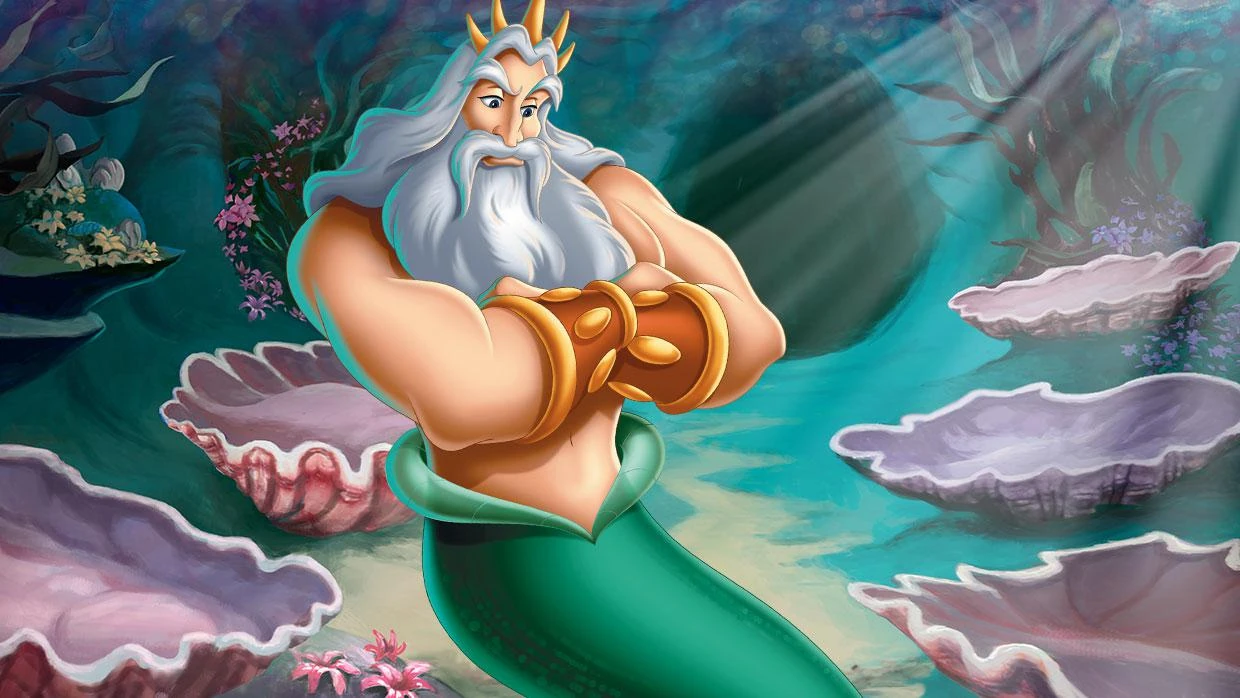
King Triton
He loves Ariel enough to surrender a kingdom for her. The tragedy is how long he believes love gives him the right to destroy the world she is trying to understand.
Quick file
Franchise: The Little Mermaid. Primary branches: the 1989 animated feature, 1992–1994 television series, 2000 sequel, 2008 prequel, stage adaptations, and 2023 live-action reinterpretation. Primary performers: Kenneth Mars across the major animated films and series, Norm Lewis in the original Broadway production, and Javier Bardem in the 2023 film.
Roles: king of Atlantica, wielder of the trident, widower in the prequel continuity, father of seven daughters, grandfather to Melody, political enemy of Ursula, and the adult whose fear turns family conflict into state policy. Defining contradiction: his capacity for sacrifice is real, but so is the harm he causes before sacrifice becomes necessary.
A father with the powers of a state
Triton is not only a strict parent. He commands a kingdom, controls magical force, assigns officers, defines the human border, and turns personal anxiety into rules everybody beneath the sea must obey. When he forbids Ariel from approaching humans, the order carries police power behind it.
That combination makes ordinary family conflict politically dangerous. A parent can ground a child. Triton can surveil, destroy property with supernatural force, and make contact between civilizations illegal. His paternal fear is amplified by an institution that rarely requires him to explain himself.
The concert establishes public family performance
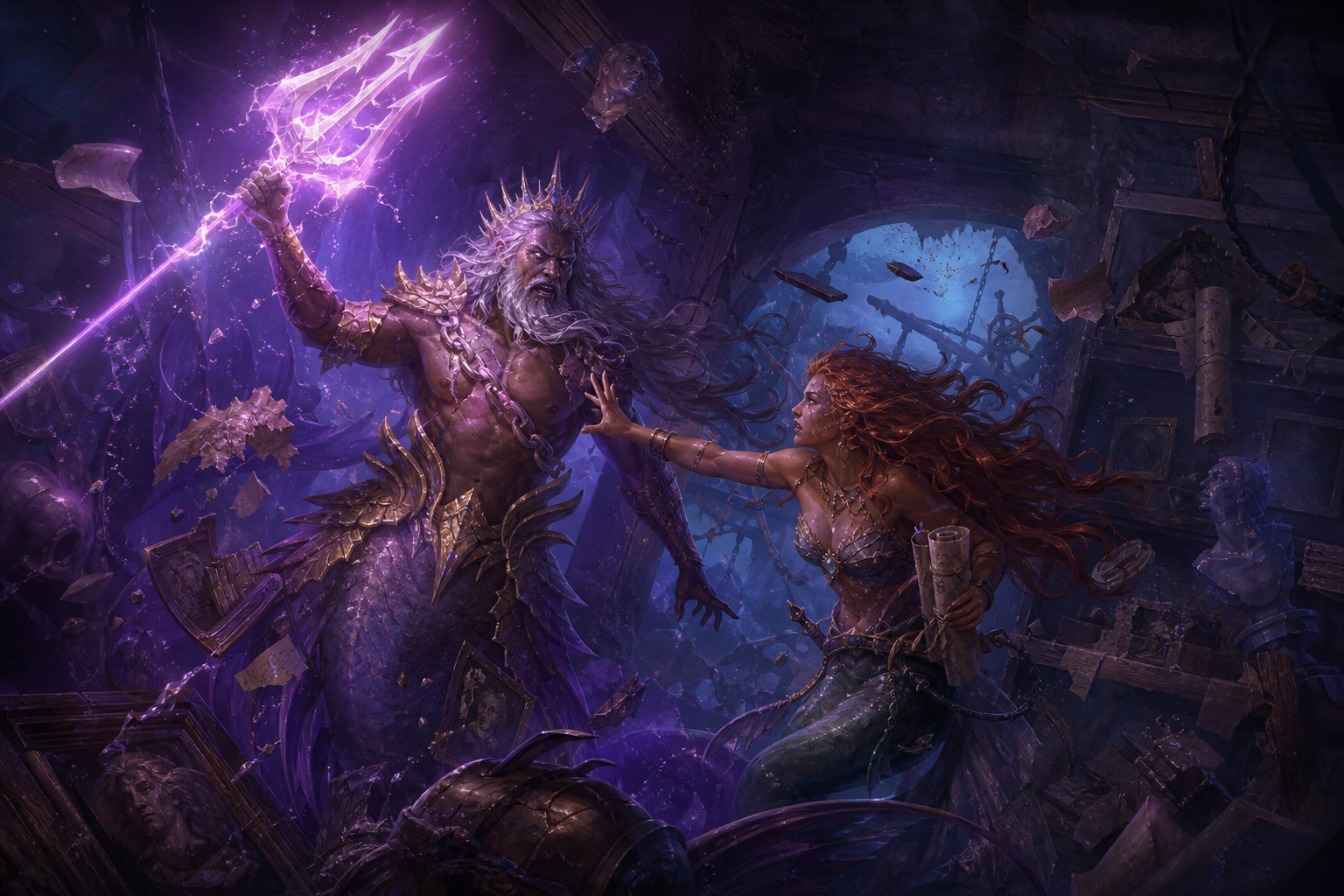
Ariel’s absence from the concert embarrasses Triton and disappoints her sisters. It also disrupts a royal event that presents family harmony to the kingdom. His anger therefore mixes parental frustration, public image, and sovereign expectation.
The daughters are expected to perform together under Sebastian’s direction while the king watches from the audience. Ariel’s absence is inconsiderate, but Triton’s response reveals how little room the royal family has to separate private identity from ceremonial duty.
Humans are a category before they are people
Triton speaks about humans as dangerous fish-eaters, not as individuals with histories and disagreements. The fear may have evidence. Ships kill sea life, hunters threaten merpeople in later branches, and Athena’s death in the prequel gives his anger a personal center.
The category still becomes prejudice when no human action can disprove it and no mermaid is permitted to investigate. Ariel’s archive exists because official knowledge stops at prohibition. Triton treats the border as a conclusion when it should be the beginning of careful diplomacy.
Sebastian becomes an instrument of surveillance
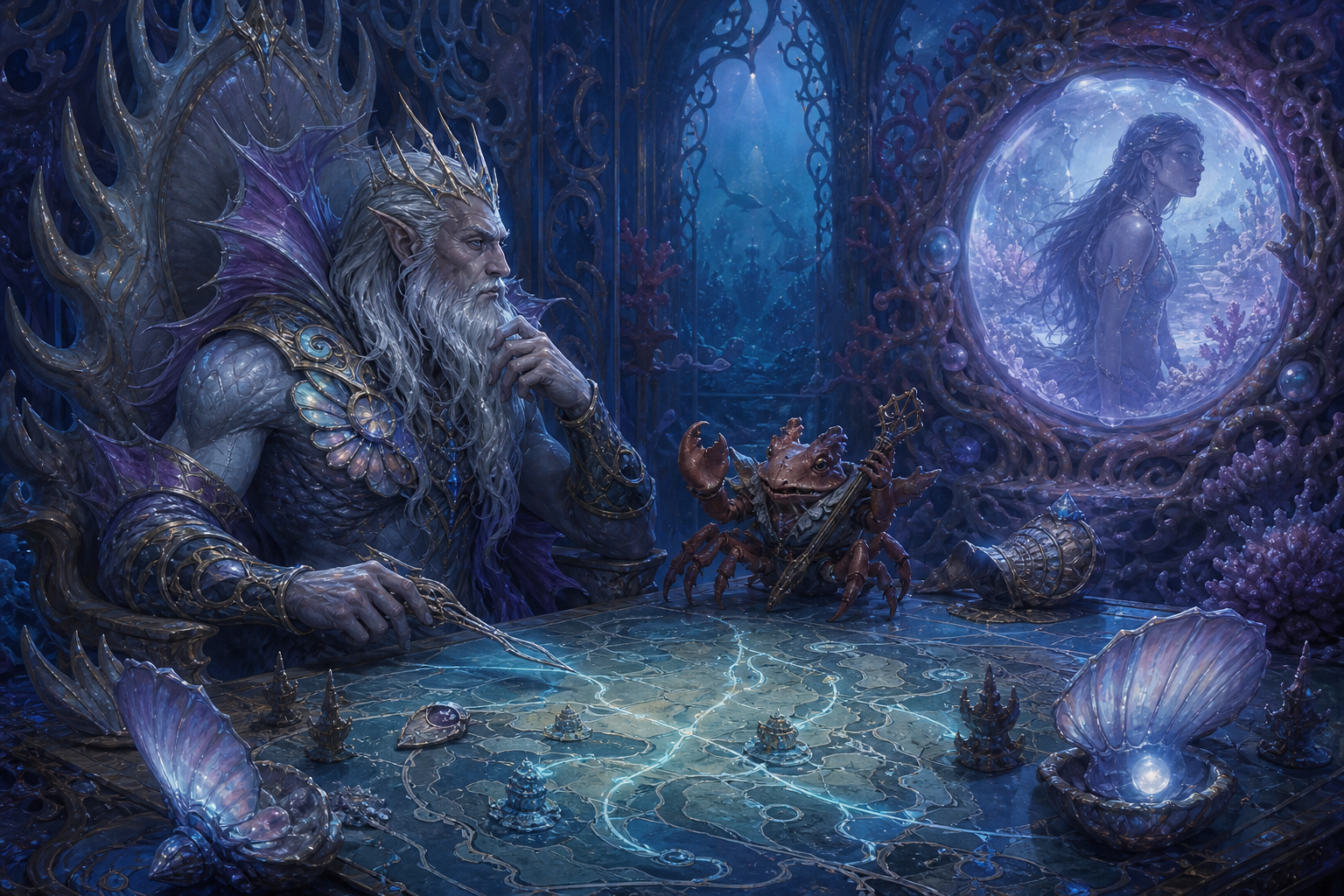
Triton assigns Sebastian to watch Ariel after the concert, turning a musician and court official into a monitor. Sebastian grows to care for Ariel, but the job begins as intelligence gathering for the father.
The arrangement creates divided loyalty. Sebastian can report honestly and expose Ariel, or protect her and disobey the king. Triton builds the situation by refusing a relationship where Ariel could discuss curiosity without expecting punishment.
The grotto scene is abuse of authority
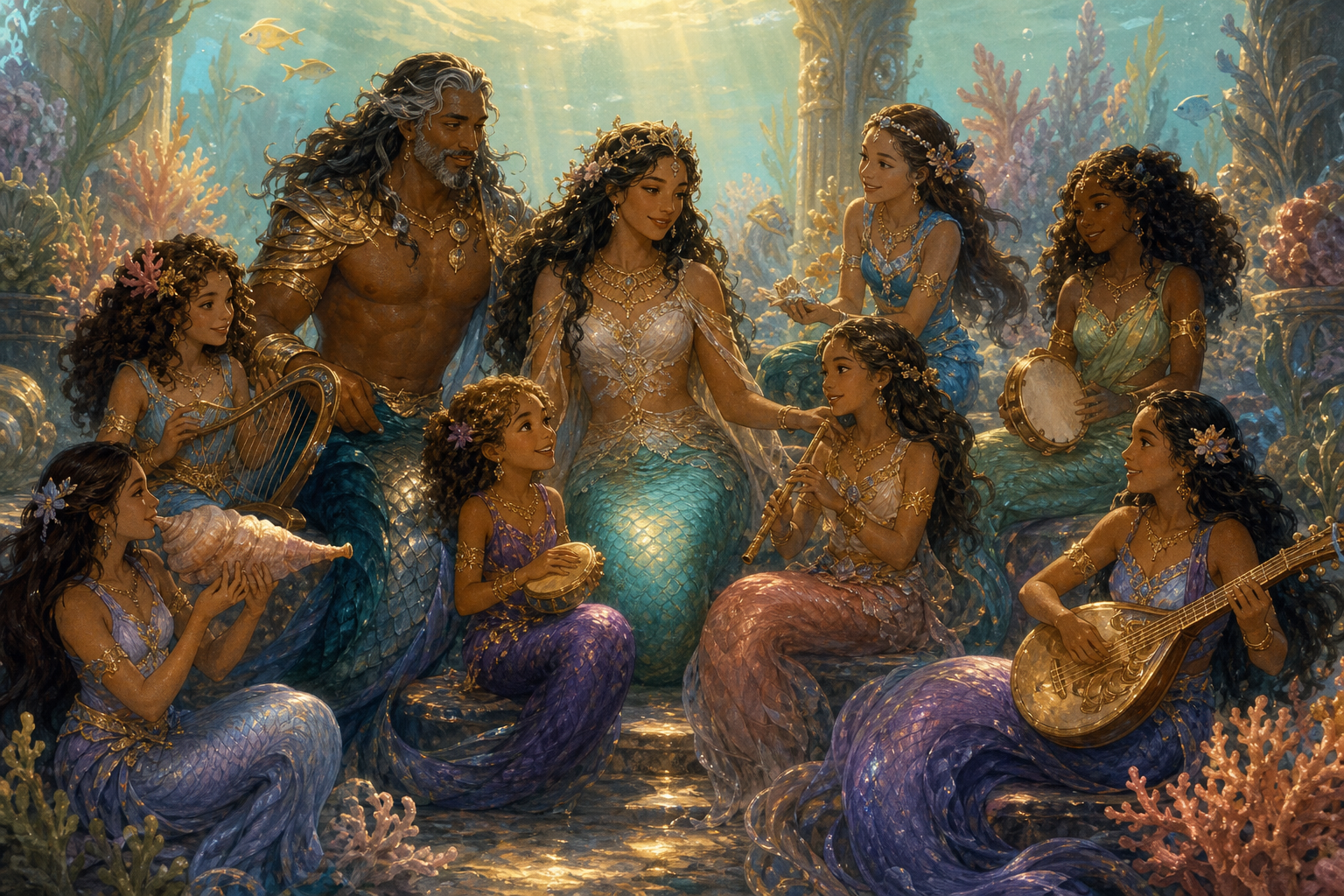
Triton discovers Ariel’s collection, hears her defend the human who nearly drowned, and reacts by destroying the entire archive. He does not remove one dangerous object. He uses the trident to obliterate years of research while she begs him to stop.
Love does not cancel the violence. Fear does not turn it into protection. The scene matters because a parent can sincerely believe he is saving a child while using power to humiliate, terrorize, and erase part of that child’s intellectual life.
Why destroying objects can break trust
Ariel’s objects are not random clutter. They record attention, risk, imagination, and a future she cannot discuss openly. Triton sees human contamination. Ariel sees evidence that another world exists and might contain a place for her.
When he destroys the collection, he tells her that anything connected to that desire is disposable. The immediate result is not obedience. It is isolation. Ursula’s agents find Ariel after the adult she should trust has made home emotionally unsafe.
Grief explains the pattern without absolving it
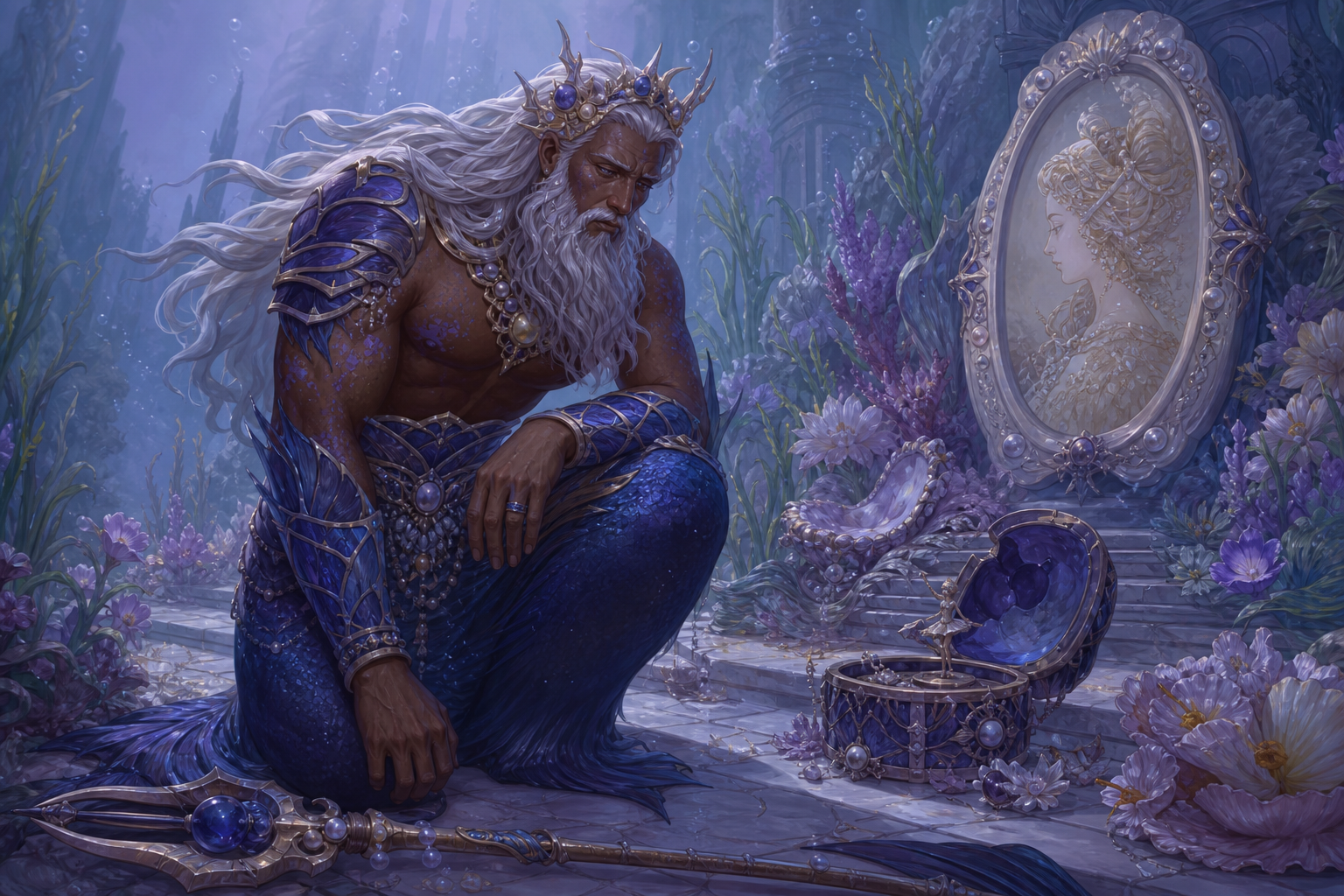
Ariel’s Beginning ties Triton’s ban on music to Queen Athena’s death. Music becomes associated with the life he lost, so he removes it from the kingdom. The rule tries to prevent reminders rather than process grief.
The same method shapes his human ban. Danger and loss become total prohibitions. Context makes Triton understandable. It does not make every person under his rule responsible for preserving his avoidance or every daughter responsible for living inside his trauma.
Athena and the family before the ban
The prequel shows a warmer family system in which music, play, and partnership existed before catastrophe. Triton was not born as the immovable king we meet later. He hardened.
That history makes repair possible because control is a response, not his only nature. It also makes the years of prohibition more painful. Seven daughters grow around the absence of a mother and the policies their father built from losing her.
Kenneth Mars gives authority a human crack
Kenneth Mars voices Triton with ceremonial force, comic impatience, explosive anger, and a tenderness that emerges when certainty fails. The king can fill Atlantica with one command, then sound suddenly small when he realizes Ariel may be gone.
The performance does not ask the audience to forget the grotto. It gives the man who caused that harm enough emotional range to choose differently. The apology is mostly carried through action because Triton is not skilled at speaking vulnerability.
Ursula understands his weak point
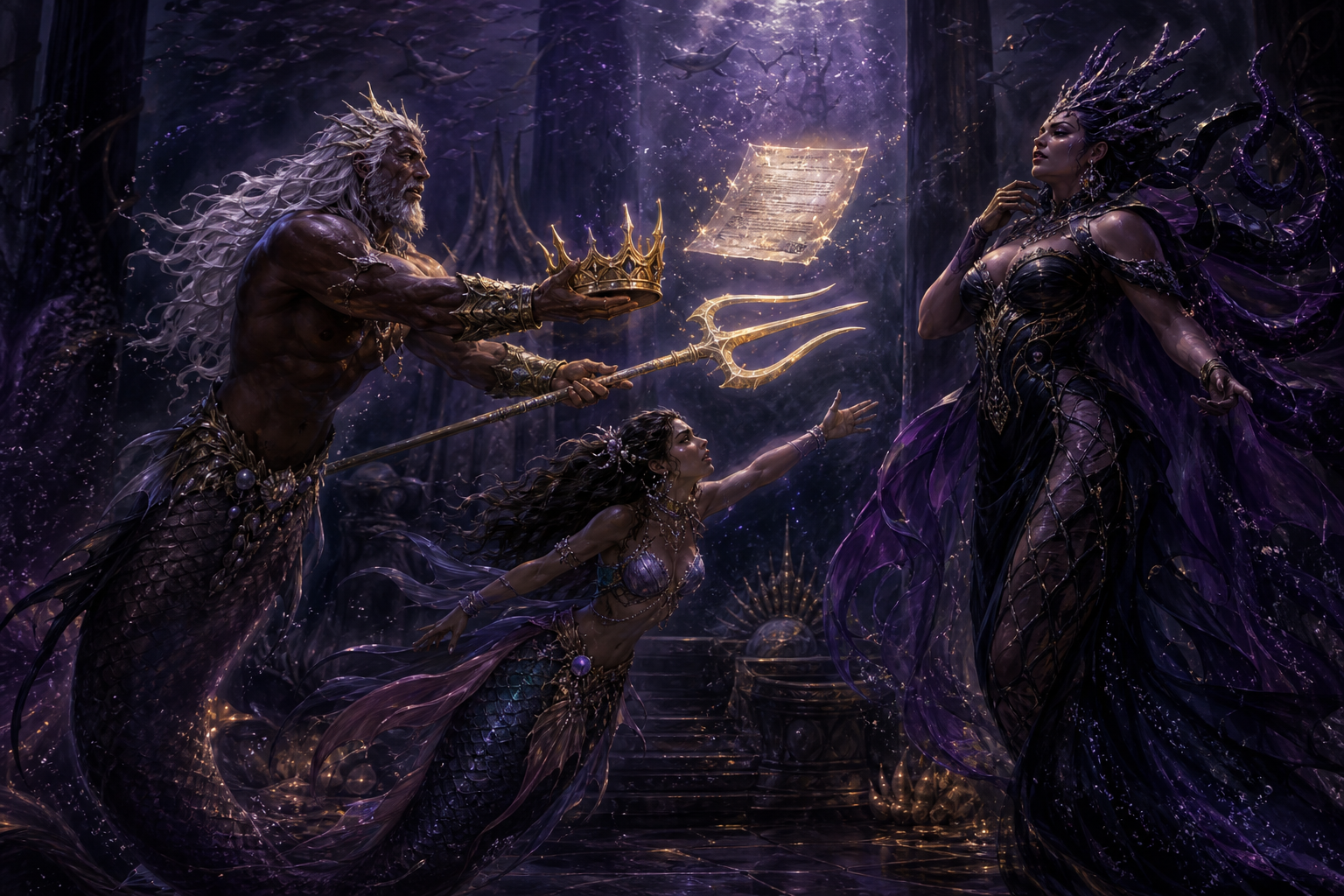
Ursula designs the bargain around Triton’s love for Ariel. She knows he will exchange himself when he sees his daughter reduced to a captive polyp. The king’s power makes him a political target. His attachment makes him predictable.
The exchange reverses their earlier conflict. Triton once treated Ariel as subject to his authority. Ursula now claims literal ownership. He finally confronts domination from the powerless side and surrenders crown and body without hesitation.
Sacrifice is not the same as repair
Giving himself to Ursula proves Triton loves Ariel more than the throne. It is brave and immediate. It does not automatically repair the fear, surveillance, and destruction that helped drive Ariel into the contract.
A complete reconciliation needs acknowledgment, changed behavior, and a safer relationship after the crisis. The film compresses that work into Triton observing Ariel with Eric and deciding to transform her. The gesture is moving because it is the first time his power expands her choice instead of closing it.

The final transformation grants an exception
Triton gives Ariel legs and permits her marriage. For the daughter, the decision is life-changing. For the kingdom, it may remain a royal exception unless the border policy also changes.
A king can approve one beloved child without building a fair system for everyone else. The most interesting continuation would ask what happens to trade, travel, scholarship, mixed families, shipwreck rescue, and accountability after Atlantica acknowledges a human alliance.
Letting go is not losing a daughter
Triton’s sadness at the wedding is framed as the cost of accepting Ariel’s autonomy. He does not stop loving her or become unnecessary. He stops requiring proximity and obedience as proof of family.
The scene works because he acts against fear. Earlier, fear meant destroy the archive. Now fear and grief remain present while he chooses release. Courage is not the absence of parental panic. It is refusing to make the child live inside it.
Return to the Sea repeats the family method
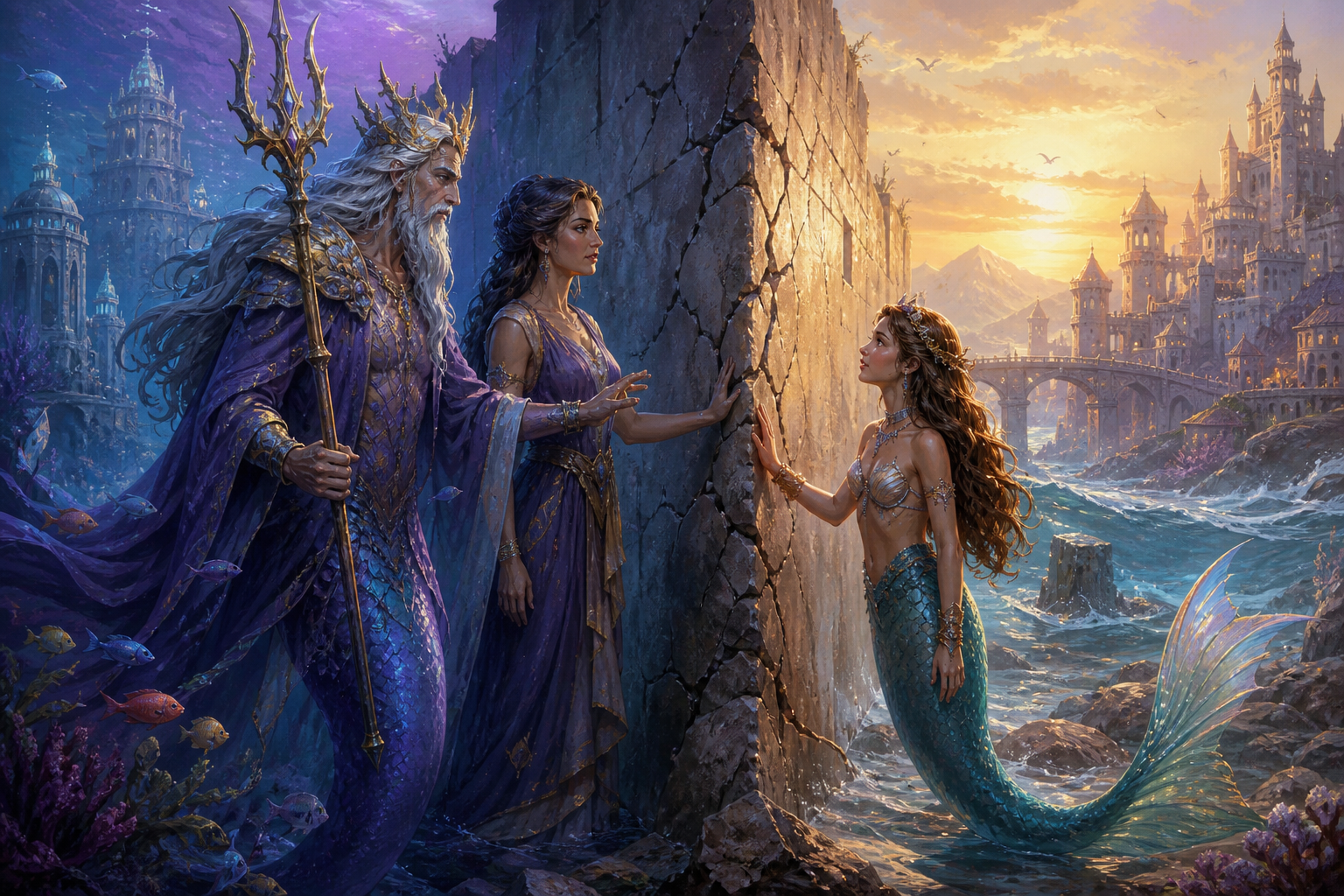
When Morgana threatens baby Melody, Ariel and Eric build a wall and hide the sea from their daughter. Triton participates in a family arrangement that echoes his own prohibitions. The danger is real. So is the secrecy.
Melody grows curious, crosses the boundary, and trusts a sea witch because adults made knowledge unavailable. Triton watches the pattern return through another generation. The sequel offers the family a second chance to remove the wall instead of granting one more private exception.
Grandfatherhood softens him without erasing kingship
Triton responds to Melody with affection and recognizes her connection to the sea. His position also makes the child valuable to enemies. Family and state remain entangled.
A stronger grandfather arc would let him tell Melody what he did wrong with Ariel, not only welcome her after the crisis. Intergenerational repair becomes durable when elders pass down accountability instead of a polished legend about eventual acceptance.
The television series widens the ruler
The animated series gives Triton more disputes, creatures, family interactions, threats, and moments of comic rigidity. It lets Atlantica function as a society rather than a palace backdrop.
Prequel episodes can conflict with later films or shift the intensity of the human ban. Treat the series as an official branch with its own continuity pressures. Do not force every lesson into one perfectly linear psychological timeline.
Norm Lewis and the stage king
Norm Lewis originated Triton in the Broadway production, where authority has to register across a theater and family conflict unfolds through additional songs and live staging. The role becomes musical in a way the 1989 film reserves mainly for other characters.
Stage material can expose interior conflict and grief more directly. It should be read as adaptation, not secret proof of what the animated king always thought. Different media make different emotions speakable.
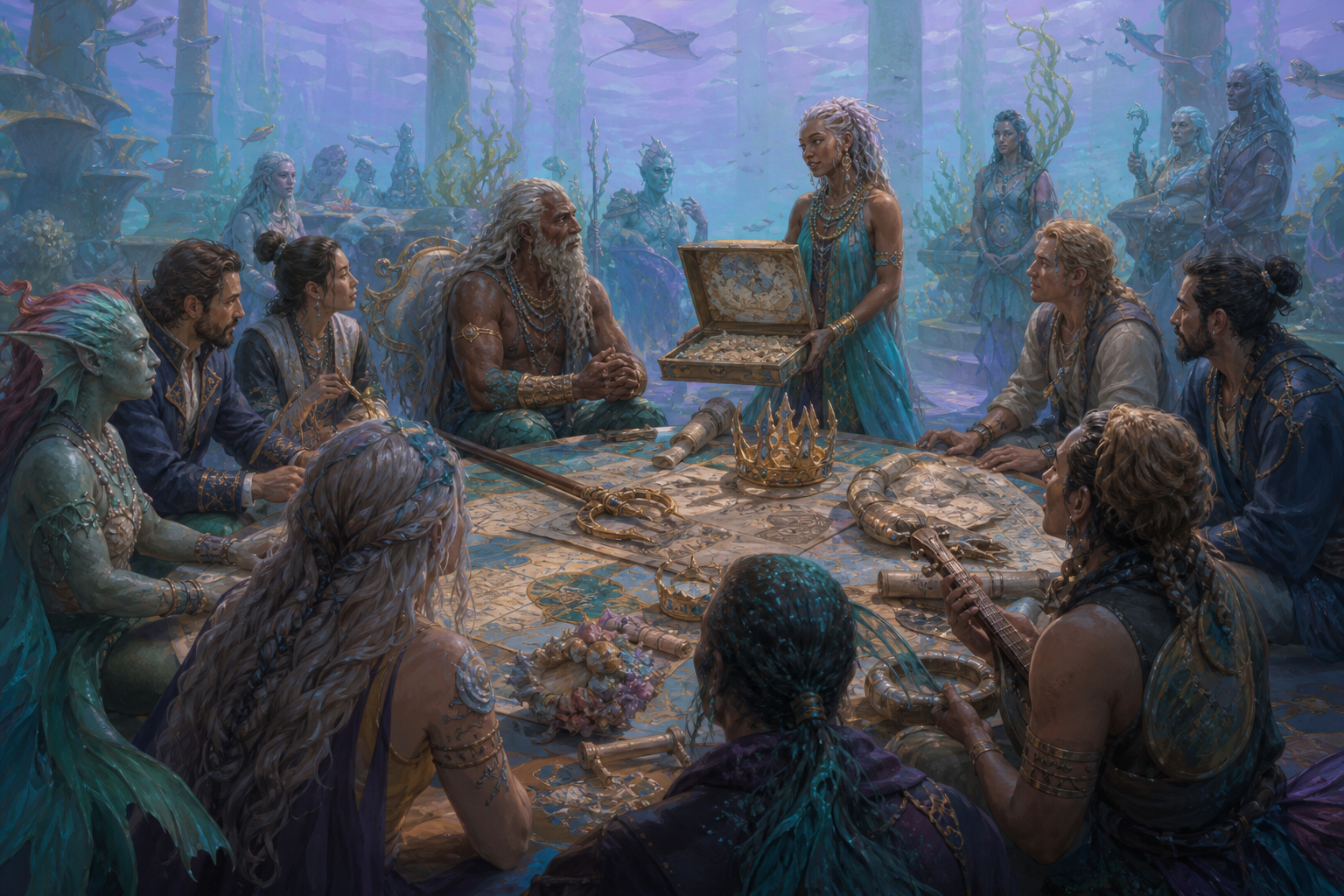
The 2023 king changes race, family, and political geography
Javier Bardem’s Triton appears in a more naturalistic ocean and within a branch where the seven daughters represent different seas. That idea expands Atlantica toward a global maritime polity, even when the film does not fully explore its governance.
The adaptation also makes Ursula his sister, turning the villain conflict into family history. Bardem’s performance carries reserve and grief at camera scale. The reinterpretation should be evaluated on its own structure rather than used to overwrite Kenneth Mars’s animated continuity.
Seven daughters from seven seas
The 2023 concept suggests each daughter has cultural, ecological, and political ties beyond one palace. If taken seriously, Triton is not simply a father with seven children. He is managing a distributed royal federation.
That makes his control of Ariel even more political. A daughter crossing the human boundary may affect treaties, representation, and security. The film hints at this scale but still resolves the central dispute through family acceptance instead of institutional debate.
The trident is force and responsibility
Triton’s staff controls transformation, weather-like force, destruction, and political legitimacy. It is weapon, crown-adjacent symbol, and administrative shortcut. The wielder can change bodies without consent or with it.
The grotto and finale show the moral difference. In one scene, Triton uses magic to erase Ariel’s choices. In the other, he uses it to enable the choice she has consistently expressed. Power does not become good because the king holds it. Its ethics depend on consent, purpose, and accountability.
Easter eggs and divine-name theories
The name Triton comes from Greek mythology, where Triton is associated with the sea and commonly represented with a human upper body and fish tail. The film borrows that cultural vocabulary without presenting a strict mythological adaptation.
References to Poseidon, Neptune, tridents, shells, and maritime kingship need careful labeling. A visual resemblance can be design lineage without being a secret canonical genealogy. Reviews should verify intentional callbacks before turning mythology into franchise fact.
What reform would look like
The ending gives Ariel freedom. Reform would give everyone a process. Atlantica needs open study, rules for human contact, rescue protocols, cultural exchange, public limits on the trident, and advisers who can challenge the king without risking exile.
Triton’s most meaningful future is not becoming a softer absolute monarch. It is learning that love and good intentions cannot substitute for institutions that survive his moods. Shared governance would turn personal repentance into public change.
Final character receipt
Triton is compelling because the story does not make him a monster. He is a loving father, grieving widower, powerful king, and source of real harm. Those truths coexist.
His arc begins with protection defined as control and ends with protection defined as enabling a chosen future. The transformation is emotionally satisfying. The deeper work begins after the wedding, when one father’s changed heart has to become a kingdom where curiosity no longer requires secrecy.
Absolute monarchy makes private fear everybody’s problem
Triton does not need to persuade a legislature that all human contact should remain forbidden. He does not need to publish evidence, define exceptions, or submit the trident to outside review. The family patriarch and the head of state occupy the same body. That means grief formed inside one marriage can become maritime policy for an entire population without any visible public process.
This structure also changes how advisers behave. Sebastian can object, but his position depends on royal favor. The daughters can argue, but they are subjects as well as children. Ursula is exiled outside the system rather than functioning as a lawful opposition. The film’s emotional economy assumes a good king who makes a bad parenting decision. A political reading notices how few people can stop him before the mistake becomes catastrophe.
Triton’s eventual change is therefore necessary and insufficient. A benevolent exception for Ariel leaves the concentration of power intact. The next frightened king could rebuild the border overnight. Institutional reform would preserve the lesson after Triton’s emotions change again.
The grotto is a destroyed research archive
Calling Ariel’s collection teenage clutter minimizes what Triton erases. The objects come from repeated expeditions, shipwreck recovery, and years of observation. Some are dangerous because Ariel does not know their functions. That is a reason for supervised study, not annihilation. A responsible ruler could establish preservation protocols, consult experts, and use the archive to understand surface technology.
Triton instead destroys knowledge because its existence contradicts policy. The act resembles censorship more than ordinary discipline. It removes evidence that humans create art, tools, music, and domestic objects. It ensures the next argument begins from Triton’s category of “barbaric fish-eaters” rather than from a complicated material record.
The scene also teaches Ariel that disclosure makes knowledge vulnerable. If she rebuilds, she has every incentive to hide it better. Authoritarian information control rarely ends the inquiry. It drives inquiry underground and leaves the curious person dependent on worse sources.
Ariel is sixteen, and that makes adult responsibility heavier
The 1989 film identifies Ariel as sixteen. She can act recklessly, miss commitments, idealize a stranger, and underestimate danger. None of that gives the surrounding adults permission to exploit or terrorize her. Adolescence increases the duty to create safe routes for exploration and disagreement. It does not reduce it.
Triton faces a real parenting problem. His daughter enters wrecks, approaches ships, and risks predators. Boundaries are not automatically abusive. The failure lies in making the boundary absolute, refusing to hear the underlying need, using surveillance instead of trust, and escalating to magical destruction when argument fails.
A better response would separate immediate safety from permanent ideology. Triton could prohibit unsupervised wreck exploration while building a research team. He could explain known human threats while admitting the limits of his knowledge. He could let Ariel challenge the rule without making challenge itself proof of disloyalty.
The daughters are a court as well as a family
Seven daughters create a web of sibling relationships the 1989 film barely explores. They rehearse together, represent the royal household, and live under the same human ban. Ariel’s rebellion affects their public image and may alter expectations for their own futures. Yet the central conflict isolates father and youngest daughter as if the rest of the family has no political position.
That omission matters after Triton grants Ariel’s transformation. Do the sisters gain travel rights? Are they expected to remain ceremonial daughters while Ariel marries into another kingdom? Did any privately agree with her research? A monarchy distributes privilege unevenly even inside one family, and the ending never asks how the exception looks from the sisters’ side.
The prequel’s music story gives them more shared history. They lost Athena too. Triton’s grief receives the power to define public life, while the daughters adapt to the prohibition he creates. The family would need collective mourning, not merely the return of one music box.
Grief repeats as architecture in Melody’s story
Triton turns grief and danger into prohibitions. Ariel later turns Morgana’s threat into a literal wall. The visual architecture changes, but the family logic remains: remove access, hide history, and hope the child’s curiosity disappears. Melody then finds the forbidden world through secrecy and becomes vulnerable to another manipulative sea witch.
Triton has a unique responsibility in that sequel because he has already lived through the pattern from the parent’s side. He knows prohibition did not stop Ariel. If he agrees to the wall without demanding honest explanation for Melody, he participates in passing the same method forward. Love becomes an inheritance of fear unless somebody names the repetition.
The wall’s removal can therefore mean more than reunifying sea and shore. It can be the family admitting that protection without truth creates its own danger. Triton’s role in repair should include telling Melody what he once destroyed and why her mother was afraid enough to repeat him.
The trident raises consent questions the films barely touch
Triton can transform bodies, destroy matter, release storms of force, and confer access between sea and land. Ursula can seize that power through contract. These abilities make bodily autonomy a constitutional issue in Atlantica, not only a magical plot device. Who authorizes transformation? Can it be reversed? What limits prevent punishment by metamorphosis?
The films answer through character morality. Triton’s final transformation is good because Ariel wants it. Ursula’s transformations are evil because they trap clients and remove agency. That moral distinction is sound, but a kingdom cannot rely forever on whether one wielder happens to read consent correctly.
Public rules around the trident would protect Triton too. Ursula’s contract can transfer sovereign power because legitimacy appears attached to objects and person. A system with distributed authority, recorded succession, and limits on magical transfer would make one coerced signature less capable of collapsing an entire state.
Kenneth Mars, Norm Lewis, and Javier Bardem build different fathers
Kenneth Mars uses vocal scale that matches hand-drawn exaggeration. Anger can arrive as thunder, then crack into fear. Norm Lewis has the advantage of live musical presence and material that lets the king sing interior conflict across a theater. Javier Bardem works closer to naturalistic film acting, where a held gaze can replace a drawn explosion.
Those craft differences change audience judgment. A booming animated outburst may feel mythic until the camera cuts to Ariel’s terror. A live stage performance can let the father articulate grief before the argument ends. A live-action close-up can make silence read as emotional refusal. No version is merely the same role in a different costume.
Credit also matters because character depth comes from collaboration. Writers determine what Triton can admit. Performers shape authority and vulnerability. Animators or effects artists build mass and movement. Musicians decide whether his emotion sounds private or ceremonial. The brand name does not perform any of that labor.
Repair requires apology, restitution, and changed access
The final transformation gives Ariel a future, but it does not restore the destroyed objects or years of forbidden study. Restitution could mean helping rebuild the archive, funding safe expeditions, documenting human and merfolk encounters, and giving Ariel authority over the collection. An apology without repair would leave the physical loss untouched.
Changed access matters just as much. If only Ariel may cross because she is the king’s daughter, the lesson remains private privilege. Other scholars, mixed families, rescuers, and travelers need fair rules. The kingdom should not require a crisis, a sea-witch coup, and paternal heartbreak every time somebody asks whether the border can open.
Triton’s best legacy would be a public record of his mistake. Kings prefer monuments to victories. Atlantica needs an account of the archive he destroyed, the contract system Ursula exploited, and the reforms adopted afterward. Memory can stop grief from becoming law only when the institution refuses to hide what fear already cost.
The final wedding image hides a diplomatic beginning
The wedding joins Ariel to a human prince and places merfolk beside human guests in open daylight. Even if the film treats the gathering as family celebration, it is also first contact between political communities whose relationship has been organized through fear. Triton arrives not merely as father of the bride but as a sovereign whose presence recognizes the union.
That moment should create work after the credits. Atlantica and Eric’s kingdom need communication systems, emergency protocols, navigation agreements, and a shared account of the shipwreck crisis. Human fishing and shipping practices affect Triton’s subjects. Merfolk magic affects human security. A marriage cannot substitute for policy when two populations begin seeing one another.
Triton’s emotional breakthrough gives diplomacy a chance. His political maturity would be measured by whether he builds that chance into something larger than Ariel’s happiness. The king finally accepts one daughter’s chosen world. The next test is whether he can help both worlds meet without asking another child to carry the entire bridge.
Keep exploring The Little Mermaid
Return to The Little Mermaid hub for film branches, reviews, Reacts, rants, lore, guides, and the full character directory.