Powered by vibes, caffeine, and questionable life choices. 💀
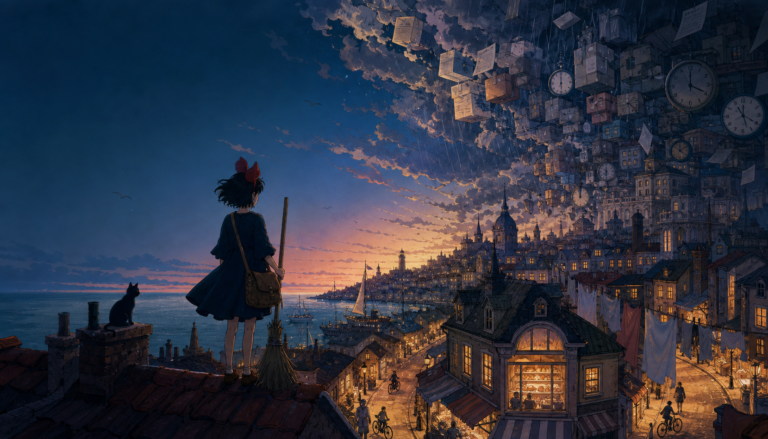
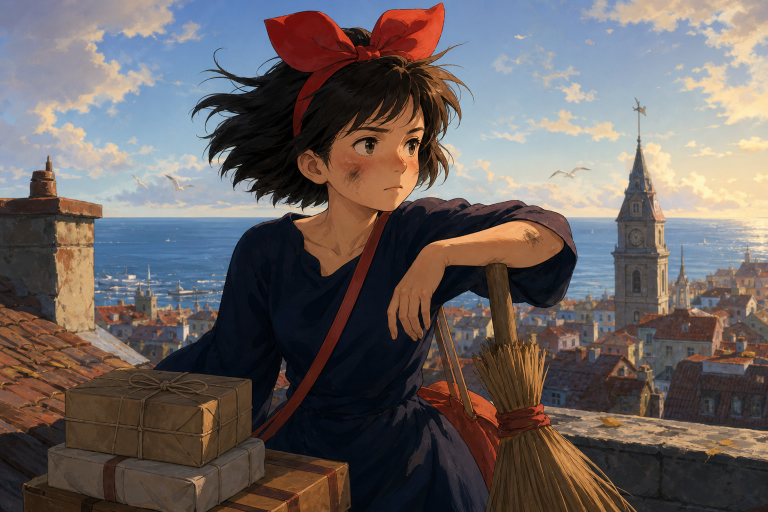
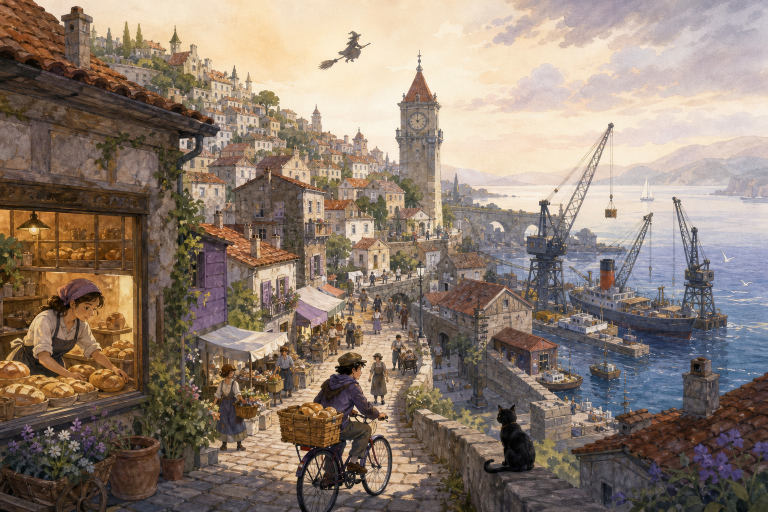
Original editorial art of a young witch facing a seaside city shaped by work, clocks, parcels, and possibility

RaeRae Reviews · Canonical Anime Film File

Kiki’s Delivery Service

A thirteen-year-old turns her only reliable talent into a business, loses the talent, and discovers that burnout does not mean she was a fraud.

Kiki’s Delivery Service gets called cozy because the bakery glows, the seaside city looks beautiful, and a black cat provides commentary. Cozy describes the surface better than the emotional machinery. Hayao Miyazaki made a film about a young person leaving home, trying to earn rent through a marketable skill, building an identity around usefulness, and then watching that identity fail under pressure. Anyone who has turned a beloved ability into paid work may recognize the trap before Kiki does.

Kiki can fly. She cannot cook especially well, read fortunes, brew advanced potions, or arrive in a new city with a business plan. Flying becomes her service because flying is what she has. The choice looks practical and brave. The choice also makes every bad flight feel like a referendum on her worth. By the time she loses access to magic, the crisis has already moved beyond a broom. Kiki no longer knows who she is when competence stops arriving on command.

Spoiler warning: This review covers the whole film, including Kiki’s loss of magic, Jiji’s changed voice, the dirigible accident, and the ending.
Director, writer, and producerHayao Miyazaki
SourceEiko Kadono’s 1985 children’s novel
Japanese releaseJuly 29, 1989
StudioStudio Ghibli
MusicJoe Hisaishi
Current U.S. viewingRent or buy through Amazon Video, Apple TV, and Fandango at Home. Subscription availability changes by licensing cycle.

Contents

  1. My actual reaction
  2. Leaving before feeling ready
  3. The delivery business
  4. Belonging to a city
  5. Burnout and lost magic
  6. Why Jiji stops talking
  7. Ursula and creative recovery
  8. Osono and practical community
  9. Tombo, envy, and friendship
  10. Gender, labor, and independence
  11. Animation and flight
  12. Joe Hisaishi’s city
  13. Book versus film
  14. The rescue and ending
  15. Cultural and industry impact
  16. What aged well
  17. Final take

My actual reaction: the broom is not the hard part

First thoughtKiki announces independence with the confidence of someone who has packed enthusiasm instead of a contingency plan.
The moment I leaned inOsono offers a room after Kiki helps a stranger, showing that community can begin through one practical exchange.
The scene that staysKiki stares at the broom that once obeyed her and realizes effort cannot force a tired self to perform.

The opening departure carries excitement and mild terror at once. Kiki hears a favorable weather report and decides to leave that night. Her mother worries about the old broom. Her father lifts her and notices how much she has grown. Friends gather. Jiji asks sensible questions that Kiki ignores. The whole scene understands how teenagers make large decisions: urgency creates courage before doubt can organize a committee.

Flight initially looks like freedom, but even the first trip contains weather, traffic, territorial tension, and poor control. Kiki lands in a freight train and wakes among hay. Independence begins with an accidental ride provided by infrastructure she did not build. The image quietly punctures the fantasy of total self-reliance.

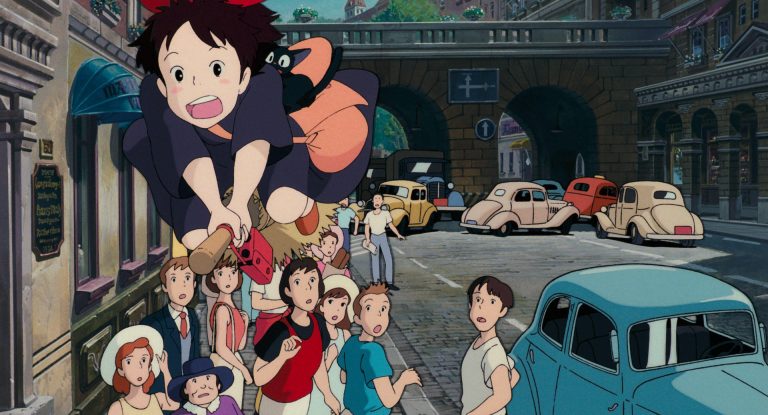
The emotional hook comes from how quickly excitement becomes social exposure. Kiki’s black dress marks her as a witch, but the city does not automatically know what to do with a witch. Cars honk. A police officer scolds her. Teen girls look polished in ways she does not. Kiki has left a village where her identity made sense and entered a city where identity must become legible through behavior, work, and relationships.

Leaving home before feeling ready

The witch tradition requires a thirteen-year-old to spend a year away from home. The custom sounds romantic until the practical questions arrive. Where will she sleep? How will she eat? What services can she sell? Which adults are safe? What happens when weather changes? The film allows tradition to motivate departure without pretending tradition supplies a safety net.

Kiki’s parents support her while knowing support cannot travel in her suitcase. Her mother gives advice and an old broom. Her father gives affection, a radio, and a final moment of physical closeness. Their goodbye avoids the cruel idea that independence requires emotional detachment. Leaving matters because the bond remains.

At thirteen, Kiki sits between childhood and public adulthood. Adults expect enough competence to manage a transaction. Peers evaluate clothes, style, and social confidence. She can make decisions but lacks experience for judging every consequence. Miyazaki does not treat that unevenness as a flaw. Adolescence means different capacities mature at different speeds.

The radio becomes a portable connection to ordinary culture. Music accompanies the flight and locates Kiki inside the same modern world as everyone below. She may be a witch, yet her imagination includes pop songs, fashionable shoes, and city life. Tradition does not freeze her outside modernity.

Choosing Koriko reveals another adolescent pattern. Kiki wants a seaside city because the image feels right. She does not research housing or demand. The decision is aesthetic before becoming economic. Adults do similar things with more paperwork. A new place often begins as a fantasy projected onto a skyline.

The delivery business turns magic into labor

Kiki’s business idea comes from matching one skill to a local need. Flying can move parcels faster than streets. Osono offers bakery space as an informal office. The plan requires little capital beyond a broom, a bag, and Kiki’s body. Such simplicity resembles modern gig work more than an old-fashioned apprenticeship.

Every delivery includes hidden labor. Kiki negotiates with clients, protects objects, finds addresses, handles weather, repairs mistakes, absorbs rude behavior, and returns home tired. Payment covers the completed task, not the worry surrounding the task. Her magical advantage does not remove service work’s emotional demands.

The toy cat delivery demonstrates how one mistake multiplies. A gust knocks the toy away. Kiki leaves Jiji as a substitute, searches the forest, meets Ursula, repairs the toy, and returns before the client notices. The customer sees a successful delivery. Nobody paying the invoice sees the improvisation required to produce success.

The herring pie delivery makes the imbalance sharper. An elderly woman and her helper have prepared a gift for a granddaughter. The oven fails. Kiki helps bake the pie, then flies through rain to deliver the food. The granddaughter receives the package with annoyance. Kiki cannot defend the sender or demand gratitude. A courier carries emotional meaning without controlling how the recipient values the meaning.

That scene often gets summarized as “young people are ungrateful,” but the film gives us too little information to condemn the granddaughter completely. Perhaps she has received the same pie repeatedly. Perhaps family pressure surrounds the gift. The important experience belongs to Kiki: she invested labor and care beyond the job, then encountered indifference. Service work regularly asks people to witness relationships they cannot repair.

Kiki’s prices, hours, and boundaries remain loose. Osono supplies guidance but does not formalize the enterprise. The flexibility helps Kiki begin and leaves her exposed. A customer’s urgency can become her urgency. Weather risk becomes personal risk. When identity and income depend on availability, saying no can feel like disappearing.

How a stranger becomes part of a city

Koriko combines influences from several European cities without becoming a documentary copy. Trams, stone streets, harbor traffic, markets, apartments, bicycles, and airships create a place with layers of time. Kiki enters from above and initially sees beauty without understanding systems.

Belonging develops through routes. Every delivery teaches geography. The bakery becomes home base. The market becomes routine. Tombo introduces another social network. Ursula’s cabin offers distance from the city. By the end, Koriko no longer functions as a backdrop chosen for beauty. The city contains people who know Kiki’s name and notice when she flies.

The process includes rejection. The first crowds stare. The police officer treats her flight as disruption. Stylish girls trigger self-consciousness. Kiki sometimes interprets neutral social differences as judgment because insecurity edits the scene before anyone speaks. The city does not hate her. The city has not learned her yet.

Osono’s bakery creates an entry point through reciprocal care. Kiki returns a pacifier to a customer. Osono notices initiative and offers food, shelter, and business support. Neither person calls the arrangement charity. That framing protects Kiki’s dignity. She contributes, and the adults make contribution possible.

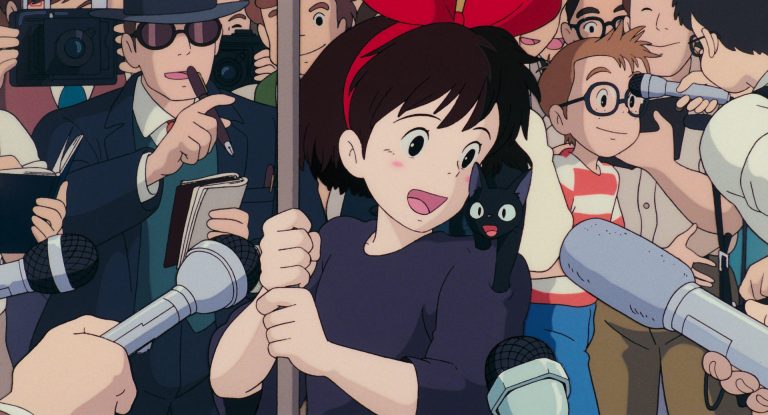
Public recognition after the rescue completes a visible arc, but quieter recognition matters more. Regular customers, bakery routines, Tombo’s friendship, and Ursula’s invitation built belonging before television cameras arrived. A city becomes home through repeated ordinary encounters, not one heroic headline.

Lost magic is burnout without office vocabulary

Kiki’s powers decline after sustained stress rather than one moral failure. She works through rain, feels socially inadequate, becomes ill, and grows disconnected from pleasure. Jiji’s speech becomes unintelligible. The broom stops responding. Her body withdraws access to the abilities she has treated as endlessly available.

Burnout can feel like betrayal because the skill remains conceptually familiar. A writer knows what writing is. A singer remembers singing. A caregiver understands care. Knowledge does not guarantee access. Kiki tries harder and receives worse results, which adds panic to exhaustion.

The film refuses a motivational montage. She does not wake early, repeat affirmations, and overpower fatigue. Ursula tells her to stop forcing the work. Rest and another person’s perspective create conditions for return. Recovery arrives unevenly and only when a real emergency gives flight meaning beyond proving competence.

That final return should not be misread as evidence that crisis cures burnout. Kiki still needs a borrowed broom and barely controls the flight. Urgency helps her cross a threshold. The credits show ongoing life afterward, suggesting that recovery becomes practice rather than a one-time victory.

Her illness also matters. Osono puts her to bed and takes care of her without demanding productivity. A workplace that treats sickness as evidence of disloyalty would deepen collapse. The bakery offers a rare combination: Kiki’s labor has value, and her value exceeds labor.

Modern viewers may connect the story to freelance anxiety, creator burnout, or algorithmic pressure. Those comparisons fit because the emotional structure predates current technology. When livelihood, identity, and beloved skill merge, every quiet period can look like professional extinction.

Why Jiji stops talking

Jiji begins as companion, skeptic, translator, and externalized self-talk. He says what Kiki may be too excited or embarrassed to admit. Their dialogue makes solitude manageable. Losing his voice therefore feels like losing both friendship and part of her inner continuity.

The Japanese ending does not restore understandable speech, while some English versions historically altered the effect. Miyazaki has connected the change to Kiki’s growth. She no longer needs Jiji to function as the same extension of herself. That interpretation does not mean she stops loving him.

Jiji also develops a life beyond Kiki through Lily and their kittens. His separation mirrors Kiki’s. Both leave a two-person childhood unit and join broader relationships. Growth changes intimacy without proving that earlier intimacy was imaginary.

Viewers sometimes treat the silence as punishment for losing magic. A gentler reading sees perception changing. Kiki once heard Jiji in a specific way. Maturity closes that channel or transforms communication. People regularly lose forms of closeness they assumed would remain unchanged.

The choice gives the ending emotional honesty. Heroism restores flight because flight remains Kiki’s own ability. Heroism does not reset every relationship to the opening state. Recovery is not reversal.

Ursula gives burnout a language

Ursula lives alone in a forest cabin and works on art. She first enters the story through Kiki’s mistake, then becomes the person most capable of understanding creative paralysis. Their connection crosses age without becoming parental.

Her advice remains valuable because she does not promise control. When drawing fails, she stops. She walks, looks, sleeps, and waits for desire to return. Sometimes the work changes. Sometimes the person changes. Creative practice becomes a relationship rather than a machine.

Ursula’s painting resembles Kiki in flight among dark forms. The image turns observation into interpretation. Kiki sees herself transformed through another artist’s attention. The painting does not flatter her with a clean heroic portrait. The work captures uncertainty and motion.

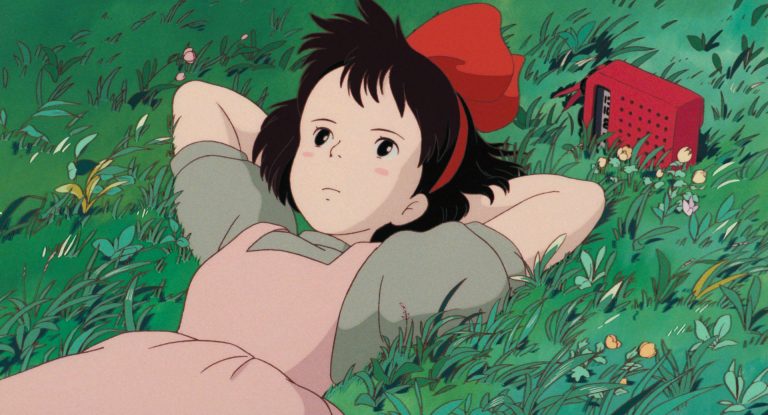
The cabin creates a pause outside commerce. Kiki is not delivering, advertising, or comparing clothes. She talks, eats, watches Ursula work, and sleeps. Rest becomes social rather than isolated. Another person can hold the fear without solving the fear.

Ursula also represents one possible adult self: independent, unconventional, serious about work, and capable of friendship. Kiki’s future does not have to resemble the fashionable girls who intimidate her or the domestic roles around the bakery. Multiple versions of womanhood can coexist.

Osono builds the safety net without making a speech

Osono offers the most practical magic in the film. She recognizes need, creates an exchange, provides food, protects rest, and nudges Kiki toward connection. Her generosity has structure. The room comes with participation in bakery life. That structure lets Kiki receive help without feeling reduced.

Pregnancy shapes Osono’s physical presence and future workload, but the film does not make pregnancy her only identity. She runs a business, reads customers, jokes with her husband, and manages a busy household. Her care for Kiki grows from competence rather than saintliness.

Fukuo speaks little, yet his actions support the same environment. He bakes, watches, makes a bread sign shaped like Kiki, and helps without demanding emotional performance. The couple demonstrates that care can arrive through infrastructure: a room, a meal, a sign, a schedule.

Osono arranges Kiki’s meeting with Tombo after noticing mutual interest. The gesture could feel intrusive, but her purpose is not romantic matchmaking alone. She sees Kiki withdrawing and creates a reason to step back into social life. Community sometimes means giving a lonely person a low-stakes obligation.

Tombo, envy, and learning not to punish enthusiasm

Tombo is fascinated by flight and immediately overwhelms Kiki. He performs confidence, talks rapidly, and treats her witch identity as the most exciting event in town. Kiki hears some of that attention as mockery because she already feels conspicuous.

Her irritation contains envy. Tombo has friends, a project, urban ease, and permission to be obsessed with aviation. Kiki has the actual magical ability and less confidence about belonging. His homemade flying bicycle shows that fascination can become labor rather than passive admiration.

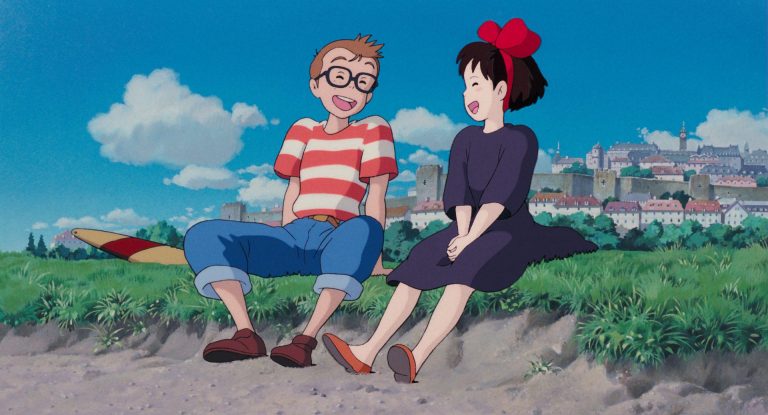
Their first ride fails spectacularly. The propeller bike breaks, and they laugh. Shared failure gives Kiki something paid work cannot provide. Nobody is grading the result. The broken machine still creates connection.

Kiki withdraws when Tombo’s polished friends arrive. The girls may be shallow, or Kiki may be reading threat through insecurity. Miyazaki wisely avoids proving a conspiracy. Social anxiety often needs no actual enemy.

The final rescue changes both characters. Tombo’s enthusiasm for aircraft places him in danger when the dirigible fails. Kiki’s knowledge of flight becomes useful outside business. She saves a person rather than a package. The act reconnects skill with care, which helps explain why magic returns.

Gender, labor, and a thirteen-year-old professional

Kiki’s independence sits inside a tradition practiced by female witches. Her mother has work, knowledge, clients, and community standing. The story begins from a world where women’s expertise needs no justification.

The city expands the available roles. Osono runs a bakery. Ursula makes art. The elderly client manages a household with Barsa. Fashionable girls occupy youth culture. Kiki does not choose one correct model. She assembles adulthood through encounters.

Her plain black dress becomes a source of insecurity because uniform and fashion follow different rules. The dress marks professional and cultural identity. City peers use clothes for social identity. Kiki wants both distinction and acceptance, a contradiction familiar to anyone entering a new peer group.

The film celebrates work while criticizing identity built only from output. Kiki earns pride through useful service. She also becomes sick and spiritually disconnected when work consumes recovery. Independence requires contribution and interdependence together.

Calling her an entrepreneur can illuminate the business and distort the childhood. Kiki does not need a brand strategy. She needs housing, food, friends, boundaries, experience, and adults who notice danger. Modern admiration for young founders should not turn the story into proof that children thrive without protection.

Animation makes flight physical

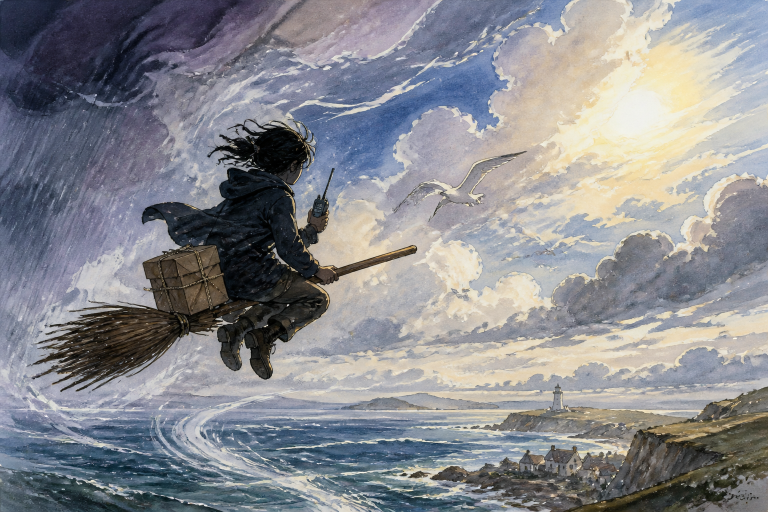
Kiki’s flying never becomes one reusable pose. Wind changes posture. Cargo changes balance. Fatigue changes control. A broom differs from Tombo’s machine and the borrowed street broom. Animation gives every flight a body.

The city’s architecture makes aerial movement legible. Rooflines, clocks, towers, streets, and harbor edges establish distance. Kiki can cross barriers quickly but cannot ignore traffic, weather, or landing space. Magic participates in physics rather than replacing physics.

Small acting carries the emotional arc. Kiki straightens when trying to look professional, folds inward when embarrassed, and becomes visibly heavy during depression. Jiji’s tail and ears supply commentary before dialogue. Osono’s movements reflect pregnancy and business routine without making either a gag.

The rescue sequence gains tension from mechanical detail. Ropes strain. The dirigible drifts. Crowds track movement. A television broadcast creates shared spectatorship. Kiki’s borrowed broom shakes and resists, making the return of power look partial and dangerous.

The 2026 4K IMAX restoration offered North American audiences a new chance to see background painting, linework, and scale theatrically. Restoration can sharpen access, although the film’s craft never depended on digital gloss. Human observation remains the special effect.

Joe Hisaishi scores independence without making loneliness glamorous

The music gives Koriko movement and charm, but quieter passages allow uncertainty to remain unadorned. Cheerful themes support exploration. Melancholy enters without announcing catastrophe. The score grows with Kiki’s relationship to the city.

Radio songs connect her to contemporary youth culture. Depending on version and territory, music choices differ, which changes tone. Dub histories matter because added lines and songs can make silence less available. The Japanese track often leaves more space around Jiji’s final change.

Sound design makes business tactile. Bakery trays, bells, bicycles, traffic, wind, rain, wings, and brooms create distinct forms of movement. The city sounds busy before Kiki belongs. Later the same noise feels familiar.

Eiko Kadono’s book and Miyazaki’s film

Eiko Kadono published the first Kiki novel in 1985 and continued the series across several books. The source offers episodic adventures and a broader life beyond the film. Miyazaki reshaped material around economic independence, city alienation, and a crisis of confidence.

The film’s burnout arc is one of the major adaptations. Such changes create a distinct argument rather than a visual transcription. Kadono’s literary Kiki and Miyazaki’s cinematic Kiki belong to related but separate continuities.

Adaptation also shifts tone through the city. Koriko becomes a composite European dream untouched by a world war, combining architecture and transport from different places. The setting gives Kiki modernity without tying her story to one national geography.

Readers approaching the books after the film should expect more than deleted scenes. The series lets Kiki age, maintain relationships, and encounter new problems. The film captures one emotional year by compressing and inventing.

The rescue, the letter home, and an imperfect recovery

The dirigible accident turns private uncertainty into public action. Kiki sees Tombo in danger and reaches for a broom. A street sweeper lends the tool, creating another small act of community. The broom does not cooperate gracefully. Kiki must negotiate with power rather than command a restored identity.

The rescue proves that skill survived, but the final letter matters more. Kiki tells her parents that work can be hard and that she feels more confident. She does not claim complete mastery. The letter frames independence as an ongoing condition.

Jiji still does not speak in the Japanese ending. That choice prevents the rescue from resetting childhood. Kiki gains something and loses something. Growth can include grief without becoming damage.

The credits show routines continuing. Customers return. Relationships deepen. Yasuno’s baby arrives. Jiji has a family. Kiki flies with more control. Heroism gets absorbed back into daily life, where real recovery must continue.

Cultural and industry impact

Kiki’s Delivery Service became Studio Ghibli’s first major domestic box-office success and helped stabilize the young studio after the slower theatrical performance of Totoro and Grave of the Fireflies. A story about a girl doing deliveries demonstrated that large audience appeal did not require a villain or war.

The film widened global expectations for coming-of-age animation. Independence could mean rent, customers, loneliness, and learning a city rather than defeating an enemy. Magical ability could fail under emotional pressure without becoming a punishment for arrogance.

Kiki became a lasting image across merchandise, fashion, fan art, and repertory cinema. The visual appeal can obscure the work story. Her bow and broom remain charming because the character beneath them feels tired, proud, awkward, and specific.

GKIDS’ 2026 IMAX release shows continued theatrical demand decades later. New audiences encounter hand-drawn scale on screens usually reserved for digital spectacle. The event also demonstrates how repertory anime has become a durable part of North American exhibition.

Creative workers frequently adopt Kiki as a burnout text. That reading travels because the film refuses shame. Lost ability does not reveal that earlier ability was fake. A blocked period can belong to a real practice.

What aged well, and where the film invites debate

The treatment of burnout aged remarkably well. The movie recognizes physical illness, social isolation, and overwork before offering any recovery. Rest is not laziness. Community is not failure.

The business remains economically vague. Kiki’s housing arrangement and low overhead protect her from pressures that would overwhelm many young workers. That softness belongs to the fable. Viewers should not convert her success into an argument that precarity builds character.

Koriko’s European composite can feel beautiful and culturally weightless. The design deliberately imagines a city without certain wartime destruction, yet borrowing architecture without social history can turn Europe into atmosphere. The fantasy works best when recognized as Miyazaki’s constructed dream rather than an authentic national portrait.

The film’s women possess unusual agency, although domestic and care labor still support nearly every success. Osono, Ursula, Barsa, the elderly client, and Kiki make the community function. The story values that labor, which does not make distribution automatically fair.

Final take

Kiki’s Delivery Service understands that becoming independent does not mean becoming self-sufficient. Kiki leaves alone and survives through a chain of people who offer rooms, meals, work, advice, tools, patience, and friendship. She contributes to that chain rather than escaping the need for one.

The lost magic gives the film lasting force. Talent can become labor. Labor can consume the conditions that let talent breathe. Recovery begins when Kiki stops treating every quiet day as proof of failure.

The rescue does not make her permanently fearless. The letter home says she has difficult days and keeps building a life. That modest claim feels more useful than triumph.

Rating: Essential. A beautiful city and a flying broom attract the eye. The movie lasts because Kiki learns that usefulness can build belonging, but usefulness cannot be the only reason she deserves a home.

Sources and further reading

The economics hiding under the cozy bakery

Kiki’s arrangement works because Osono lowers the cost of entry. A room and access to food give the new business time to find customers. Families and communities have always supplied such support, although official success stories often erase the help and celebrate the individual.

The delivery service depends on public infrastructure. Streets create addresses. Telephones allow orders. The bakery provides visibility. Customers possess disposable income. The city’s harbor and shops generate movement. Kiki’s broom is extraordinary, but the business cannot exist on magic alone.

Her competitive advantage comes from speed and access. She can cross water, climb above traffic, and reach remote homes. The same advantage produces risk because flight exposes her to weather. A business that treats a person’s body as the main asset can convert injury or illness directly into lost income.

Pricing remains offscreen, which keeps the story warm and prevents close accounting. That choice also leaves questions. Does Kiki charge for waiting, extra care, or failed ovens? Who pays when cargo falls? How does a teenager handle a hostile customer? The film does not need invoices, but the unseen questions reveal why Osono’s guidance matters.

The bakery benefits too. Kiki brings attention, helps with tasks, and extends the household network. Reciprocity prevents the arrangement from becoming a rich adult rescuing a grateful child. Both sides gain, even when the exchange cannot be reduced to equal cash value.

Depression arrives as disconnection

Kiki’s low period includes more than professional frustration. Food loses pleasure. Social invitations feel threatening. Comparison becomes automatic. Sleep and illness interrupt routine. Jiji’s voice disappears. The world has not changed dramatically, but her connection to the world has changed.

Miyazaki avoids diagnostic certainty. A viewer can call the experience depression, burnout, adolescence, loneliness, creative block, or a mixture. The lack of a label keeps attention on needs: rest, care, perspective, and relationships that do not demand performance.

Her isolation contains self-protection. Declining Tombo’s invitation avoids possible embarrassment. Staying in her room avoids proof that flight has vanished. Each avoidance reduces immediate pain and shrinks the life that could support recovery. The pattern feels psychologically credible without becoming a lecture.

Ursula’s visit interrupts that shrinking world. She does not drag Kiki to a party or insist on optimism. A trip to the cabin offers change at manageable scale. Conversation happens alongside ordinary activity. The friendship gives Kiki a way to speak before she has a solution.

Osono provides another form of intervention by arranging a delivery connected to Tombo. The plan respects Kiki’s working identity while opening a social door. No single person fixes her. Different relationships address different parts of the collapse.

Objects carry emotional labor

Packages are never only objects in this film. A pacifier carries care from parent to baby. A toy cat carries affection toward a child. A pie carries an older woman’s devotion toward a granddaughter. A broom carries family tradition and personal ability. Delivery makes Kiki responsible for meanings created by strangers.

The toy cat episode becomes especially rich because Jiji must imitate an object. A living companion freezes into the pose of a commodity while Kiki searches for the missing copy. The comedy depends on the difference between life and representation. The family dog recognizes that difference and quietly helps.

The old broom represents inherited knowledge. Kiki initially prefers her own newer broom, then loses that broom during the final rescue. A street sweeper’s ordinary tool becomes the vehicle for her return. Tradition, personal identity, and public labor meet in one object.

The bread sign Fukuo makes turns a service into a place. Before the sign, customers need explanation. After the sign, Kiki’s work becomes visible in the streetscape. Belonging has material evidence.

Her red bow performs similar work. The plain black dress follows witch tradition, while the bow gives Kiki a personal silhouette. Uniform and individuality do not have to cancel each other. A small choice can make inherited identity feel owned.

Dub history changes the ending

English-speaking audiences have encountered several versions. The early Streamline dub, Disney’s 1997 dub, later revisions, changed songs, and altered dialogue create different emotional rhythms. Phil Hartman’s Jiji became especially beloved in Disney’s version, which gave the cat more jokes and initially added a final line.

Added speech changes the meaning of recovery. When Jiji speaks again, the ending suggests that Kiki’s old world has returned. When Kiki still hears an ordinary meow, growth carries a permanent change. Neither performance can erase the film’s images, but dialogue guides interpretation.

Music substitutions relocate the story. Japanese pop songs place Kiki within a specific musical culture and period. English songs make the film feel familiar to another audience. Localization can create access and also replace texture.

Modern releases that offer Japanese audio, subtitles, and English dubs let viewers compare rather than argue from memory. Translation remains interpretation. A responsible review should identify which version supports a claim, especially when discussing Jiji.

Five visual ideas that explain the whole movie

The freight train

Kiki begins her independent life sleeping in hay while a train carries her accidentally. The image is funny and corrective. Personal freedom already relies on collective systems.

The bakery window

Glass separates public shop space from private work. Kiki sees customers, weather, and street life while remaining anchored to a household. The window becomes a safe border for learning the city.

Ursula’s painting

A flying figure surrounded by dark forms turns Kiki’s crisis into art without solving the crisis. Another person can see meaning where Kiki sees failure.

The airship

The city gathers around a technological spectacle that becomes a disaster. Modern progress remains exciting and unreliable. Kiki’s old magic becomes rescue technology when new machinery fails.

The borrowed push broom

The least glamorous broom in the film carries the climax. Ability returns through a tool associated with ordinary municipal work. Heroism begins with somebody handing over what they have.

The film understands adolescence as social translation

Kiki’s hardest task is not flying. She must learn what different people mean when they speak from different positions. A customer’s politeness may hide entitlement. Tombo’s enthusiasm may sound like mockery. Osono’s request may double as care. Ursula’s advice may offer permission rather than instruction.

Children often live in relationships where adults define context. Independence removes that translator. Kiki has to decide whether a stranger is safe, whether a job is fair, and whether an invitation is sincere. Mistakes become part of learning rather than proof that she left too soon.

Her self-consciousness around other girls shows identity becoming comparative. At home, being a witch was ordinary. In Koriko, the black dress and red bow make her visibly different. She studies shoes and laughter because belonging seems to require codes she never received.

The film does not solve insecurity by proving Kiki prettier or more special. Her difference becomes useful through work and recognizable through friendship. She stops needing every room to confirm that she fits.

Adolescence also changes the relationship with parents. Kiki’s final letter filters difficulty to protect them while offering real news. She has begun managing their worry, a small adult behavior. The letter still reaches toward home. Independence changes the direction of care without ending the need for care.

Community is built through repeated usefulness and unearned kindness

Kiki earns many relationships by helping. That pattern can look dangerously close to the belief that people deserve care only after becoming useful. The film corrects the pattern through moments where help arrives before Kiki can repay anyone.

Osono feeds her. Ursula shelters her. Fukuo makes the sign. A street sweeper hands over a broom. Crowds cheer during the rescue. Some exchanges produce future reciprocity, but nobody pauses to calculate a balance.

Kiki contributes in return because contribution gives her agency. The healthier lesson is not that usefulness buys belonging. Belonging creates enough safety for usefulness to become generous rather than compulsory.

The bakery sits at the center because food businesses create repeated contact. Customers return. Workers learn habits. News travels. Kiki’s office operates inside a place already structured around daily need. A delivery service extends that network across the city.

Koriko eventually recognizes Kiki through accumulated memory. The flying witch stops being a traffic problem and becomes their courier, neighbor, friend, and rescuer. Public identity grows from repeated encounters, not a marketing campaign.

Formal innovation through an anti-adventure

The film uses fantasy iconography while refusing the expected fantasy plot. No evil witch competes with Kiki. No magical artifact needs recovery. No prophecy chooses her. The central antagonist is a collapsing relationship to self.

That structure influenced later stories that treat supernatural ability as part of daily life. Magic can intersect with rent, food, transit, friendship, and fatigue. Worldbuilding becomes convincing through ordinary consequences rather than encyclopedic rules.

Miyazaki also places a female coming-of-age story inside public space. Kiki moves through streets, shops, homes, skies, and workplaces. Her development is neither confined to romance nor framed only through family conflict. Economic life becomes emotional material.

The absence of a villain changes pacing. Smaller tensions carry weight because viewers are not waiting for a dark lord to appear. A rude reaction, missed invitation, storm, fever, or silent cat can move the story. Animation proves capable of drama built from social texture.

The climax offers spectacle without changing the underlying genre. The dirigible rescue draws a crowd and television cameras, yet the solution depends on everything Kiki learned during ordinary work: reading wind, navigating buildings, improvising, and accepting help.

Details and echoes worth noticing

Two voices, one mirror

In the Japanese cast, Minami Takayama voices both Kiki and Ursula. The choice strengthens Ursula’s function as a possible older self without requiring a supernatural theory.

The city without a world war

Koriko mixes Stockholm, Visby, and other European influences into a timeline where architecture and airships coexist differently. Miyazaki has imagined a Europe spared certain wartime destruction. The city is alternate memory rather than accurate map.

The radio at the beginning and end

Broadcast sound accompanies departure and connects Kiki to a wider world. The radio turns private courage into a journey happening within modern everyday culture.

The bakery sign

Fukuo’s bread sculpture gives the business a public symbol. The image also folds witch identity into food craft. One worker represents another worker through his own material.

The caged geese

Birds repeatedly remind viewers that natural flight and magical flight differ. Kiki can read wind partly by watching living creatures. Flight remains ecological knowledge, not only supernatural force.

Why Kiki speaks so clearly to modern creative workers

The internet encourages people to turn identity into output. Artists become content creators. Hobbies become side hustles. Expertise becomes a personal brand. Kiki’s story predates those labels and understands the emotional cost.

She begins with a gift that feels natural. Customers transform the gift into deadlines and evaluation. Comparison enters. Fatigue accumulates. The gift stops responding. Such a sequence can happen to illustrators, teachers, translators, musicians, caregivers, programmers, and anyone whose competence becomes the main proof of value.

Recovery requires separating self from output. Ursula makes art and also walks, cooks, talks, and waits. Osono runs a bakery and also builds a household. Kiki learns that a difficult working day does not contain her full identity.

The movie remains more useful than advice demanding passion. Passion can become another performance requirement. Kiki does not recover because she feels sufficiently inspired. She responds to a person she cares about and accepts an imperfect tool.

That rescue may reopen flight, but sustainable life appears in the credits. Routine, relationships, play, and work continue together. A career becomes survivable when no single delivery carries the burden of proving existence.

That final distinction keeps the story honest. Kiki does not become an adult by eliminating need. She becomes more capable of recognizing which needs belong to work, friendship, rest, family, and her own changing mind. The broom returns as one tool among many, not the only evidence that she deserves to stay.

Koriko becomes home because people remember one another through ordinary days. Magic helps Kiki cross the skyline. Mutual attention gives her somewhere worth landing.

The result feels generous because competence matters, failure matters, and neither one gets the final word about who Kiki is.

The film protects that balance by letting recovery remain social, uneven, and ordinary instead of turning one successful rescue into a cure for every pressure she carries.

Leave a Reply