
Animal
KATSEYE auditioned for five male versions of themselves, got their headshots shredded, and called Demi Moore when the wardrobe crisis became a spiritual emergency.
What changed every time I replayed it
First listen: KATSEYE turned an audition room into a threat. The suits think they are watching the girls. The girls know exactly who is trapped behind the glass.
Second listen: The strutting pulse becomes more effective, but the production also feels too supervised. The title promises an animal. The beat keeps checking whether it used a coaster.
Third listen: Boyseye changes the lyric. The wild self is not only desire hiding behind public polish. It is every rejected possibility that the members learned to monitor during a televised formation process.
Fourth listen: I still want the glass to crack in sound. Warp the bridge, stack the ad-libs, dirty the rhythm, or let one final chorus lose its posture. The performance gives the song teeth. The arrangement keeps a dental guard nearby.
RaeRae Reacts
I expected “Animal” to be a song about losing control. I did not expect the video to begin with KATSEYE trying to earn approval from five men who are also KATSEYE. That decision immediately makes the premise sharper. The group is not simply being judged by random executives; they are being judged by constructed masculine versions of themselves, sitting safely behind glass and deciding whether the women onstage are convincing enough. It turns the familiar pop-industry audition into a hall of mirrors. The authority figures are fake, but the anxiety is not.
KATSEYE knows this setting better than most groups could. Their formation was public, ranked, edited, discussed, and converted into entertainment through Dream Academy and Pop Star Academy. They learned how to perform while being watched and how to appear spontaneous inside a system built around evaluation. “Animal” brings them back to that room, except now they control both the audition and the judges. The joke is not that approval no longer matters. The joke is that the voices deciding whether they are good enough have already moved inside their own heads.
That is why Boyseye is more than a cute gender-swap gimmick. Each member plays a masculine authority who carries pieces of her own face, mannerisms, and attitude. The women are forced to impress versions of themselves taught to value control, status, and distance. When Boyseye tears up the headshots, the scene externalizes a vicious creative habit: rejecting your own image before somebody else gets the chance. It is campy, but underneath the camp is a recognizable form of self-surveillance.
The song: excellent posture, complicated identity
The track moves with a strutting pulse rather than the deliberate ugliness that made “Gnarly” impossible to ignore. Omer Fedi and Blake Slatkin build the production around forward motion, clipped rhythmic accents, and a sleek pop surface that gives the members room to sound flirtatious without making the song feel weightless. The central idea is public composure versus private instinct, and the production stays poised enough to make the promised wildness feel like something pressing against a locked door.
Ed Sheeran’s involvement is the headline-friendly fact, but the full writing team explains more about the record’s shape. Johnny McDaid brings the architecture of arena-ready songwriting; Fedi and Slatkin understand contemporary pop’s preference for compact hooks and sharp sonic branding. The result is efficient almost to a fault. “Animal” knows the route from verse to chorus and travels it without wasting time, but efficiency can make rebellion feel surprisingly well supervised.
My question after several listens is not whether the hook works. It does. My question is whether the song sounds specifically like KATSEYE, or whether KATSEYE’s performance supplies identity to a song that could survive being reassigned. The members bring different textures and attitudes, but the melodic writing does not always exploit those differences. A group with this many distinct vocal colors should be allowed to create more friction inside the arrangement rather than moving through one immaculate lane.
That does not make “Animal” generic in the lazy sense. The concept, vocal attitude, and video give it a strong personality. But the audio alone is less unruly than its title. I wanted one passage where the production actually lost its manners: a bridge that warped the rhythm, an ad-lib pileup, a harmony that became feral, or a final chorus that sounded as if the observation-room glass had cracked. The song tells me there is an animal behind the door. The video lets it out. The production keeps checking that it wiped its feet.
Boyseye, the observation room, and the male gaze
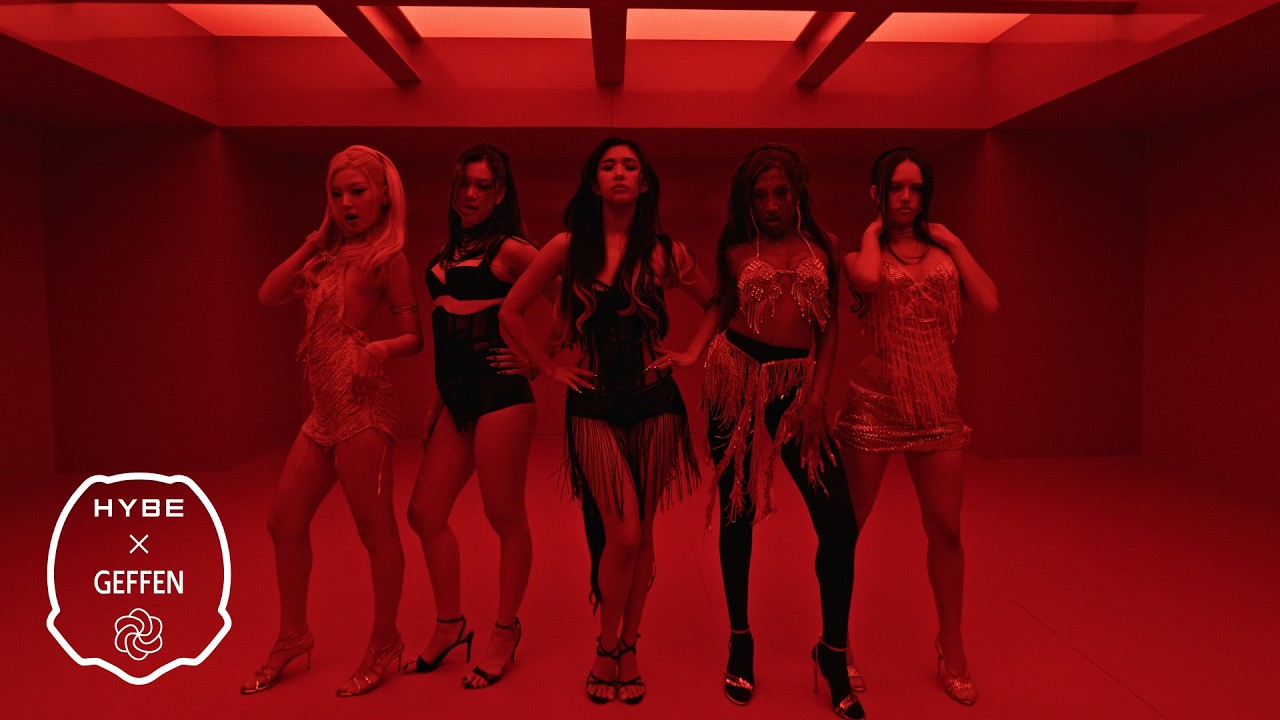
The two-way glass is the video’s smartest object because it turns looking into power. KATSEYE performs under red light while Boyseye watches from a clean corporate room. The performers can feel judgment without controlling how they are being interpreted. That is the basic mechanism of the male gaze, but the gender-swapped casting complicates it: the “men” looking at them are their own performed alter egos. The gaze is institutional, masculine-coded, and self-generated at the same time.
There is also a joke here about the impossible instruction given to girl groups. Be polished, but not artificial. Be sexy, but remain respectable. Be individual, but never disrupt the group silhouette. Be spontaneous on schedule. Boyseye’s dissatisfaction represents a standard that can always move after the women meet it. The headshots being torn up are not constructive criticism; they are proof that the audition’s real function is to maintain the judges’ authority.
The women respond by trying to change themselves, which sends the video into wardrobe panic. Clothes fly, options multiply, and the search for the correct image becomes physically chaotic. This is where “Animal” stops treating fashion as surface decoration and turns it into the battlefield. The members are not only choosing outfits. They are trying to discover which version of femininity will survive the room.
Demi Moore is not a random cameo
Demi Moore enters with the calm of someone who has already watched several generations of Hollywood tell women how to look, age, desire, and remain marketable. Casting her after The Substance gives the wardrobe scene extra bite, whether every viewer catches the connection or not. That film is obsessed with beauty standards, replacement, self-hatred, and the violence of trying to manufacture an acceptable female body. In “Animal,” Moore sits inside another room where women are dismantling themselves in pursuit of the right presentation.
Her styling authority also deliberately recalls Miranda Priestly from The Devil Wears Prada. Moore does not imitate Meryl Streep’s character exactly; she plays with the same economy of judgment. A look, a refusal, or a question about a shoe is enough to send everyone back into motion. Rolling Stone described the cameo as Moore’s own twisted Miranda Priestly, and the reference works because fashion approval is treated as both absurd and terrifyingly consequential.
Then she gives them permission to get wild. That permission is funny because the entire song argues for an uninhibited self that should not need authorization. Yet the transformation only happens after an older, established woman stops the frantic self-correction and redirects it. Moore is not another Boyseye judge behind glass. She enters the mess, sees the women directly, and helps them use fashion as amplification rather than disguise.
The cameo also continues KATSEYE’s growing habit of using recognizable actresses as symbols of power. Jessica Alba played the executive at the center of “Gabriela”; Moore becomes the fashion oracle inside “Animal.” These are not just celebrity decorations. Both women arrive carrying decades of public image, industry judgment, and cultural memory. KATSEYE borrows that history, then places it inside stories about young women negotiating who gets to define them.
Lyrics decoded: who gets to see the animal?
The lyrical premise depends on selective visibility. The person being addressed appears controlled in public but reveals another self in private, especially through movement and desire. That could remain a simple flirtation, “I know the real you”, but the video expands it into a question about performance. If every public self is managed, is the private self automatically more authentic? Or is “wildness” another role people perform when they believe the door is closed?
The dance floor becomes a threshold between those identities. It is public enough to be watched but physical enough to loosen control. That makes it the perfect setting for a song about glimpses rather than complete revelation. The narrator does not claim permanent access to the hidden self. She catches flashes of it, interprets them, and turns them into attraction. The animal is powerful partly because it is not constantly available.
KATSEYE’s own celebrity context makes that idea richer. Fans receive carefully selected pieces of personality through performances, interviews, livestreams, documentaries, and social media. The promise of “the real person behind the idol” is one of pop culture’s most profitable fantasies. “Animal” plays with that hunger without fully satisfying it. The group gives us masculine alter egos, polished performers, panicked dressers, glittering final forms, and choreography, multiple selves, all staged, none automatically false.
Easter Eggs & Surprises
- Boyseye is KATSEYE judging KATSEYE. The boardroom is populated by gender-swapped versions of the five performing members. That makes the audition a visual argument about internalized judgment rather than a simple women-versus-men setup. Their most intimidating gatekeepers wear their own faces.
- The torn headshots repeat the group’s origin story in miniature. KATSEYE was formed through an elimination process where images, performances, and personalities were continuously evaluated. Destroying the headshots turns that history into a fast, ugly joke: a human being reduced to a photograph that can be rejected in seconds.
- The observation glass creates two audiences. Boyseye watches from inside the story while we watch both rooms from outside it. We are invited to criticize their judgment even as the camera places us in another position of surveillance. The video does not let the real audience pretend it is innocent.
- Demi Moore carries The Substance into the closet. Her recent role makes a scene about women frantically changing their appearance impossible to read as neutral. Moore’s presence brings beauty pressure, aging, replacement, and the cost of self-reinvention into the room without requiring a speech.
- The Miranda Priestly reference changes the kind of authority onscreen. Boyseye rejects from a distance; Moore judges at close range and eventually helps. Her fashion vetoes are severe, but she is invested in the transformation rather than preserving the group’s failure.
- The claw-like choreography literalizes the title without becoming costume play. The members use hands, shoulders, and controlled bursts of movement to suggest an animal body while remaining unmistakably human and fashion-focused. The choreography treats instinct as something emerging through the polished form, not replacing it.
- The red performance room is desire under laboratory conditions. Red signals heat and danger, but the observation setup keeps that heat contained. The group’s “wild” energy is still being studied, framed, and assessed until the final transformation changes who appears to own the room.
- Sophia missed the official countdown. In the 30 minutes before the YouTube premiere, Lara, Yoonchae, Megan, and Daniela celebrated with animal-style fries from In-N-Out and teased the new era. Sophia’s absence from that stream is a small release-day detail, not a hidden scandal, but it belongs in the timeline fans will later try to reconstruct.
- The “Toxic” resemblance is a conversation, not a confirmed sample. Some listeners heard echoes of Britney Spears’ “Toxic,” but available official credit reporting does not list a sample or interpolation. Similarity is worth discussing; presenting fan recognition as a legal music credit is not.
The RaeRae lens: the watcher moves inside
The observation room works at three scales. Personally, it is self-criticism. Interpersonally, it is the fear that another person controls your value. Structurally, it is an industry that turns evaluation into entertainment and teaches performers to anticipate the edit before the camera moves.
From a Confucian perspective, public identity grows through roles and relationships. That can produce discipline and responsibility, but it can also make the self too dependent on correct performance. Boyseye becomes the internal official deciding whether each woman has satisfied the role assigned to her.
A Buddhist lens pushes the satire further. The fixed, acceptable self is an illusion the audition keeps trying to manufacture. KATSEYE plays the applicant, the judge, the masculine alter ego, the polished idol, and the animal under the surface. None is the whole person. The suffering begins when one mask claims permanent authority.
Demi Moore’s presence connects that argument to age, beauty, and the entertainment industry’s long habit of treating women as products with expiration dates. The wardrobe transformation is funny because fashion becomes ritual armor. It is also sharp because approval still arrives through a glamorous elder who understands the machine from inside it.
The global-group context matters too. KATSEYE members carry different national, racial, linguistic, and cultural readings into one brand. “Marketable identity” can easily become a demand that each woman perform a simplified version of herself. The video’s smartest rebellion is not choosing one authentic self. It is showing that identity remains plural, performed, watched, and still capable of biting back.
Release context: this is bigger than one single
“Animal” is scheduled for KATSEYE’s five-track third EP, WILD, arriving August 14, 2026. It follows “Pinky Up” and continues the group’s first EP era without Manon, who remains on hiatus. That absence changes the visual geometry and vocal distribution whether the promotion addresses it directly or not. The video’s fixation on group identity, replacement, and evaluation inevitably lands differently when the public is already watching a five-member configuration and asking what permanence means.
The release also sits between major expansion points: the theatrical film KATSEYE: Wild Hearts is scheduled for August 12, followed by the Wildworld Tour beginning in September with dates across North America and Europe. “Animal” therefore has several jobs. It must work as a song, sell an EP era, introduce the film-and-tour narrative, and demonstrate that the current configuration can carry KATSEYE’s momentum. The boardroom anxiety is fictional. The scale of the real-world audition is not.
Credits I actually wanted to know
| Performed by | KATSEYE. The canonical group remains Daniela, Lara, Manon, Megan, Sophia, and Yoonchae; the official video visibly centers Daniela, Lara, Megan, Sophia, and Yoonchae. |
|---|---|
| Songwriters | Ed Sheeran, Johnny McDaid, Blake Slatkin, Omer Fedi |
| Producers | Omer Fedi, Blake Slatkin |
| Video director | Cody Critcheloe, who also directed KATSEYE visuals including “Touch” and “Gnarly” |
| Guest | Demi Moore |
| Label | HYBE x Geffen Records |
| EP | WILD, scheduled for August 14, 2026 |
Film and performance crew: the official-description credit roll names director Cody Critcheloe, creative director Humberto Leon, visual director João Moraes, executive creator Sungdeuk Son, head of creative production Jay Ihn, performance direction by Grant Gilmore and Sohey Sugihara, contributing choreography by Sergio Reis, cinematography by Russ Fraser, production design by Wesley Goodrich, costume by Kyle Luu, hair by Evanie Frausto, makeup by Andrew Park, nails by Naomi Yasuda, editing by Dakota Giglio at Church Edit, VFX by Local Formations, color by Myles Bevan at Modern Post, and production by Object & Animal with executive producer Alex Brinkman and producer Jami Taylor Arceo. The live official description remains the final authority; the current mirror is retained as a source receipt.
The studio master runs 2:38 while the official video runs 3:11 because the film includes narrative material. The exact MV is the playlist obligation. Teasers, choreography videos, and routine performance versions fold into this song family unless a later item contains genuinely separate editorial material. A same-day instrumental appears under a colliding Apple artist identity, so it stays unmerged until that identity is verified.
KATSEYE is a U.S.-based global girl group built through the HYBE and Geffen system, not a Korean-market act merely because it appears on this playlist. Its K-Pop routing is supported by the site’s established KATSEYE architecture and K-pop production framework. This group recording does not create Solo Artist eligibility for any member.
Final take
“Animal” is a better visual argument than it is a musical rebellion, and I mean that as both praise and complaint. The video understands the group’s history, the violence of evaluation, the comedy of self-surveillance, and the way fashion can operate as both cage and weapon. Boyseye is clever enough to reward a second watch, while Demi Moore’s cameo has actual thematic purpose instead of feeling pasted on for headlines.
The song itself is polished, catchy, and performed with confidence, but I still want it to endanger its own structure. If the concept promises the private self breaking through, let me hear the moment the production can no longer contain her. Give me one section that feels less focus-tested and more physically necessary. KATSEYE sells the track. The video transforms it. The difference between those two accomplishments is the most interesting thing about the release.
Factual context checked against Universal Music Canada official release, Apple Music single, Spotify release, Edaily Korean report, Universal Music Japan, official-description crew mirror, Rolling Stone Australia, ANTARA, People, and JamBase.