
Hootie Frutti: KATSEYE Turned Appetite Into the Joke
Release file
Released: August 14, 2026
Runtime: 02:33 official MV; 02:20 song
Label / channel trail: HYBE LABELS; HYBE/Geffen
Sound: Physical club-pop with drum-programmed punch, a deliberately excessive appetite hook, and handoffs that let six vocal colors keep changing the joke’s temperature.
Production and writing: Thom Bridges produced, programmed drums, and co-wrote; Rachel West, Amanda Kiddo, and Daniela González share composition/lyric credits.
Vocal and engineering trail: Bart Schoudel vocal production; Robby De Sa vocal engineering; Tom Norris mix; Victor Verpillat additional mix; Chris Gehringer mastering with Will Quinnell.
Performance direction: Grant Gilmore and Sohey Sugihara; choreography contribution by Sienna Lalau.
Sources: Exact official playlist uploadDaily+894.5KTotal views128.2M; Qobuz official release and personnel record.
Bottom line:
Verdict: “Hootie Frutti” is KATSEYE turning desire into a joke before anybody else can turn the women into the joke. The beat is physical, the concept is knowingly excessive, and the women control the looking.
What changed every time I replayed it
The first watch belongs to the hook and the video’s loudest joke. The second belongs to the handoffs: who prepares the next line, who changes the temperature without taking center, and who keeps performing after the edit has moved elsewhere. By the third replay, the question I kept asking was whether the record still has an argument when the screen is minimized.
That separation matters for an in-depth React. A music video proves selected framing, styling, narrative and edited performance. It cannot quietly prove an untouched live vocal or a full choreography that the camera never shows. Praise becomes stronger when the evidence stays attached to the exact upload.
The song underneath the styling
KATSEYE work inside compact global-pop architecture: quick setup, a hook designed to be recognized immediately, and very little patience for a bridge. Efficiency is not the enemy. The problem begins when recognition replaces development and the final chorus arrives without changing the emotional stakes.
The members keep the surface from flattening. Lara’s vocal color, Sophia’s clarity, Daniela and Megan’s physical attack, Yoonchae’s precision and Manon’s restraint are not interchangeable products. The mix is most alive when those differences converse instead of being polished into one anonymous international-pop voice.
The joke belongs to KATSEYE
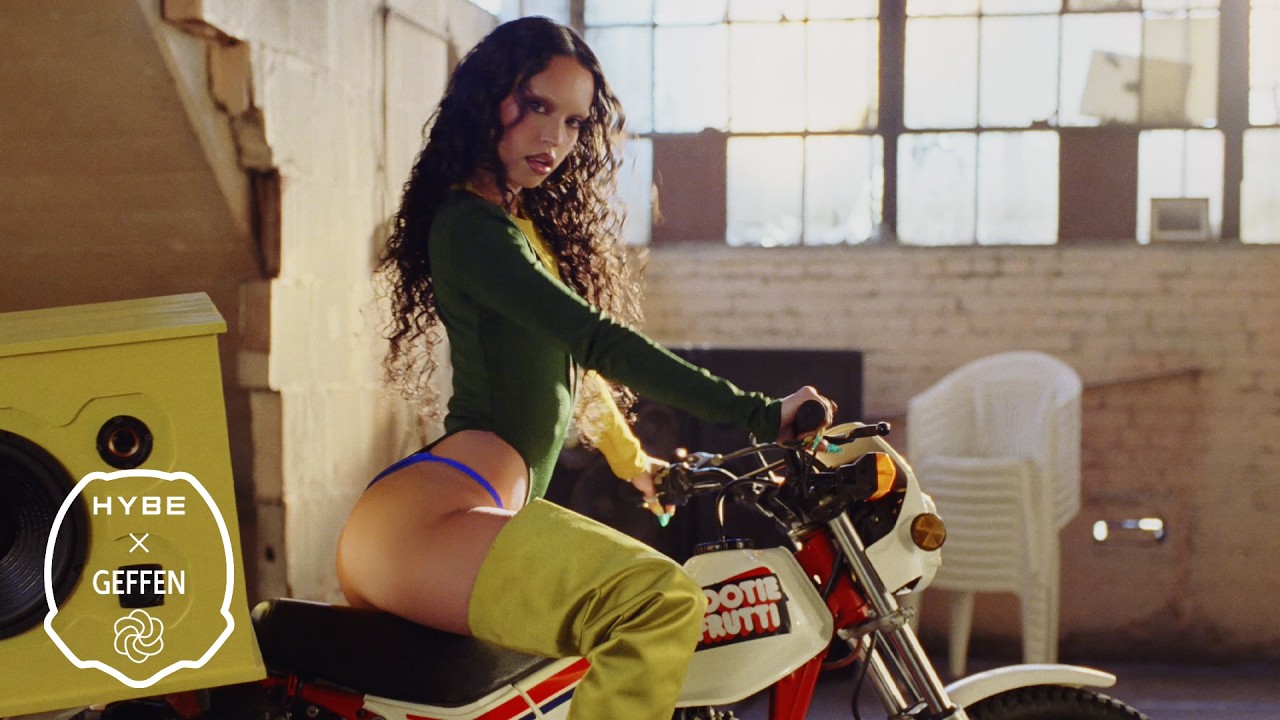
“Hootie Frutti” turns appetite into choreography and exaggerates the luxury-smoothie absurdity until desire becomes something the women can joke about before anybody else weaponizes it. The fruit language is deliberately unserious; the control behind it is not. The members decide when the frame gets access and when it gets teased for asking.
Baile-funk propulsion gives the record a physical purpose. Its best moments are less about lyrical revelation than the way consonants, shoulders and edit points land on the same pressure. The wet warehouse and motorcycle imagery could have become a generic “expensive sexy” package, but the performers’ comic timing keeps puncturing the pose.
Beat, borrowing and responsibility
A global-pop record can borrow rhythmic vocabulary without pretending influence is ownerless. The correct response is not to flatten every syncopated club pattern into “a fun beat,” but to name the audible lineage, follow the credited makers and avoid claiming that a two-minute pop single represents an entire Brazilian scene.
The groove succeeds because it asks for bodily response before interpretation. My complaint is that the ending does not add a new weapon. Once the hook has proved it can move the room, another thirty seconds of rhythmic or vocal escalation could turn pleasure into consequence.
Six-member history and current five-member activity
The official roster remains Daniela, Lara, Manon, Megan, Sophia and Yoonchae. HxG announced a temporary health-and-wellbeing hiatus for Manon while scheduled activities continue. Naming the five members visible in a current campaign is accurate; turning that temporary absence into an invented departure is not.
That distinction also protects the work. Older six-member recordings remain six-member performances. Current formation and line changes can be evaluated without using them as clues in a rumor puzzle about health, contracts or friendship.
The international access problem
A group marketed as global should not make international listeners reconstruct basic release context from scattered notices, clipped translations and algorithm luck. Exact video titles, dates, credits, member status and regional availability are part of the infrastructure around the art. They determine whether a fan can follow closely without treating the fastest rumor account as an archive.
This is why the site keeps the exact official upload beside dated official sources and canonical profiles. English-language songs do not automatically create equal access. A worldwide audience still needs one dependable path from the video to the people, the status notice and the rest of the release family.
What worked
The strongest choice is coherence. Hook, styling, edit and performance agree on the song’s temperature while leaving enough detail for a second watch. KATSEYE are most persuasive when they perform like women who understand the camera’s bargain and can play with it, not trainees waiting for confidence to be approved.
Humor helps rather than cheapens the concept. Camp can expose an industry pressure more clearly than solemn explanation, especially when the performers control the joke and the viewer realizes the joke has been controlling the gaze all along.
Where it could hit harder
The recurring frustration is duration. One changed final chorus, an empty bar, a longer formation shot or a bridge with a new harmonic idea would let the central premise develop beyond recognition. Louder is not the same as more consequential.
The editing can also become overprotective. When every beat receives a close-up, formation intelligence disappears. Let a movement complete its sentence. Let an expression stay in frame long enough to change. The performers have already done the labor; the camera does not need to rescue every second.
Camera grammar and performance evidence
The edit rewards two kinds of watching. First, follow the person holding the line and note how framing, lens distance and cut rhythm manufacture emphasis. Then ignore center and watch the members completing transitions at the edge. The second method reveals the ensemble labor that a highlight edit treats as background. It also prevents a close-up from being mistaken for proof that one performer carried an entire sequence alone.
Facial performance is not decoration here. A delayed smile, a glance held one beat too long or a deliberately flat reaction can reverse the meaning of a lyric. Those choices are part of choreography even when no large movement occurs. KATSEYE understand that the face and the formation can tell different stories at once, and the tension between them is often more replayable than the literal plot.
Vocals, line handoffs and group identity
The most useful vocal question is not a fantasy ranking; it is function. One voice establishes the phrase, another adds grain, another makes the hook feel conversational, and another closes the line cleanly enough for the edit to turn. Distribution should be discussed as arrangement, not as a moral reward system. Seconds alone cannot tell us whether a part was exposed, doubled, harmonized or designed to launch somebody else.
That approach also makes room for growth. A member can become more rhythmically precise, more comfortable with silence or better at shaping a short line without being declared the secret winner of the group. The point of a canonical profile network is to preserve change over time without turning every release into another audition.
Why the short runtime still matters
Short songs can be complete, but this one’s compact form places unusual pressure on repetition. Every returning hook has to gain something through texture, visual escalation or changed delivery. When the final return behaves exactly like the first, the record feels edited for circulation rather than composed toward an ending. A longer runtime would not automatically solve that; one purposeful contrast would.
The page therefore separates liking the immediate pleasure from pretending the architecture is beyond criticism. A song can be fun, physically persuasive and worth replaying while still leaving an unrealized bridge on the table. That is not a contradiction. It is the difference between recommendation and analysis.
Profile routes
Replay section
Replay section: Return once for the hook, once for the member handoffs, once for the frame edges, and once with the screen minimized. Keep this exact upload separate from performances and choreography versions; the difference between versions is evidence, not clutter.