
CVM Sekai Naruto Character File
Karura
Gaara’s mother is not important because she died beautifully. She is important because the truth of her love survives a Kazekage’s lie, a tailed-beast program, and years of abuse built around her name.
The verified record is short, but the consequences are enormous
Karura makes her formal manga appearance in chapter 547 and her anime appearance in Naruto Shippūden episode 297. The story reaches her through Rasa’s reanimated confrontation with Gaara. That delayed entrance is important. Viewers know the effects of Karura’s supposed hatred long before the narrative permits the woman herself to appear inside the corrected memory.
Published reference data gives Karura a November 11 birthday, age 24 at death, height 170.5 centimeters, weight 50.7 kilograms, and blood type B. She is Rasa’s wife, Yashamaru’s elder sister, and mother of Temari, Kankurō, and Gaara. The manga does not provide a ninja rank, mission ledger, or complete professional biography. A serious profile should say so instead of filling the empty space with fan invention.
Karura dies around Gaara’s birth after Shukaku is sealed into him during pregnancy. Her love becomes the force associated with Gaara’s automatic sand defense. The exact metaphysics remain poetic and partially unexplained. The narrative conclusion does not: Rasa identifies the protection as Karura’s love, and the official Naruto site repeats that reading directly.
Verified data and the boundaries of a life the story barely records
Karura first appears in manga chapter 547 and in Naruto Shippūden episode 297. Her birthday is November 11. The published profile lists her at 170.5 centimeters, 50.7 kilograms and blood type B. She is a Sunagakure citizen and member of the Kazekage family through marriage to Rasa. Her children are Temari, Kankurō and Gaara; Yashamaru is her brother; later family links include Shikadai and Shinki.
The record does not provide her age, ninja rank, registration number, Academy history, mission ledger, chakra natures or databook combat statistics. It does not even establish that she served as a shinobi. Calling every named adult in a hidden village a kunoichi is how fandom turns geography into a job title. Karura’s confirmed act of supernatural protection is enormous, but it does not create an unseen career.
Her story is reconstructed through late manga revelation, Rasa’s confession, Yashamaru’s coerced lie and the behavior of Gaara’s sand. That source structure matters. Karura receives very little direct speech because she dies at childbirth. The profile therefore separates what she says and does from what men later claim she felt. Dead women have been used as emotional furniture long enough. We are checking the receipts.
Temari carries her face. Gaara carries her protection.
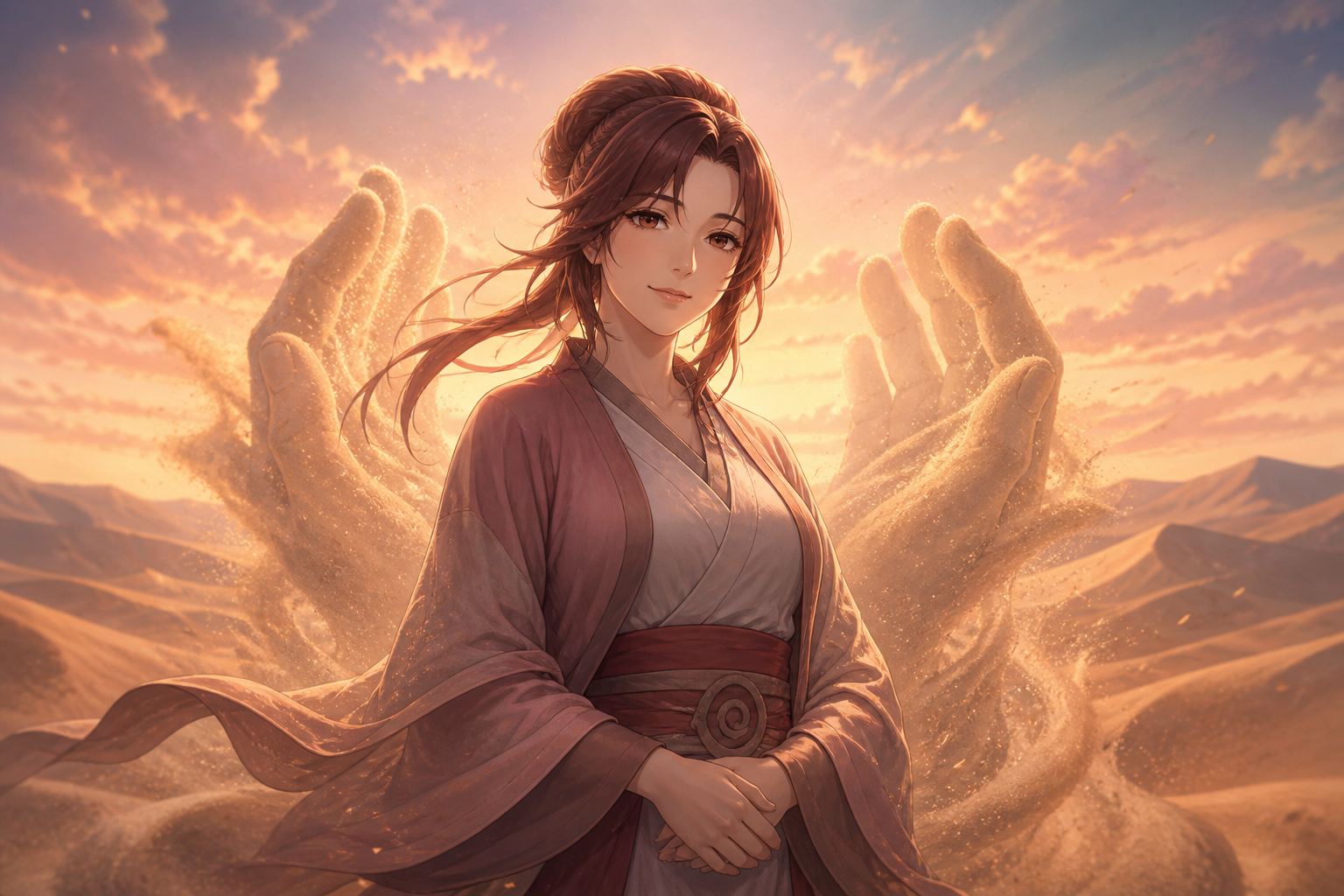
Karura’s design makes the Sand Siblings look like one family rather than three children attached to a title. Her light hair and facial features echo Temari most clearly. Gaara inherits a different kind of visual connection. When the sand rises into Karura’s shape, the story gives his invisible protection a human outline.
That silhouette does more than make a battlefield reveal easy to understand. Gaara has spent years using sand as armor because people are dangerous. The war scene reframes the armor as an embrace. The same material can hold enemies down and hold a crying son together. Naruto’s visual language turns defense into a relationship.
Karura is usually shown through pregnancy, memory, or sand imagery. Those limits matter. The series does not give her a large wardrobe history or a long sequence of adult choices. Artwork that turns her into a generic desert goddess may look pretty while erasing the exhausted young woman caught inside a military family.
Appearance record: sandy hair, indigo eyes and a face divided among her children
Karura has shoulder-length sandy-brown hair framing a gentle face, indigo eyes, a simple outfit and a long pale-yellow scarf. The design avoids the armor, rank markers and ceremonial weight surrounding Rasa. She is visually located inside the family before the story gives her independent public identity.
Temari strongly resembles her mother in facial structure and coloring. Gaara carries the clearest supernatural trace: when the automatic sand defense reaches its fullest protective shape, it forms Karura’s image. Kankurō does not receive the same obvious visual shorthand, which makes him easier for summaries to erase from her motherhood. Biology does not become less real because character design gave one sibling the loudest resemblance.
Karura is also shown in the medical crisis around Gaara’s premature birth. Her failing body and the tiny newborn create the scene’s truth before anybody discusses jinchūriki strategy. She is not an abstract maternal spirit yet. She is a dying patient asking to hold her child while the medical team cannot save her. The later symbol works because the story first gives it a body and a cost.
Sunagakure turns Karura’s pregnancy into military infrastructure
Rasa orders Shukaku sealed into Gaara while Karura is pregnant, and Chiyo performs the sealing. The decision uses two bodies at once. Gaara becomes a weapon before birth. Karura’s pregnancy becomes the delivery system for village policy.
Naruto often talks about jinchūriki as children burdened by tailed beasts. Karura forces the camera one step earlier. Somebody carries the child through the procedure. Somebody absorbs the medical risk. Somebody dies while the village evaluates whether the result will increase military power.
The political context is real. Sunagakure faces economic pressure and wants a controllable tailed-beast asset. Shukaku is dangerous. None of those facts creates Karura’s consent on the page. Canon does not give us the conversation where she freely chooses the sealing plan, so the profile cannot invent enthusiastic agreement to make Rasa easier to forgive.
Chiyo’s role also matters. A state project needs specialists. Leadership authorizes harm, medical and sealing experts make the plan possible, and family members live with the consequence. Responsibility is distributed. It does not disappear.
The complete birth record: sealing, premature labor, the last request and the first protection
Rasa decides that Suna needs a more powerful military asset after the Land of Wind’s daimyō cuts the village budget and uses cheaper Konoha services. Chiyo seals Shukaku into unborn Gaara. The record says Karura was forced to allow the sealing against her wishes. Gaara is born prematurely, and Karura’s condition collapses. Rasa wants the medical team to save her, but wanting rescue after authorizing the project does not cancel the decision that placed her there.
As her heart rate fails, Karura asks to see Gaara. She holds the small, fragile infant and promises to protect him no matter what happens. This is the cleanest direct evidence of her feeling. She does not curse him. She does not describe him as revenge. She does not assign him the emotional job of punishing Suna. She sees a vulnerable child and answers with care.
That distinction becomes the entire moral spine of Gaara’s history. Rasa later orders Yashamaru to say Karura hated Gaara and named him through a phrase about self-loving carnage. The lie does not merely insult a dead woman. It installs a false origin story inside a child already isolated by state policy. If a person believes his first relationship was rejection, every later act of trust feels like walking onto a trapdoor.
The true sequence is harsher and kinder at once. Karura dies because a village weapon program uses pregnancy as infrastructure. Her final act refuses that program’s language. She addresses Gaara as a child worth protecting, not an asset worth measuring.
Who gets to speak for a dead woman?
For most of Gaara’s childhood, Karura cannot correct the story told about her. Yashamaru says she resented Gaara, cursed the village through him, and never loved him. Rasa later admits that the claim was a lie ordered to provoke Gaara and test Shukaku’s volatility.
This is one of Naruto’s nastiest uses of narrative control. Rasa does not only authorize violence against his son. He borrows Karura’s dead voice to make the violence feel maternal. Gaara is told that rejection began before he could remember. The lie gives his isolation an origin story and makes love appear impossible.
A dead person’s reputation is easy for an institution to manage. She cannot challenge the official version. The sand becomes counter-testimony. Karura’s continuing protection communicates what Rasa’s policy tried to suppress.
The lesson extends beyond this family. Archives, leaders, and survivors often disagree about what a dead woman wanted. The ethical response is not to invent a cleaner speech for her. The ethical response is to separate confirmed action, reported statement, admitted lie, and interpretation.
The automatic sand defense is love with material force
Gaara’s sand protects him without waiting for a conscious command. Rasa initially reads that defense as Shukaku protecting its host. During the war, the sand takes Karura’s form and shields Gaara from Rasa’s attack. Rasa finally understands that the protection comes from Karura.
The reveal holds even after Akatsuki extracts Shukaku from Gaara and Chiyo restores Gaara’s life. The official Naruto site explicitly identifies the persistent sand defense as Karura’s love. That matters because the story separates mother and tailed beast. Gaara’s protection is not proof that the monster owns him.
Fans sometimes flatten the scene into a literal ghost technique with a complete rulebook. Canon does not provide one. Karura does not receive a named jutsu, elemental affinity, or combat move list. The safest statement is the story’s own: her love and will continue through the sand that automatically protects Gaara.
The emotional function is just as important as the mechanic. Gaara has believed his defense proves that he is alone with Shukaku. The truth reveals that solitude was never total, even when every living adult made it feel total.
How the automatic sand defense works, and what the record cannot prove
Karura’s protective will and chakra inhabit Gaara’s sand, causing it to move automatically when he is in danger, including danger from his own actions. The defense reacts without requiring a conscious command from Gaara. During the war confrontation, the sand forms Karura’s shape while restraining Rasa and other reanimated Kage. Rasa recognizes the protection as hers rather than Shukaku’s.
This is not a catalog of named jutsu. Karura is not shown performing Magnet Release, sealing Shukaku herself or training Gaara’s sand control. The Fourth Databook describes her will in the sand, and the manga gives the protective manifestation a visible form. Calling it maternal chakra is accurate. Giving her a fan-made combat class is not.
The defense also has limits because Gaara can still be injured, exhausted, overwhelmed or separated from usable sand. Karura’s protection does not freeze him outside consequence. It gives the child a continuous layer of care strong enough to keep reaching for him while his own conscious control grows around it.
Symbolically, the sand performs what no living adult managed consistently: it notices danger without asking whether Gaara has proved his value first. Rasa watches for control. The council watches for usefulness. Assassins watch for an opening. Karura’s sand simply protects. That is why the reveal lands like a truck despite involving no new power-up.
The lie about Gaara’s name rewrites identity at the root
Yashamaru tells young Gaara that Karura named him as a curse and that his name means a self-loving carnage. The child then carves the kanji for love into his forehead and decides he will live only for himself. The story of his name becomes a survival doctrine.
Rasa’s later confession breaks the reliability of that account. Yashamaru’s final cruelty was ordered as part of the test. Karura loved Gaara. That does not automatically supply a fully documented alternative naming ceremony, and this profile will not manufacture one. The important correction is that the “your mother hated you” interpretation was operational deception.
Gaara eventually keeps the name while changing what love means. He moves from self-preservation to connection, public duty, and chosen bonds. Karura’s truth does not erase the scar. It changes the foundation beneath it.
Karura and Rasa: marriage is not evidence of equal power
Rasa is Karura’s husband, the Kazekage, and the person who orders Shukaku sealed during her pregnancy. Those roles place intimacy and state authority in the same relationship. The manga does not give us enough private scenes to describe their marriage as loving, hateful, arranged, or politically equal.
What we can judge is conduct. Rasa uses Karura’s body in a village weapons project. After her death, he misreads her protection and authorizes a lie about her feelings. During reanimation, he recognizes that Karura understood Gaara’s value when he did not.
Rasa’s remorse restores her truth to Gaara. That is useful. It does not make him the author of Karura’s love. He is finally reporting what his policy failed to see.
Karura and Yashamaru: sibling love trapped inside command
Yashamaru is Karura’s younger brother and Gaara’s caretaker. Rasa states that Yashamaru resented him, not Gaara, because Rasa had Shukaku sealed into his pregnant sister. That detail changes the emotional map. The uncle’s anger points upward toward the leader who made the decision.
Yashamaru still obeys Rasa’s assassination order. Shinobi duty turns grief into service for the institution that caused it. He attacks Gaara, repeats the lie about Karura, and dies in an explosion meant to complete the test.
Calling Yashamaru innocent erases his final actions. Calling his love fake repeats Rasa’s operational lie. The harder truth is that a person can love his sister and nephew, resent the Kazekage, and still participate in the command structure that destroys the child.
Karura had three children, even when the plot follows one
Temari and Kankurō are Karura’s elder children. Gaara’s birth and jinchūriki status dominate the surviving material, but Karura’s family does not begin and end with the child whose sand carries her will.
Temari’s resemblance gives Karura a visual continuation. Kankurō and Temari later become central to Gaara’s safety and leadership. They support him as Kazekage, fight for him, and help create a sibling bond that Rasa’s household once made dangerous.
The sand protects Gaara specifically. That does not prove Karura loved the other children less. Canon ties the automatic defense to the crisis around Gaara’s birth and his continuing danger. Absence of a supernatural technique around Temari or Kankurō is not evidence of absence of maternal love.
All three children eventually build lives larger than Rasa’s weapons program. Karura’s legacy should include that survival without pretending she personally witnessed the adults they became.
Temari, Kankurō and Gaara after Karura: three children inherit different absences
Gaara receives Karura’s supernatural protection and the cruelest lie about her feelings. Temari and Kankurō receive neither the same shield nor a full maternal narrative. They grow up beside a brother their father isolates and repeatedly targets, learning to fear the weapon policy that killed their mother. Their silence about Karura is not proof that she mattered only to Gaara. It is proof that Naruto does not spend enough pages on how bereaved siblings remember the same woman differently.
Temari later carries Karura’s face into diplomatic adulthood. Kankurō becomes the brother most immediately responsible for treating Gaara as a person once the Sand Siblings begin to change. Gaara becomes Kazekage and builds relationships Rasa stole from him. Karura’s family survives by creating bonds the original household could not safely hold.
The later family expands through Temari and Shikamaru’s son Shikadai, and through Gaara’s adoption of Shinki. Karura never meets them. Still, the family pattern matters. A pregnancy once treated as state equipment eventually leads to descendants and chosen kin who move between villages without becoming weapons in an invasion plan.
That is legacy without pretending the dead woman consciously designed every future choice. Karura gives Gaara protection. Her children do the rest through survival, apology, sibling repair and decisions she never had time to witness.
The war revelation gives Gaara medicine, not a replacement childhood
Gaara meets reanimated Rasa as commander of the Allied Shinobi Forces and Fifth Kazekage. Their sand clashes before the conversation opens. Rasa sees that his son has become the leader he once decided had no value.
When the sand takes Karura’s form, Rasa tells Gaara the truth. Karura always loved him. Yashamaru lied under orders. Gaara cries inside the sand’s embrace and describes the truth as medicine from his father. The wording is precise. Medicine can treat a wound. Medicine does not claim the wound never happened.
Gaara’s office, friendships, and bonds were built before Rasa supplied the missing information. Karura’s love supported him, but Gaara still did the work of becoming someone who could receive and extend love. The reveal honors both mother and son when viewers resist turning either into a magic shortcut.
Ability record and honest limits
Karura has no confirmed shinobi rank, mission count, elemental nature, or catalog of named techniques in the main record. Her supernatural contribution is the protective will expressed through Gaara’s sand.
The sand can react without Gaara’s conscious command, form shields, and take Karura’s shape during the war confrontation. The story connects that protection to love. It does not establish that Karura independently controls every grain from an afterlife command center.
That boundary protects the character from fake completeness. A detailed profile is not one that assigns invented jutsu to fill a table. Detail means explaining what the story confirms, what the image implies, and where the evidence stops.
Maternal duty, bodily autonomy, and a village’s appetite
A Confucian reading highlights obligations inside family and government. Rasa holds authority as husband, father, and ruler. Those roles increase his duty to protect. They do not increase his right to spend Karura and Gaara as village resources.
A Buddhist reading focuses on attachment and continuing consequence. Karura’s love is not possession. The protection allows Gaara to survive long enough to form other bonds. Rasa’s attachment to control produces suffering because he keeps testing the child instead of accepting uncertainty.
The gendered labor is unavoidable. Karura carries the pregnancy, bears the sealing risk, dies, and then has her feelings rewritten by men managing a military outcome. The franchise later restores her love, but the restoration arrives through Rasa’s confession. Karura’s own direct speech remains limited.
That creative choice is moving and frustrating. Naruto gives a dead mother enormous symbolic power while granting her little ordinary life. Fandom should honor the love without pretending symbolic motherhood replaces a full woman’s biography.
Karura, Garuda, and the protective shape
The name Karura is associated in Japanese religious and mythic vocabulary with Garuda, the great bird figure transmitted through Hindu and Buddhist traditions. Naruto uses the name inside a desert family, but the series does not hand readers a direct author note explaining every symbolic intention.
The responsible interpretation is modest. Garuda traditions carry associations with speed, protection, and conflict with serpentine beings. Karura’s narrative function centers protection. That resonance is interesting. It is not proof that every sand movement maps to a religious text.
The stronger in-story symbol is the sand body itself. Karura becomes visible when Gaara needs the truth. Her form holds him, hides his tears, and stops Rasa’s attack. The image turns maternal memory into a boundary that state violence cannot cross.
Manga, anime and media boundaries
Karura’s primary record is concentrated in manga chapters 547 and 548, with earlier false testimony about her shaping Gaara’s Part I history. Naruto Shippūden episode 297 stages the war revelation and gives the role to Yukari Oribe in Japanese. The anime can expand pacing, expression and memory imagery, but the central truth comes from the manga confession and the sand’s response.
She is not supported by a major film, OVA, game or novel career of her own. The franchise may reference Gaara’s family history in broader media, but that does not create separate Karura adventures. A short shelf is the honest shelf.
The Garuda association belongs to name and symbol study, not to a claim that she uses the anime-only Fire Release Cooperation Technique: Garuda. That technique has its own subject and performers. Shared mythic vocabulary is not shared ability ownership.
This profile also treats Yashamaru’s Part I account as false testimony within the story, not as an earlier canon version that remains equally true. Rasa later admits he ordered the lie. Karura’s direct promise, the automatic sand and the war confession resolve the contradiction.
What fandom gets wrong about Karura
“She cursed Gaara and Sunagakure.”
That belief comes through the lie Yashamaru tells under Rasa’s orders. The later reveal establishes that Karura loved Gaara and protected him.
“Shukaku controls the automatic defense.”
Rasa once believed that. The war revelation and official Naruto site identify Karura’s love as the continuing source of protection.
“The sand proves Karura only loved Gaara.”
No. The technique responds to Gaara’s birth circumstances and danger. Canon does not state that Temari or Kankurō received less love.
“Rasa gave Gaara his mother back.”
Rasa gives Gaara the truth. Karura supplied the love. Gaara built the life capable of carrying it.
“Karura is automatically the best-written mother because her love is powerful.”
Powerful symbolism and full characterization are not the same thing. Her emotional role is enormous. Her independent life remains underwritten.
Yukari Oribe and the original Japanese performance
Yukari Oribe performs Karura in the original Japanese anime. Her role is concentrated in memory and the war-era revelation, where the adaptation finally gives audible speech to the woman whose feelings had previously been reported and falsified by other people.
Oribe’s verified credit belongs beside Karura’s promise to protect Gaara and the later correction of Yashamaru’s lie. I am not inventing pitch, breath or timing criticism beyond scenes heard closely enough to support it. A correct cast record is better than fake performance analysis wearing expensive vocabulary.
Why Karura still matters
Karura matters because Naruto understands that a lie about love can become a child’s entire worldview. Gaara does not simply believe his mother is dead. He believes she used her last breath to reject him. That story helps turn self-love into his only acceptable survival rule.
The correction therefore does more than make him cry. It changes the archive of his life. The sand that seemed to prove his monstrosity becomes evidence of care. The protection he thought came from Shukaku becomes a relationship older than his memory.
RaeRae’s take? Karura spent years doing all the emotional labor while dead, and the men still managed to misfile the credit. Rasa called the sand a tailed-beast reflex. Yashamaru delivered a government-approved lie. Gaara finally receives the truth after becoming Kazekage without them. If that is not Naruto’s most brutal paperwork correction, I do not know what is.
The final verdict
Karura is a young mother whose body becomes part of Sunagakure’s weapon program and whose voice is stolen after death. Her love survives both acts. The sand protects Gaara until he can build friends, siblings, and a village leadership worthy of that protection. Karura’s tragedy is not that love failed. Love did its job. The living adults failed to tell the truth about it.
Sources and canon boundary
Manga chronology controls this profile. Anime staging, databook material, novels, films, games, and later franchise appearances are labeled instead of being blended into one false continuity.
Primary franchise references: Naruto Official and VIZ Media Naruto. CVM Sekai’s conclusions about Gaara’s protective sand, Shukaku’s sealing, Rasa, Yashamaru, Temari, Kankurō, maternal love, stolen testimony, and canon limits are editorial analysis, not invented creator quotations.