
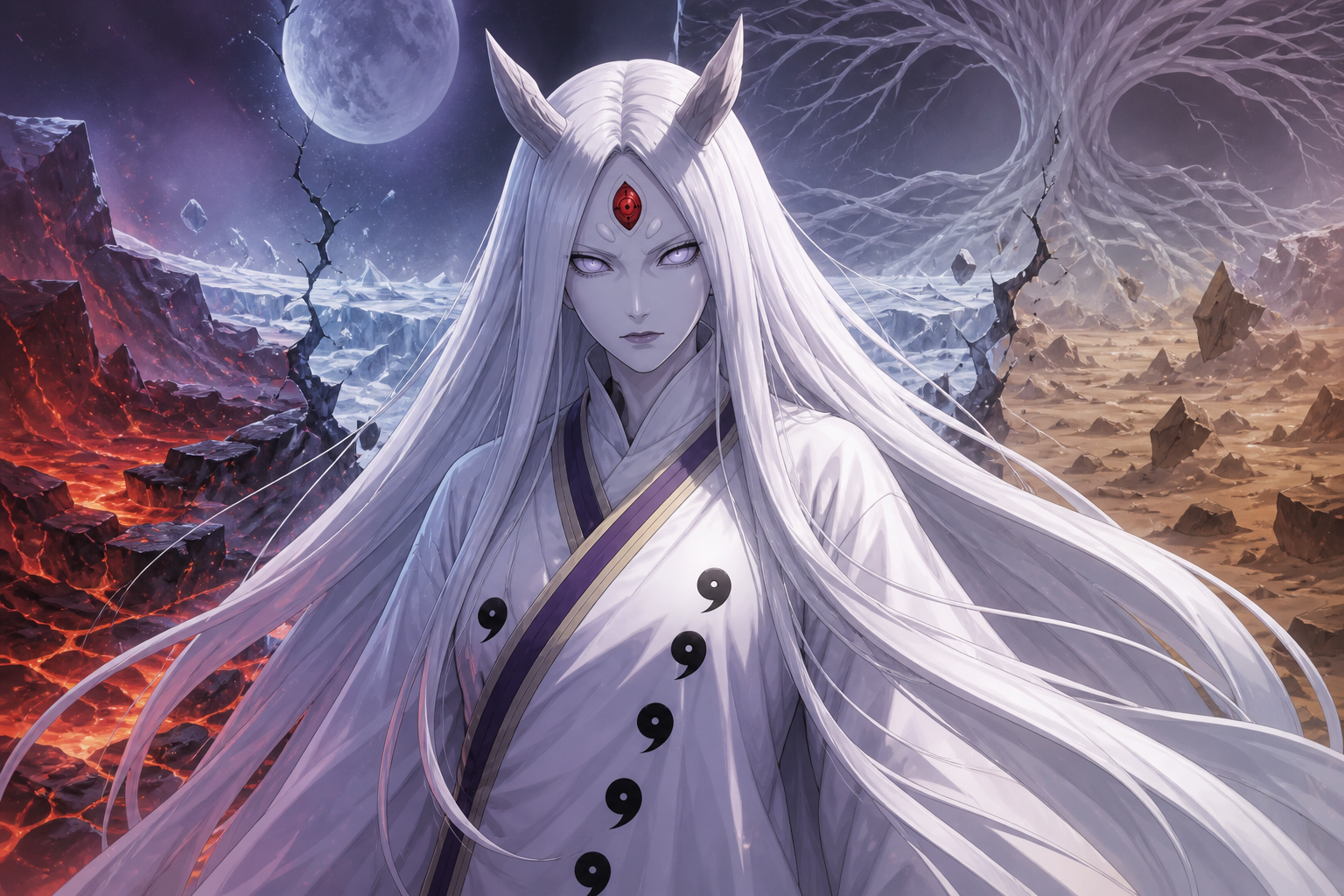
Naruto character dossier
Kaguya Ōtsutsuki
The mother of chakra returns to collect a world as property and discovers that power cannot replace the bonds her descendants built without her.
Who Kaguya is before the title “Rabbit Goddess” swallows the woman
Kaguya Ōtsutsuki is an ancient member of the Ōtsutsuki clan, the first known person on Earth to wield chakra, mother of Hagoromo and Hamura, origin point of the power that becomes the Ten-Tails, and the final divine-scale antagonist of Naruto Shippuden. Her sons seal her. Black Zetsu spends centuries arranging her return. Team 7 seals her again.
The profile becomes messy when every adaptation and sequel fact gets poured into one unlabeled bowl. The Naruto manga establishes Kaguya’s arrival from elsewhere, her consumption of the chakra fruit, her use of Infinite Tsukuyomi, her sons, her transformation into the Ten-Tails, and the ancient sealing. The anime adds a fuller human-era story involving Tenji, Aino, regional conflict and her slide from protector to feared ruler. Boruto later places her inside a larger Ōtsutsuki harvesting system and identifies Isshiki as the partner she betrayed.
Those layers can speak to one another without pretending they entered the franchise at the same time. Kaguya’s meaning changes as the worldbuilding expands. She begins as the source behind shinobi myth. The anime gives her a tragic court history. Boruto makes her part of a predatory cosmic clan.
That changing frame is important because Kaguya has enormous narrative weight and limited page time. A complete profile has to separate what the main manga dramatizes, what the anime develops, and what the sequel retroactively explains.
An outsider arrives before shinobi history has a name
Kaguya reaches Earth in an age before the organized shinobi world. A God Tree stands on the planet and produces a chakra fruit. Human societies exist without the ninjutsu systems, hidden villages and clan techniques that later define Naruto.
The manga keeps much of her early social life at mythic distance. Hagoromo describes the broad catastrophe. Kaguya consumes the fruit, obtains overwhelming power and uses Infinite Tsukuyomi. The story cares most about how that power enters human history and why her sons oppose her.
The anime-original expansion gives Kaguya a more intimate arrival. She becomes connected to the Land of Ancestors, its ruler Tenji and attendant Aino. The expansion frames her as a mysterious woman trying to avoid conflict, then shows violence, betrayal and fear pushing her toward the fruit. Those episodes add motive and emotion. They are not a substitute for the manga’s leaner record.
Boruto later states that Kaguya came with Isshiki Ōtsutsuki as part of the clan’s planet-harvesting process and turned against him. That information shifts her from lone celestial stranger to deserter from an extraction system. Her fear of future Ōtsutsuki arrival then has a concrete source.
The chakra fruit gives Kaguya power and turns the planet into inventory
The Divine Tree draws chakra and life from the world to produce a fruit. Kaguya eats that fruit and gains power far beyond the people around her. The act makes her the first known Earthly bearer of chakra and gives her the Rinne Sharingan.
Official Boruto material makes the extraction logic even uglier. A Ten-Tails becomes a Divine Tree after consuming a living Ōtsutsuki. The roots drain chakra and genetic information from life across the planet until a fruit forms. This is agriculture only if the field is allowed to scream.
Kaguya uses her power to stop conflict and becomes worshiped as a goddess. The peace is not stable because domination has replaced negotiation. Infinite Tsukuyomi places people under genjutsu, and victims become connected to the tree. The method contains the ending in miniature: peace achieved by taking consciousness away from the people who must live inside it.
Hagoromo and Hamura are children, heirs and the first rebellion
Kaguya gives birth to Hagoromo and Hamura. The brothers inherit chakra. Hagoromo later becomes known as the Sage of Six Paths and develops Ninshū, a practice meant to connect people through spiritual understanding. Hamura becomes central to the lunar line and the first sealing.
Kaguya sees the sons’ inherited power as chakra taken from her. That view destroys the normal moral direction of parenthood. Parents give life knowing children will become separate people. Kaguya interprets separation as theft.
The difference between Kaguya and Hagoromo is not that one uses chakra and the other does not. Hagoromo distributes knowledge and hopes connection will grow. Kaguya centralizes power and treats connection as loss of control. Both projects produce unintended consequences, but only one begins by allowing other people moral existence.
The brothers discover the threat surrounding their mother and oppose her. In the anime expansion, their path includes learning more about the God Tree’s victims and Kaguya’s control. The manga presents the ancient confrontation more compactly through Hagoromo’s account and Black Zetsu’s corrections.
The Ten-Tails is Kaguya’s rage, body and stolen world folded together
Kaguya merges with the God Tree and becomes the Ten-Tails as she tries to reclaim chakra from Hagoromo and Hamura. The monster is not simply her pet. Kaguya and the tree form the calamity the brothers must stop.
Hagoromo and Hamura battle her for months and seal the Ten-Tails through Six Paths Chibaku Tensei. The body becomes the moon while Hagoromo retains and later divides the chakra into the nine tailed beasts. The empty husk remains as the Demonic Statue of the Outer Path.
That division creates lives Kaguya never recognizes as independent. Kurama, Shukaku and the other tailed beasts develop personalities, relationships and memories. Madara and Obito later try to recombine them as components. Kaguya’s return depends on repeating the same refusal to see them as people.
As the sealing occurs, Black Zetsu emerges from Kaguya. He survives, alters the Uchiha stone tablet and begins the long project that will make Madara a vessel. Kaguya loses the battle but leaves an active instruction inside history.
Madara reaches his victory and becomes Kaguya’s doorway
During the Fourth Shinobi World War, Madara becomes the Ten-Tails’ jinchūriki and casts Infinite Tsukuyomi. The Divine Tree binds most of humanity. Madara believes Project Tsuki no Me has succeeded.
Black Zetsu pierces him and announces that the will inside the plan was Kaguya’s. Chakra floods Madara’s body. The restored Kaguya emerges using his body and the accumulated power as a vessel.
Kaguya looks at Naruto and Sasuke and sees the chakra of Hagoromo’s sons. She cries before trying to reclaim them. That emotional beat matters. She is not a robot checking energy readings. The faces of a family conflict return through strangers.
Recognition still becomes possession. Kaguya does not ask what Naruto and Sasuke want, how their lives differ from Indra and Asura, or what the tailed beasts have become. She sees inherited chakra and decides the inheritance should come home.
The scene also completes Madara’s accountability loop. He uses bodies, eyes and tailed beasts as containers for his solution. Kaguya’s restoration turns him into the last container.
Team 7 fights a god by refusing to become separate pieces
Kaguya transports Naruto, Sasuke, Sakura, Kakashi and Obito into a lava dimension. Naruto and Sasuke carry the sun and moon seals needed for Six Paths Chibaku Tensei. Kaguya’s simplest route is therefore separation. If the two cannot touch her together, sealing fails.
Amenominaka shifts the entire battlefield between dimensions. Ice immobilizes. Gravity restricts movement. Desert distance isolates Sasuke. Acid and lava punish mistakes. Kaguya turns geography into a weapon without needing doors, travel time or supply lines.
Naruto’s Reverse Harem Jutsu creates a brief opening because unpredictability remains a real tactical asset. The moment is ridiculous on purpose. Cosmic lineage cannot prepare Kaguya for every human invention, especially the ones dignified warriors would never put in a sacred tablet.
Sasuke is sent to the desert dimension. Obito and Sakura use Kamui and a huge chakra effort to search Kaguya’s connected spaces. The rescue makes the final victory collective. Naruto and Sasuke carry the sealing marks, but they cannot reunite without people the power charts treat as secondary.
Obito dies protecting Naruto and Kakashi from All-Killing Ash Bones. His final gift gives Kakashi temporary dual Mangekyō power. Kakashi manifests Susanoo and helps create the opening. Sakura strikes Kaguya from above when Kaguya tries to escape Naruto and Sasuke’s approach.
The final image belongs to the original Team 7 formation: Naruto, Sasuke, Sakura and Kakashi acting in one coordinated sequence. The franchise’s first lesson, teamwork, survives all the way to the goddess battle.
Kaguya’s powers change space, bodies and the rules of distance
Kaguya carries more chakra than any ordinary shinobi framework can sensibly measure. Her abilities still have functions and tactical counters. Calling her a god should not turn the profile into a fog machine.
Byakugan: Her pale eyes provide near-panoramic vision and chakra perception. Even strong vision does not equal perfect attention. Naruto’s tactics and the team’s angles can create openings.
Rinne Sharingan: The forehead eye is tied to Infinite Tsukuyomi and her dimensional techniques. Exact abilities should not be casually reassigned to every Rinnegan or Sharingan user.
Amenominaka: Kaguya replaces the surrounding world with one of her personal dimensions. The technique moves the combatants with the environment rather than opening an ordinary travel doorway.
Yomotsu Hirasaka: Black portals let her move herself or body parts through space. The portals support ambush, evasion and cross-dimensional movement.
All-Killing Ash Bones: Bone projectiles cause the struck body to disintegrate. Obito’s death proves that one clean hit carries irreversible cost.
Eighty Gods Vacuum Attack: Chakra fists deliver overwhelming close-range and ranged pressure. The attack expresses scale without requiring a conventional weapon.
Rabbit Hair Needle and chakra control: Her hair can attack with precision, while Byakugan vision supports targeting. She can absorb chakra and directly interfere with techniques and bodies.
Expansive Truth-Seeking Ball: Kaguya builds a vast sphere from the collected chakra of those trapped by Infinite Tsukuyomi. The intended expansion threatens to erase and remake the dimension.
Kaguya can also transform into an unstable Ten-Tails-like mass when chakra reacts inside her. The tailed beasts within Naruto can destabilize that balance. She is strongest when she controls distance, dimensions and separation. Team 7 wins by restoring contact.
Relationship atlas: family treated as possession
Hagoromo Ōtsutsuki: Hagoromo is son, inheritor and rebel. Kaguya sees his chakra as hers. Hagoromo later spreads Ninshū, divides the tailed beasts and prepares a future answer through Naruto and Sasuke.
Hamura Ōtsutsuki: Hamura joins his brother in the first sealing and becomes tied to the moon. His role proves that Kaguya’s defeat is originally a family coalition, not Hagoromo’s solo legend.
Black Zetsu: Black Zetsu is Kaguya’s manifested will and most loyal agent. His devotion restores her, but the relationship has almost no room for his separate self. He functions as purpose given a body.
Madara Uchiha: Madara is the successful vessel produced by centuries of manipulation. Kaguya inherits the war he creates and the chakra he gathers. She does not rescue him. His body is consumed by her return.
Naruto Uzumaki: Naruto carries Asura’s chakra and the tailed beasts Kaguya sees as lost power. He answers her total claim with bonds, improvisation and the insistence that history contains many lives.
Sasuke Uchiha: Sasuke carries Indra’s chakra and the second seal. Kaguya isolates him because cooperation with Naruto is the true threat. His space-time perception and Susanoo help the team survive her dimensions.
Sakura and Kakashi: Neither carries an ancient reincarnation seal. Both remain essential to the final opening. Their contribution refuses a bloodline-only reading of history.
Boruto turns Kaguya from lone goddess into a rebel inside an extraction clan
Boruto expands the Ōtsutsuki from Kaguya’s mythic origin into a clan with repeatable harvesting practices. A Ten-Tails, a sacrificed Ōtsutsuki, a Divine Tree and a chakra fruit form an extraction cycle aimed at planetary life.
Isshiki Ōtsutsuki is identified as Kaguya’s partner when they arrive on Earth. Kaguya turns against him and leaves him near death. The sequel does not make every detail of her motive transparent, but the betrayal establishes that she breaks clan procedure before the Naruto-era sealing.
This context sharpens her fear. Kaguya prepares an army because she expects Ōtsutsuki threats. The White Zetsu force is therefore connected to anticipated invasion, not random paranoia.
Fear of an imperial system does not make Kaguya anti-imperial in practice. She adopts the same logic at home. Earth becomes her resource base. Human beings become chakra stock. A colonized subject can reproduce colonial violence when survival becomes permission to own somebody else.
Boruto also prevents fans from treating Kaguya as the absolute ceiling of all Ōtsutsuki lore. Later clan members bring different abilities, ranks and plans. Her Naruto profile should include that context without letting the sequel erase the specific mother-and-sons tragedy that gives her original role meaning.
Mami Koyama gives the original Japanese Kaguya a voice after years of silence and myth
Mami Koyama performs Kaguya in Naruto Shippuden’s original Japanese cast. The official Naruto site lists her alongside Naoya Uchida’s Madara, Wataru Takagi’s Obito and the core Team 7 performers.
Kaguya has fewer ordinary conversations than most major antagonists. She arrives as image, pressure and inherited memory. Black Zetsu explains much of the plan. The performance therefore has to serve moments of grief, command, confusion and lethal focus without the long rhetorical speeches that define Pain or Madara.
Koyama carries an unusual dramatic burden: she must make an ancient figure feel present after the story has spent years describing Kaguya as a myth, a bloodline and a source of power rather than a person.
What Kaguya says about motherhood, empire and the ownership of gifts
Macro: extraction arrives wearing divine language: The Ōtsutsuki process turns worlds into fruit. Sacred power is revealed as an industrial harvest whose inputs are living populations. Kaguya opposes her clan and still treats Earth through the same resource logic.
Micro: fear makes possession feel like protection: Kaguya anticipates future danger and gathers power to survive. Protective preparation becomes domination when nobody else is allowed to own chakra, memory or choice.
Interpersonal: motherhood without separation: She cannot accept that Hagoromo and Hamura are people whose inheritance belongs to them. Love, fear and ownership collapse into one demand: return what came from me.
Confucian lens: family duty runs in both directions: Children owe parents respect, but parents owe children humane cultivation and moral care. A parent who treats children as extensions violates the relationship she invokes. Hagoromo and Hamura’s resistance can be read as duty to the wider human order.
Buddhist lens: attachment creates the monster it fears: Kaguya clings to chakra, sons, safety and a permanent position above change. The effort to prevent loss transforms her into the Ten-Tails and produces the sealing she fears.
Fandom and industry lens: a final boss introduced too late: Kaguya expands the franchise’s cosmology, gives Black Zetsu a hidden purpose and places Team 7 against the origin of chakra. She also arrives after Madara has accumulated years of narrative investment. Fans are reasonable to feel the exchange damages the climax even when the themes line up.
Fandom arguments that need cleaner boundaries
“Kaguya is an alien, so the entire ninja story stops mattering.”: The sequel frames the Ōtsutsuki as extraterrestrial or otherworldly harvesters. Team 7 still defeats Kaguya through lessons built across the human story: teamwork, trust, improvisation and sacrifice.
“She only wanted to protect Earth.”: Fear of future Ōtsutsuki is part of her motive. She also casts Infinite Tsukuyomi, drains people and tries to reclaim all chakra. Protection without consent becomes rule.
“Black Zetsu controls Kaguya.”: Black Zetsu restores her, advises her and speaks extensively. He identifies himself as her will. Kaguya remains the power and decision-maker in the battle.
“Sakura did nothing in the final fight.”: Sakura supplies chakra for Obito’s dimensional search and lands the strike that closes Kaguya’s escape route during the sealing sequence.
“Reverse Harem Jutsu defeats Kaguya.”: The technique creates a brief opening. The actual victory requires Obito’s sacrifice, Sakura’s support and strike, Kakashi’s temporary Mangekyō power, and Naruto and Sasuke applying both seals.
“Every anime backstory scene is manga canon.”: The Tenji, Aino and Land of Ancestors material is anime expansion. Useful adaptation material should be labeled rather than smuggled into the manga chronology.
Canon boundaries across manga, anime, movies and games
The controlling narrative is Kishimoto’s Naruto manga. The core Shippuden adaptation stages Kaguya’s restoration and battle while adding a larger origin arc. Boruto supplies later Ōtsutsuki clan and Isshiki context.
Kaguya’s manga debut occurs in the final war after Black Zetsu strikes Madara. The anime credits Mami Koyama and expands the period before her sons’ rebellion. Exact episode labeling matters because flashback, myth and present restoration are different appearances.
Games such as the Ultimate Ninja Storm series make Kaguya playable and translate dimension-scale techniques into arenas, combos and ultimate attacks. Those mechanics are adaptations, not a free source of manga abilities.
Kaguya has no ordinary role in the Naruto theatrical movies. Supplemental promotional art, game stories or roster appearances should not be presented as additional main-continuity adventures. Her central story remains ancient arrival, first sealing, war-era restoration and second sealing.
Legacy: Kaguya breaks the ceiling and the pacing at the same time
Kaguya changes what Naruto’s world is allowed to contain. Chakra stops being merely a mystical human system and becomes part of a larger extraction history. The moon, the tailed beasts, the Rinnegan and the stone tablet all connect to one ancient family disaster.
She also becomes a permanent fandom argument about escalation. The story moves from village missions to cosmic dimensions. Some fans love the scale. Others feel the grounded political wounds of the shinobi system get replaced by bloodline gods.
The best reading does not pretend one side is foolish. Kaguya is thematically connected to ownership, inherited conflict and forced dreams. Her dramatic preparation remains thinner than Madara’s. Theme cannot substitute for pacing, and pacing criticism cannot erase theme.
Boruto builds an entire antagonist ecology from the door Kaguya opens. That makes her more important to franchise architecture than her Naruto screen time alone suggests.
Being first does not make every future yours
Kaguya’s claim over chakra sounds powerful because she stands near the beginning of its human history. She consumed the fruit. Her children inherited power. Generations built entire civilizations around what followed. Then she returns and treats every later life as stolen property.
That logic confuses origin with ownership. A parent contributes to a child’s existence and still does not own the child’s mind. An inventor can begin a practice without owning every meaning other people create from it. Kaguya sees chakra inside Naruto, Sasuke, Sakura, Kakashi, the tailed beasts, and the wider shinobi world as pieces that must come home. The people carrying it see relationships, memories, labor, trauma, and choices.
The difference is why Team 7 matters more than raw power arithmetic. Naruto and Sasuke possess the sealing marks, but they cannot finish the fight alone. Sakura creates the opening. Kakashi uses a borrowed final gift. Obito spends his remaining life moving people across dimensions. Kaguya has more chakra than any individual opponent and loses to cooperation she cannot reduce to a single owner.
Fear can explain hoarding without making it protection
Kaguya’s fear of other Ōtsutsuki gives her choices context. A larger danger exists. Preparing for it is not paranoia invented from nothing. The failure comes when she decides preparation requires absorbing every person into a dream and concentrating all usable power inside herself.
Protection without consent becomes captivity. Infinite Tsukuyomi gives victims private fantasies while their bodies feed a system they never chose. Kaguya can call that peace because conflict stops. A locked room is also quiet. Silence does not prove the people inside are safe, free, or even awake.
Her maternal language carries the same problem. She reacts to chakra as if rebellious children have taken what belongs to their mother. The metaphor asks for obedience, not relationship. Hagoromo’s later teaching moves the other direction: chakra can connect separate people precisely because they remain separate.
Kaguya’s late arrival in the plot remains a fair structural criticism. The story asks one character to carry ancient cosmology, maternal fear, alien invasion, the God Tree, Black Zetsu’s plan, and the final battle with limited dramatic runway. A complete profile should admit that pacing problem without pretending the ideas are empty. She crystallizes Naruto’s final argument: inherited power is a responsibility shared among living people, not a deed held forever by whoever touched it first.
Final verdict: Kaguya mistakes origin for ownership
Kaguya is the first known Earthly bearer of chakra. She is not the sole author of everything chakra becomes. Hagoromo turns chakra toward connection. The tailed beasts become people. Shinobi build techniques, relationships, abuses, reforms and meanings across generations.
Her tragedy is that she recognizes danger and cannot imagine safety without possession. Her horror is that she acts on that belief with enough power to turn a planet into one closed fist.
Team 7 wins by opening the fist. Naruto and Sasuke bring the seals. Sakura, Kakashi and Obito make contact possible. Kaguya arrives as the mother of chakra and leaves inside a prison built by children who learned that inheritance is something you answer for, not something you own.
Sources and canon boundary
Manga chronology controls this profile. Anime expansions, databook material, novels, games, films, and Ōtsutsuki-era adaptation staging are labeled instead of being blended into one false continuity.
Primary franchise references: Naruto Official and VIZ Media Naruto. CVM Sekai’s conclusions about Kaguya’s motherhood, chakra ownership, fear, Infinite Tsukuyomi, consent, Team 7, and accountability are editorial analysis, not invented creator quotations.