
Naruto character dossier
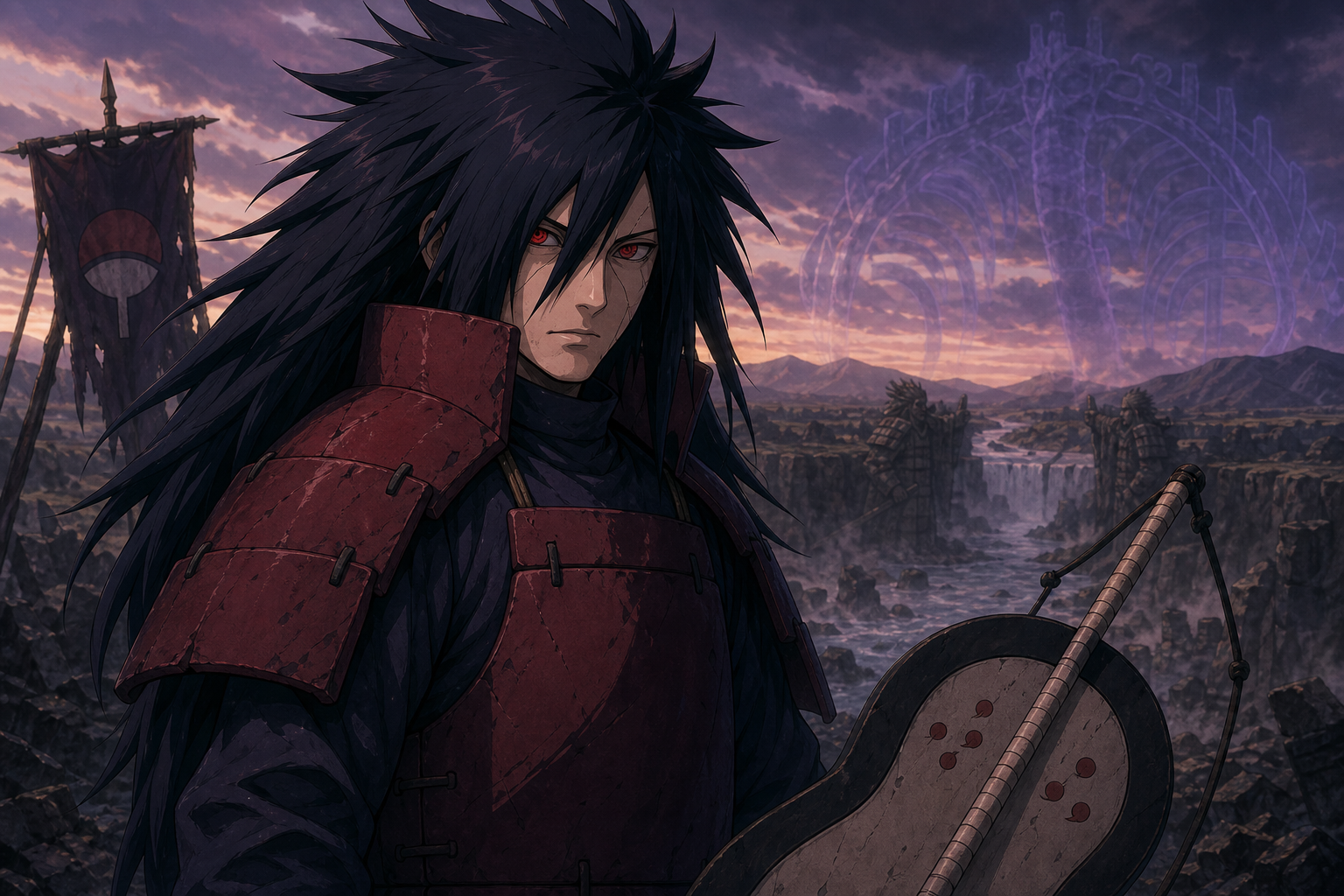
Madara Uchiha
The village founder wanted peace so badly that he decided nobody else could be trusted to choose reality. Madara’s tragedy begins where political imagination hardens into the belief that consent is merely another obstacle.
Who Madara is beneath the statue
Madara Uchiha is the eldest known son of Tajima Uchiha, a Warring States commander, the brother of Izuna, the childhood friend and adult rival of Hashirama Senju, and one of the two founders of Konohagakure. He becomes the Uchiha clan’s leader, helps end the endless Senju-Uchiha blood feud, abandons the village he helped build, attacks Konoha with Kurama, and loses to Hashirama at the Valley of the End.
That famous defeat does not end his story. Madara survives through a delayed Izanagi, steals a piece of Hashirama’s flesh, awakens the Rinnegan late in life, summons the Demonic Statue of the Outer Path, and lays the foundation for Project Tsuki no Me. He places his Rinnegan in Nagato, recruits a dying Obito, and turns another grieving Uchiha into the hands that will continue his plan.
Kabuto later brings Madara back with Reanimation Jutsu during the Fourth Shinobi World War. Madara breaks the normal release of that technique, regains a living body, becomes the Ten-Tails’ jinchūriki, and casts Infinite Tsukuyomi. Black Zetsu then reveals that Madara was also being used. The man who treats everyone else like pieces discovers that he has spent generations on somebody else’s board.
Two boys meet beside a river before clans name them enemies
Madara grows up when shinobi children are military labor. Clan survival depends on sending sons into battles that can kill them before adulthood. The story does not romanticize that age simply because the armor looks magnificent. Bodies are small. Graves multiply. Adults call the arrangement duty because admitting the truth would mean admitting that the system eats its own future.
Madara meets Hashirama beside a river without immediately knowing that the other boy belongs to the enemy Senju clan. They compete at skipping stones, argue, dream, and discover that both have lost brothers. Their private idea is almost embarrassingly simple: build a place where children do not have to murder one another.
The friendship matters because Madara’s capacity for trust is real. Hashirama does not invent goodness inside him. Madara already laughs, competes, plans and hopes. That makes his collapse more disturbing. Naruto is not handing us a born tyrant. The series shows how a boy with a humane dream learns to believe that other people’s freedom is the problem.
Once their surnames become known, friendship becomes intelligence risk. Both fathers use their sons to test the other side. The river changes from refuge to battlefield. Madara awakens his Sharingan through the pain of severing the bond. Even before adulthood, the shinobi economy teaches him a rotten lesson: intimacy creates a target.
Izuna’s death becomes Madara’s permanent political wound
Madara has several brothers, but Izuna is the sibling who survives long enough to stand beside him as an adult fighter. The two awaken Mangekyō Sharingan, and Izuna remains Madara’s closest clan bond. Tobirama Senju mortally wounds Izuna in battle. Before dying, Izuna gives Madara his eyes. Madara gains Eternal Mangekyō Sharingan and loses the person whose trust matters most to him.
Fans sometimes flatten this into eye theft because the Uchiha power system is full of stolen eyes. Izuna’s transfer is presented as a brother’s gift, not Madara ripping power from an unwilling victim. The ethical problem arrives afterward. Madara turns Izuna’s love and warning into a permanent veto against trusting the Senju, even when the living clan wants peace.
Grief gives Madara evidence. The Rinnegan does not give him prophecy. Tobirama truly killed Izuna in war. Tobirama also carries dangerous suspicion toward the Uchiha. Yet Madara begins treating every future compromise as a delayed version of his brother’s death. Nobody can prove loyalty strongly enough because Madara has made uncertainty itself unacceptable.
That is one of his most human failures. He does not want to betray Izuna by moving forward. So he freezes the political world at the moment of loss and calls the freeze vigilance.
Founding Konoha proves Madara can build before he chooses to dominate
Hashirama defeats Madara but refuses to purchase peace through Madara’s humiliation. Hashirama offers his own life when Madara demands proof. Madara stops him. The clans form an alliance and establish Konohagakure, the village hidden in the leaves. Madara names the village. Hashirama imagines children training and growing there without being thrown straight into clan slaughter.
This accomplishment belongs to both men. Hashirama is not the sole enlightened founder with Madara tagging along until villain music starts. Madara’s authority brings the Uchiha into the compact. His willingness to risk peace makes the village possible. The statues at the Valley of the End remember their conflict, but the village itself is also evidence of their cooperation.
The first Hokage selection opens the fracture. Hashirama wants Madara to lead, but the office is not his private gift to hand over. Hashirama becomes Hokage through the village’s decision. Madara sees the result as proof that Senju power will define the new institution while the Uchiha slowly lose influence.
His fear is not nonsense. Villages can preserve old hierarchies under new names. Tobirama’s distrust and later policies deserve scrutiny. Yet Madara’s response is to demand that his clan follow him away from the home they helped create. The Uchiha refuse. He then interprets their choice as blindness instead of consent.
The Valley of the End is a divorce fought with a tailed beast
Madara leaves Konoha and later returns with Kurama under Sharingan control. The attack is not a clean ideological debate between founders. Madara enslaves a sentient tailed beast and points that living weapon at the community he helped establish. Hashirama answers with Wood Release, including the Wood Human and wood dragon, while Madara wraps Kurama in Susanoo armor.
The scale reshapes the landscape and produces the valley later marked by their statues. Hashirama wins and appears to kill Madara. The village understands the battle as the end of its rebellious founder. Madara has already prepared a delayed Izanagi in his right eye, trading that eye’s sight to rewrite his death.
He leaves a shadow clone in the coffin and disappears underground. This is where Madara crosses from defeated dissident into secret architect. He no longer tries to persuade the clan, compete for office, or expose bad policy. He decides history will be corrected from beneath the people living inside it.
Kurama also deserves a sentence beyond power scaling. Madara’s control of the fox becomes part of the suspicion that follows the Uchiha and jinchūriki systems. He claims to oppose a world of instrumental violence while treating another being as equipment. The contradiction is not decorative. The plan is already reproducing the abuse it promises to end.
Hashirama’s flesh, the Rinnegan and a plan built underground
During the final battle, Madara bites off a piece of Hashirama’s flesh and later grafts the tissue into his own body. The combination of Indra and Asura’s chakra eventually awakens the Rinnegan, but not as an instant battle reward. Madara receives the eyes near the end of his natural life.
He summons the Demonic Statue from the moon, uses its power to remain alive, and cultivates material linked to Hashirama. He also places his Rinnegan in the child Nagato without the boy’s informed consent. Nagato grows up believing the eyes are naturally his while Madara’s plan depends on using him as a future resurrection mechanism.
Black Zetsu presents himself as Madara’s will. Madara accepts that explanation because the arrangement confirms his desire to remain the author after death. The truth is nastier. Black Zetsu has altered the Uchiha stone tablet and is guiding Madara toward Kaguya’s revival.
Madara still owns his crimes. Manipulation does not erase the manipulator’s choices. The irony works because he has spent decades doing the same thing to others. He edits Obito’s reality, hides information from Nagato, borrows identities, and designs loyalty through dependence. Black Zetsu defeats him with the same political technology.
Saving Obito’s life becomes the first step in stealing his future
Madara finds Obito crushed after the Kannabi Bridge mission and keeps him alive by rebuilding damaged tissue with synthetic material connected to Hashirama. Rescue is real. So is grooming. Obito wakes isolated underground, physically dependent on Madara’s system and desperate to return to Kakashi and Rin.
Madara lectures him about a cursed world and a dream realm where loss can be erased. Obito initially rejects the worldview. Madara then helps create the conditions around Rin’s death, placing a seal in her heart and arranging events that drive her into Kakashi’s Chidori. Obito sees the moment and breaks.
Madara does not merely persuade a sad teenager. He targets a wounded child, controls access to information, engineers trauma, and offers a total explanation while the victim is least able to test it. That is recruitment through captivity wearing the language of revelation.
Obito later commits his own crimes. The profile cannot dump every death onto Madara as though Obito becomes a puppet with no agency. Accountability can hold more than one person. Madara manufactures the trap. Obito spends years choosing to maintain and enlarge it.
Madara gives Obito his name and the Moon’s Eye Plan. The borrowed name becomes armor, threat and false lineage. When the real Madara returns, the relationship turns openly hostile. Two men who believe they are using each other discover that neither has built trust capable of surviving the final stage.
Reanimation gives Madara the battlefield he always thought he deserved
Kabuto Yakushi summons Madara through Reanimation Jutsu during the Fourth Shinobi World War. Madara expects Nagato’s Rinne Rebirth, notices the wrong body, and immediately understands that the plan has drifted. Kabuto claims to have improved him beyond his prime. Madara hates the presumption even while using every advantage the modified body provides.
His entrance against the Allied Shinobi Forces is iconic because the direction makes scale feel insulting. He fights an army at close range, shifts into Fire Release, Sharingan, Rinnegan and Susanoo, then drops a meteor. When the first meteor is stopped, a second follows. The joke is cruel: survival of the impossible attack only reveals another one behind it.
The Five Kage unite against him. Madara uses Wood Release, clones and Susanoo to overwhelm them. Their stand still matters. The Kage force cooperation across villages whose histories created the war machine Madara exploits. They cannot defeat him, but the alliance itself disproves his claim that only domination can end inherited hatred.
When Kabuto releases Reanimation Jutsu, Madara rescinds the summoning contract from his side and keeps the immortal body. That feat shows expertise and arrogance in equal measure. He has escaped yet another person’s attempt to control him, then returns directly to controlling everyone else.
After fighting the Kage, he joins Obito at the Ten-Tails battlefield. Their partnership is a succession dispute pretending to be teamwork. Madara needs Obito to revive him fully. Obito no longer wants to be discarded as a temporary executor. Each built a plan that assumes the other man’s will becomes irrelevant at the correct moment.
Living again does not restore the limits Madara abandoned
Black Zetsu forces Obito to perform Rinne Rebirth, returning Madara to a living body. Madara loses the automatic regeneration of Reanimation but regains the physical reality he craves. He steals senjutsu chakra from Hashirama, retrieves a Rinnegan, battles the tailed beasts, and seals them into the Demonic Statue.
He tears Kurama from Naruto and stabs Sasuke, bringing both young men close to death. The violence mirrors his founding-era mistake. Madara still treats the next generation as proof for his theory instead of people with the right to reject it.
As the Ten-Tails’ jinchūriki, Madara gains flight, Truth-Seeking Balls, vast regeneration and Six Paths power. Might Guy’s Eight Gates assault nearly kills him. Madara respects Guy’s taijutsu and calls him the strongest. The praise is genuine, but Madara’s delight also reveals how thoroughly battle has colonized his emotional life. He feels most alive while somebody is nearly dying.
Naruto and Sasuke return with Six Paths power and force Madara to take them seriously. Madara steals Kakashi’s Sharingan to reach Obito’s Kamui dimension and recover his second Rinnegan. People, eyes and bodies remain resources in his final accounting.
Infinite Tsukuyomi is peace with the people removed
Madara activates Infinite Tsukuyomi by reflecting the Rinne Sharingan from his forehead onto the moon. Most of the world falls under genjutsu. The Divine Tree binds sleeping bodies while each mind receives a dream shaped around desire.
Calling that peace requires shrinking the word until it means silence. Nobody negotiates. Nobody forgives. Nobody grows. Hunger, grief and political conflict disappear because the people experiencing them lose access to shared reality. Madara solves suffering the way a jailer solves disagreement in an empty room.
The seduction is obvious. Dream worlds can return dead family, repair failed love, grant status and remove shame. Naruto refuses because a painless lie purchased through stolen agency is not care. Shared reality remains messy because other people remain real.
Black Zetsu strikes Madara once the jutsu succeeds and uses his body to revive Kaguya. Madara’s greatest victory becomes the proof that he never understood the text guiding him. The stone tablet did not offer neutral ancient truth. Power had edited the archive.
That is a sharp warning for any fandom obsessed with secret lore. A document can be old and still be propaganda. A revelation can feel complete because somebody designed it to close every exit.
Madara’s abilities belong to different bodies and different moments
Madara is powerful in every era, but discussions become nonsense when every technique gets stacked into one imaginary default body. Living founder Madara, elderly Rinnegan Madara, Kabuto’s reanimated Madara, revived living Madara, and Ten-Tails Madara do not carry identical advantages or costs.
Sharingan and Eternal Mangekyō
Madara reads movement, casts genjutsu, controls Kurama and manifests Susanoo. Izuna’s eyes give him Eternal Mangekyō Sharingan and protect him from the blindness caused by repeated Mangekyō use. Those abilities belong to a specific stage of his life rather than one timeless composite form.
Susanoo
His armored chakra avatar advances from partial defenses to a Complete Body form whose sword swings reshape the battlefield. Edo regeneration lets him spend power differently from a living fighter.
Fire Release and physical combat
Madara’s massive fire techniques can require many shinobi to answer together. He is also a brutal close-range fighter, skilled with weapons and capable of using the gunbai to redirect attacks.
Rinnegan
Late-life awakening gives him Six Paths techniques, including gravitational power and meteor summoning. Limbo creates shadows in a parallel plane, but perception and contact change once Naruto and Sasuke receive Six Paths power.
Hashirama tissue and Wood Release
The graft grants access to Wood Release and affects his later body. That power is acquired through Hashirama’s flesh, not an original Uchiha inheritance. The distinction matters because fandom power lists often erase how much of Madara’s later arsenal depends on appropriated biology.
Ten-Tails jinchūriki
The Ten-Tails jinchūriki state is his most extreme form, with flight, regeneration, Truth-Seeking Balls and the power needed for Infinite Tsukuyomi. Guy, Naruto and Sasuke still expose limits and force defensive responses, so transformation does not make every exchange effortless.
Madara’s genius is not only volume. He identifies mechanics quickly, shifts between ranges, reads political and battlefield incentives, and uses spectacle to damage morale. His weakness is the same confidence. He assumes that understanding a system means he owns every actor inside it.
Relationship atlas: love, rivalry and ownership
Hashirama Senju
Hashirama is Madara’s childhood friend, rival, co-founder and final companion. Their bond survives clan war, village politics, apparent murder and world war. Hashirama recognizes Madara’s dream without accepting his method. Madara wants Hashirama’s recognition so badly that he spends a lifetime pretending only power matters.
Izuna Uchiha
Izuna is beloved brother, battlefield partner and the grief Madara never metabolizes. His eyes extend Madara’s power. His death hardens Madara’s suspicion. Loving Izuna does not authorize Madara to speak forever on behalf of every living Uchiha.
Tobirama Senju
Tobirama embodies Madara’s fear that the new village will preserve anti-Uchiha suspicion. The fear has evidence. Madara still turns Tobirama into proof that cooperation can never work, which helps guarantee the breakdown he predicts.
Obito Uchiha
Madara saves Obito, rebuilds his body, engineers his despair and recruits him. Obito is victim and later perpetrator. Their relationship is the ugliest version of inherited will: an elder reproducing his wound inside a child and calling the transfer destiny.
Nagato
Madara places the Rinnegan in Nagato and plans to use him as a resurrection tool. Nagato’s suffering, politics and identity become infrastructure for a stranger’s return. That hidden violation sits underneath Akatsuki long before its red clouds become famous.
Black Zetsu
Madara believes Black Zetsu is his manifested will. Black Zetsu is actually Kaguya’s will and the editor of the stone tablet. Their relationship turns Madara’s authorship fantasy inside out, because the man who treats everyone as pieces discovers that his own certainty was cultivated.
Naruto and Sasuke
Naruto and Sasuke inherit the conflict without accepting Madara’s conclusion. Naruto protects shared bonds without demanding a dream prison. Sasuke understands structural injustice but ultimately confronts the cost of solitary control. Together they are not simple upgrades of Hashirama and Madara. They are the next generation getting a chance to make a different choice.
Naoya Uchida gives Madara the authority of a man who expects history to listen
Naoya Uchida is Madara’s original Japanese performer in Naruto Shippuden. The credit matters because Madara arrives after years of other people using his name. The real man’s performance has to make the borrowed legend feel smaller than the person who created it.
I am not going to invent claims about breaths, pauses or vocal texture without a scene-based Japanese-audio comparison in front of me. The honest observation is structural. Madara’s dialogue moves between old intimacy with Hashirama, contempt for armies, delight in worthy combat and absolute certainty about the dream plan. The role needs authority without turning every line into the same villain growl.
Naoya Uchida’s Japanese performance anchors this profile’s adaptation analysis, especially the controlled authority, dry contempt and flashes of remembered intimacy that keep Madara from becoming a single booming villain register.
What Madara says about villages, peace and consent
Macro: the village solves one war and industrializes another
Konoha ends the Senju-Uchiha blood feud, but the hidden-village model also organizes military labor at national scale. Madara sees the contradiction. He cannot accept reform that requires generations, compromise and the possibility of failure. His answer removes politics rather than improving it.
Micro: grief becomes a management system
Madara responds to Izuna’s death by trying to eliminate uncertainty. He manages clans, successors, eyes, bodies and memories. The personal wound becomes global policy. That is what makes him frightening beyond raw power.
Confucian lens: duty without reciprocity becomes domination
A founder has obligations to the community, and the community has obligations to its members. Madara treats his founding authority as permanent moral ownership. He demands loyalty after refusing the reciprocal discipline of being answerable to the living village.
Buddhist lens: attachment dresses itself as liberation
Madara claims to release humanity from suffering, but he cannot release his attachment to Izuna, Hashirama, victory or authorship. Infinite Tsukuyomi freezes desire into private satisfaction. Liberation becomes endless attachment with no waking world to challenge it.
Creative lens: the final villain is also a false final villain
Madara’s scale, history and entrance code him as the ultimate antagonist. Black Zetsu’s betrayal denies him that authorship. The choice can frustrate fans because Kaguya arrives late, but the thematic humiliation fits Madara perfectly. The controller was controlled.
Fandom arguments that need a grown-up table
“Madara was right.”
Madara correctly identifies repeated war, elite hypocrisy and the cruelty of sending children to fight. Infinite Tsukuyomi still violates every person’s body and mind. A sound diagnosis does not make mass captivity ethical.
“Tobirama caused everything.”
Tobirama’s suspicion and policy choices matter. So do clan warfare, Izuna’s death, Madara’s pride, Black Zetsu’s manipulation and Madara’s own decisions. One disliked Senju cannot carry the entire causal chain.
“Madara only wanted peace.”
Madara wanted peace and control. The second word changes the first. He was willing to enslave Kurama, manipulate children, start a war and bind humanity to a tree. A peaceful destination cannot clean methods that erase everybody else’s agency.
“Hashirama never understood him.”
Hashirama understood enough to risk peace, offer his life and sit beside Madara at the end. Understanding does not require agreeing that reality should be abolished. Compassion becomes meaningful because Hashirama keeps moral limits while recognizing the grief underneath Madara’s choices.
“Black Zetsu makes Madara innocent.”
Black Zetsu deceives Madara about the tablet and Kaguya. Madara still grooms Obito, uses Nagato, attacks the village, drives the war and casts the jutsu. Being manipulated does not erase the harm he knowingly authors.
“Prime Madara has every ability at once.”
No. Fans often combine Eternal Mangekyō Madara, elderly Rinnegan Madara, modified Edo Madara, revived Madara and Ten-Tails Madara into one spreadsheet monster. Form and cost matter, along with the body, borrowed abilities and conditions supporting each version.
Canon boundaries across anime, novels, games and OVAs
The main profile follows Masashi Kishimoto’s Naruto manga and the core Naruto Shippuden adaptation. Anime flashbacks expand Madara’s history and presentation, but added scenes should not silently replace the manga’s record. Game retellings can dramatize famous battles and offer playable forms without creating new main-story facts.
Madara appears across franchise games because his multiple forms are built for combat rosters. Those appearances document his place in franchise culture, not an extra canonical life. Movies and OVAs may use cameos, commemorative lineups or game-style encounters. Unless a work changes the main continuity, this dossier labels the appearance as supplemental.
The strongest receipt for his official profile spine is the Naruto Official Site’s December 24 birthday column, which traces the Warring States childhood, Hashirama bond, Obito succession, reanimated war entrance, Five Kage battle, Ten-Tails plan and final conversation. The manga remains the controlling story record.
Legacy: Madara wins the monument and loses the future
Madara becomes one of anime’s most recognizable war antagonists because the series spends years letting his name arrive before his body. Obito borrows it. The Valley carries it. Clan history fears it. When Madara finally steps onto the battlefield, spectacle pays off a legend that has been accumulating interest.
His influence also reaches beyond villain cool. He forces the franchise to test whether its beloved village system truly solved the violence that created it. Konoha protects children better than the Warring States clans did, yet still trains child soldiers, hides political crimes and reproduces clan suspicion. Madara points at those failures with bloody accuracy.
Then he uses the failures as permission to become worse. That is why he remains useful. He is not a warning against noticing structural injustice. He is a warning against confusing total control with courage.
Final verdict: Madara could build a village, but he could not live inside one
Madara’s greatest feat is not the meteor, Susanoo or Rinnegan. He helps create a political future that his younger brothers never received. His greatest failure is deciding that the future becomes worthless once other people can shape it without him.
Hashirama accepts an unfinished world full of grief, compromise and successors who may disappoint him. Madara wants a finished world sealed inside one perfect answer. Naruto sides with the unfinished one because bonds require awake people, and awake people can say no.
That is the whole file. Madara is a founder, brother, survivor, visionary, groomer, war criminal, manipulated reader and magnificent fool. He understands that reality hurts. He never learns that loving humanity means letting humanity remain real.
Sources and canon boundary
Manga chronology controls this profile. Anime expansions, databook material, novels, games, films, and reanimation-era staging are labeled instead of being blended into one false continuity.
Primary franchise references: Naruto Official and VIZ Media Naruto. CVM Sekai’s conclusions about Madara’s leadership, Hashirama, Obito, the Infinite Tsukuyomi, consent, political control, manipulation, and accountability are editorial analysis, not invented creator quotations.