
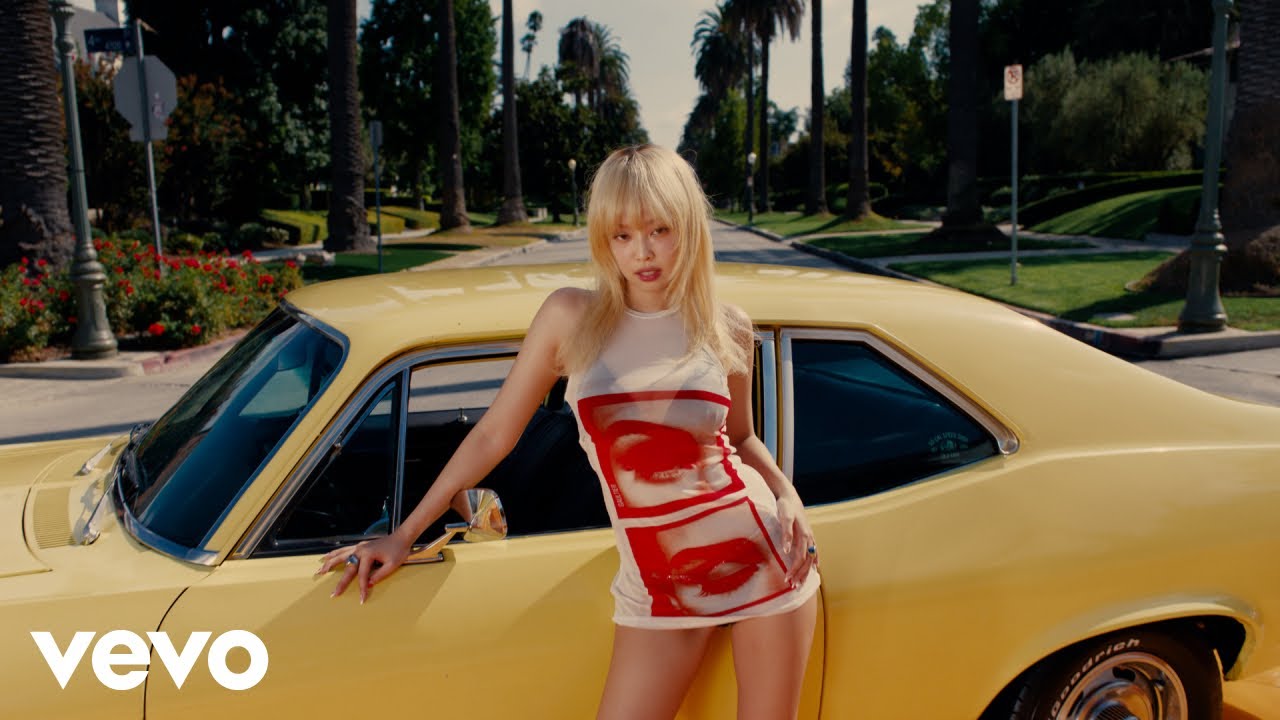
Mantra: JENNIE Turned Confidence Into a Group-Chat Dare
JENNIE makes confidence repeatable, percussive and camera-ready—then leaves just enough boundary trouble for the pretty-girl slogan to answer.
Release file
Released: October 11, 2024
Runtime: 2:28
Artist / channel: JENNIE / JENNIE
Exact-file focus: The exact official Mantra music video, not a stage, dance practice, short or fan upload.
Bottom line
Mantra is JENNIE treating confidence as a practice people repeat together, not a personality trait delivered at birth. The hook is designed to circulate, the video turns Los Angeles into a series of controlled entrances, and the song is strongest when “pretty girl” energy behaves like mutual permission rather than another beauty requirement.
What changed on replay
Replay one follows the low-end bounce under the chant. Replay two watches how JENNIE changes size for each camera distance. Replay three catches the women around her functioning as community rather than anonymous proof of popularity. Replay four asks the harder question: who gets excluded when confidence is packaged through conventional desirability?
A mantra is repetition with intent
The title acknowledges that the hook must be said more than once because confidence is not permanent. Repetition can build rhythm and self-belief at the same time. JENNIE’s clipped delivery keeps the phrase from sounding like therapeutic instruction. It is closer to a group-chat dare: put the sentence in your mouth, see whether posture follows.
Los Angeles is character and commodity
Cars, streets, heat and nightlife provide a recognizable fantasy of movement. The city suits her post-YG independence narrative because it appears open, mobile and less institutionally contained. It is also a commercial image assembled from expensive access. The video sells freedom through locations and objects most viewers cannot casually borrow, making confidence and consumption difficult to separate.
The performance is about focal control
JENNIE does not need the largest movement to own a frame. She uses timing, stillness and direct eye contact to decide when surrounding motion becomes background. That economy is the technical core of the video. The camera is active, but it rarely manufactures authority she has not already established through posture and release.
Pretty-girl solidarity has a boundary problem
The hook can feel inclusive when “pretty” names attitude rather than one face. The visuals still operate through narrow beauty and luxury codes. That contradiction should be named without dismissing the pleasure women find in the song. Pop can create genuine confidence inside a frame that remains commercially selective. Enjoyment and critique do not cancel each other.
The ODDATELIER significance
Mantra arrived in JENNIE’s independent-company chapter, so every decision was read as evidence of freedom. A company logo does not prove total creative control, but confirmed participation and a coherent solo campaign provide stronger evidence than fandom assumption. The release matters because it begins a sequence that Ruby later expands.
The counterargument
The song is short, hook-heavy and built from confidence language already familiar in pop. Listeners asking for a larger compositional journey are justified. Its defense is precision. No section pretends to be more profound than the concept, and the performance gives a compact idea physical clarity. The weakness is not confusion; it is limited room.
What I would change
Add a bridge where the production drops the luxury surface and lets several women deliver the mantra in contrasting voices. The community claim would become audible rather than remaining mostly visual, and the final hook could return with more democratic weight.
Why it belongs beside quieter work
JENNIE’s later Less than a Lover shows uncertainty, while Mantra shows constructed assurance. Treating one as the “real” person misses the artistic range. Confidence can be sincere and practiced; vulnerability can be sincere and staged. The catalog becomes useful where both modes expose their machinery.
Replay verdict
Mantra is not a complete philosophy of self-worth. It is a compact performance technology: rhythm, repetition and gaze aligned long enough to change the room. Its beauty politics deserve scrutiny, but the hook survives because JENNIE understands the difference between reciting confidence and making confidence move.
Canonical profiles
Official video
 JENNIE — Mantra Official VideoDaily+91.5KTotal views258.6M
Receipts
JENNIE’s official video and official solo site anchor the release and current career context.
Confidence and labor
The video makes ease look natural, but focal control is learned work. JENNIE has to know where the lens is, how wide the shot has become, when another performer needs visual room and how small a gesture can remain legible. The “mantra” therefore operates on two levels. The lyric repeats confidence; the performance demonstrates the preparation required to make confidence appear spontaneous.
The body is not a motivational poster
Pretty-girl anthems can offer pleasure while placing another demand on women: look effortless, desirable, socially approved and happy about it. JENNIE’s cool delivery partly resists by treating beauty as attitude and motion. The styling still privileges conventional bodies and luxury access. A useful review can acknowledge viewers who feel energized and viewers who feel the gate closing. Both reactions are produced by the same file.
Community in the frame
The surrounding women matter most when they answer the hook rather than decorate the star. Shared looks, synchronized release and group movement create the impression of confidence circulating. The choreography could push that idea further by allowing more individual styles to disrupt the center. Solidarity becomes convincing when difference remains visible, not when everyone is perfectly arranged as evidence for one person.
The short runtime is strategy and limitation
Compact pop is replay-friendly, especially when a hook can move quickly across short-form platforms. The same economy limits development. Mantra establishes premise, repeats and exits before confidence encounters a serious obstacle. That is efficient branding and a narrower song arc. One bridge with a new perspective would not ruin immediacy; it would reveal what the mantra is needed to survive.
JENNIE’s voice as percussion
She uses clipped consonants, breath and placement to make speech-like phrases sit inside the beat. The technique matters more than conventional vocal fireworks here. A held note would interrupt the song’s walk. Rhythmic diction keeps the body moving and lets the hook feel like language generated by the groove rather than lyrics laid on top of it.
What independence can and cannot prove
Because this release belongs to her post-YG solo structure, audiences interpret coherence as personal freedom. Confirmed credits and company control provide evidence, but no mainstream release is made alone. Directors, writers, dancers, label staff and stylists contribute. The strongest claim is not that JENNIE created every pixel. It is that the campaign repeatedly expresses a chosen problem—identity under observation—with enough consistency to suggest meaningful authorship.
Final assessment
Mantra succeeds as a compact technology of confidence and remains imperfect as a politics of inclusion. Its hook is precise, the visual control is exceptional, and the community promise is narrower than the women who may use the song. That tension is worth keeping. Pop does not become more honest when criticism pretends pleasure is liberation or pretends limitation makes pleasure fake.
The hook after the video ends
A useful test is whether the mantra survives without luxury cars, heat and styling. The clipped rhythm does. Listeners can use it while getting ready, walking into a room or recovering posture after a bad day. That portability is the song’s real achievement. The visual sells one glamorous implementation; the audio provides a small repeatable action. Its limitations remain, but the hook is not dependent on owning the objects around it.
The song also benefits from refusing a fake universal biography. It does not tell every woman she has lived the same life as JENNIE. It offers a phrase and attitude people can borrow. Borrowing is healthier than identification without boundaries: take the rhythm, not the demand to become the person whose name and face carry the campaign.
Verdict
JENNIE Mantra React examining confidence, beauty politics, Los Angeles imagery, performance control, replay changes and verdict.
What changed every time I replayed it
The second replay catches how JENNIE uses consonants as percussion. The third follows focal control rather than large choreography. The fourth notices Los Angeles functioning as both character and commodity, and the fifth confirms that the short runtime is smart recruitment and a limit on development.
Lyrics and meaning
A mantra is repetition with intent. The lyrics turn confidence into a group-chat dare, but the larger argument is not that a body becomes worthy by performing certainty. JENNIE makes confidence a practiced action while the video shows the labor, styling and camera control required to make that action look effortless.
RaeRae verdict
Mantra is compact because it understands the hook is an invitation, not a constitutional document. JENNIE’s focal control makes the confidence persuasive; the pretty-girl solidarity language still needs room for women who do not fit the frame’s beauty economy.