
JIN PROFILE FORMAT · Character Biography · Full Franchise Chronology
Jaq and Gus Character Profile: The Tiny Friends Who Carry Cinderella Home
One makes the plan. One nearly eats the plan. Both understand that friendship means carrying the key when the door is bigger than your whole body.
Before calling them comic relief
Jaq and Gus are easy to remember as two small bodies running through a very large house, but size is the point rather than the joke. Cinderella has almost no institutional power inside the Tremaine household, and the mice have even less. Their friendship builds a pocket-sized mutual-aid network beneath a home organized around extraction. They listen, warn, carry, sew, steal back what was stolen, and keep believing action matters when every visible rule says otherwise.
The pair also keeps Cinderella from becoming the lonely saint people sometimes flatten her into. She feeds them, names them, teaches them which humans are safe, and protects them from Lucifer. They return care with labor and loyalty. Their bond is not a cute accessory attached to the romance. Their bond is the daily relationship that makes survival possible long before a prince learns her name.
Profile at a glance
Jaq is the quick strategist, translator, scout, and organizer. Gus is the rescued newcomer whose appetite, physical strength, and emotional transparency make him both vulnerable and unexpectedly useful. Jimmy MacDonald voices Jaq in the 1950 film while also providing the voices for Gus and Bruno. Rob Paulsen and Corey Burton later carry major portions of the pair across sequel and television appearances, with performers varying across productions and games.
Their closest relationships include Cinderella, the household mice, Bruno, Major, and the birds who help complete the dress. Their recurring enemy is Lucifer, whose control of halls, stairs, food routes, and hiding places turns the manor into occupied territory. The mice bring courage, improvisation, craft, and community to the franchise. Their weaknesses include impulsive risk, poor timing, Gus’s appetite, and Jaq’s habit of treating confidence as a substitute for a safe plan.
The first rescue tells us who Cinderella is
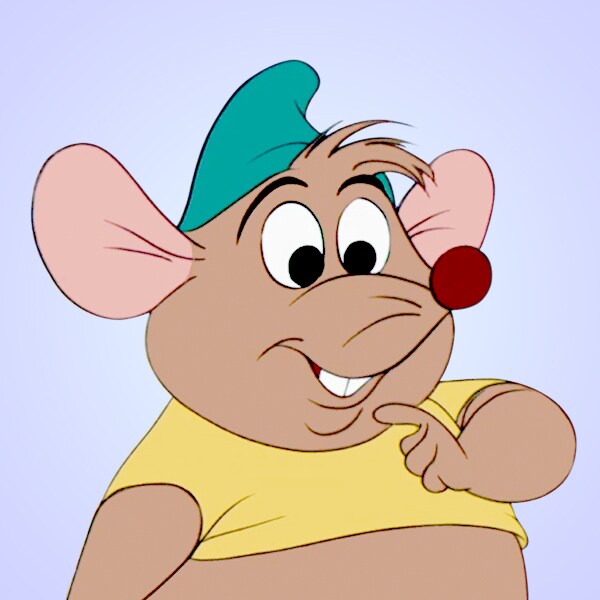
Gus enters the story through danger. A trap has caught him, the cat is nearby, and the house gives small creatures very little room for error. Cinderella does not dismiss his fear or leave survival to chance. She releases him, feeds him, gives him clothes, gives him a name, and introduces him to a community. That sequence turns kindness into material practice rather than a personality adjective.
Jaq helps manage the arrival because generosity still needs logistics. A new mouse cannot simply wander into Lucifer’s range without instruction. Jaq explains routes, danger, and household relationships. Cinderella creates refuge; Jaq helps the refuge function. Gus becomes family because welcome includes food, information, clothing, and somebody willing to say where the cat sleeps.
Jaq is an organizer before he is a sidekick
Jaq watches the household like a field commander who never received a map. He knows doors, ledges, clocks, keys, voices, and the timing of human movement. His value comes from connecting information to action. When Cinderella needs help, Jaq does not wait for a magical solution. He gathers a crew, assigns work, and converts scraps into a dress that can cross the threshold Lady Tremaine tried to close.
Calling him clever is accurate but incomplete. Strategy without trust would leave him as one mouse hiding well. Jaq persuades others to risk themselves because the community remembers Cinderella’s care. His leadership grows from reciprocity. He cannot command through rank or force, so he coordinates through shared purpose, urgency, and the belief that their friend deserves a night beyond the kitchen.
Gus is not stupid
Gus is inexperienced, hungry, distractible, and physically obvious in a world where survival rewards quiet movement. None of those traits equals stupidity. He learns the household rapidly, understands loyalty, recognizes threats, and acts under pressure. His choices sometimes create complications because hunger and fear arrive before strategy. That is different from lacking intelligence, and the distinction changes how the comedy lands.
The film uses his roundness, appetite, and delayed reactions for humor, but Gus repeatedly carries difficult loads and enters dangerous spaces. He may need Jaq to explain a plan twice. He still goes. Courage is especially visible when a frightened person does not look naturally heroic. Gus earns affection because his bravery keeps happening alongside vulnerability rather than after vulnerability disappears.
The house from mouse height
From Cinderella’s height, the manor is oppressive. From the floorboards, the same building becomes a landscape of cliffs, exposed crossings, traps, claws, and human feet. A breakfast tray is a mountain. A key is nearly a piece of furniture. A staircase transforms a delivery into an expedition. The mouse perspective makes domestic labor physically legible because ordinary household objects suddenly regain weight.
That change in scale also reveals how power works. Lady Tremaine rules through rooms and commands; Lucifer rules through access. He can occupy a corridor and cut off food, movement, or rescue. Jaq and Gus survive by learning the architecture better than the official residents. Knowledge of overlooked spaces becomes the poor person’s answer to ownership.
Cinderella speaks their language
The mice understand Cinderella, and she understands their speech even when the human world does not. The franchise never needs to turn that connection into a scientific rule. Emotional and practical fluency matters more. She hears creatures other people treat as pests, then responds as though their needs carry weight. Her attention creates a world within the house where hierarchy is not the only language.
Jaq often serves as the clearest verbal bridge, repeating plans and reacting to human conversation with expressive certainty. Gus communicates more through gesture, appetite, alarm, and affection. Together they show that understanding is not limited to polished speech. Cinderella reads both because she pays attention, which may be the rarest form of magic in the original film.
The breakfast raid
The corn-gathering sequence is comic suspense built around resource distribution. Lucifer positions himself between the mice and food, enjoying control beyond hunger. Jaq devises a route while Gus tries to carry more than safety allows. Their problem is not greed in the abstract. Food exists, a predator monopolizes access, and small bodies must become tactical to eat.
Gus’s overloaded stack makes viewers laugh because the danger is exact and recognizable. Anybody who has tried to secure one more needed thing before a door closes understands the impulse. Jaq’s frustration comes from knowing that survival plans fail at the point where scarcity encourages excess. The scene works because neither mouse is entirely wrong: restraint protects the group, and hunger keeps asking why restraint is necessary.
Lucifer is a political problem with whiskers
Lucifer does more than chase mice according to nature. He toys with them, blocks routes, performs innocence for Lady Tremaine, and uses household favor as protection. The cat understands that the dominant human will interpret every conflict in his favor. Jaq and Gus therefore fight an enemy who controls both physical danger and the official story about danger.
That arrangement mirrors Cinderella’s position. Lady Tremaine can create impossible conditions and still describe Cinderella as disobedient. Lucifer can provoke chaos and still become the indulged victim. The mice recognize the pattern immediately because their bodies pay for the lie. Their conflict translates the household hierarchy into chase comedy without making the hierarchy less real.
The dressmaking collective
Cinderella’s first ball gown is not a makeover delivered by wealth or magic. The mice and birds construct the dress while she completes the labor designed to keep her away. Jaq coordinates fabric, thread, discarded accessories, and many small makers. Gus contributes strength and effort. The sequence celebrates craft as collective resistance, with every stitch saying that Tremaine does not own the shape of Cinderella’s evening.
The dress also carries reused materials the stepsisters threw aside. Waste becomes beauty after passing through hands they consider beneath notice. When Anastasia and Drizella tear the gown apart, they destroy evidence that Cinderella’s community can make value without their permission. The cruelty reaches beyond cloth because the garment contains hours of care from friends who cannot safely confront the attackers.
What Gus carries
Gus is often assigned weight. He carries corn, thread, keys, and whatever else appears too large for one mouse. His physicality turns abstract support into visible strain. Viewers can see the wobble, hear the effort, and understand that helping Cinderella demands more than cheering from a hiding place. He contributes through the body everybody else jokes about.
That choice gives his roundness another meaning. Appetite may endanger him, yet nourishment also makes him capable of force. He can push, lift, hold, and absorb impact. The same body coded as comic excess becomes essential during rescue. Gus does not need to become leaner, smoother, or quicker to earn heroic status. He needs a moment when what he already has can serve somebody he loves.
What Jaq notices
Jaq’s greatest skill may be attention. He notices Cinderella’s mood, the movement of household members, the location of materials, and the exact instant a plan has started going wrong. His rapid speech matches a mind processing several threats at once. That alertness can look like natural confidence, but constant vigilance is also the habit of somebody living beside a predator.
The franchise lets the vigilance remain charming without asking what rest would mean for him. Jaq rarely stops being useful. He scouts, translates, corrects Gus, directs the group, and steps forward when adults fail. A deeper reading can admire competence while recognizing the cost of always becoming the person who knows what everybody should do next.
The key rescue
Lady Tremaine locks Cinderella away at the exact moment proof and freedom are closest. The rescue requires a key too heavy for the mice, stairs too large for their bodies, and Lucifer guarding the destination. Jaq and Gus turn the sequence into a labor story. Success depends on carrying weight together, protecting the route, and refusing to accept a locked door as a final answer.
Magic has already expired. The Fairy Godmother cannot solve this imprisonment. The Prince is downstairs and does not know where Cinderella is. The mice possess the necessary information, then perform the work. The film quietly places the final rescue in the hands of friends who have no title, wand, carriage, or legal authority.
Why the slipper still needs mice
The glass slipper is treated as singular proof, but proof is useless when the person holding power can suppress access. Lady Tremaine breaks one slipper and confines the woman who can wear the other. Jaq and Gus expose the gap between evidence and justice. Somebody must protect the witness, move the key, and create the chance for truth to enter the room.
This is why their subplot belongs to the main argument rather than a separate animal adventure. Cinderella’s identity has always been known by the people and creatures closest to her. The court needs an object because the court failed to know her. Her friends need only a door opened long enough for her voice to be heard.
Bruno joins the coalition
Jaq and Gus cannot defeat Lucifer by matching the cat’s size. They call Bruno, the old dog Cinderella has already protected from Lady Tremaine’s anger. The alliance pays off another relationship built through mercy. Bruno does not arrive as random muscle. He arrives because care has accumulated across species and becomes available during crisis.
The sequence does not make kindness transactional. Cinderella did not spare Bruno so he would someday attack a cat. Still, communities remember who treated them as disposable and who made room for them. The climax allows that memory to become force. Lucifer’s privileged isolation loses against a network he spent the film dismissing.
Friendship without matching personalities
Jaq and Gus work because they are not interchangeable. Jaq plans fast, worries loudly, and assumes responsibility. Gus trusts fast, wants openly, and acts with his whole body. Jaq sometimes treats Gus as another problem to manage. Gus sometimes ignores the caution keeping them alive. Their affection survives irritation because difference is part of the partnership rather than a flaw to eliminate.
The pair models a friendship where competence moves between people. Jaq knows routes and timing. Gus supplies strength, emotional warmth, and the willingness to attempt a task after the plan has collapsed. One leads more often, but neither becomes decorative. The best scenes require both the sharp idea and the stubborn body carrying the idea uphill.
Male friendship in a domestic story
The original film gives two male-coded friends a relationship centered on sewing, food, household protection, emotional loyalty, and collaborative care. They are brave without needing to leave the domestic sphere for a battlefield. Their heroism happens in bedrooms, kitchens, corridors, and sewing rooms because those spaces contain the conflict that matters.
That detail deserves more attention than another joke about Gus wearing tiny clothes. Jaq and Gus do not lose masculinity by helping make a gown. Craft becomes tactical, friendship becomes service, and courage includes noticing that a woman is being deliberately overworked. They act because domestic injustice counts as a real emergency.
Cinderella II and life after escape
Cinderella II divides attention across stories about palace rules, Jaq’s wish to become human, and Anastasia’s romance. The mouse story asks whether usefulness depends on size and whether changing form can solve insecurity. Jaq imagines a larger body will let him help Cinderella in a larger way, only to discover that scale creates unfamiliar limits.
Gus remains part of the grounding friendship, responding to Jaq’s transformation with concern and recognition rather than envy. The story is lighter than the original imprisonment plot, but the emotional question matters. Jaq has built identity around being capable. When Cinderella’s life changes, he worries that the role making him valuable may disappear.
Jaq as Sir Hugh
The human transformation gives Jaq reach, strength, and social visibility while removing the instincts that made him effective. He struggles with a body that should represent advancement. The comedy exposes the fantasy that larger automatically means more powerful. Competence came from experience, relationships, and knowledge of scale, not from occupying more space.
The name Sir Hugh gives the transformation a courtly joke, yet the episode has a sincere center. Jaq wants to remain needed by Cinderella after she enters palace life. His wish is less about becoming human than about fear of losing intimacy. Returning to mouse form becomes acceptance of a self whose worth never required promotion into another species.
Gus after the wedding
Gus does not receive the same existential plot, which can make him look static. His steadiness supplies the answer Jaq cannot initially hear. Friendship, shared history, and practical contribution continue even when Cinderella gains a title. Gus behaves as though belonging survives the move because Cinderella’s care was never based on rank.
His position also reveals the limits of sequel focus. A character associated with appetite and reaction rarely receives private desire beyond food, safety, and friends. Those desires are valid, but Gus could carry more story. The franchise repeatedly proves he can handle weight, then leaves much of his interior life inside the joke.
Cinderella III and altered history
A Twist in Time revisits the slipper, the palace, and Lady Tremaine’s determination to overwrite Cinderella’s marriage. Jaq and Gus function as keepers of the true timeline. When memory and official recognition become unstable, they remember what happened. Their loyalty is archival. They hold the relationship history the spell tries to erase.
The film makes their testimony especially important because the Prince’s mind has been changed and palace authority accepts the new story. Jaq and Gus cannot defeat magic through status. They observe inconsistencies, move evidence, and help Cinderella keep fighting. Once again, small witnesses protect reality while powerful adults become vulnerable to a convenient lie.
Memory as resistance
Fairy-tale retellings often treat memory as romantic destiny, something a true lover should recover through feeling. The mice bring a more practical version. They know who was present, which object mattered, and who manipulated the sequence. Their knowledge comes from watching the details nobody important noticed.
That makes Jaq and Gus accidental historians of the franchise. They witness household abuse, the first dress, the lock, the slipper, palace life, and the rewritten timeline. Because they live beneath formal notice, villains underestimate their evidence. History survives in the floorboards, carried by people power never thought worth silencing.
The question of ownership
The Tremaine house treats mice as invaders even though the mice have built homes, relationships, and routines within the structure. Human ownership declares their presence illegitimate while relying on a cat to enforce removal. Cinderella interrupts that logic by recognizing residence and need. She does not ask for property documents before offering breakfast.
Jaq and Gus therefore complicate the mansion as a family inheritance. Lady Tremaine may control the deed and the rooms, but another community inhabits the walls and helps preserve Cinderella’s future. The household belongs emotionally to the people who care for one another, even when law and force assign ownership elsewhere.
Food is never only a gag
Gus’s hunger is played broadly, yet food organizes the mice’s vulnerability. Gathering corn requires risk. Lucifer can weaponize access. Cinderella’s willingness to feed them distinguishes refuge from mere tolerance. Appetite becomes comic because the audience trusts that Gus will probably survive, but the scene retains the logic of scarcity.
His desire for one more piece should not become a moral lecture about self-control. A newly rescued mouse does not know when the next meal will come. Hoarding can be the memory of uncertainty expressed through the body. The film does not diagnose him, and fandom need not. The visible truth is enough: Gus wants abundance in a house where safety is rationed.
Clothing and belonging
Cinderella dresses Gus after rescue, placing him within the visual community of clothed mice. The tiny outfit is funny, but clothing also marks welcome. He has arrived naked, frightened, and unnamed. Fabric becomes dignity, protection, and an announcement that somebody expects him to stay.
Jaq’s familiar clothing signals an established role and personality. Both designs make mice readable as individuals rather than a swarm. That individuality supports the film’s ethics. Once pests have names, preferences, friendships, and clothes repaired by hand, extermination stops looking like neutral household management and starts looking like violence against neighbors.
Voice and performance
Jimmy MacDonald gives the original pair different rhythms even while performing both. Jaq sounds quick, directive, and perpetually halfway into the next plan. Gus sounds rounder, slower, and emotionally immediate. The stylized mouse speech requires audiences to listen through altered pronunciation, which mirrors Cinderella’s unusual willingness to hear them as people.
Later performers preserve the distinction across sequels, television, games, and park material. Rob Paulsen is strongly associated with later Jaq performances, while Corey Burton has frequently voiced Gus. Performance continuity matters because the friendship depends on instant contrast. A single alarmed syllable tells viewers whether the scene is about a plan changing or a snack appearing.
Why they belong on the character hub together
Jaq and Gus deserve individual recognition, but a combined profile respects how their most important meanings emerge through exchange. Splitting every shared event into two isolated biographies would create repetition and weaken the friendship. Their identities remain distinct while the partnership becomes the unit through which the franchise tests loyalty, courage, and scale.
A combined card also avoids treating Gus as Jaq’s accessory. The profile can place their strengths beside one another and show which scenes fail without either contribution. Jaq provides direction; Gus gives direction weight. Cinderella provides the relationship that makes both forms of effort meaningful.
What adaptations often lose
Realist remakes tend to reduce talking-animal agency because mice carrying keys or sewing gowns can threaten the desired tone. Removing them may make a story look more adult while cutting the clearest image of Cinderella having a community before romance. Solitude becomes prettier and emotionally poorer.
The 2015 film uses mice and visual acknowledgment without giving them the same verbal and tactical role. That choice supports the adaptation’s world, but something important changes. Cinderella’s kindness still reaches animals, yet the animals no longer answer with an organized rescue network. The theme moves from reciprocal solidarity toward personal virtue observed by nature.
The problem with calling every act magic
The Fairy Godmother supplies transformation, but the mice perform hours of nonmagical work before her arrival and dangerous work after the spell ends. Folding every good outcome into fairy-tale magic erases craft, planning, friendship, and bodily effort. The pumpkin carriage is magic. Carrying a key up the stairs is labor.
That separation improves the whole story. Cinderella receives help from wonder because despair has become unbearable, and she receives help from friends because relationships have been built every day. One answer is miraculous. The other is political in the smallest, warmest sense: people pooling limited power so somebody can leave a locked room.
Are they servants too?
The mice volunteer enormous labor for Cinderella, which raises a useful question. Does the story replace one exploited worker with a cheerful workforce of smaller workers? The difference lies in relationship, consent, and reciprocity. Cinderella does not command the dress project or punish failure. The mice choose the gift because she has consistently protected them.
Choice does not make effort weightless. Their labor should remain visible, and Cinderella’s gratitude matters. The original film allows joy within the work because the makers control the purpose. Lady Tremaine assigns endless tasks to prevent freedom. Jaq organizes a temporary task to create freedom. Same house, opposite moral structure.
Courage without invulnerability
Jaq never stops being physically vulnerable to Lucifer. Gus never becomes graceful enough to eliminate danger. Their victories do not depend on a training montage that makes fear obsolete. They succeed through persistence, alliances, and the ability to keep moving after a plan becomes chaos.
That model of courage fits Cinderella better than conquest would. Nobody in her circle can dominate the household alone. They survive through care, timing, and repeated refusal. The mice make resilience visible without pretending resilience is painless. Every crossing remains dangerous even after the audience knows they are brave.
The RaeRae verdict
Jaq is the friend with a plan, three backup plans, and a stress level nobody checks because he always looks competent. Gus is the friend who heard half the instructions, brought too much food, almost got caught, and still carried the impossible thing all the way upstairs. I know both of these people. Some days I have been both before lunch.
What gets me is that the prince cannot save Cinderella from the locked room because he does not know she is there. The fancy court has a slipper, a proclamation, horses, guards, and one extremely determined Grand Duke. None of that works until two mice move a key. Tiny friends beat official procedure. That is the movie.
The final reading
Jaq and Gus are comic, frightened, skilled, hungry, loyal, occasionally reckless, and essential. They transform a fairy tale about rescue into a story about mutual aid operating beneath the notice of power. Their greatest contribution is not the dress or the key alone. Their contribution is proof that Cinderella built a life of relationship before the palace offered a new address.
The pair deserves more than a sidekick label because the emotional architecture collapses without them. Cinderella’s kindness would have fewer consequences, the first dress would not exist, confinement would succeed, Lucifer would control the house, and true history would have no witnesses during the sequel’s altered timeline. Small characters carry the franchise because nobody told them importance had a height requirement.
Sources and credits
Film chronology and credited performances are checked against official D23 entries for Cinderella (1950), Cinderella II, and Cinderella III.
Keep exploring
Return to the Cinderella hub for reviews, profiles, rants, and guides.