
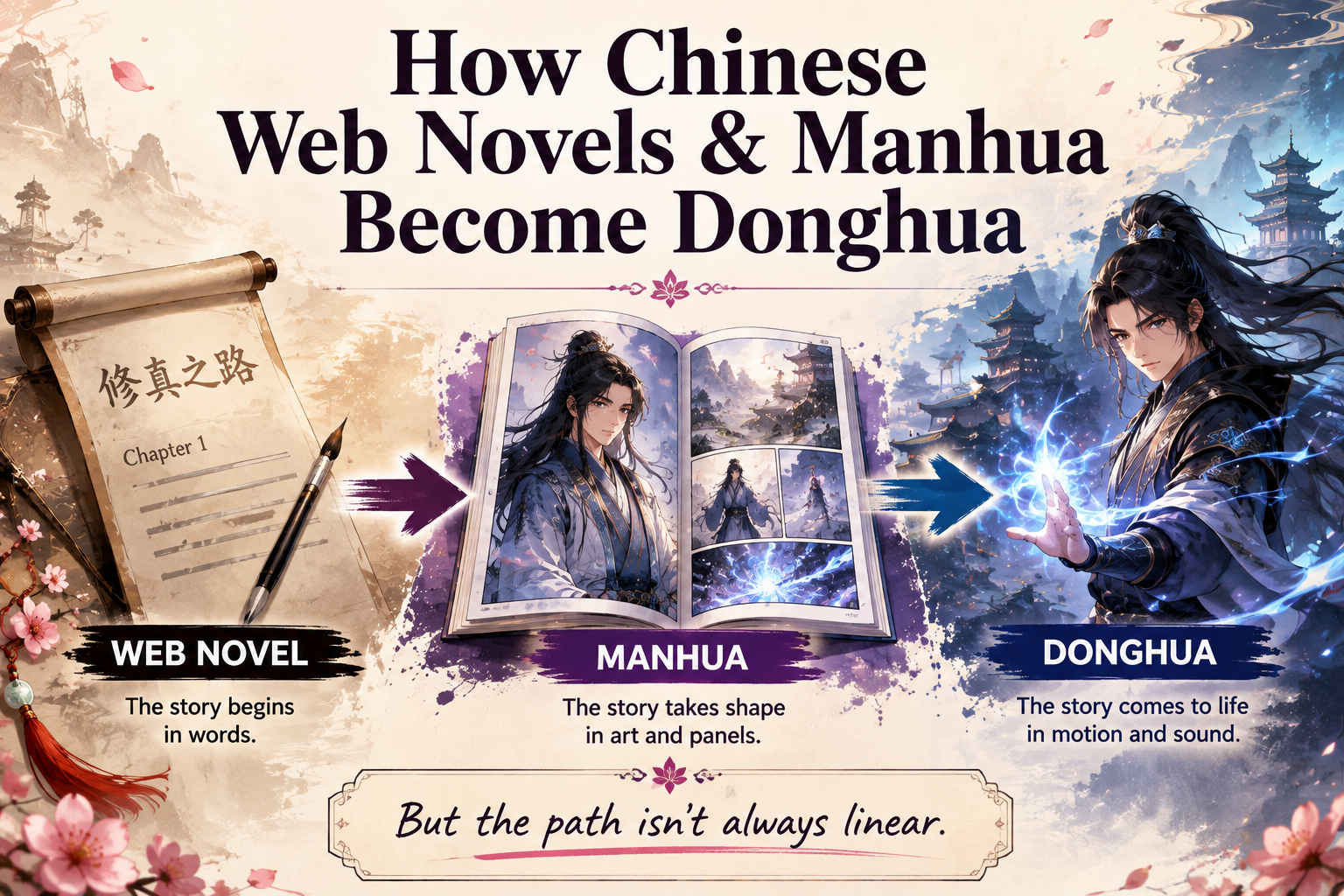
How Chinese Web Novels & Manhua Become Donghua
A Chinese story can begin as millions of words published chapter by chapter online, become a full-color manhua, appear again as a donghua, receive a live-action drama, spawn games and audio adaptations, and somehow collect several English titles before an international viewer has figured out which version came first. The tempting explanation is a nice straight line: web novel → manhua → donghua. Sometimes that is exactly what happened. Sometimes it is completely wrong.
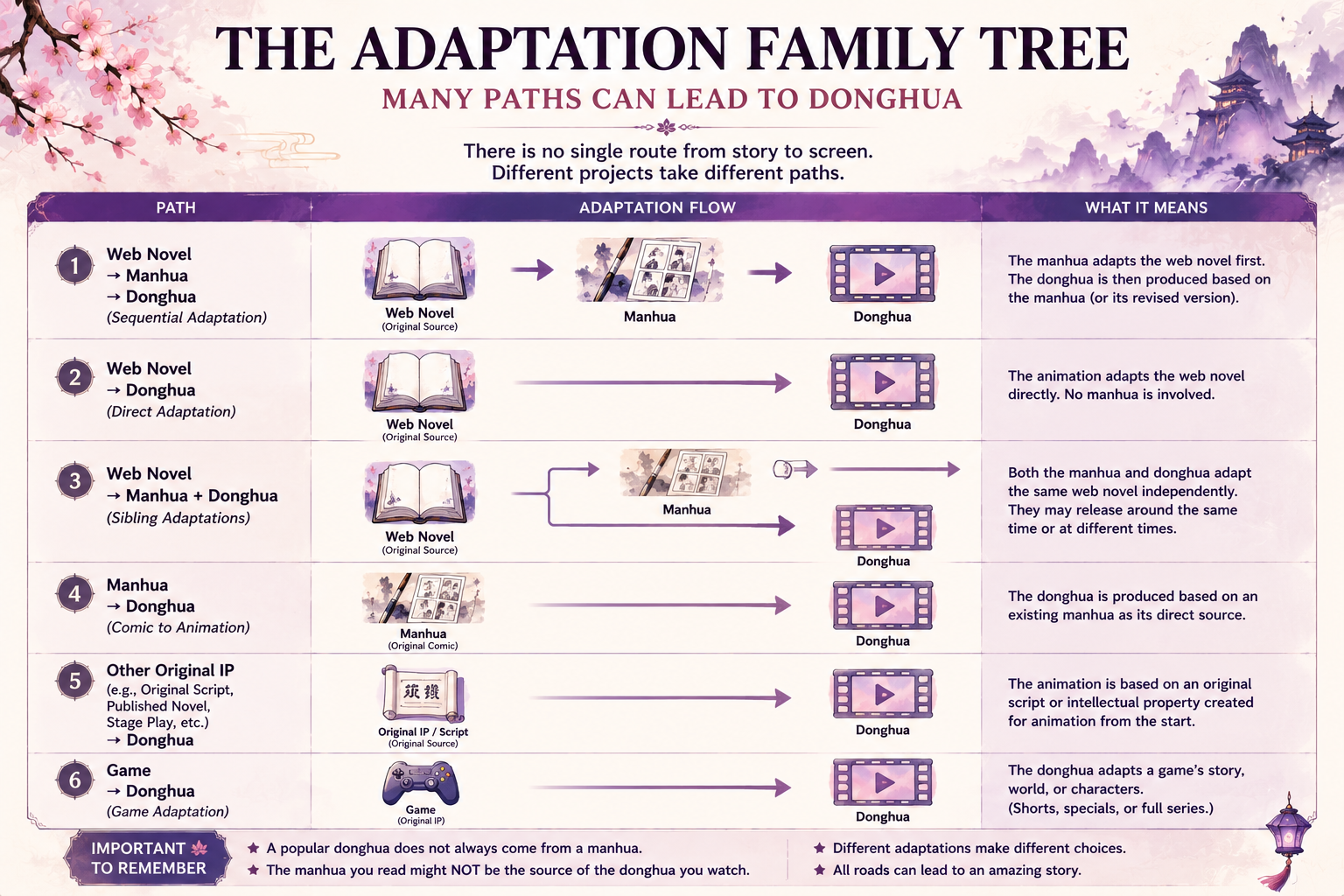
Modern Chinese entertainment properties can move through several adaptation paths. A donghua may adapt a web novel directly. A manhua and donghua may be sibling adaptations of the same novel. A comic can be the direct source. A game can become animation. A project can originate as animation without an earlier novel or comic. Even when two adaptations share the same source, they can make very different choices about pacing, character design, plot, romance, action, worldbuilding, tone, and which details survive the trip into a new medium.
So this is not just a guide to turning still pictures into moving pictures. We are following the entire adaptation family tree: where the intellectual property begins, why companies decide to animate it, how enormous serialized stories become episodes, what the production team actually has to create, why material gets cut or rearranged, and why the donghua you watch may disagree with the manhua sitting beside it without either one necessarily being the other’s source.
- Where do donghua stories begin?
- Why Chinese web novels matter
- Where manhua fits
- The adaptation family tree
- Who gets the right to make the donghua?
- How an adaptation is planned
- How huge novels become episodes
- Character and world design
- Scripts, storyboards and animatics
- 2D and 3D animation production
- Voice acting, music and sound
- Editing and post-production
- Why the adaptations do not match
- Content rules and adaptation changes
- Platforms and release
- Why any of this matters to fans
Four things to know before comparing versions
The easiest way to understand Chinese adaptation chains is to stop assuming that every franchise moves through the same order. “There is a novel, a manhua, and a donghua” tells us which versions exist. It does not tell us which version adapted which. That distinction matters because fans often blame one adaptation for “changing” another version that was never actually its source.
Where do donghua stories actually begin?
There is no single birthplace for donghua. Some projects are original animation. Others adapt comics, games, novels, mythology, published fiction, or other existing properties. But if you spend much time around modern serialized Chinese animation, especially fantasy and cultivation series, you will quickly run into one source category over and over again: online literature.
China’s web-fiction ecosystem turned serialized prose into an enormous entertainment industry. Authors can publish stories chapter by chapter, sometimes at a pace that makes traditional publishing schedules look leisurely. Popular works can accumulate hundreds or thousands of chapters, sprawling casts, multiple realms, political factions, romances, side plots, elaborate progression systems, and enough worldbuilding to keep adaptation teams employed for years.
Once a property proves that readers care, it becomes attractive for other media. A manhua can introduce the story to people who prefer visual reading. Donghua can add motion, performance, sound, and spectacle. A live-action drama can reach another audience. Games can turn the world into something interactive. Audio dramas can give characters voices before animation ever arrives. Merchandise and licensing can expand the property again.
This is why the word source matters. The earliest version of the story may be prose even if the comic is what international fans discovered first. A manhua may establish a popular visual design without originating the plot. A donghua may use the same characters and major story beats while adapting the original novel rather than the comic. Once several adaptations exist at the same time, visual familiarity can make the family tree look simpler than it really is.
Why web novels matter so much to modern donghua
Web novels are particularly valuable adaptation sources because they can prove audience demand before animation begins. A story that already has millions of reads, paid chapters, active discussion, fan art, rankings, character popularity, or a successful print edition is less commercially mysterious than an untested concept. The property arrives with evidence that people are willing to spend time inside its world.
They also arrive with a ridiculous amount of material. Long-form web fiction can build complex societies, clan histories, cultivation systems, romances, rivalries, political factions, multiple generations, side characters, alternate realms, and extended training arcs that would be impossible to fit into one short season of animation without cutting aggressively. That abundance is both the attraction and the problem.
Prose also handles information differently from animation. A novelist can stop the action for three paragraphs to explain why a technique is dangerous, why a character is lying, how an ancient sect collapsed, or what the protagonist privately thinks about the person standing across the room. Readers can move through that explanation at their own speed. Animation has fixed runtime. The episode keeps moving whether the viewer understands the spiritual-meridian diagram or not.
Internal thought is especially vulnerable. A web-novel protagonist may appear calculating, terrified, suspicious, deeply in love, or morally conflicted because the reader has constant access to their mind. Remove that narration and keep only their external actions, and the same character can suddenly look cold, reckless, stupid, or emotionally vacant. The plot may remain technically intact while the character changes dramatically.
That is why source readers sometimes insist the animated character is “different” even when the donghua preserves the same events. They may be responding to lost interiority rather than a rewritten plot. Adaptation is not only about which scenes survive. It is about which information survives.
Where does manhua fit into the adaptation chain?
Manhua can be the original source of a donghua, but it can also be an intermediate adaptation of something older. When a web novel becomes manhua, the comic has to make a new set of creative decisions. Characters who existed primarily through prose now need faces, hairstyles, clothing, weapons, body language, color palettes, architecture, landscapes, monsters, magical effects, and visual relationships to one another.
That visual interpretation can become extremely influential. Once readers spend hundreds of chapters looking at a particular version of a character, the design begins to feel definitive even if the novel never specified every detail. If the later donghua chooses a different costume, face shape, weapon design, or hair color, fans may experience that as a change from “the original” when the supposed original was itself already an adaptation.
Manhua also compresses prose differently from animation. A comic can preserve internal narration through captions, thought bubbles, visual symbolism, or long dialogue while still moving faster than a novel. It can freeze on an important expression for as long as the reader wants. It can devote an enormous panel to one attack without paying for the movement between poses. Animation has to solve those problems differently.
This is why the manhua can be useful reference material for understanding a property without necessarily being the donghua’s direct blueprint. It may help establish visual expectations or popular interpretations while the animation team still works from the original novel, shared franchise material, or its own adaptation plan.
The adaptation path is not always linear
The neatest possible pipeline is easy to understand: a web novel becomes manhua, and the manhua becomes donghua. That path certainly exists. It is also only one possibility. Modern Chinese media properties can be developed in parallel, and different production teams can license the same underlying intellectual property for different media.
A web novel can therefore produce a manhua and a donghua as sibling adaptations. The comic team makes one set of choices about pacing, character design, and scene selection. The animation team makes another. If the two versions disagree, neither necessarily “changed” the other. They may simply have looked at the same source material and made different decisions.
Some donghua adapt manhua directly. Others adapt games, published novels, or original scripts. A multimedia project can even be conceived from the beginning as a coordinated property spanning several formats. Once that happens, asking “which version came first?” may be less useful than asking which work holds the underlying story rights and which materials each adaptation officially credits.
Who gets the right to make a donghua?
A popular story is also intellectual property. That means adaptation begins long before an animator draws a frame. Rights holders, publishers, literary platforms, production companies, animation studios, streaming platforms, investors, and other business partners may all have interests in how the property can be used. The exact structure differs from project to project, which is why there is no universal Chinese adaptation contract hiding behind every donghua.
For a web novel, the rights situation can involve the author and the platform or publisher handling the work, depending on the contracts attached to publication and adaptation. A manhua adaptation may have its own production arrangement. Animation rights can be licensed separately. Music, games, live action, merchandise, international distribution, and other uses can involve additional agreements.
This matters because a successful novel is not simply sitting on the internet waiting for whichever studio likes it best. Somebody has to secure the ability to adapt it, assemble financing, decide what form the project will take, and determine which companies will participate. A streaming platform may be more than the place where the finished donghua appears. It can be involved much earlier through investment, commissioning, marketing, or IP strategy.
Rights also affect what material is available to the production team. An adaptation may have access to the original novel, character materials, author consultation, existing manhua designs, franchise documents, or some combination of those resources. Different arrangements can produce different relationships between the versions.
How an adaptation is planned before production begins
Once a story is selected for donghua, the adaptation team has to answer a brutal question: what exactly are we animating? A long web novel may contain years of serialized material. The first season cannot simply begin at Chapter 1 and keep moving until the budget disappears. The team needs a dramatic unit that can function as an animated season or release block.
That requires structural decisions. Where should the first major arc end? Which characters must be introduced now, and which can wait? Which early explanations are necessary for the audience to understand later events? Which side stories are emotionally valuable but impossible to fit? Does the season need to reach a famous battle or romantic turning point that existing fans expect? Can the story build to a satisfying ending even though the source continues for another thousand chapters?
The production also has to consider the intended audience. Existing novel readers already know terminology, factions, relationships, and the rules of the world. A new animation viewer may know none of it. An adaptation that assumes too much can become incomprehensible. One that explains everything can suffocate under exposition. The writing team has to decide what can be shown visually, what needs dialogue, what can be postponed, and what can disappear.
Episode runtime changes the math again. A scene that takes five minutes to read can become thirty seconds of animation or ten minutes depending on how much action, silence, performance, and visual detail it contains. Prose length is not screen time. One paragraph describing a spectacular battle may require an enormous production effort, while three pages of internal thought can vanish into one look from a voice actor and a carefully timed cut.
Adaptation planning is therefore less like copying and more like rebuilding the architecture with different materials. The same rooms may be there. Some hallways get moved. A storage closet becomes a major emotional scene. Three decorative balconies are quietly removed because somebody has to animate the damn thing.
How do hundreds or thousands of web-novel chapters become watchable donghua?
This is where adaptation becomes ruthless. A long Chinese web novel can afford to wander in ways animation usually cannot. The author may spend chapters on training, travel, side characters, political negotiations, clan disputes, cultivation theory, family history, internal monologue, comedy, romance, repeated confrontations, minor villains, and worldbuilding that slowly accumulates meaning over hundreds of updates. Readers who followed the novel during serialization may have spent months or years living with details that an animation audience is expected to absorb in a fraction of that time.
A donghua has a completely different relationship with time. Every animated minute has to be planned, written, designed, voiced, animated, lit, rendered or drawn, composited, edited, scored, mixed, reviewed, and delivered. A conversation between two characters still consumes production resources. A battle involving multiple fighters, magical techniques, creatures, collapsing environments, particle effects, complex camera movement, and flowing robes can consume enormously more. The adaptation cannot treat every novel chapter as though it has equal dramatic or production weight.
So material gets compressed. Several conversations may become one. A minor character’s information can be transferred to somebody the audience already knows. Repeated explanations can disappear after the first one. Travel can become a montage. Training that occupied ten chapters may become a short sequence showing only the milestones. A side conflict can disappear entirely if removing it does not damage the main arc the season is trying to tell. Sometimes a minor antagonist is merged with another character because the adaptation does not have enough screen time to establish both.
Chronology can change too. A character may be introduced earlier because the animation needs a stronger visual anchor. Information that the novel revealed gradually may move forward so viewers understand a faction before a major battle begins. A flashback may be relocated to the point where it carries the greatest emotional weight on screen. Two scenes separated by dozens of chapters can be combined because they serve essentially the same purpose once the story is rebuilt as animation.
This can make source readers angry because the missing material may genuinely be excellent. It can also make the adaptation better television. Both things can be true. A wonderful chapter is not automatically a wonderful animated episode, especially if preserving it would repeat information already shown, derail the season’s central conflict, or require three episodes to explain why a secondary elder is upset about a grudge that began four generations ago.
Internal narration is one of the first casualties
Prose has direct access to thought. A novelist can tell us that a character recognizes an enemy’s technique, remembers a warning from twenty years earlier, notices a tiny inconsistency in someone’s story, feels jealous, suspects betrayal, and is deliberately pretending not to understand, all while the character’s face remains perfectly calm. That is incredibly efficient storytelling when the audience can simply read the person’s mind.
On screen, the same character may only stare at somebody for three seconds. If the adaptation does not find another way to communicate that thought process, viewers receive a very different character. Someone who felt calculating in the novel may look passive in animation. Someone whose fear filled several paragraphs may look reckless because the audience only sees the action they eventually chose.
Donghua can preserve internal information through voice-over, flashbacks, symbolic imagery, changes in performance, reaction shots, dialogue, or visual clues. Sometimes the adaptation simply trusts the audience to infer what the novel explained directly. Every option changes the balance between clarity, pacing, subtlety, and faithfulness to the source.
Character design and world design are acts of adaptation too
A web novel can describe a character without completely defining them. We may know that someone is tall, beautiful, intimidating, dressed in white, associated with a particular clan, carrying a famous sword, or known for a distinctive gaze. The reader’s imagination supplies everything the prose leaves open. Animation does not have that luxury. The protagonist needs an actual face, body, hairstyle, costume, color palette, weapon, silhouette, and range of expressions that can remain recognizable through episode after episode.
Character designers therefore translate literary description into a production-ready identity. Clothing has to communicate personality, social status, historical inspiration, sect affiliation, fantasy setting, and the practical requirements of animation. A gorgeous illustration covered in embroidery, chains, tassels, jade ornaments, translucent fabric, tiny metal pieces, and individual hair accessories may look fantastic on a book cover and become a small engineering crisis once the character has to fight.
The same problem applies to weapons, magical artifacts, creatures, cities, sect compounds, palaces, mountains, vehicles, landscapes, and entire realms. A novelist can write that an enormous heavenly palace floats above an ocean of clouds and then continue to the next sentence. The animation team has to decide what that palace actually looks like, how large it is, how people move through it, where the camera can travel, which areas recur, how it is lit, and whether it needs to survive several seasons without being redesigned every time somebody returns.
What if the manhua already designed everything?
Then the manhua can become an important visual reference, but it still does not automatically become a rigid blueprint. The donghua may have a different art director, another target audience, a separate licensing arrangement, or an entirely different production pipeline. A design that works beautifully in one frozen comic panel may be cumbersome when repeated across hundreds of animated shots.
This becomes especially obvious in 3D production. Character models need geometry, textures, facial rigs, body rigs, hair systems, clothing behavior, and enough flexibility to perform. Flowing robes and waist-length hair are lovely until physics enters the meeting. A tiny ornament that never caused a problem in the manhua can clip through a character’s shoulder every time they turn around.
Designs may therefore be simplified, redistributed, recolored, or altered so they remain readable in motion. That does not automatically mean the team ignored the source. Sometimes it is an aesthetic decision. Sometimes it is a technical decision. Sometimes it reflects information from the original novel rather than the comic. And sometimes, yes, somebody simply decided the new outfit looked better.
Scripts, storyboards and animatics turn adaptation decisions into actual screen time
Once the adaptation structure is established, episode writers have to turn the selected material into scripts. That means deciding what characters say aloud, which thoughts remain internal, where scenes begin and end, how transitions work, what information the viewer needs right now, and what can wait. A novel chapter and an animation script are fundamentally different documents because the script has to anticipate what the audience will actually see and hear over a fixed amount of time.
Storyboarding pushes the episode farther into visual storytelling. The storyboard divides scenes into shots and establishes framing, composition, character placement, camera position, action flow, and visual emphasis. One sentence from prose can become a sequence of several shots. Several paragraphs can collapse into one image if the visual tells the same story faster.
Action depends heavily on this stage. A novel can describe impossible speed through language. A manhua can choose a handful of spectacular poses and let the reader imagine the movement between them. Donghua has to create that movement. Where does the attacker start? Where is the opponent standing? What does the audience need to see before the strike lands? When do we need a wide shot so the battle does not become two glowing people teleporting through unrelated close-ups?
Timed previsualization or animatic work can expose problems that are not obvious on paper. A dramatic pause may feel powerful at two seconds and ridiculous at six. A speech that reads beautifully may stop the episode dead once an actor has to perform every line. A battle that sounded manageable in the script may require far more shots than the schedule can comfortably support.
This is another place where adaptation decisions happen before polished animation exists. By the time viewers see the final sequence, dozens of choices about timing, geography, emphasis, and what the audience is supposed to notice have already been made.
How the donghua production actually comes together
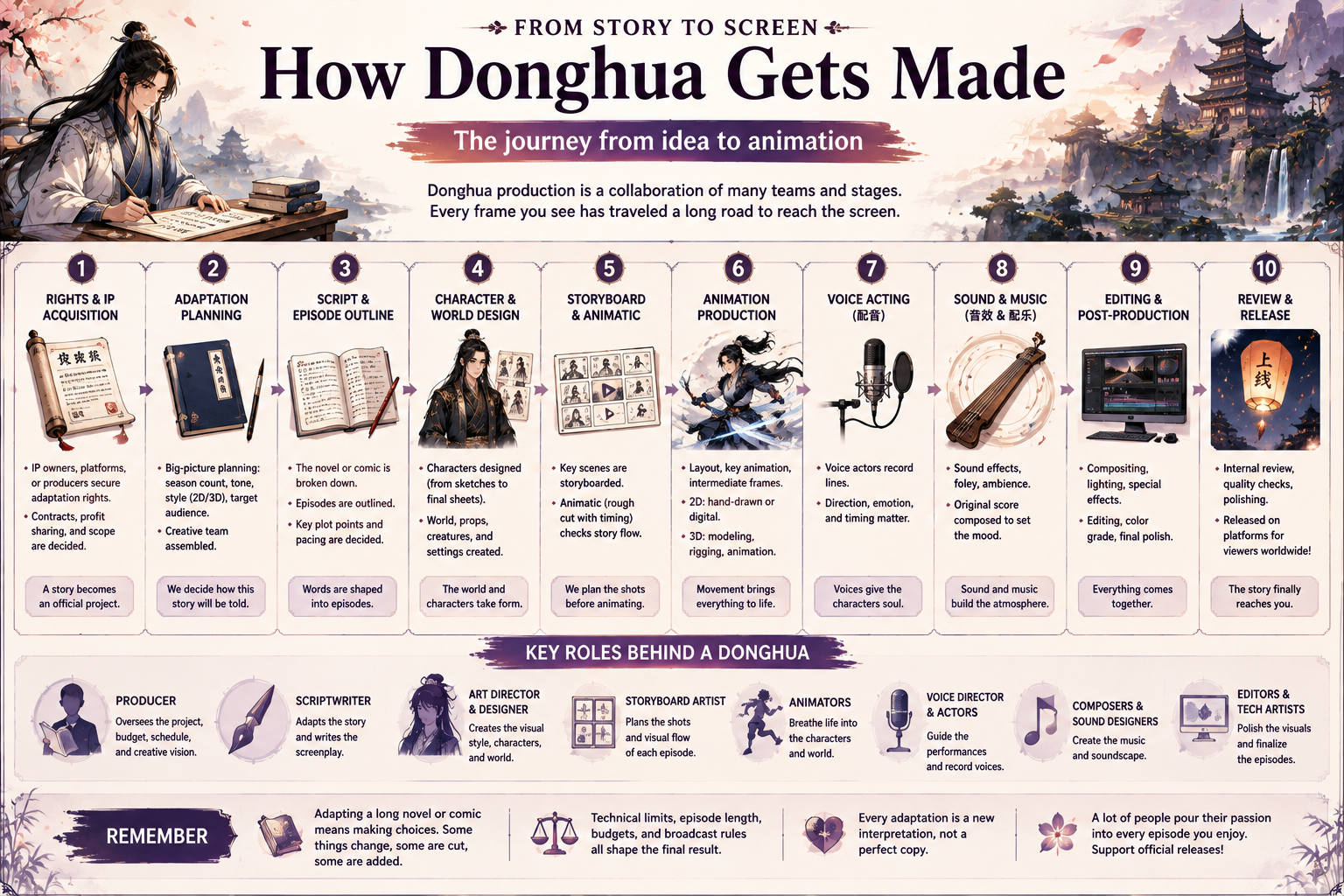
By the time viewers start talking about “the animation,” a huge amount of work has already happened. Rights have been arranged. The adaptation has been structured. Scripts have been written. Characters and environments have been designed. Shots have been planned. The production pipeline now has to turn those decisions into finished moving images.
The exact workflow depends on the studio and whether the project is primarily 2D, 3D, or hybrid. A 2D production can involve layouts, key animation, in-between work, backgrounds, digital painting, effects, compositing, and correction. A 3D production involves modeling, texturing, rigging, layout, character animation, simulation, lighting, rendering, effects, and compositing. Hybrid productions combine techniques and may use 3D environments or effects inside otherwise 2D animation.
None of these stages exists in isolation. If character designs are too complicated, animation becomes harder. If an environment is not ready, shot production can stall. If a late story change requires a new creature, that creature now needs to be designed and built. If a major battle becomes more ambitious after storyboarding, the schedule has to absorb that ambition somewhere.
This is one reason quality can vary within the same series. Production is a schedule as much as it is an art form. A major episode may receive more time, attention, or particularly strong staff. Another episode may be carrying the consequences of delays elsewhere. Long-running donghua also have to sustain production across far more material than a short film or one-off promotional animation.
Voice acting, music and sound change the story again
A novel character has whatever voice the reader imagines. A manhua adds a face but still leaves sound inside the reader’s head. Donghua removes that ambiguity. Once a voice actor performs the role, dialogue gains pitch, rhythm, breath, hesitation, anger, affection, sarcasm, fear, age, and personality. The exact same written sentence can feel completely different depending on how it is performed.
Chinese voice actors therefore do far more than read dialogue already present in the source. They interpret characters. A quiet pause can replace a paragraph of internal narration. A laugh can reveal that a polite sentence is actually an insult. A character who seemed cold in prose can become warmer through performance. Another can become more intimidating precisely because the actor refuses to shout.
Voice performance also has to fit animation timing. A beautiful novel line may simply be too long for the shot. Dialogue can be rewritten for natural speech. Exposition that worked perfectly in prose may sound absurd when a human being has to say all of it while supposedly fighting for their life. Adaptation therefore continues in the recording booth.
Sound effects give physical weight to ideas that prose only described. A sword can hum with spiritual energy. A formation can crackle into existence. Footsteps can make a palace feel enormous. A creature can become frightening before the camera reveals it. Silence can become just as important, especially when the episode allows tension to sit rather than filling every second with noise.
Music adds another layer of interpretation. A romantic scene can feel tender, tragic, hopeful, ominous, or suspicious depending on the score. Character themes create associations that never existed in prose. Opening and ending songs can become part of a franchise’s identity. By this point, the donghua is not simply illustrating the source. It has built its own audiovisual language around the same story.
Editing and post-production determine how all the pieces finally behave together
Animation, dialogue, music, effects, backgrounds, lighting, and camera work do not magically assemble themselves because everybody finished their individual files. Editing determines the final rhythm of scenes and transitions. Compositing combines visual layers. Color and lighting adjustments help shots belong to the same world. Effects are integrated. Dialogue, music, ambience, and action sounds are balanced into a finished mix.
This stage can dramatically affect how polished the animation feels. Strong compositing can give depth and atmosphere to relatively simple underlying assets. Poor integration can make individually good elements feel disconnected. Lighting can make a 3D environment feel cinematic or strangely artificial. Editing can make a battle feel fast and coherent or turn beautiful animation into a sequence where nobody knows which direction the villain is standing.
Post-production is also where the episode becomes a deliverable product rather than a collection of creative pieces. Titles, credits, final audio, technical specifications, platform requirements, and other delivery elements have to be prepared. The viewer sees one finished episode. The production sees the point where dozens of separate pipelines finally become one thing.
Why the web novel, manhua and donghua do not match
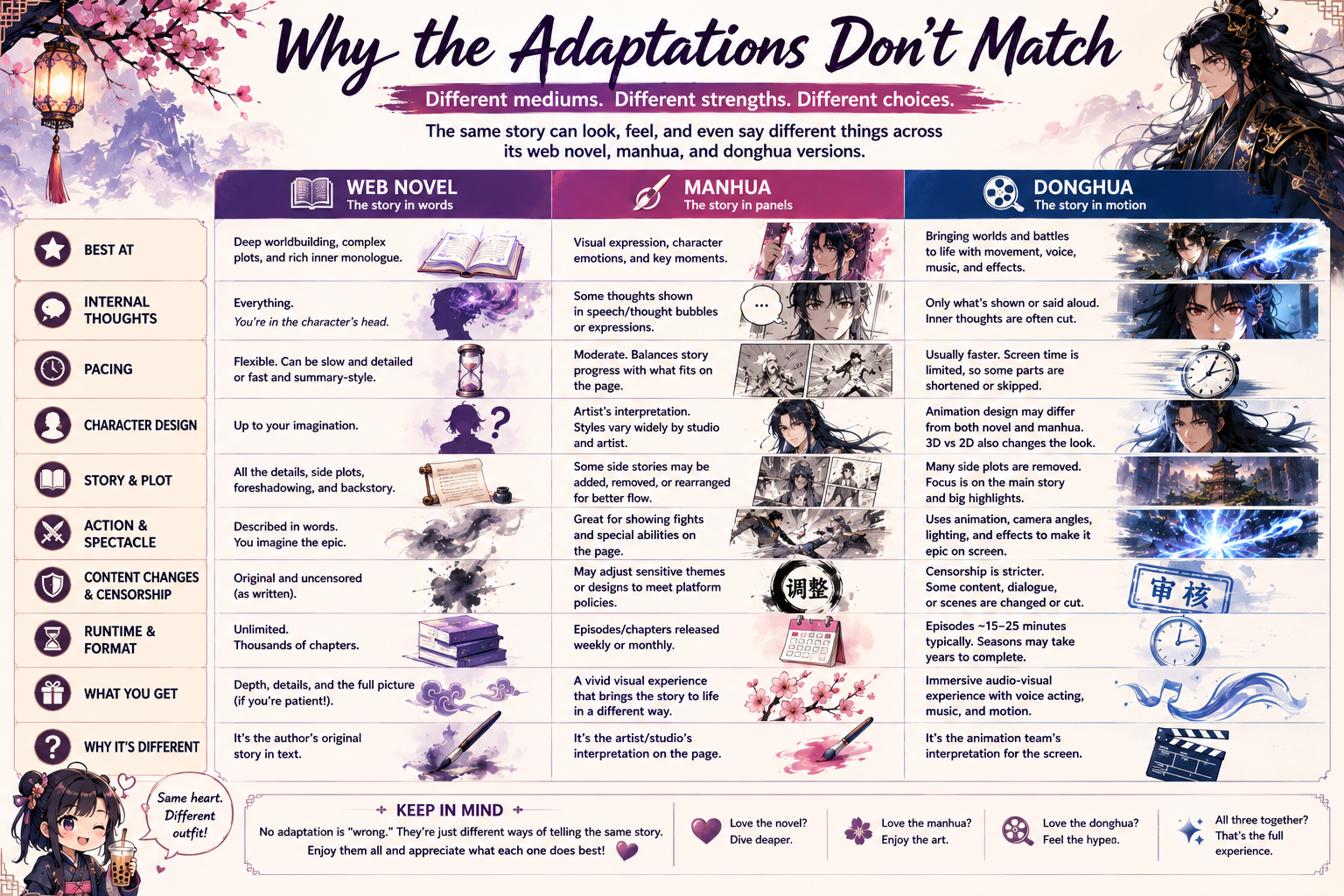
By now the answer should be less mysterious: they cannot match perfectly because they are not the same storytelling machine. A web novel controls language and direct access to thought. A manhua controls sequential images and reader-paced timing. A donghua controls moving images, sound, voice performance, music, editing, and fixed runtime. Each medium gains tools and loses others.
Web novels are particularly strong at depth. They can explain history, motivation, politics, cultivation theory, internal reasoning, and tiny strategic details without needing to visualize every word. The reader can spend as long as needed on an explanation. The author can stop a battle to explain exactly why one technique counters another without anyone worrying that the episode has only six minutes left.
Manhua gives the story a concrete visual identity while still allowing the reader to control pacing. A dramatic panel can be studied for twenty seconds or skipped in two. Internal narration can remain on the page. The artist can choose the most spectacular instant of a fight and let the reader imagine the movement around it. That makes comics extremely efficient at creating visual impact without animating every transition.
Donghua adds movement, voice, music, sound design, editing, lighting, and the emotional force of performance. It can make an attack feel physically enormous. It can turn a glance into a romantic moment through acting and music. It can make a city feel alive through sound and camera movement. But it also loses the reader’s control over time. The episode moves forward at the pace the production chose.
These differences naturally affect pacing. The novel can spend forty chapters on an arc that the manhua covers in twenty chapters and the donghua finishes in four episodes. A side character beloved by novel readers may be reduced because the animation has limited time. A battle barely described in the source may expand because motion and spectacle are areas where animation can contribute something new.
Character design can diverge for the same reason. The novel may leave visual details open. The manhua chooses one interpretation. The donghua chooses another. If the animation adapts the novel directly, the manhua design may never have been binding in the first place.
| Story Element | Web Novel | Manhua | Donghua |
|---|---|---|---|
| Internal thoughts | Can explain them directly and extensively. | Can preserve them through captions, text and visual reaction. | Must use voice-over, performance, dialogue, imagery or implication. |
| Pacing | Can expand for hundreds or thousands of chapters. | Reader controls how quickly panels are consumed. | Fixed runtime forces stronger compression and timing decisions. |
| Character appearance | Can leave many visual details open to imagination. | Creates a fixed visual interpretation. | Needs production-ready designs capable of moving repeatedly. |
| Worldbuilding | Can explain systems, history and politics at enormous length. | Can combine exposition with maps, panels and visual shorthand. | Often has to show quickly, simplify, move exposition or cut it. |
| Action | Language can describe scale without physically producing it. | Can choose the most dramatic frozen moments. | Must choreograph and animate the movement between those moments. |
| Sound & music | Imagined by the reader. | Usually implied visually. | Becomes an entirely new storytelling layer. |
Content rules, platform requirements and audience considerations can reshape adaptation too
Fans often assume every difference between source and adaptation is an artistic decision made by the director or writers. Real productions operate inside broader commercial and regulatory environments. A donghua has to be approved for release through the systems relevant to its production and distribution. Platforms also have their own audience goals, business models, scheduling needs, and content expectations.
That can affect what material survives. Violence can be altered in intensity or presentation. Sexual content may be reduced. Sensitive political or historical material may require changes. Supernatural or religious imagery can be framed differently depending on context. Relationships can be emphasized, softened, redirected, or communicated more indirectly. The exact reasons vary by project, and viewers should be careful about claiming a specific motive without evidence from the production or reliable reporting.
Runtime and target audience can create equally important changes without any regulatory issue at all. A platform may want shorter episodes. The donghua may be designed for a broader audience than the original novel. Producers may want the first season to reach a famous plot point quickly. Marketing may emphasize characters already popular with source readers. An adaptation can therefore change because of ordinary commercial strategy rather than some dramatic behind-the-scenes battle.
This is also where international viewers need to be careful. A translated subtitle can make a relationship or concept feel different from the Chinese dialogue. An international release may use another title or episode grouping. Something that appears to be an adaptation change may actually be a localization choice layered on top of the adaptation.
Streaming platforms shape how donghua is released, packaged and discovered
Modern Chinese donghua is deeply connected to online distribution. Streaming platforms can function as commissioners, investors, promotional engines, rights partners, and distributors rather than simply hosting a finished animation after somebody else makes it. That relationship helps explain why the platform can matter almost as much as the studio when tracing a property’s adaptation history.
Release structures can also feel unfamiliar to viewers trained on Japanese seasonal anime or Western television. Episode runtimes vary. Seasons may be divided into parts. Long-running series can continue through release patterns that do not map neatly onto the Japanese cour system. Specials, revised editions, VIP access, early-release arrangements, or platform-specific packaging can make episode numbering look inconsistent across databases.
International licensing adds another layer. The Chinese title may receive an official English name that differs from the established novel translation. Seasons can be regrouped. Subtitles may use different terminology. Episodes may arrive later than the domestic release. A service can list a continuation as a new season while another database treats it as the same production run.
This is one reason following Chinese characters and pinyin alongside English titles can be so useful. The original name gives the property an anchor even when translation and platform packaging begin multiplying around it.
Why understanding the adaptation pipeline makes the donghua better to watch
The first benefit is that source comparisons become much smarter. Instead of saying “the donghua ruined the manhua,” you can ask whether the manhua was even its source. If both works adapt the same web novel, the more useful comparison is how each version interpreted the original material. That changes the conversation completely.
The second benefit is understanding what was actually lost. A deleted scene is easy to identify. A deleted function is more important. Did the adaptation remove a conversation that explained a political alliance? Did it remove the protagonist’s internal reasoning and accidentally make them look stupid? Did it cut a side character whose later betrayal now appears to come from nowhere? Those are more meaningful questions than counting chapters.
The third benefit is appreciating what animation adds. Adaptation is not merely a list of things the donghua failed to preserve. Animation contributes voice performance, music, sound, movement, lighting, choreography, timing, editing, and visual spectacle. A scene can become more emotionally powerful in donghua even if it contains fewer words than the novel.
And the fourth benefit is simply navigating Chinese media without getting lost. Once you recognize the difference between original source, manhua adaptation, donghua adaptation, live-action version, platform title, and international localization, the franchise stops looking like six unrelated stories that somehow stole the same character names.
Chinese franchises are less of a straight line and more of a family group chat
I used to make the easiest possible assumption: novel becomes comic, comic becomes animation. Nice. Organized. Everybody stands in a line and waits their turn. Then Chinese media politely informed me that this filing system was adorable.
The novel might become manhua and donghua separately. The manhua can establish the visual version everybody recognizes while the donghua is still adapting the prose. A drama appears. A game appears. An audio drama has already been there for two years. The English title of the novel does not match the English title of the donghua. Somebody on a streaming platform has called Part 2 Season 3. Now I am standing in the middle of an adaptation family reunion asking everyone how they are related.
But once you stop expecting a straight line, the whole thing becomes easier. Ask what the original IP is. Ask what each adaptation officially credits. Ask whether the manhua and donghua are parent and child or siblings. Then compare what each medium actually does well instead of grading every version according to how closely it resembles the one you happened to meet first.
I also think this makes adaptation arguments more interesting. “They cut stuff” is true of almost every adaptation ever made. Fine. What did the cut change? Did we lose context? Did a relationship become shallower? Did the animation replace five pages of description with thirty seconds of absolutely gorgeous visual storytelling? Those are conversations worth having.
Same story does not mean same version. Web novel, manhua and donghua are different storytellers holding the same family history.