
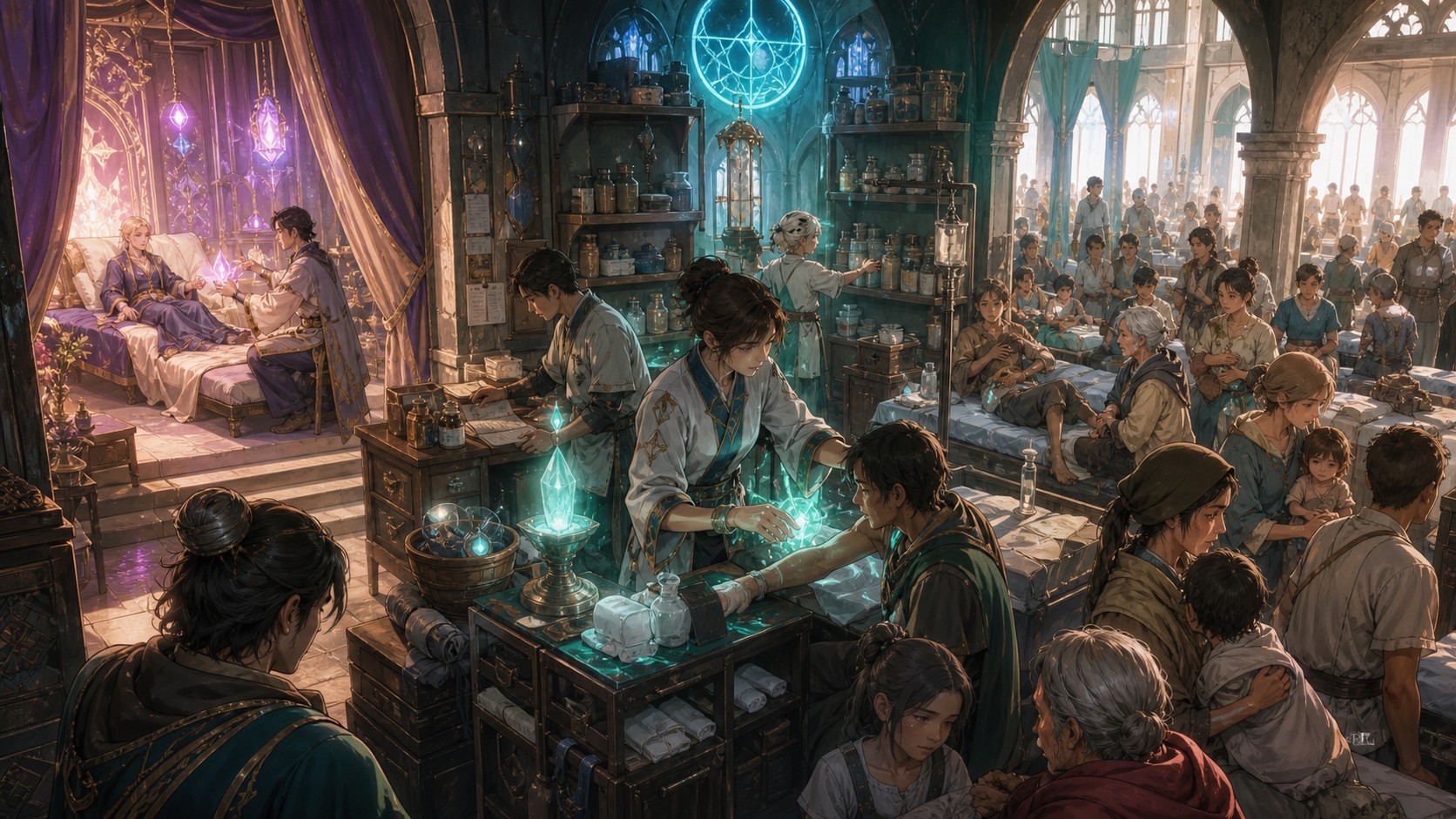
Healing Magic Breaks the Healthcare Economy When Every Cure Is Instant
A healer closes a sword wound with one glowing hand, everybody cheers, and the kingdom goes right back to having no clinics, no nurses, no public-health system, and no plan for the next hundred patients.
Bottom line first: healing magic healthcare does not erase the need for a real system. Healing magic creates different labor, access, training, safety, and payment problems. A story can give one gifted priest the power to repair a shattered rib in thirty seconds. That miracle still leaves a line outside the door, a village three days away, a healer who needs sleep, a child with a chronic condition, contaminated water making everybody sick again, and a noble willing to buy the first appointment.
Fantasy anime often uses healing as an eraser. A fight can break every bone in the hero’s body because a green glow restores the hero before the next episode. The spell protects the action schedule, but the world around the spell stays strangely empty. Nobody asks how healers are trained, how many exist, how patients find them, who pays, what mistakes look like, or why any poor person dies from an ordinary infection when magic can rebuild an organ.
That silence matters because healthcare is never only the cure. Healthcare is the workforce, the clinic, the supply chain, the records, the sanitation, the prevention, the transport, the trust, and the rules that decide who receives scarce help first. Healing magic can transform every piece of that system. Healing magic cannot make the system unnecessary.
The spell may be instant, but access never is
One healer can cast one miracle at a time. Even a spell with no material cost consumes attention, judgment, travel, and working hours. A capital city may have a temple full of trained healers while the frontier has one exhausted apprentice. A noble household may keep a private healer on salary while a mining town shares a traveling priest with six villages. Magical abundance at the point of treatment can exist beside brutal scarcity everywhere else.
Distance becomes the first healthcare policy. Can a patient survive the trip? Do roads stay open in winter? Does the village have a cart? Can a healer teleport, and who controls the teleportation circle? A series that shows instant recovery after the hero arrives at a royal infirmary has not proven that healing is available. The series has proven that the hero can reach the best institution in the country.
Money becomes the second policy. A healer may charge per spell, receive a temple salary, work for the army, serve a guild, owe labor to a lord, or receive public funding. Every model changes behavior. Per-spell payment rewards more treatment. A fixed salary can support prevention but may leave workers overwhelmed. Noble patronage gives one household excellent care while weakening the public pool. Military service directs talent toward soldiers rather than civilians.
Status becomes the third policy. Royal guards receive treatment before refugees. Registered adventurers use guild clinics while unlicensed workers wait. Citizens receive subsidized care while migrants pay cash. Humans enter the temple while demons or beastfolk are refused. The magic can be morally neutral, but access rules never are. A fantasy healthcare system tells viewers who the state considers worth saving.
Naruto understands that medical power requires a workforce
Naruto gives medical ninjutsu more institutional weight than many fantasy series. Healing requires unusual chakra control, study, discipline, and field judgment. Tsunade does not wave at a hospital and create a generation of experts. She pushes for trained medical ninja on teams because combat survival depends on staffing. Sakura’s development takes time because competence carries more weight than a convenient glow.
The setting also shows a familiar workforce problem. Elite medical talent becomes visible because elite missions need protection. War accelerates training and directs resources toward trauma care. Village leadership understands the value of medics when shinobi are injured, but civilian health remains far less visible. That imbalance mirrors a common storytelling habit: military medicine receives worldbuilding because fighters drive the plot, while primary care disappears because ordinary sickness rarely earns an opening theme.
Medical ninjutsu still raises hard questions that the series only partially explores. How many practitioners serve each district? Who handles births, disabilities, infections, aging, rehabilitation, or mental health? Can a civilian study the same techniques? Does the village owe care to families whose labor and taxes support the shinobi system? The existence of a hospital answers where some treatment happens. The existence of a hospital does not answer who receives enough care.
Tsunade and Sakura also prove why training bottlenecks survive magic. A rare talent cannot scale through good intentions. Teachers need time. Students need supervised practice. Errors can kill patients. Advanced techniques may require knowledge that few people possess. Once a series establishes those facts, healers become a labor force rather than a bag of potions with dialogue.
Frieren lets healing have edges
Frieren: Beyond Journey’s End benefits whenever priestly magic has boundaries. Poison, curses, spiritual authority, and specialist knowledge do not collapse into one universal repair beam. A party needs the right person for the right danger. That division makes preparation meaningful because healing is not identical to prevention, diagnosis, or curse removal.
Specialization creates a believable system. A village healer may handle wounds and fever while a traveling priest treats curses. An urban temple may preserve rare texts while rural practitioners rely on experience. A mage may identify a magical mechanism without possessing the religious technique to reverse the damage. Patients move between experts, and every transfer risks delay or misunderstanding.
Limits also protect character stakes. When every condition has a known counterspell, injury becomes a scheduling problem. When knowledge is incomplete, healers must judge uncertainty. A symptom may resemble poison but come from a curse. A spell may stabilize the body without removing the cause. Treatment may save a patient today while requiring follow-up that the party cannot provide. Healing gains drama when success depends on knowing what happened, not only having enough mana.
Delicious in Dungeon remembers that bodies live inside systems
Delicious in Dungeon can make resurrection feel ordinary inside the dungeon while keeping the rules strange, local, and consequential. Bodies, souls, food, ecology, magic, and dungeon conditions belong to one connected environment. Recovery does not float above material life. Characters still need nutrition, knowledge, time, and people who understand what the dungeon permits.
That connection matters more than whether a spell looks realistic. The series gives miraculous recovery a jurisdiction. Dungeon rules do not automatically become universal rules for every village and battlefield. A system tied to place creates migration, risk, commerce, and exploitation. People may enter the dungeon because survival works differently there. Others may sell services around those rules. The miracle changes behavior because the miracle has conditions.
Food also refuses to become a decorative health bar. Bodies need fuel. Recovery draws on physical resources. A patient restored from catastrophic injury may still need calories, rest, warmth, sanitation, and observation. Fantasy healthcare gets better when healing magic joins nursing, nutrition, and shelter instead of replacing every form of care that tends to be performed quietly.
Black Clover shows why one gifted healer cannot cover a country
Black Clover fills squads and noble institutions with specialized magic, including recovery abilities that can change a battle. The exciting part is obvious. A talented healer keeps fighters alive when ordinary medicine would fail. The structural problem sits behind the spectacle: rare magical attributes create concentrated services. A squad lucky enough to recruit a gifted healer becomes safer than a squad without one.
That inequality would spread beyond combat. Families with magical connections would seek particular bloodlines or institutions. Noble houses could monopolize recovery mages. Rural regions might depend on weak generalists while the capital gathers specialists. A kingdom could advertise miraculous care while most citizens never meet the person capable of casting the miracle.
Rare healing power would also affect wages and freedom. Can the healer choose patients? Can the military compel service? Can a guild forbid private work? Does the crown prevent healers from emigrating? A person with a scarce life-saving ability becomes valuable enough to reward, regulate, protect, imprison, or exploit. Fantasy stories often praise the gift while ignoring the labor politics wrapped around the gifted person.
Emergency care: Battlefield stabilization and trauma magic save lives, but triage still decides whose care comes first when patients outnumber healers. Powerful spells raise the stakes because every minute spent on one catastrophic injury leaves someone else waiting.
Primary care: Routine visits, pregnancies, childhood illness, chronic conditions and early diagnosis prevent emergencies that flashy magic later claims credit for fixing. A believable clinic spends more time preventing crises than performing glowing rescues in a crowded hall.
Public health: Clean water, sanitation, vaccination equivalents, food safety, quarantine and disease tracking protect whole communities before a healer touches anyone. Those systems lack spectacle, but their absence determines whether healing magic faces ten patients or ten thousand.
Long-term care: Rehabilitation, disability support, pain management, mental health, elder care and home assistance remain necessary after the wound closes. Recovery also depends on housing, transportation and caregivers who can keep treatment working beyond the moment of magic.
Triage does not disappear when spells are powerful
A disaster produces more need than any clinic can meet. Healers must decide who needs immediate care, who can wait, who can walk, and who cannot be saved with available resources. Stronger magic may raise the number of people who survive, but stronger magic can also attract more patients from farther away. Success creates demand. Demand recreates scarcity.
Triage becomes morally difficult when social pressure enters the room. A prince with a shallow wound may outrank a worker losing blood. A famous hero may receive the last mana crystal because the war effort depends on that hero. A healer’s child may arrive beside a stranger’s child. Rules protect staff from making every decision through fear, bribery, or political command, but rules also encode the values of whoever wrote them.
Good fantasy can use that conflict without turning healers into heartless gatekeepers. The real antagonist may be the council that refused to fund another ward, the guild that kept training slots artificially low, or the lord who diverted medical supplies to private storage. The painful bedside decision begins much earlier in a budget meeting that never looked dramatic.
Licensing protects patients and protects monopolies
Healing magic can cause harm. A spell may hide internal damage, spread a curse, drain the patient, create dependency, erase useful symptoms, or interact with another treatment. Training and licensing make sense because patients cannot always judge competence. A glowing hand looks convincing even when the caster has no idea what the glow is doing.
Licensing can also become a gate. A temple may refuse women, commoners, foreigners, or rival faiths. A noble academy may charge fees that only wealthy families can pay. A guild may limit new healers to preserve wages. The law may criminalize village remedies while offering no licensed replacement nearby. Patient safety becomes the excuse for controlling labor and knowledge.
A believable story lets both truths exist. Unregulated care can exploit desperate people. Overregulated care can protect powerful institutions. Characters may fight for supervised apprenticeships, rural licenses, public scholarships, transparent exams, or recognition of traditional expertise. Those fights make the healing system feel lived in because competence is never separated from permission.
Instant healing would change insurance, crime, and work
If treatment can reverse severe injury, dangerous industries may become more reckless. Mine owners could skip safety measures because a company healer costs less than stronger supports. Adventurer guilds could classify broken bones as routine business expenses. Armies could plan assaults around expected magical recovery. Healing power may reduce suffering for individuals while increasing the amount of risk institutions force onto workers.
Payment systems would respond. Insurers might cover common spells but deny rare curse removal. Guild plans might require approved healers. Temples might forgive fees for members while charging outsiders. Employers might own the clinic and the injury records, giving workers reasons to hide symptoms. A free public service might exist in the capital while provinces rely on charity.
Fraud would evolve too. Healers could bill for spells never cast. Patients could fake injuries for compensation. Criminal groups could use unregistered healers to avoid reporting sword wounds. Employers could pressure healers to declare workers cured before recovery is complete. Magic does not remove paperwork. Magic gives paperwork new ways to lie.
A closed wound is not the same as a restored life
Fantasy healing usually loves visible damage because visible damage offers a clean before and after. Chronic illness, disability, pain, fatigue, trauma, and cognitive injury resist that rhythm. A spell might rebuild tissue without restoring strength. A veteran may walk again while remaining terrified of crowds. A cursed patient may survive but need lifelong monitoring. A child born with a condition may need access, education, and equipment rather than a dramatic cure.
When every disabled character exists only to wait for magical repair, the story treats a life as paused until the body becomes acceptable. Better fantasy asks what support looks like when a cure is unavailable, unwanted, risky, or partial. Accessible buildings, communication tools, adaptive magic, income support, personal assistance, and social respect belong in a magical world too.
Rehabilitation also creates different specialists. Physical training, occupational support, speech work, counseling, pain care, and community reintegration cannot always be compressed into one spell. A healer may save a hand while another professional helps the patient use that hand again. The second job receives less visual sparkle, yet the second job decides whether survival becomes a working life.
Public health beats the most gifted healer in the kingdom
A healer can cure one infection. Clean water prevents thousands. A healer can restore one poisoned child. Food inspection prevents the contaminated shipment from reaching the market. A healer can treat fever. Disease surveillance notices that five villages developed the same fever after the same merchant caravan passed through.
Public health frustrates fantasy storytelling because success looks like nothing happened. No outbreak, no mass grave, no desperate spell. The lack of spectacle makes prevention easy for fictional governments to ignore and easy for viewers to overlook. The same invisibility shapes real politics. Leaders receive applause for emergency rescues while sanitation workers keep whole cities alive without a theme song.
Magic could make prevention fascinating. Scryers track outbreaks. Alchemists test wells. Wind mages ventilate crowded wards. Earth mages build drainage. Familiar networks carry warnings. Illusionists create public lessons for people who cannot read. The strongest healthcare magic may never touch a wound because the strongest intervention stops the wound, infection, or exposure from happening.
How to fix the trope without slowing every fight
Give healing a capacity limit. The limit can involve time, fatigue, knowledge, materials, distance, side effects, or specialist skill. A clear limit does not need to feel like a game meter. A healer rubbing cramped hands after a crowded shift tells viewers that labor has a boundary. An empty crystal cabinet tells viewers that supplies have a boundary. A referral letter tells viewers that knowledge has a boundary.
Show one path into care. A village nurse stabilizes a patient before transport. A guild desk checks coverage. A temple waives payment after a disaster. A military clinic treats soldiers first and civilians later. One path reveals access, funding, and institutional values without pausing the story for a lecture.
Let preventive work alter the plot. A sanitation officer catches a curse moving through wells. A school healer notices a pattern adults dismissed. A vaccination spell becomes a political fight because a rival temple spreads rumors. A quarantine protects one city while bankrupting traders. Prevention produces conflict because public health always asks individuals to accept rules for harms they may never personally see.
Keep consequences after the glow fades. The patient may need rest, rehabilitation, medication, monitoring, or a safer home. The healer may face burnout, grief, or investigation after an error. The clinic may run out of supplies. The family may owe money. Recovery becomes a journey inside the story rather than a reset button for the story.
Healers are workers before healers are symbols
Fantasy healers are often written as endlessly gentle people whose compassion produces unlimited overtime. The saint smiles through another night shift. The priest treats every stranger for free. The medical mage joins every dangerous mission because refusing would look selfish. That image turns care into a personality trait and hides the labor required to keep offering care.
Burnout would change a magical clinic. Exhausted healers make slower judgments, miss symptoms, and lose patience. Some leave public service for quieter private work. Others reduce hours or stop casting difficult spells. A system that depends on personal sacrifice eventually loses the people most willing to sacrifice. Calling them heroes does not replace staffing, rest, supervision, safety, or wages.
Teams matter because no gifted person should carry every task. Nurses monitor patients between spells. Assistants prepare materials. Pharmacists or alchemists check interactions. Cleaners prevent infection. Clerks protect records and appointments. Midwives, counselors, rehabilitation workers, and community health workers notice needs that battlefield healers never see. A fantasy clinic becomes believable when care comes from a team instead of one glowing celebrity.
Medical records become magical power
A healing spell may depend on knowing what happened before. Previous curses, allergies, mana reactions, inherited conditions, and failed treatments all matter. Records let a new healer avoid repeating an old mistake. Records also create danger because kings, guilds, employers, or enemies may want the information.
A ruler could search records for forbidden bloodlines. An army could identify citizens fit for conscription. An insurer could deny coverage after learning that a patient carries a costly curse. A criminal guild could steal addresses from a plague registry. Privacy rules would not be decorative bureaucracy. Privacy would decide whether frightened people trust the clinic enough to seek care.
Continuity also matters when patients move. Refugees may arrive without documents. Travelers may use different medical terms. Rural healers may keep paper records while the capital stores enchanted memory crystals. A shared system improves care, yet a central system also gives the state enormous surveillance power. Healing magic creates a reason to build information infrastructure and a reason to fear whoever controls the archive.
The miracle needs a waiting room
Healing magic should make fantasy healthcare richer, stranger, and more political. Instead, too many series use the spell to excuse the absence of every system that keeps ordinary people alive. The hero receives perfect emergency care because the plot knows the right healer. Everybody outside the party receives a background funeral.
A believable kingdom would build around the miracle. Leaders would train workers, regulate dangerous practice, stock supplies, fund rural access, track disease, protect patient records, and argue over payment. Wealthy people would still find shortcuts. Institutions would still fail. Healers would still make mistakes. The difference is that failure would have an address.
So let the saint regrow the hero’s arm. Then show the crowded ward behind the glowing chamber. Show the apprentice taking notes, the cleaner replacing bloodied linens, the clerk finding a bed, the family asking about cost, and the public-health worker tracing the poison back to the well. The miracle is not the whole healthcare system. The miracle is one procedure inside the system.