
RAERAE RANT · HAWAIʻI · TOURISM · LABOR · PLACE · ICONIC BY MISTAKE FORMAT
Hawaiʻi Is Not a Postcard: Lilo & Stitch Works Because the Island Looks Back
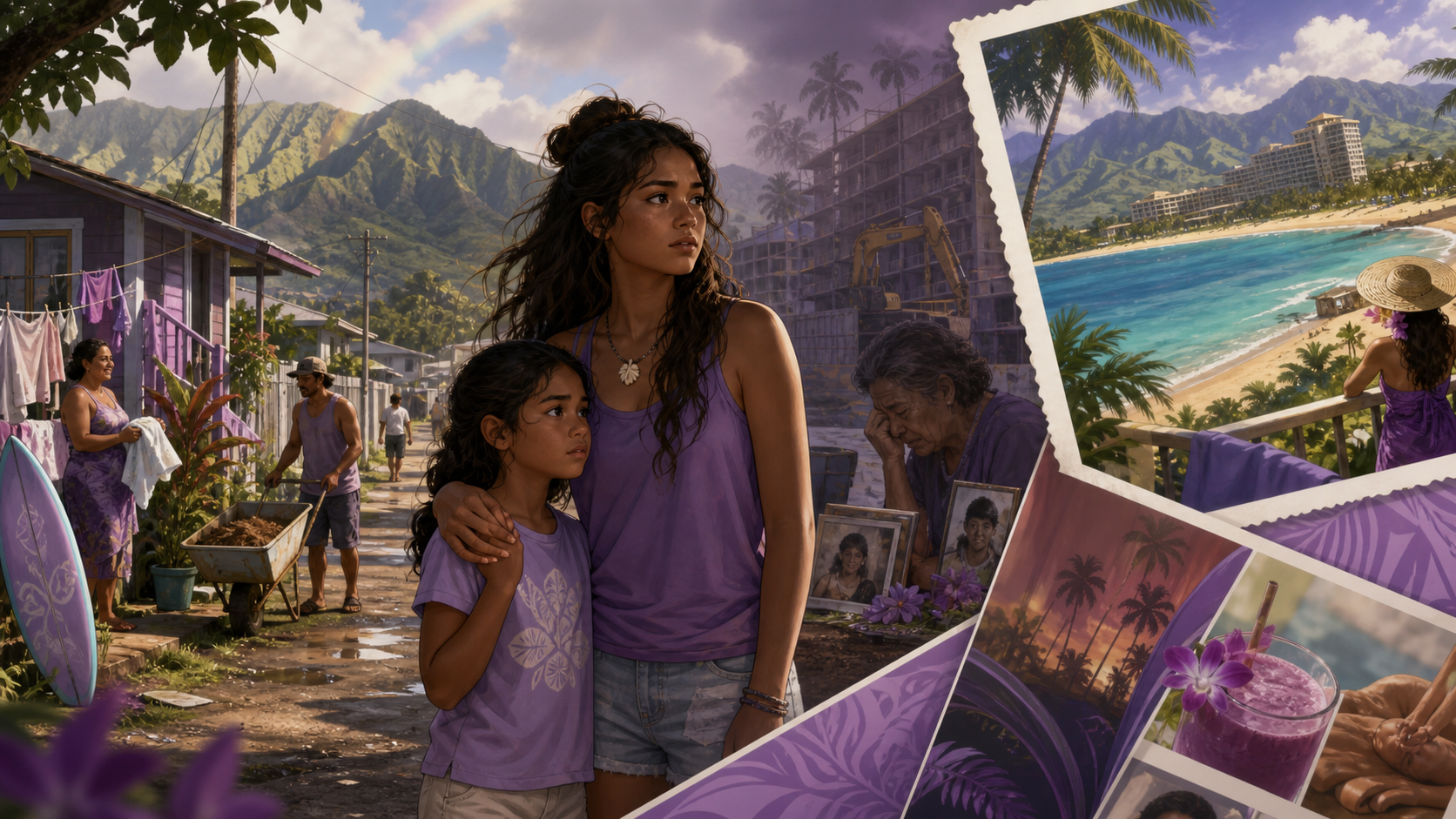
The island is somebody’s home before the camera turns the ocean into somebody else’s escape.
The movie begins where the postcard usually stops
Lilo & Stitch gives us ocean, mountains, hula, bright shirts, and enough blue sky to sell a vacation before the first act settles down. Then the camera keeps moving. We reach a small house with repairs waiting, a young woman worried about employment, a grieving child everybody has labeled difficult, and a social worker whose visits can separate the only family left. Hawaiʻi remains beautiful, but beauty does not cancel rent, labor, loss, or surveillance.
That choice is one reason the original film still hits harder than the franchise merchandise surrounding the little blue alien. The setting creates the family’s material problem instead of serving as a tropical screensaver. Nani works inside an economy shaped by visitors. Lilo watches outsiders purchase an uncomplicated island fantasy while her own household cannot afford uncomplicated anything. The contrast has teeth.
I am tired of paradise requiring invisible residents
A postcard needs clean edges. The resort faces the water, the beach appears empty at the perfect hour, and every local person exists to dance, serve, guide, smile, or authenticate the visitor’s escape. Homes, traffic, schools, water systems, wages, grief, and political history stay outside the frame. Paradise works as a product because residents disappear whenever their needs interrupt the sale.
Lilo refuses to disappear. She takes photographs of tourists because they look strange to her, reversing the usual direction of the tourist gaze. She does not perform gratitude for being observed. Her town contains aunties, workers, children, old cars, small businesses, and ordinary irritation. The island looks back. That reversal is funny, but the joke also breaks the postcard open.
Nani is doing emotional labor before she clocks in
Nani has to translate herself for employers who control access to income. She has to sound cheerful while carrying grief, parenting stress, and the terror of losing Lilo. Tourism-facing work often demands a polished emotional surface because the visitor purchased a feeling along with the service. The employee’s reality becomes a backstage problem that must never disturb somebody else’s vacation.
The film lets that performance fail. Nani gets angry, exhausted, distracted, and desperate. Her failure to maintain pleasantness becomes a threat to employment, then employment instability becomes evidence against her guardianship. A visitor economy does not merely sit behind the plot. The economy tightens the chain around her family every time one bad shift threatens the house.
The state’s own research knows the relationship is complicated
Hawaiʻi’s Department of Business, Economic Development and Tourism has published research describing tourism’s social and cultural impacts, including housing costs, Native Hawaiian concerns, infrastructure pressure, and resident attitudes. A Native Hawaiian advisory report placed tourism inside a longer history of diminished decision-making power rather than treating the industry as a neutral stream of money. The official record already rejects the idea that benefits settle every argument.
More recent destination-management plans talk about resident quality of life, community input, cultural resources, overcrowding, and sites strained by visitor demand. Those goals matter because management language quietly admits the old model produced costs residents were expected to absorb. The conversation has moved beyond counting arrivals. A fandom reading should be able to move beyond pretty scenery too.
Tourism employs people and still deserves scrutiny
The easy version of this rant would declare tourism evil and move on. That would erase workers who depend on the industry, Native Hawaiian businesses operating within the sector, and families whose income comes from lodging, food, transportation, entertainment, retail, and cultural work. State research found tens of thousands of Native Hawaiians employed in tourism-related industries. People cannot critique an economy by pretending workers can abandon paychecks on command.
The harder argument asks who sets the terms, who owns the most profitable assets, who carries environmental and housing costs, and how much power residents have over growth. Employment can be necessary without making every arrangement fair. Nani needing a job does not prove that the job market serves her household well. Necessity often reveals power rather than consent.
The Pelekai house is more political than the resort
The house looks worn because people live there. Doors slam. Repairs wait. Food gets made. Arguments happen in rooms that still carry the memory of the parents. The building holds grief and survival at once. When the story threatens the house, the threat reaches beyond property. Removal would break the family’s relationship to one another, their neighborhood, and the routines that make loss survivable.
A resort room can be reset for the next arrival. A family home accumulates history nobody can reproduce after displacement. That difference matters in a place where housing scarcity, vacation rentals, external demand, and high costs repeatedly enter public policy debates. The house does not need to resemble a postcard. The house needs enough stability for two sisters to remain a family.
The alien invasion is less extractive than the normal economy
Stitch arrives as an actual invader. He crashes into Hawaiʻi, uses Lilo as protection, damages property, and brings armed pursuers into the household. Yet the story gradually makes his extraction visible and negotiable. He must change his relationship to the family. He learns care, accepts boundaries, and chooses belonging. The conflict can name his harm because nobody has normalized alien destruction as economic development.
Tourism enters the background with better manners. Visitors buy experiences, workers perform welcome, and the island supplies scenery. The exchange looks ordinary enough to escape the moral spotlight. That normality should make us more curious, not less. Systems become hardest to question when everybody calls the arrangement inevitable.
Hula is not atmosphere
Lilo’s hula class places cultural practice inside discipline, relationship, memory, and community. The dance is not a random tropical flourish pasted onto an alien comedy. Lilo can struggle socially while still belonging to a practice larger than her current conflict. The film gives hula enough narrative presence to feel lived, though any mainstream studio representation still deserves attention to who shaped the depiction and whose voices received authority.
Tourism imagery often separates cultural expression from people, history, and responsibility. A dance becomes entertainment. A word becomes branding. A flower becomes décor. The viewer receives beauty without obligation. Lilo’s story works best when cultural details remain attached to the child, family, teachers, place, and consequences surrounding them.
The camera can love Hawaiʻi without consuming Hawaiʻi
Landscape photography is not automatically exploitation. Mountains and ocean belong in the visual language because place shapes mood, movement, weather, work, and imagination. The problem begins when the camera presents land as an empty resource waiting for an outsider’s pleasure. Emptiness erases stewardship, history, access, and community before development ever starts.
The original film often frames daily life against beauty rather than removing daily life to preserve beauty. Laundry, roads, shops, and cramped interiors coexist with sweeping skies. That coexistence should become the franchise rule. Hawaiʻi does not need visual ugliness to count as real. Hawaiʻi needs residents to remain central when the view becomes gorgeous.
Lilo photographs the tourists because she owns a point of view
The tourist camera traditionally decides who becomes subject and who remains observer. Lilo disrupts that hierarchy with her own photographs. She studies the people who assume the island exists for their looking. Her images may be playful, but her attention gives her authorship. She makes visitors part of her strange local archive instead of accepting a role inside theirs.
That detail also fits her grief. Photography freezes people, gathers evidence, and builds a private system of meaning. Reducing the hobby to quirky child behavior misses the emotional and political charge. Lilo chooses where the frame goes. A story set in a place endlessly framed by outsiders gives the local child a camera.
Kauaʻi cannot be a generic tropical sticker
The island matters specifically. Distance, scale, roads, employment options, community familiarity, and the relationship between developed visitor areas and residential life shape the story. Calling the setting “Hawaii” without island specificity repeats the flattening the film partly resists. An archipelago becomes one marketable mood while distinct communities and histories blur together.
Franchise expansion should deepen that specificity rather than exporting the family into interchangeable paradise backdrops. Which neighborhood holds the action? What local pressures affect work and housing? Who knows the sisters? What changes when galactic visitors arrive? Specificity produces stronger fantasy because the impossible event collides with a place that already has texture.
Aloha cannot become a customer-service command
Visitors often receive aloha as warmth owed to them. The word becomes a promise that local people will welcome, forgive, explain, and remain pleasant. When a cultural value turns into a service standard, workers carry the burden of performing somebody else’s idea of Hawaiʻi. Nani’s anger then looks like failure rather than a human response to pressure.
Reciprocity changes the picture. A visitor should arrive with obligations to learn, respect limits, support local priorities, and understand that access is not ownership. Hospitality chosen within relationship can be beautiful. Hospitality demanded by an economy becomes emotional extraction with flowers around the edges.
The family is poor in a place sold as abundance
The postcard advertises endless sun, water, food, leisure, and ease. The Pelekai household experiences scarcity. Time is scarce. Money is scarce. Childcare is scarce. Adult support is scarce. Institutional patience is scarce. The contradiction exposes how abundance can exist visually while remaining inaccessible materially to the people living inside the image.
Poverty does not make the sisters less Hawaiian, less loving, or less deserving of place. Yet popular media often treats local hardship as clutter that ruins the destination fantasy. Lilo & Stitch lets hardship stay in frame. The next step is refusing to romanticize struggle as charming authenticity. Nani should not have to be beautifully resilient forever.
Resilience is the compliment people give when support stays missing
Nani is extraordinarily capable. That truth can become another way to abandon her. Every time she survives a crisis, adults gain permission to assume she can survive the next one. Resilience turns from recognition into workload. The family receives applause for holding together while systems continue withholding the conditions that would make survival less dramatic.
Hawaiian communities are often described through resilience after displacement, disaster, economic pressure, or political injury. The word can honor strength. The word can also hide who created the conditions requiring strength. A useful editorial voice praises survival while keeping responsibility visible.
The visitor gets an escape while the worker gets a schedule
Vacation time suspends ordinary obligations for the traveler. Somebody else cooks, cleans, performs, transports, repairs, and answers questions so the visitor can feel free. Workers do not enter the same suspension. Their children still need care. Their housing still costs money. Their grief still arrives during the shift. Paradise for one person can depend on another person making labor disappear.
The film brushes against this asymmetry through Nani’s job search and the tourist-facing businesses around her. I wish later franchise entries had kept pressing. An alien family creates endless opportunities to expose what visitors expect from the island and what residents need in return. Comedy could carry the critique without turning the story into a lecture.
Cobra sees the house but not the whole economy
Cobra evaluates whether Nani can provide a stable home. He looks at the condition of the house, supervision, employment, and immediate danger. Those concerns belong to his job. The assessment becomes incomplete when the economic environment appears as background rather than an active force. A young guardian cannot personally repair a housing market, low wages, childcare scarcity, and visitor-driven employment volatility.
Individual accountability makes sense only beside structural accountability. Nani can improve routines. Employers, agencies, landlords, policymakers, and community institutions also make choices that shape whether the family can succeed. A file focused exclusively on her behavior produces a clean target and a dishonest map.
The franchise should let local characters disagree
No community holds one opinion about tourism, development, culture, policing, or change. Some residents benefit from a project. Some oppose the project. Some need the paycheck and hate the terms. Some want tighter visitor limits. Some own businesses. Some feel excluded from decisions. A credible story leaves room for disagreement without assigning one character to speak for everybody.
Lilo & Stitch often uses the sisters as the emotional truth of Hawaiʻi because the narrative follows them. Expansion should introduce more local perspectives with interiority, not background figures who decorate a moral already decided. Fandom depth grows when community becomes a conversation rather than a symbol.
Galactic tourism would repeat every earthly mistake
Once aliens discover Earth and the experiments, somebody will market the experience. Travelers will want photographs with Stitch, tours of crash sites, themed food, and access to places the family considers private. Investors will promise jobs. Officials will praise visibility. Residents will watch traffic, prices, and surveillance change. The science-fiction premise practically writes the satire.
A strong continuation could ask whether ʻohana becomes a brand. Does Lilo control her own story? Do experiments receive payment for likenesses? Can the family refuse visitors? Does the Federation build infrastructure or simply regulate residents? The future should not repeat extraction on a larger map and call the repetition interplanetary friendship.
My rant is not asking the movie to stop being beautiful
I want the waves, light, music, food, rain, flowers, and impossible color. Beauty is part of lived experience, not property owned by advertising. The demand is that beauty remain connected to people who work, grieve, argue, create, govern, remember, and care for the place. A sunset can hold pleasure and politics at once.
The original film understands this balance more often than many stories set in Hawaiʻi. My frustration grows because later branding can extract the alien, the flower, and the word ʻohana while leaving the social texture behind. The safest merchandise version is also the shallowest interpretation.
A better hub keeps the place attached to every branch
Character profiles should discuss how place shapes Nani, Lilo, David, Cobra, and the experiments rather than treating Hawaiʻi as a line in the setting box. Reviews should examine labor, tourism, family policy, representation, and production choices. Episode reactions should notice when local life becomes active story and when scenery becomes wallpaper. Guides should name island specificity and point readers toward Native Hawaiian sources.
That approach does not turn fandom into homework. Curiosity makes fandom larger. I can laugh at Stitch stealing a bra, cry over the family photograph, obsess over experiment numbers, and still ask who benefits from the paradise image. More attention creates more feeling when the writing stays human.
The vision is resident-first storytelling
Imagine a franchise room where Native Hawaiian writers, cultural practitioners, artists, historians, workers, and local families hold real authority from development through release. Consultation after the plot is locked cannot substitute for authorship. Resident-first storytelling would shape which conflicts appear, which jokes land, which words need context, and which futures feel possible.
The result would not need to agree with my rant. The result would need enough rooted perspective to disagree with complexity. A local character could defend tourism, challenge a development, start a business, resent a visitor, welcome a visitor, or change positions. Authority creates room for contradiction. Token approval creates a checklist.
The journey returns to Lilo looking back
Lilo’s gaze saves the film from becoming another outside fantasy. She sees tourists, classmates, social workers, aliens, and family through a logic nobody else fully controls. Her looking can be funny, abrasive, tender, and wrong. The important part is that she remains a subject making meaning in her own home. Hawaiʻi surrounds her because Hawaiʻi is home, not because the audience ordered a view.
That is the standard I want every branch to carry. Show the beauty. Keep the residents visible. Name the labor. Respect the culture. Let community members possess opinions that do not flatter visitors. Treat ʻohana as relationship and responsibility rather than a souvenir slogan. The postcard can stay on the rack. The story should belong to the people living beyond the frame.
The word ʻohana carries weight because the family can fail
Marketing loves ʻohana because the word offers instant warmth. Printed on merchandise, the idea can become a promise that everybody belongs without requiring anybody to practice difficult responsibility. The film gives the word weight through danger. Nani and Lilo hurt one another. Stitch uses them. Institutions threaten separation. Belonging becomes meaningful because characters must choose repair when escape would be easier.
Removing that struggle turns ʻohana into décor, the linguistic equivalent of a sunset behind a hotel logo. Keeping the struggle visible protects the idea from becoming empty branding. Family includes obligation, boundaries, material care, apology, and the terrifying knowledge that love does not automatically produce stability.
Food reveals who the fantasy expects to serve
Meals and food work carry family intimacy throughout the story. Food also sits at the center of the visitor economy. Restaurants and hospitality businesses translate place into purchasable taste while cooks, servers, cleaners, suppliers, and farmers keep the experience moving. The customer receives authenticity as a plate. Workers experience schedules, wages, tips, heat, and the pressure to remain welcoming.
A richer franchise would follow food in both directions. Who grows ingredients? Who owns the restaurant? Which dishes belong to family memory, and which were modified for visitor expectation? Who eats after the shift? Tiny details could connect Nani’s job search to a whole system without sacrificing pace or humor.
The beach is public life, not an unlimited backdrop
Beach scenes can suggest freedom because access appears open and costless. Real access depends on transportation, parking, shoreline policy, safety, time away from work, environmental protection, and whether visitor crowds make residents feel pushed from familiar places. State destination plans now identify overcrowding and overtaxed sites as management problems. The language sounds technical because the lived conflict has already become ordinary.
Lilo’s beach belongs to play, grief, rescue, experimentation, and family memory. Visitors can share beauty without treating every location as a personal set. A story attentive to place would show etiquette and limits as part of belonging rather than presenting boundaries as hostility toward outsiders.
Merchandise can detach Stitch from every reason we love him
Stitch travels easily as a global character because his face survives without context. A plush toy does not need Kauaʻi, Nani’s labor, Lilo’s grief, or the family photograph. The design remains cute after the social world disappears. Commercial success therefore rewards the franchise for extracting the alien from the story’s most grounded relationships.
Fans can enjoy merchandise without pretending the process is neutral. The question is what returns when new stories get made. If Hawaiʻi supplies colors and words while corporate storytelling centers portable cuteness, the franchise keeps the postcard and discards the home. I want every Stitch product to lead somebody back toward Lilo, Nani, and the place that taught him family.
Live action makes the gaze problem sharper
A live-action adaptation photographs actual land, actual communities, and performers whose bodies carry representation differently from drawings. Production choices affect local economies and public access. Casting choices shape which faces become globally associated with Hawaiʻi. Marketing can intensify visitor desire. The claim that a remake merely updates a beloved story becomes too small for the footprint involved.
The adaptation should therefore expand local authority rather than using realism as a visual upgrade. More photographic detail does not guarantee more truth. A flawless resort image can feel less honest than an animated kitchen full of damage, noise, and love. Truth depends on perspective, power, and what the frame refuses to erase.
Fandom has responsibilities without becoming a courtroom
Fans do not need perfect vocabulary or expert credentials before discussing place. We do need humility about what we know, curiosity about Native Hawaiian perspectives, and the discipline to avoid treating one film as cultural education. Enjoyment can open a door. Enjoyment cannot appoint us spokespersons. The safest habit is listening beyond the studio and linking readers toward people whose communities carry the history.
That practice makes conversation more interesting. We can compare versions, notice omissions, question marketing, support local creators, and still scream when Stitch causes chaos. Editorial fandom should increase the number of voices in the room. The real goal is not polished moral purity. The goal is a bigger, messier, more honest love for the work and the place the work uses.
Sources and further reading
For the public-policy context behind this editorial, see the State of Hawaiʻi Sustainable Tourism Project, the state report on Native Hawaiians in the tourism sector, and the Hawaiʻi Tourism Authority overview of Destination Management Action Plans. These sources inform the context. The interpretation and opinions are RaeRae’s.
The franchise works when Hawaiʻi remains a place with memory
The first film allows ordinary material pressure to shape the emotional world. Nani’s job search, transportation problems, housing damage, tourist labor, social-service visits, and responsibility for a grieving child exist beside aliens without becoming less important. Hawaiʻi is not only a beautiful location surrounding a universal family story. The island economy determines what choices the sisters can realistically make, which adults hold power over them, and why one bad afternoon can threaten the household.
That specificity is why postcard treatment feels so insulting. A postcard keeps ocean, color, music, and recognizable scenery while removing cost, history, sovereignty, labor, and the people whose lives make the place more than an image. Lilo takes photographs of tourists because she is looking back at the industry that turns her home into somebody else’s consumable memory. The joke contains an entire argument about who is permitted to observe whom.
Later installments become weaker whenever Hawaiʻi functions mainly as a launchpad for experiment adventures. The series can remain playful and still let schools, neighborhoods, local businesses, relatives, land, language, and community obligations affect the plots. An experiment finding one true place should mean more than matching a power to a convenient job. Placement should ask who benefits, what relationship is formed, and whether the island is being asked to absorb another problem created somewhere else.
Respect also requires naming what the franchise cannot represent completely. One Native Hawaiian child cannot stand in for every community, and Disney’s version of local life remains filtered through a mainland corporation. The answer is not to remove specificity in the name of universality. The answer is more local voices, more disagreement, more ordinary texture, and enough humility to distinguish affection for Hawaiʻi from authority over Hawaiian history.
The live-action conversation makes this standard even more important. A production can photograph real coastlines, hire local workers, include Hawaiian music, and still treat the islands as visual proof of authenticity rather than a political and cultural home. Presence is not the same as perspective. The question is who receives interiority, whose knowledge shapes the script, where money and credit travel, and whether Hawaiʻi remains recognizable after the camera collects the beauty. Lilo’s story should keep the mess that makes the place lived in: traffic, tourists, family networks, local arguments, work schedules, weather, grief, humor, and children who are not performing welcome for visitors. The island looks back because people live there. Any version that forgets that gaze has returned to the postcard.
The difference lives in small choices: whether local characters have problems unrelated to visitors, whether language appears beyond decoration, whether land is treated as relationship rather than backdrop, and whether humor travels in more than one direction. A place becomes a character only when the story lets that place refuse the camera’s easiest fantasy.
Hawaiʻi is home before the franchise arrives and remains home after the credits leave.
Keep exploring
Return to the Lilo & Stitch hub for the films, series, characters, reactions, and guides.
My irritation survives because the franchise knows abandonment wounds these characters and still treats repeated separation as convenient plot fuel. Consequences do not need to disappear, but care should produce better systems, clearer communication, and fewer tests disguised as love.