CVM SEKAI MEMBER FILE · TWS
Hanjin (TWS)
Hanjin is a distinct visual and vocal presence shaped by cross-language work. TWS sells the feeling of a friend arriving at the right moment, but that promise only works when six members remain recognizable inside the group polish. This profile follows what Hanjin actually contributes, what official sources confirm and where the performance story still has room to grow.

Profile
Stage name: HANJIN
Born: January 5, 2006
Group: TWS
Company: PLEDIS Entertainment
Debut: January 22, 2024 with Sparkling Blue
Official role: Member; PLEDIS does not publish a longer fixed-position label for him.
Fandom: 42
The short version
Hanjin moved into a Korean training environment and had to build communication while also learning choreography, recording habits and team rhythm. He has described first meeting Dohoon and Kyungmin, then slowly reading each member’s character.
His early use of very formal Korean makes a funny anecdote, but the deeper point is labor. Language learning happens in public, and idol schedules rarely pause until confidence catches up.
Hanjin has said he wants to keep evolving and send good energy to music listeners around the world. That goal is broad; his actual progress makes it concrete. Watch how much more relaxed his timing and expressions become from Sparkling Blue forward.
Before the public knew the name
TWS entered public view carrying the pressure attached to PLEDIS’s first boy-group launch after SEVENTEEN in about nine years. That comparison guaranteed attention and created an impossible shortcut: six rookies were asked to inherit expectations built by another team over a decade.
The useful question was never whether Hanjin could imitate a senior member. It was whether he could become legible inside a new six-person system while cameras arrived before the system had years to settle.
The debut assignment
Sparkling Blue asked every member to sell nervous youth without making the performance look under-rehearsed. That is harder than it sounds. “Plot Twist” needs exact timing, quick travel and an expression that suggests surprise even after the hundredth rehearsal.
Hanjin contributes by keeping the performance human inside the count. The concept collapses if everybody looks like a cheerful metronome.
What “Plot Twist” reveals
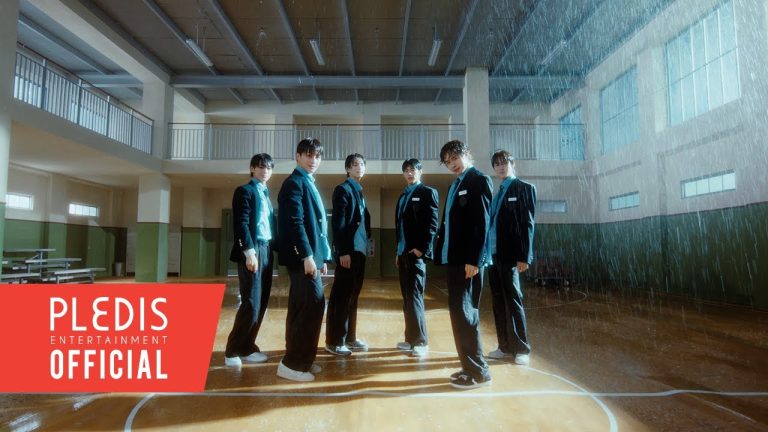
The main MV treats a first meeting as a chain of failed plans, while the performance version reveals how carefully the apparent chaos is built. Watch Hanjin during the handoffs, not only during the centered seconds.
Idol profiles often reduce contribution to center time. The more honest evidence lives at the edge of a formation: whether focus remains active, whether a pathway stays clean and whether the next member receives energy instead of starting from zero.
Voice and musical function
His early use of very formal Korean makes a funny anecdote, but the deeper point is labor. Language learning happens in public, and idol schedules rarely pause until confidence catches up.
TWS arrangements frequently run bright and busy. A useful voice does more than sound pleasant in isolation. It must clarify a phrase, change the temperature or make the next handoff feel inevitable.
Movement and camera sense
Hanjin has said he wants to keep evolving and send good energy to music listeners around the world. That goal is broad; his actual progress makes it concrete. Watch how much more relaxed his timing and expressions become from Sparkling Blue forward.
Camera sense is not permanent eye contact. It is knowing when the story needs direct address, when a reaction should stay with another member and when a small change of weight will read better than a face full of effort.
SUMMER BEAT! widens the weather
The second mini album moved the group from first-day nerves into summer friendship and flirtation. “If I’m S, Can You Be My N?” used personality-type language as a social shortcut, while “hey! hey!” favored open motion.
Hanjin had to preserve the group identity without repeating the same school-day performance. The shift is subtle, which makes it a useful test of adaptability.
Last Bell and emotional timing
The November 2024 single era introduced the feeling of a chapter closing. “Last Festival” needs restraint because farewell songs become sticky when every line arrives already crying.
Hanjin helps the group hold sentiment inside rhythm. The emotion has somewhere to land because the performance does not beg for it in advance.
TRY WITH US and the age threshold
The third mini album in April 2025 made approaching adulthood part of the text. “Countdown!” frames growth as movement rather than a completed personality transplant.
That is an honest lane for Hanjin. Debut did not freeze him at one skill level or public character. The interesting material is the visible adjustment from release to release.
Japan and live repetition
A Japanese debut and first tour in 2025 added another language, audience rhythm and live schedule. Touring exposes habits that edited music videos can hide: breath recovery, concentration, consistency and how members rescue one another when a moment shifts.
For Hanjin, international work also means making personality readable across translation. Performance becomes part of the sentence when the interview answer cannot carry everything.
play hard changes the silhouette
The fourth mini album pushed beyond the soft school-uniform image. “Head Shoulders Knees Toes” demanded heavier attack and a less innocent physical line.
The point was not to prove Hanjin had become tough overnight. The useful growth is control over another shade while keeping the person underneath recognizable. Costume change is easy; performance range has to be earned.
NO TRAGEDY and active romance
By April 2026, TWS framed romance as a choice strong enough to reject a scripted tragic ending. “You, You” and the fifth mini album replace passive fate with movement.
Hanjin now performs that larger declaration with two years of group history behind him. Confidence reads differently when the audience has seen the first-meeting nerves that came before it.
Positions and the label problem
Only Shinyu’s leadership is consistently treated as a formal group role in primary material. Lists that declare every member a fixed main, lead or sub position often repeat fan-made databases as if PLEDIS filed the paperwork.
This page describes what Hanjin does on record and on camera without turning observation into an official title. Evidence can stay useful without pretending certainty.
Chemistry is work
TWS’s friendship concept depends on reactions, timing and trust between members. Chemistry may feel spontaneous to viewers, but schedules, shared rooms, practice and conflict repair sit behind the easy-looking exchange.
Hanjin is most revealing when another member holds the center and he still participates in the moment. A group concept survives through response, not six isolated highlight reels.
How to watch Hanjin
Start with both exact “Plot Twist” uploads. Use the main MV for character and narrative framing, then the performance version for pathways, transitions and group spacing. Continue chronologically through “If I’m S, Can You Be My N?,” “Last Festival,” “Countdown!,” “Head Shoulders Knees Toes” and “You, You.”
Do not decide the entire profile from one viral clip. Compare the same performer across different tempos, concepts and years. Growth becomes visible only when the archive keeps its dates straight.
What I want next
I want more credited creative fingerprints, whether that means lyrics, arrangement conversation, choreography input or a clearly documented performance choice. Idol development becomes more interesting when the member can explain why a detail exists.
For Hanjin, the next step is specificity. Skill attracts attention; a choice nobody else would make creates identity.
Fandom without the fog
42 is the official fandom name and a numeric mirror of 24, linking the audience to TWS’s time-based name. The word also sounds like the Korean term for the space or relationship between people.
Support does not require inventing facts, fixed positions or private personality diagnoses. Follow official work, notice change and let Hanjin remain more complicated than a reaction GIF.
The person versus the assigned character
A profile becomes useless when it repeats one early anecdote until the member can no longer move. Hanjin may have a recognizable public tendency, but edited content selects moments and promotional concepts reward consistency.
Watch for change instead of policing a persona. The artist seen in 2026 has completed recording cycles, tours and thousands of hours of shared work that the debut introduction could not predict.
Bright music requires force
Listeners sometimes mistake brightness for ease. Fast melodic music exposes pitch, breath and timing, while cheerful performance must stay energized without turning the face into a fixed grin.
For Hanjin, the assignment is technical and emotional at once. The body must hit the phrase while the expression keeps the invitation open. That labor deserves more respect than “naturally refreshing.”
The edge of the formation
Centered shots are designed to be noticed. The better test comes after the camera leaves. Hanjin still has to maintain spacing, react to the active member and prepare the next transition without visually switching off.
Performance versions make that work visible. They are not cheaper copies of the main MV; they are documents of how six people distribute attention.
Recording growth is harder to see
Studio vocals arrive edited, layered and balanced, so confident claims about raw ability should be made carefully. What the records can show is how producers place Hanjin, what color they repeatedly trust and whether the range of assignments expands.
Compare eras rather than isolated seconds. A new harmony, lower phrase, rhythmic passage or sustained line can reveal development without pretending the released master is an untouched audition tape.
Variety content and the personality trap
Official group shows help viewers learn timing, humor and relationships, but they remain produced work. A funny reaction can be genuine and still be selected because it fits an episode.
Enjoy Hanjin without converting entertainment into a diagnosis. The public record supports observations about communication and chemistry, not certainty about every private feeling.
Age is context, not the whole headline
The official birth date establishes where Hanjin stood during each release, which matters when the catalog talks so directly about youth and adulthood. It does not make age a substitute for contribution.
Coverage should neither age him up to excuse adult expectations nor reduce him to a child after he demonstrates professional responsibility. Both moves erase the actual worker.
The SEVENTEEN comparison has limits
Sharing PLEDIS makes senior-group comparison unavoidable, and SEVENTEEN offers a powerful example of team identity, performance craft and growing authorship. It does not provide a checklist TWS must photocopy.
The best lesson for Hanjin is not imitation. It is that a long career becomes distinctive when members accumulate documented choices and a catalog starts sounding like the people who made it.
A profile should admit uncertainty
Primary sources confirm the lineup, birth date, debut, releases and Shinyu’s leadership. They do not confirm every position label, childhood rumor, favorite item or personality code repeated by profile sites.
Leaving an unverified field out is better journalism than filling every blank. This page can be expanded when Hanjin or PLEDIS supplies stronger evidence.
The archive needs exact dates
React posts on CVM Sekai publish one to three days after the exact video release. That keeps new work in the correct historical order and prevents a 2026 repair from pretending it appeared beside a 2024 debut.
The same discipline helps this profile. A changed opinion can sit beside the record of what viewers actually saw at the time, instead of silently rewriting history.
RaeRae’s read on Hanjin
Hanjin moved into a Korean training environment and had to build communication while also learning choreography, recording habits and team rhythm. He has described first meeting Dohoon and Kyungmin, then slowly reading each member’s character.
Hanjin has said he wants to keep evolving and send good energy to music listeners around the world. That goal is broad; his actual progress makes it concrete. Watch how much more relaxed his timing and expressions become from Sparkling Blue forward.
Release files prevent lazy memory
A title, upload date, runtime, label trail and exact player may look like the boring part of music coverage. They are the part that stops one performance version from swallowing another and keeps a repair date from corrupting chronology.
When Hanjin appears in multiple cuts of the same song, each cut can reveal different evidence. Accurate filing makes deeper criticism possible.
Images are records too
This profile uses a unique real official PLEDIS portrait stored inside the WordPress media library with source attribution, descriptive alt text and matching social metadata. It is not hotlinked and it is not reused as another member’s identity card.
That work matters because six generic group thumbnails would technically contain Hanjin while still failing to show readers whom the profile is about.
The solo question can wait
Being visible inside a group does not require rushing every member toward an independent debut. Solo work becomes useful when there is a musical point of view, a song suited to the voice and enough time to support it properly.
For now, Hanjin has meaningful room to develop through TWS recordings, special stages, covers and documented creative participation. A release calendar should follow readiness, not fan-profile symmetry.
Public confidence is learned
The gap between rehearsal-room competence and relaxed public presence can take years. Interviews, livestreams, fan meetings and tours ask different forms of attention from a performer who may still be deciding what deserves privacy.
Watch Hanjin become more direct without demanding constant access. Confidence grows better when an audience leaves room for mistakes, pauses and changed answers.
What this profile will update next
New TWS music should add exact official-video Reacts, source-dated tracker entries and any documented change in credits or responsibilities. A relevant individual cover, OST or solo release should receive its own React and update this same page rather than spawning a duplicate artist identity.
The goal is continuity. Hanjin should have one current profile that accumulates evidence, images and links in a readable order.
Keep the criticism proportional
A young performer can give a weak stage, receive an unsuitable part or still need technical growth without becoming talentless. The opposite is also true: one excellent clip does not prove permanent mastery. Context matters, and repeated evidence across different songs, stages, years and working conditions matters much more.
This profile will praise what Hanjin lands, name what needs work and compare like with like. Fair criticism is specific enough that the artist could understand the evidence instead of receiving a vague verdict about personal worth.
Official links
PLEDIS official TWS profile · TWS YouTube · TWS Weverse · CVM Sekai TWS group hub
YouTube tracking history
Plot Twist main official MV React · Plot Twist official performance-version React. These are separate uploads with separate camera arguments.
Sources
- PLEDIS — current member lineup, birth date and official portrait
- PLEDIS — official TWS discography through 2026
- Billboard Korea — member interview and 2025 growth reflections
- Weverse Magazine — Hanjin’s debut interview and group first-meeting account
Plot Twist main official MV — 2024
Read the exact main-MV React · Watch the official uploadDaily+11.1KTotal views48.6M. The narrative debut film turns a failed first-meeting plan into forward motion.
Plot Twist official performance version — 2024
Read the exact performance-version React · Watch the official uploadDaily+3.5KTotal views10.1M. The choreography cut exposes the formation traffic and rehearsal underneath debut-day spontaneity.
Bottom line
Hanjin matters to TWS because a distinct visual and vocal presence shaped by cross-language work. The profile will stay alive by tracking evidence, not by gluing a fan-made position label onto a performer who is still changing.