
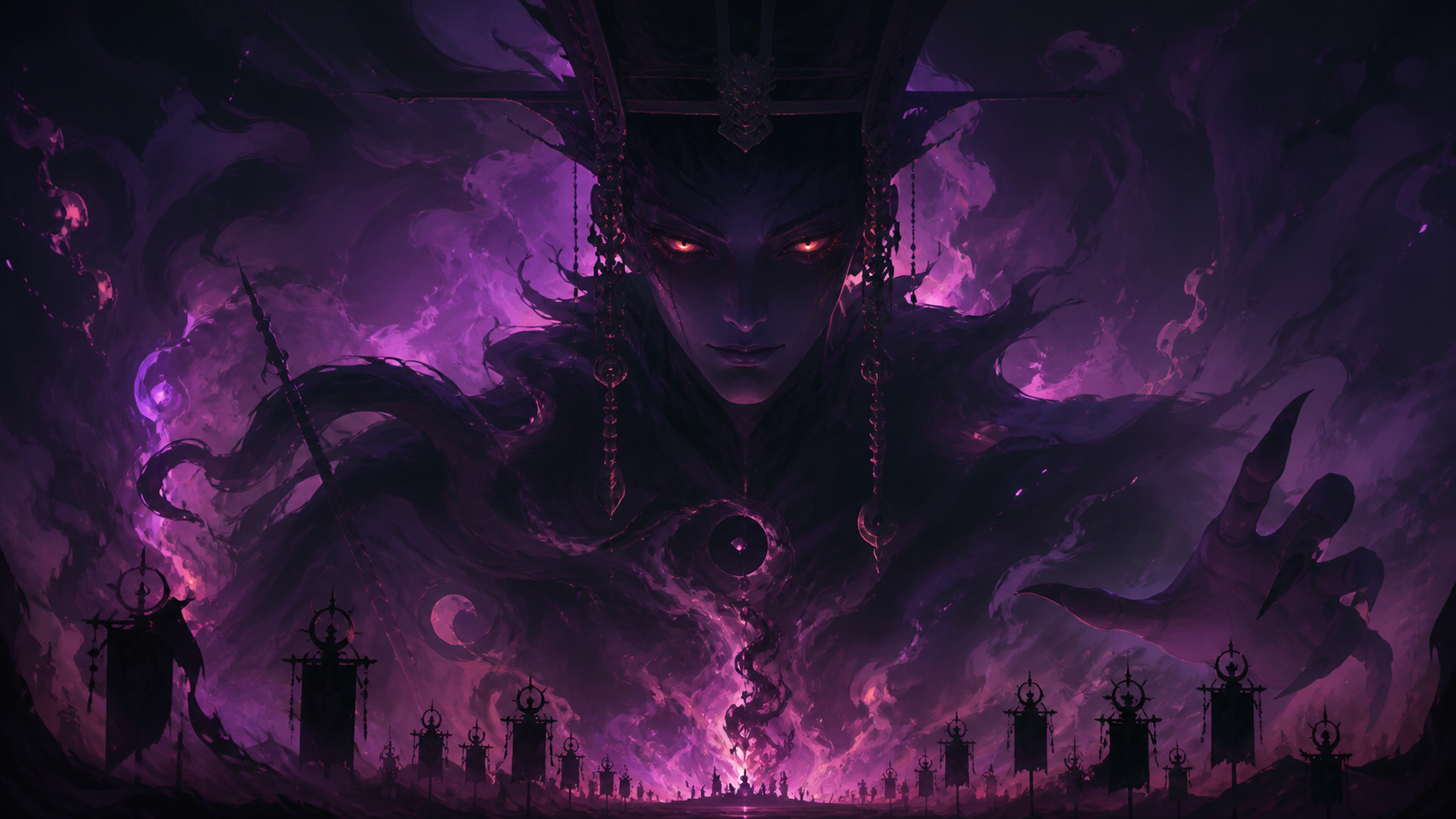
Gwi-Ma in KPop Demon Hunters
| Character file | Verified details |
|---|---|
| Name | Gwi-Ma |
| Role | Demon overlord and primary antagonist |
| Voice actor | Byung Hun Lee |
| Goal | Break through to the human realm and take the world |
| Human-world agent | Jinu |
| Method | Exploits shame, misery, insecurity, and desire through manipulation |
| Physical presentation | Massive fangs and lips suspended in shadow before his full emergence |
| Source of power | Souls drawn through demonic influence and the Saja Boys' fandom trap |
| Central relationship | Owns Jinu's soul and uses him as a Trojan horse |
| Story function | Turns private shame and mass attention into systems of control |
Gwi-Ma does not need to invent your worst thought. He waits until you have repeated it enough times to yourself, then offers to make the pain useful. That is why the enormous mouth works. He is appetite, voice, promise, and threat before he is allowed the dignity of a complete body. He speaks. Other people carry the consequences into the world for him.
Netflix calls him a master manipulator who exploits weakness. The film makes the word weakness more complicated than cowardice. Jinu's poverty, love for family, ambition, guilt, and shame all become openings. Rumi's fear of her demon heritage becomes another. Gwi-Ma targets wounds that already contain something human and twists them toward isolation.
Byung Hun Lee voices the villain with enough restraint to make listening feel dangerous. Gwi-Ma can roar, but raw volume is not his sharpest weapon. He is most frightening when he sounds as though surrender is simply the logical conclusion of what his victim already believes.
Gwi-Ma begins as a mouth because consumption is his character
The official cast guide describes Gwi-Ma as massive fangs and lips hovering in shadow after years cut off from the human realm. The design withholds eyes, hands, and ordinary expression. Viewers meet an appetite that can speak.
A mouth consumes, commands, bargains, and names. Gwi-Ma performs all four functions. He devours souls, issues orders, makes deals, and tells vulnerable people what their pain means. His body is reduced to the organ most useful for domination.
The image also makes his followers look small. Jinu stands before a presence without a face he can read. There is no mutual recognition in the arrangement. One party speaks from darkness. The other must make himself useful.
Being cut off has not made him powerless
The Honmoon prevents Gwi-Ma from entering the human realm directly, but the barrier does not end his influence. He works through souls, servants, shame, music, and attention. Physical exclusion changes his method rather than eliminating the threat.
That distinction matters to the film's mythology. A wall can prevent one kind of invasion while leaving emotional and cultural channels exposed. The hunters are prepared to fight bodies. Gwi-Ma learns to weaponize desire at scale.
His patience becomes part of the danger. He can spend centuries controlling Jinu and waiting for a plan capable of reaching around the barrier.
Jinu is not his partner
Gwi-Ma owns Jinu's soul. Netflix describes Jinu as a Trojan horse in the human world, not an equal strategist entering a fair alliance. Their conversations may contain negotiation, but the power beneath them is coercive.
Jinu proposes the Saja Boys plan because he hopes Gwi-Ma will erase the memories that torment him. Even the desired payment demonstrates captivity. He does not ask for freedom to live with what happened. He asks his owner to remove the part of him still capable of feeling it.
Gwi-Ma preserves that shame because it keeps Jinu manageable. A healed servant might question the arrangement. A servant convinced he is beyond forgiveness will accept exploitation as deserved.
The original bargain targets poverty through love
Netflix's official food guide recounts Gwi-Ma's approach to Jinu when the young musician cannot provide for his mother and sister. The demon tells him he is not good enough for them and offers help becoming good enough. That wording is cruelly precise.
Gwi-Ma does not say Jinu lacks food. He turns material deprivation into personal failure. Poverty becomes evidence of unworthiness, and help becomes a test of love. Refusing the bargain can then feel like choosing to let family suffer.
The manipulation succeeds because Jinu wants to care for other people. Gwi-Ma takes a moral desire and redirects it through shame. The villain does not prove compassion is weak. He proves compassion without power can be exploited by someone offering a shortcut.
Fame is bait because it can impersonate security
Jinu accepts musical talent and access to wealth. Fame appears to solve the immediate humiliation of poverty. It supplies food, status, and the visible proof that he has escaped powerlessness.
Gwi-Ma understands that success can become its own trap. Once Jinu reaches comfort, guilt over the family left behind grows more painful. The bargain does not remove shame. It changes the evidence shame uses.
The demon can then whisper that memory itself is the problem. He offers another false solution to pain created by the first solution, keeping Jinu dependent on the person who engineered the wound.
Shame is Gwi-Ma's real leash
Jinu explains that demons feel shame and misery and that Gwi-Ma controls them through those feelings. The line gives the villain's power an emotional mechanism. Chains are not only external. Victims participate in confinement by believing the worst interpretation of themselves.
Shame narrows possibility. If Jinu believes one selfish decision defines his entire soul, resistance can look hypocritical. If Rumi believes demon heritage makes her dangerous, concealment can look like the only way to keep love.
Gwi-Ma wins when a person mistakes a feeling for a final verdict. His power depends on keeping shame unquestioned and private.
Misery becomes renewable energy
The villain does not merely enjoy suffering. He organizes it. Each controlled soul carries pain that can be activated, redirected, and used to produce more souls. Jinu recruits the Saja Boys. The Saja Boys capture attention. Their performance prepares fans for Gwi-Ma to feed.
This structure makes misery renewable. A wounded person helps build the system that wounds others. The new victims expand the power available to the original manipulator.
The film's emotional victory must therefore interrupt more than one villain. Rumi and Jinu have to reject the private beliefs that make Gwi-Ma's system feel inevitable.
The Saja Boys turn fandom into an extraction machine
The soundtrack guide explains that “Your Idol” sets fans up for Gwi-Ma to feast. The performance uses music, black hats, choreography, and paranormal spectacle to transform devotion into access.
Fans believe they are participating in pop culture. The demon system treats their attention as harvestable energy. Affection is separated from consent and redirected toward consumption.
Gwi-Ma's plan is effective because fandom already involves repetition, identification, competition, and collective feeling. He does not create those behaviors. He removes the relationship and leaves only extraction.
“Your Idol” states his theology plainly
The performance invites fans to surrender through the language of devotion. An idol becomes an object of worship, but the song strips metaphor from the term. Gwi-Ma wants attention that does not question where it goes.
The black-hat visual language turns polished stagecraft into ritual. Beauty and threat remain fused. The audience's delight helps produce the conditions for its own capture.
Gwi-Ma does not hate music. He understands its power well enough to counterfeit communion. His version moves feeling upward toward a devouring authority rather than outward among people.
HUNTR/X and the Saja Boys offer opposite relationships to an audience
HUNTR/X uses music to protect fans and strengthen the Honmoon. The Saja Boys use music to collect fans for Gwi-Ma. Both groups work through mass attention, but the moral direction differs.
Protection can still become paternalistic when hunters hide every truth and decide what humanity is allowed to know. Extraction is clearer. Gwi-Ma sees listeners as fuel.
The finale replaces both distance and consumption with a more reciprocal power. HUNTR/X sings honestly, the audience responds, and connection forms without requiring perfect idols or passive worshipers.
Rumi is dangerous to him because she makes categories unstable
Rumi carries demon heritage and still protects humanity. Her existence contradicts any system that treats demon identity as automatic moral corruption. That matters to Gwi-Ma because rigid categories help shame do its work.
If demon blood does not determine allegiance, Rumi can stop interpreting her marks as proof that she belongs to him. If a demon can choose differently, Jinu can imagine resistance.
Gwi-Ma needs identity to feel like destiny. His control weakens when characters judge themselves and each other by choices rather than origin.
He does not create Rumi's shame alone
Celine and the hunter tradition teach Rumi to hide her demon marks and imagine the Golden Honmoon as a route to removing them. Gwi-Ma exploits a wound created partly by the people trying to protect her.
That is one of the film's strongest moral decisions. Evil does not operate in a vacuum. A controlling villain benefits when families and institutions make certain truths unspeakable.
Celine is not equivalent to Gwi-Ma. Her intention is love and safety. The impact of secrecy still prepares emotional ground he can use.
The villain's voice enters where conversation has been denied
Rumi cannot speak honestly to Celine, Mira, Zoey, or Bobby about the whole crisis. Jinu has spent centuries trapped inside a private account of his failure. Isolation creates silence around both characters.
Gwi-Ma fills silence with interpretation. He tells victims what their pain proves and what surrender will fix. His certainty becomes seductive because nobody else has been allowed into the conversation.
The defense is not merely stronger willpower. It is relationship capable of surviving difficult truth.
Memory erasure is not mercy
Jinu seeks the removal of memories connected to his family and betrayal. Gwi-Ma treats forgetting as a possible reward for service. The offer frames conscience as a technical malfunction.
Erasing memory would reduce pain, but it would also remove the evidence through which Jinu can understand harm and choose repair. Gwi-Ma wants relief that destroys moral agency.
The villain's promise resembles compassion because he acknowledges suffering. It is control because he offers only the solution that makes the victim easier to own.
Gwi-Ma weaponizes the language of inadequacy
“Not good enough” is one of his most efficient ideas. It can attach itself to family, talent, identity, appearance, or loyalty. The phrase never needs a stable definition because the victim supplies new evidence.
Jinu is not good enough to provide. Rumi fears she is not pure enough to lead. Fans can be encouraged to prove devotion through more attention. Each person runs toward a finish line controlled by someone who benefits when it moves.
Gwi-Ma does not need every target to believe the same lie. He needs each target to believe worth can be granted by surrender.
Byung Hun Lee makes manipulation sound patient
Byung Hun Lee gives Gwi-Ma weight without relying only on shouting. The voice can sound ancient, amused, and certain that resistance will eventually exhaust itself.
Patience makes the villain larger than the immediate plot. He has controlled Jinu across centuries and has survived exclusion behind the Honmoon. A temporary setback does not feel capable of changing his appetite.
The performance also distinguishes him from the Saja Boys' polished appeal. They seduce through pop intimacy. Gwi-Ma speaks from distance as the authority receiving what their intimacy captures.
The incomplete body keeps him outside ordinary empathy
Faces invite interpretation. Eyes can reveal uncertainty. Hands can perform care or vulnerability. Gwi-Ma's early design withholds those points of connection and gives viewers the mouth that consumes. He appears less like a person than a force organized around appetite.
That abstraction suits the first half because the characters also experience him through systems. Jinu receives commands. Demons receive shame. Humans feel the pressure of a barrier holding something back. Nobody meets him on equal ground.
When he emerges more fully, the escalation is not simply bigger animation. Appetite has acquired access to the world it has been feeding upon from a distance.
His size is the result of accumulated surrender
Gwi-Ma's overwhelming scale makes him appear naturally powerful, but the plot reveals that his power is social and extractive. Souls, servants, and surrendered attention feed the presence that later seems inevitable.
This matters because enormous authority often hides its sources. A system presents itself as too large to resist after gathering strength from countless individual concessions.
The finale reverses the process. Jinu reclaims his soul through choice. Rumi refuses shame. Mira and Zoey return to relationship. Fans respond to honest music. Gwi-Ma becomes smaller when the people sustaining his logic stop participating in it.
Jinu's sacrifice is a direct rejection of ownership
Jinu tells Rumi she gave him his soul back before giving it to her. The line denies Gwi-Ma's central claim. A soul cannot remain property when the person exercises moral agency through sacrifice.
The act does not erase Jinu's earlier harm. It proves harm did not eliminate his capacity to choose. That distinction is fatal to a villain who controls through the belief that shame defines destiny.
Gwi-Ma loses more than a useful servant. He loses evidence for his worldview. The owned demon becomes a person capable of giving what the owner claimed to possess.
The final battle is fought over interpretation
Weapons and supernatural force matter, but the decisive struggle concerns what Rumi's demon identity means. Gwi-Ma needs it to mean corruption, isolation, and eventual belonging to him. Celine's doctrine has unintentionally supported part of that interpretation.
Rumi answers through song and relationship. Her marks remain part of her while her choices remain her own. Mira and Zoey do not defeat the revelation by pretending it never happened. They return after confronting the fear it caused.
The transformed Honmoon emerges from a new interpretation of protection. Difference no longer has to be erased before connection becomes powerful.
Gwi-Ma mistakes pain for proof of belonging
He treats shame and misery as evidence that demons belong under his control. If someone hurts in the way his realm recognizes, he claims the hurt confirms identity and allegiance.
The logic is abusive because it makes suffering self-validating. Pain caused by control becomes proof that control is natural. Attempts to escape can produce more fear, which the controller then cites as another reason escape is impossible.
Jinu and Rumi break that loop by allowing pain to inform choice without allowing it to dictate ownership.
He offers certainty when complexity feels unbearable
Rumi is both human and demon. Jinu is both perpetrator and victim. Celine is both loving and harmful. The film's emotional world refuses clean categories.
Gwi-Ma offers relief from complexity. Demons are his. Shame is destiny. Memory is a burden he can erase. Power can fix inadequacy. These answers are terrible, but they are simple.
The heroes win by accepting harder truths. Identity can be mixed. Accountability can coexist with compassion. Protection can require changing tradition rather than perfecting it.
His plan uses the entertainment industry's existing machinery
The Saja Boys do not need to build an audience system from nothing. They enter charts, broadcasts, challenges, awards, performances, and fandom competition already designed to amplify attention.
Gwi-Ma's supernatural scheme plugs into that machinery. He treats visibility as access and popularity as a collection route. The speed of the group's rise matters because industry systems reward momentum before anyone asks what the momentum serves.
The critique is not that fandom itself is demonic. It is that a system measuring love only through scalable attention can be hijacked by anyone willing to treat people as units.
The Pride is a fandom name with predatory architecture behind it
The Saja Boys' fandom becomes known as the Pride. On the public surface, the name offers belonging and shared identity. Under Gwi-Ma's plan, that collective bond channels fans toward consumption.
The double meaning is effective because fandom names can feel like invitations into family. Gwi-Ma empties the family promise and keeps the access.
His scheme asks what happens when community language is controlled by an authority that never intends reciprocity. Fans believe they are gathering around artists. The hidden beneficiary is waiting behind them.
He reduces every relationship to leverage
Jinu's love for family becomes leverage. Rumi's fear becomes leverage. The Saja Boys' personas become leverage against fans. Even rivalry becomes a tool for pushing HUNTR/X toward desperation.
Gwi-Ma cannot understand relationship as an end. Every bond is a route to control somebody else. Affection matters only because it identifies where pressure will hurt.
That is why the finale's freely chosen solidarity defeats him. Mira and Zoey return to Rumi without a bargain. Jinu sacrifices without expecting reward. Connection stops being exchangeable currency.
He is not defeated by purity
The old hunter plan aimed toward a Golden Honmoon that would seal demons away. Rumi initially connects that completion with removing her demon marks. Victory appears to require purification.
The actual ending rejects that condition. Rumi does not become fully human before she can defeat Gwi-Ma. She integrates truth, voice, and relationship while remaining herself.
This is the correct defeat for a villain who turns shame into control. Purity would confirm his claim that demon identity makes Rumi unacceptable. Acceptance removes the leverage instead.
The film must not confuse empathy with pardon
Gwi-Ma's targets deserve careful analysis. Gwi-Ma himself is not given a sympathetic wound that explains away his appetite. That boundary is useful.
Understanding manipulation does not require imagining the manipulator as secretly correct or tragically misunderstood. His methods are deliberate. He identifies vulnerability and exploits it for power.
The film can preserve moral complexity around Jinu, Rumi, and Celine while remaining clear that Gwi-Ma chooses domination.
A sequel should not resurrect him unchanged
Netflix has confirmed another film, which makes the future of the supernatural conflict relevant. Bringing Gwi-Ma back at identical scale with the same plan would weaken the first victory.
If remnants of his power remain, they should reveal consequences rather than reset the board. Souls may need recovery. Former servants may carry internalized shame. Human systems built around captured attention may continue operating without their original master.
The more interesting sequel threat is the architecture he left behind. Defeating a mouth does not automatically silence every idea it taught people to repeat.
His origin can remain partly unknown
The first film does not explain every stage of Gwi-Ma's existence or rise. A sequel may expand that history, especially the relationship between demons, hunters, and the Honmoon.
Backstory should clarify the world without converting him into a misunderstood victim by default. Not every villain needs a childhood designed to request forgiveness from the audience.
The essential question is how his system formed and why previous hunters relied on containment rather than addressing the emotional vulnerabilities he exploited.
The hunter order misunderstood part of the battlefield
Generations of hunters strengthened a barrier against demonic entry. That work protected human lives, but Gwi-Ma's success reveals a strategic gap. A wall cannot prevent people from feeling shame or accepting manipulative promises.
The order treated demons primarily as an outside force. Rumi's identity and Jinu's history show that the conflict also moves through memory, desire, culture, and relationship.
Future hunters need emotional literacy beside combat training. Otherwise another manipulator can use the same openings even without Gwi-Ma's exact power.
Celine and Gwi-Ma use secrecy for opposite reasons
Celine hides Rumi's heritage because she fears the consequences and wants to protect her. Gwi-Ma exploits the hidden shame because it isolates Rumi and makes control easier. Their intentions are opposite.
The connection matters because harmful systems can cooperate without agreement. Celine's protection produces a silence Gwi-Ma benefits from. His attack then appears to validate her fear that disclosure was dangerous.
Breaking the cycle requires Celine to change, not because she is secretly the villain, but because good intentions cannot remain an exemption from examining impact.
The music defeats him by restoring reciprocity
Gwi-Ma's music strategy sends feeling toward consumption. “Your Idol” captures attention for him. HUNTR/X's final performance moves in another direction. The group reveals truth, and the audience responds as participants rather than harvested fuel.
Reciprocity changes the supernatural outcome because it changes the human relationship beneath the spectacle. The singers are not pretending to be flawless protectors. The listeners are not surrendering themselves to an unreachable authority.
Music becomes communal again, which leaves the devouring mouth without the same route to feed.
Byung Hun Lee gives the final threat emotional intelligence
The performance never lets viewers forget that Gwi-Ma understands people. He is not a beast who stumbled into power. He listens for the sentence a victim already fears, then repeats it with authority.
Lee's voice gives those lines precision. The villain can sound intimate across enormous distance because manipulation imitates recognition. He appears to see the person nobody else understands.
The fraud is that he sees only the wound he can use. Everything else about the person is irrelevant to him.
Gwi-Ma's greatest fear is not a stronger hunter
A stronger hunter might reinforce the same system of shame and purity that keeps vulnerable people isolated. Gwi-Ma can work with that. His real threat is a community capable of hearing an ugly truth without abandoning the person who tells it.
Rumi becomes dangerous when Mira and Zoey can know her fully. Jinu becomes dangerous when Rumi sees responsibility and humanity at the same time. Celine can become dangerous to his legacy when she admits the old doctrine caused harm.
Connection removes the private room where his voice sounded like the only answer.
He cannot imagine a fan who keeps ownership of herself
Gwi-Ma's plan assumes attention ends in surrender. A fan listens, repeats, gathers, and eventually becomes available to the authority receiving that devotion. There is no room in his model for affection with judgment, enthusiasm with boundaries, or participation that remains voluntary.
That failure is larger than arrogance. He cannot understand why people would share feeling without transferring ownership. The final audience response defeats him because connection circulates among performers and listeners instead of collecting at the top. Fans can love the music, recognize themselves inside it, and still remain people rather than resources.
This is where the fandom story becomes more than decoration around a demon fight. The ethical question is not whether intense feeling is embarrassing or dangerous. It is who controls the feeling, whether consent survives scale, and whether the community gives something back to the people sustaining it.
RaeRae's verdict
Gwi-Ma is a mouth in the dark telling people their pain proves they belong to him. That is the whole nightmare. He does not need to chase every victim when shame will keep them seated and ask what else they can do to earn relief.
I love that the movie defeats him without turning Rumi into the pure version of herself Celine promised. If she had to erase the demon part before winning, Gwi-Ma would still control the terms. Instead, the marks remain and the verdict changes.
If the sequel brings his influence back, give me consequences, not a reset. Show the souls learning to live after ownership. Show the hunters rebuilding doctrine. Show the entertainment machine still tempted to treat attention as food. The giant mouth can be gone while the sentences it taught people remain, and those sentences are the fight worth continuing.
Official production sources
Netflix Tudum's official cast guide credits Byung Hun Lee and describes Gwi-Ma as an ominous master manipulator, physically reduced to massive fangs and lips in shadow, who exploits weakness and uses Jinu as a Trojan horse to reach the human world. Netflix's official Jinu file confirms that Gwi-Ma owns Jinu's soul, that Jinu made his bargain more than four centuries earlier, and that Jinu ultimately sacrifices himself for Rumi.
Netflix's official food guide provides Gwi-Ma's manipulation of Jinu's poverty and love for his family. The official soundtrack guide explains that “Your Idol” prepares the Saja Boys' fans for Gwi-Ma to feast upon. Netflix's Korean-spirit guide identifies Gwi-Ma as the film's fiery, soul-devouring demon and separately explains that gwi is a Korean root associated with ghosts or malevolent spirits.
Those sources establish production facts and limited cultural language. The analysis of shame, coercion, fandom extraction, purity, reciprocity, institutional failure, and possible sequel consequences is RaeRae editorial interpretation of the completed film.