
JIN PROFILE FORMAT · Character Biography · Full Franchise Chronology
Grand Duke Character Profile: The Man Carrying Cinderella’s Impossible Assignment
The King has one emotional emergency, the Prince forgets to ask a name, and somehow one exhausted administrator must search an entire kingdom with a breakable shoe.
Before reducing him to a monocle
The Grand Duke is the man standing between a King’s private panic and an entire kingdom’s public workload. He arranges the ball, observes the Prince, reports failure, guards the slipper, enters every eligible household, and tries to preserve royal dignity while his employer breaks furniture. The comedy is exquisite because the job is impossible.
Calling him merely a bumbling official misses how often he succeeds under unstable conditions. He cannot force love, stop midnight magic, identify a woman nobody knows, or prevent Lady Tremaine from hiding Cinderella. He still turns one glass shoe into a functioning national search. That is bureaucracy operating at fairy-tale speed while hoping nobody sneezes near the evidence.
Profile at a glance
The Grand Duke is the King’s chief administrator, the official assigned to arrange the royal ball and locate the mysterious woman chosen by the Prince. Luis Van Rooten voices both the Duke and the King in the 1950 film, creating two sharply different performances inside the same comic partnership. Rob Paulsen later voices the Duke in animated sequel material.
His strengths include logistics, diplomacy, endurance, procedural focus, discretion, observation, and survival under pressure. His failures include excessive obedience, panic, class assumptions, weak resistance to royal volatility, and dependence on a fragile identification method. His defining problem is not incompetence. His defining problem is responsibility without enough authority to correct the people creating the crisis.
The job behind the title
The film never hands viewers a formal description of the Grand Duke’s office. His duties resemble chief of staff, master of ceremonies, royal secretary, investigator, diplomat, and household manager. Whenever the King wants something translated from emotion into action, the Duke receives the assignment.
That range explains his permanent anxiety. He is accountable for outcomes produced by romance, magic, crowds, weather, class performance, and a Prince who disappears from the public portion of his own ball. No job title could make those variables reasonable. The monocle remains attached because perhaps the man is trying to locate the clause protecting him.
Relationship with the King
The Duke knows how to approach the King, when to soften a report, which detail will trigger an explosion, and how far to stand from breakable objects. Their relationship contains familiarity alongside hierarchy. The King trusts him enough to assign intimate family problems, then terrifies him when intimacy refuses to become manageable.
Comedy makes the dynamic affectionate, but affection does not equal safety. The Duke performs emotional labor before administrative labor can begin. He must regulate the ruler’s mood, preserve the ruler’s self-image, and accept blame for facts outside his control. Competence becomes the ability to remain useful while being shouted across a room.
One actor, two power levels
Luis Van Rooten performs both the King and the Grand Duke, yet the characters never blur. The King’s voice expands, erupts, and occupies space. The Duke’s voice narrows, negotiates, stalls, and searches for safe wording. Power changes breath before dialogue communicates rank.
The dual casting makes their scenes a performance conversation within one actor’s range. Van Rooten creates the command and the recoil, the impossible demand and the careful response. Their comic timing depends on two voices understanding each other perfectly while pretending the institution is normal.
Planning the royal ball
The King orders a ball capable of gathering every eligible maiden in the kingdom. The Duke must convert that sentence into invitations, schedules, guards, music, food, protocol, receiving lines, guest records, transportation flow, and a ballroom prepared for dynastic matchmaking. The film shows spectacle after somebody solved the logistics.
His labor disappears into elegance, which is how successful event work often looks. Guests see chandeliers and music. The Duke sees the number of doors that can fail. Cinderella’s arrival feels miraculous because the palace machinery is already running, and her magic enters through a system somebody had to make accessible.
Monitoring the Prince
The King expects the Duke to observe whether the Prince has finally become interested in a woman. The assignment turns an adult son’s romantic life into a performance metric. The Duke watches from the edge of the ballroom because reporting upward matters as much as the dance itself.
He notices the shift when Cinderella and the Prince leave the formal line of candidates and move into private connection. His satisfaction belongs partly to the people involved and partly to relief that the King’s project may succeed. An employee under pressure can celebrate love and completed deliverables at the same time.
The missing name
Nobody at the palace asks Cinderella’s name before midnight. The Prince knows her through conversation and feeling, while the Duke sees a candidate apparently meeting the objective. The omission creates the entire search. Ceremony recorded attendance but failed to record the woman who mattered.
That failure is not solely the Duke’s. The ball is built to display women, not know them. Names matter less than eligibility until one person escapes the category. Cinderella becomes memorable precisely because she stops functioning as a line item, and the institution has no field for that experience.
Midnight from the administrator’s view
Cinderella runs, the carriage collapses beyond view, and the Duke is left with a Prince who has lost the woman he chose. No security plan could account for a magical deadline whose terms were disclosed only to the guest. The Duke nevertheless becomes responsible for the disappearance.
The scene demonstrates the limits of procedure. Guards can close gates, but they cannot preserve a spell. Records can list invitees, but Lady Tremaine never intended Cinderella to attend. Administration manages known conditions. Fairy tales create crises by hiding the condition that matters most.
Delivering bad news
The Duke’s report to the King becomes a masterclass in speaking toward danger. He delays the worst detail, searches for a survivable phrasing, and watches hope convert into fury. The King wants the romantic result and cannot accept that the woman vanished without identification.
The Duke’s fear is funny because Van Rooten and the animators control every pause. The fear is also rational within the world. Royal anger can change careers, status, and safety. He must keep communicating while the person receiving information makes communication hazardous.
The glass slipper assignment
The slipper gives the Duke something procedure can process. Unlike chemistry or memory, a shoe can be carried, tested, witnessed, and recorded. The King orders the search, and the official finally receives a task with a measurable condition. Every eligible foot becomes a data point.
The method is ridiculous and strangely rigorous. The Duke cannot substitute resemblance, family claim, or social rank. The slipper must fit. That narrow rule prevents Tremaine from simply presenting a preferred daughter through confidence alone, though magic later exposes how vulnerable the rule remains.
A kingdom-wide field operation
The search requires travel to every household containing an eligible woman. Somebody must organize routes, verify coverage, manage crowds, protect the slipper, and document attempts. The Duke likely sleeps very little while the kingdom treats his arrival as a chance at royalty.
His exhaustion matters because fairy-tale decrees often skip implementation. The King speaks once. The Duke repeats the decision through miles of doors. Authority may be concentrated, but administrative burden spreads across bodies, horses, schedules, and weather.
The candidate line
Women approach the slipper under family pressure, personal ambition, public scrutiny, and the knowledge that one fit may change an entire life. The Duke must keep the process neutral enough to satisfy the decree. He cannot personally evaluate love, character, or truth.
The procedure reduces identity to compatibility with an object. That reduction is the system’s strength and moral weakness. A foot can disprove false claims, yet a shoe cannot reveal whether a household has imprisoned the person who actually wore the shoe.
Arrival at the Tremaine manor
By the time the Duke reaches Cinderella’s home, the search has become routine. Lady Tremaine receives him with polished cooperation while controlling which women are visible. He encounters a respectable household presentation rather than the labor hierarchy operating upstairs.
His failure to detect Cinderella immediately reflects class trust. An aristocratic widow appears to have produced all eligible daughters for inspection. The servant moving through the home is socially easy to overlook, and the locked room remains outside the official tour. Procedure inherits the blind spots of the society implementing procedure.
Anastasia and Drizella at the fitting
The stepsisters force their feet toward the slipper while the Duke attempts to preserve decorum. Their desperation turns the royal search into physical comedy. He remains bound to let the process finish because the decree does not exclude unpleasant candidates.
His expression tells viewers what official language cannot. He recognizes mismatch, ambition, and chaos while withholding personal judgment. Administrative neutrality can protect fairness, but neutrality can also require enduring nonsense one candidate at a time.
Lady Tremaine’s obstruction
Lady Tremaine does not openly refuse the royal search. She complies with the visible rule while hiding the person who would satisfy the rule. Her strategy exploits the Duke’s dependence on household gatekeepers. He cannot test somebody he has not been told exists.
The scene shows why access is part of justice. A neutral test applied only to people power allows into the room will reproduce the household’s lie. Jaq and Gus must free Cinderella because the official process lacks a mechanism for locating suppressed candidates.
The slipper shatters
Lady Tremaine trips the footman carrying the glass slipper, destroying the object while preserving plausible deniability. The Duke reacts as though the kingdom’s future has exploded on the floor because, under his instructions, that reading is almost literal.
The moment also reveals the danger of a single evidence system. One fragile artifact carries the Prince’s certainty, the King’s decree, the Duke’s labor, and Cinderella’s access. Tremaine attacks the bottleneck. Her intelligence lies in recognizing which object the institution cannot replace.
Cinderella’s second slipper
Cinderella produces the matching slipper after the first breaks, moving from candidate to holder of evidence. The Duke must accept new proof that did not travel through official custody. Common sense and visual identity complete what procedure could not.
Her action saves him as well as herself. The search would otherwise end in failure, and the official standing over the shards would carry that failure back to the King. Cinderella brings truth, freedom, and the one receipt capable of rescuing everybody from Tremaine’s sabotage.
Does he recognize Cinderella?
The Duke saw the mysterious woman at the ball from a distance and later sees Cinderella in different clothing and circumstances. The film emphasizes the slipper rather than facial recognition. That choice supports fairy-tale logic while exposing how strongly class presentation changes perception.
A woman in a gown beside the Prince becomes unforgettable. The same woman in household clothes can remain unseen until evidence names her. The Duke is not uniquely foolish. He represents an institution trained to recognize status before personhood.
The Prince’s desire versus royal procedure
The Duke receives the Prince’s determination through the King’s command rather than through a developed conversation with the Prince. He becomes executor for a desire filtered through paternal authority. That chain protects royal hierarchy while making the chosen woman a national matter.
The Prince needs the Duke because private memory cannot search every home. The Duke needs a clearer account than the story provides. Their mutual dependence remains underwritten, which is why the official can appear both essential and oddly detached from the romance he is trying to restore.
Cinderella II and institutional continuity
The sequel moves Cinderella inside the palace and explores rules governing ceremonies, banquets, clothing, and public contact. The Grand Duke belongs naturally to that administrative ecosystem even when focus shifts among anthology stories. He represents the machinery Cinderella must learn before she can revise the machinery.
Her changes may create extra work in the short term while making palace life more humane. The Duke’s response becomes a subtle test of bureaucratic flexibility. An official can defend tradition because tradition simplifies decisions, or help translate a new royal value into practice.
Cinderella III and corrupted procedure
Lady Tremaine uses the wand to make the slipper fit Anastasia and alter the Prince’s memory. The Duke follows evidence that now appears valid because magic has corrupted both measurement and witness. Procedure cannot protect truth when the inputs have been deliberately rewritten.
His obedience becomes dangerous without becoming malicious. He helps advance a false engagement because every authorized indicator supports the result. The sequel asks whether an official can notice contradiction before authority does. The Duke is trained to execute certainty, not investigate reality manipulation.
The false bride
Anastasia enters the palace as the apparent woman from the ball, and the Duke participates in preparations surrounding the match. He has no reason within ordinary experience to suspect that memory and glass have been enchanted. His success metrics announce completion.
That success is a warning. A process can operate flawlessly after fraud enters at the foundation. More efficiency only moves the falsehood faster. Cinderella must work outside official channels because official channels are busy congratulating themselves.
When obedience becomes complicity
The Duke rarely originates harmful policy. He carries orders from people above him. That position invites sympathy, but repeated execution still produces consequences. The ball objectifies candidates, the search enters homes, and the altered engagement advances through palace labor.
Complicity does not require equal power. His room for refusal may be limited, especially under the animated King’s temper. A fair profile should examine constraint without converting the official into a machine. He makes choices inside pressure, even when the story gives those choices little dramatic space.
What resistance could look like
The Duke may not be able to reject a royal decree safely, but he can ask questions, document anomalies, protect candidates, preserve evidence, and slow a process when facts stop aligning. Bureaucratic ethics often lives in those smaller decisions.
A richer sequel could give him the moment when procedure and truth separate visibly. Would he protect the process because the process defines his role, or protect the people the process was supposed to serve? The character has enough intelligence for that conflict and deserves more than another panic reaction.
Rob Paulsen and sequel continuity
Rob Paulsen voices the Grand Duke in later animated material, inheriting a performance built on tension, precision, and escalating alarm. Continuity requires more than copying a nervous pitch. The Duke must sound like a capable adult whose competence keeps being assigned impossible conditions.
Paulsen’s broader voice career makes the casting familiar to animation audiences while the role retains courtly specificity. Every formal phrase carries the possibility that chaos will interrupt before the sentence reaches the verb.
Body language and design
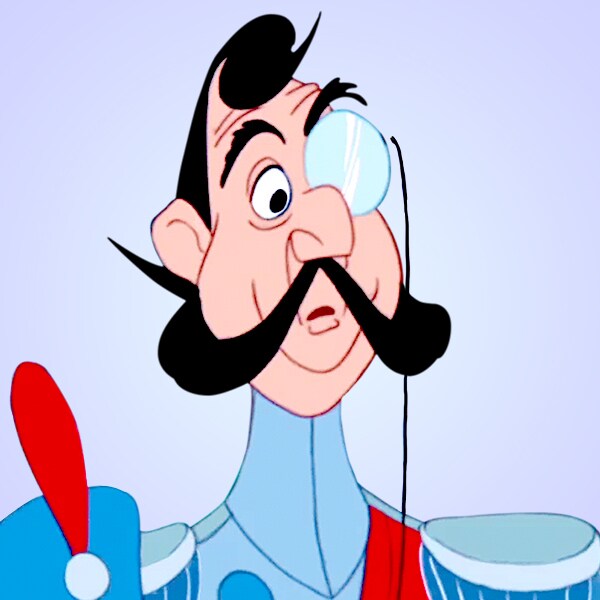
The Duke’s narrow frame, formal clothing, spectacles, and carefully managed posture contrast with the King’s compact explosiveness. He bends, recoils, peers, and attempts to remain dignified while the room changes around him. His body registers consequences before dialogue confirms the danger.
The monocle or glasses emphasize observation, yet seeing does not always produce understanding. He can inspect a slipper with precision and overlook the social conditions hiding Cinderella. The design turns vision into both professional tool and thematic limitation.
The comedy of paperwork
Cinderella rarely shows literal forms or ledgers, but the Duke’s role implies records behind every proclamation. Comedy grows from the distance between one romantic sentence and the administrative mountain required to honor the sentence. The Prince says he will marry the woman. The Duke gets the route plan.
That division remains painfully recognizable. Leaders announce transformation. Workers determine addresses, schedules, exceptions, evidence standards, and what happens when somebody breaks the only slipper. Fairy-tale bureaucracy is funny because ordinary bureaucracy already contains absurd stakes.
Class and the front door
The Duke enters homes through formal reception and speaks first to the person recognized as head of household. That protocol gives Lady Tremaine control over the encounter. Cinderella’s legal and familial relationship to the manor disappears behind her labor role.
Officials often depend on institutions they are supposed to inspect. A polished gatekeeper can conceal harm by defining who counts as a resident, employee, daughter, or eligible person. The Duke’s search becomes complete only after the hidden person interrupts the official list.
A better search
A more reliable search would have gathered names at the ball, interviewed staff, asked the Prince for detailed memories, protected the surviving evidence, and questioned whether every household presented all eligible residents. None of those steps would feel as clean as trying a shoe.
The story chooses the slipper because fairy tales need symbolic precision. A profile can enjoy the symbol while noticing the procedural disaster. The Duke is not a bad investigator so much as a ceremonial official handed an investigative emergency and one glass clue.
What the Grand Duke symbolizes
The Grand Duke symbolizes invisible implementation, middle management beneath emotional leadership, bureaucracy’s power and blindness, the fragility of evidence, and the worker asked to turn somebody else’s private desire into public procedure. He also symbolizes how competence can look foolish when authority defines an impossible outcome as simple.
His arc has no dramatic promotion or rebellion. He endures, completes the search, and returns the story to romance. That modest function is precisely why he matters. Institutions persist through people whose names rarely appear on the fantasy.
The RaeRae verdict
The Grand Duke needed a union. The King yelled “find the girl,” handed him one breakable shoe, provided no name, no guest record, no description beyond vague beauty, and then expected a kingdom-wide result. Sir, that is not a plan. That is a panic attack delegated in formalwear.
He still found her. The mice deserve the rescue credit, Cinderella deserves the second-slipper receipt, and the Duke deserves one full week where nobody asks him to organize a dynastic emergency. I know he would spend the first two days checking whether leave was allowed.
Profile receipt
The Grand Duke arranges the ball, watches the Prince meet Cinderella, reports her disappearance, carries the glass slipper, manages the kingdom-wide fitting, confronts the Tremaine household, witnesses the slipper’s destruction, and accepts Cinderella’s matching proof. Luis Van Rooten voices him in the original film, with Rob Paulsen associated with later animated performances.
His strengths are logistics, discretion, endurance, observation, diplomacy, and procedural discipline. His failures are excessive obedience, class blindness, panic, dependence on fragile evidence, and limited resistance to volatile authority. His central relationship is with the King, whose desires define both his workload and his fear.
The final character reading
The Grand Duke is anxious, capable, loyal, overworked, class-bound, observant, procedurally limited, and much more important than the romance allows him to appear. His work turns the King’s wish into the physical conditions under which Cinderella can be found.
He earns a full profile because fairy-tale endings require implementation. Somebody sends invitations, opens gates, protects evidence, reaches the last house, and listens when a servant says she also has the right to try. The Duke is the nervous hinge between decree and door.
After happily ever after
Cinderella’s arrival likely increases rather than ends his work. A royal wedding requires security, ceremony, guests, diplomacy, residence changes, public messaging, and integration of a bride with no conventional court preparation. The man who found her probably receives the folder.
Cinderella II suggests she will challenge palace routines, which means the Duke may become translator between humane reform and established process. That could be his most interesting future: learning that procedure works best when the person once hidden upstairs helps redesign who the palace sees.
Why he survives the franchise
The Grand Duke remains recognizable because viewers know the feeling of receiving an urgent request whose author has skipped every practical question. His panic is specific to monarchy and universal to work. He cannot say the deadline is impossible, so his face says everything.
The character also provides necessary friction between royal fantasy and household reality. Without him, the slipper would leap from palace to manor through narrative convenience. With him, the story admits that even magic needs somebody to carry the case.
He deserves better than being remembered only as the nervous man at the fitting. He is the witness who sees the romantic night become an evidence problem, the planner who turns a decree into miles of travel, and the official standing close enough to power to understand power while remaining too subordinate to challenge power easily.
That contradiction keeps him useful for the entire Cinderella ecosystem. Reviews can follow the romance. Guides can follow the slipper. Character analysis needs the person who physically connects those stories. The Grand Duke carries the bridge in both hands and spends the trip praying nobody drops the glass.
Sources and credits
Film chronology and credited performances are checked against official D23 entries for Cinderella (1950), Cinderella II, and Cinderella III.
Keep exploring
Return to the Cinderella hub for reviews, profiles, rants, and guides.
Bureaucracy at the locked door
The Grand Duke carries out an absurd order with the exhausted precision of a civil servant who knows resistance will only produce a louder royal demand. That comic position still gives him real power. He decides how the search proceeds, which homes count, how evidence is handled, and whether a locked young woman receives the chance the proclamation promised. Tremaine depends on procedure becoming too hurried to notice Cinderella. The Duke’s eventual attention therefore matters. He is not the rescuer, but he becomes the official witness who allows the slipper test to reach the person the household tried to erase. A deeper profile treats him as more than a nervous messenger. He shows how institutions can reproduce private control through indifference, or interrupt it by taking their own stated rules seriously.