
Gildarts Clive
Fairy Tail Character Profile
Gildarts can break magic, stone and most people’s confidence with one hand. What he cannot do is Crash Magic his way backward into Cana’s childhood.
Gildarts Clive can break magic, stone and most people’s confidence with one hand. What he cannot do is Crash Magic his way backward into Cana’s childhood. That failure is the point of his character.
Fairy Tail introduces Gildarts as the guild’s wandering legend, the S-Class mage whose return makes Magnolia rearrange a street before he accidentally rearranges the buildings. Then the story starts checking what all that strength costs. Acnologia changes his body. Natsu learns that courage without fear is just bad judgment wearing a scarf. Cana reveals that Gildarts’s heroic life left a daughter growing up inside his own guild, watching him come and go without knowing how to claim him.
He is warm. He is brave. He loves Cana as soon as he learns the truth. He is also absent enough that she spends years carrying the truth alone. Both belong in the profile. Affection is not the same as presence, and a big reunion hug does not retroactively attend one school event.
Gildarts works because Fairy Tail lets raw power be impressive without pretending it solves relational failure. His best lesson is not that he is the strongest man in the room. Strength finally has to sit down, listen and accept a consequence no fist can smash.
Fast facts and honest canon boundaries
- *Name:* Gildarts Clive
- *Japanese name:* ギルダーツ・クライヴ
- *Primary identity:* veteran Fairy Tail S-Class mage
- *Magic:* Crash Magic
- *Guild leadership:* Fifth Master of Fairy Tail for a brief succession period
- *Family:* father of Cana Alberona; Cornelia is Cana’s mother
- *Japanese performer:* Kazuhiko Inoue
- *Primary continuity: Hiro Mashima’s Fairy Tail manga, its television adaptation and the sequel manga Fairy Tail: 100 Years Quest*
Official TV Tokyo program records credit Kazuhiko Inoue as Gildarts. Publicly accessible official material does not give us permission to paste every age, height or measurement circulating through fan databases. If a primary guide is unavailable, the boundary stays visible. A complete profile does not need fake precision to look respectable.
The language around his rank matters. Gildarts is an S-Class mage and one of Fairy Tail’s defining powerhouses. The story often treats him as its strongest active member. That reputation is not the same thing as an eternal mathematical ranking across every arc, transformation and sequel opponent. Power scales love a clean spreadsheet. Canon keeps bringing circumstances.
Design: a traveler whose body keeps the receipt
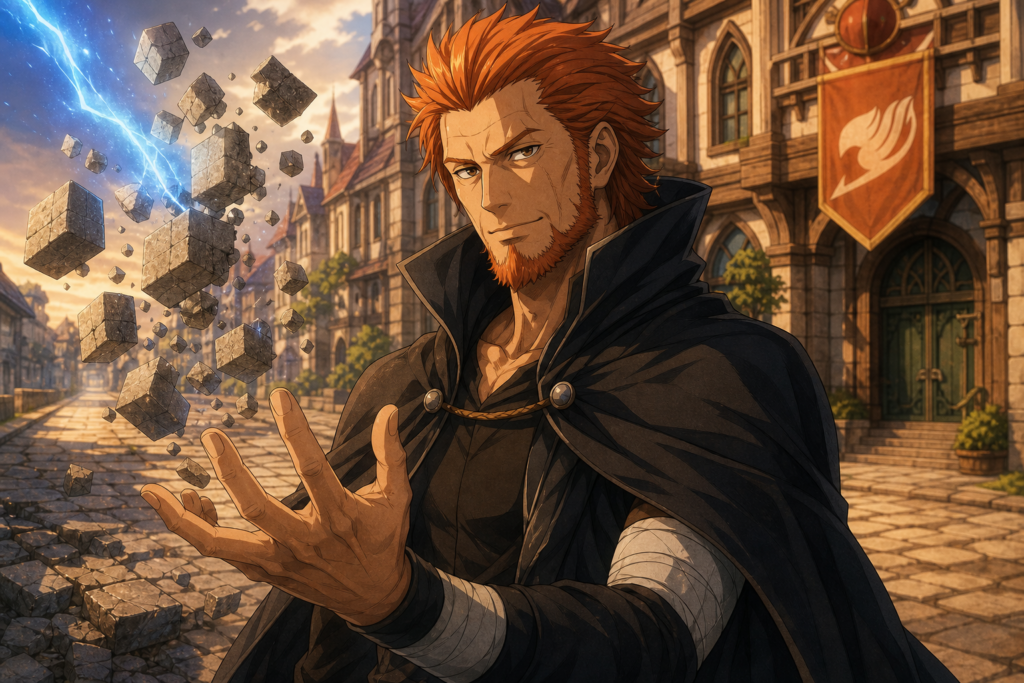
Gildarts is built like a man who has spent more time on roads than in meetings. He is tall and broad, with swept-back orange-red hair, a short beard and a face that can move from easy humor to terrifying focus without much warning. Dark travel clothing and a high collar give him weight without dressing him like a king.
His injuries after facing Acnologia matter to the design. The encounter costs him parts of his body, and later artificial replacements become part of how he moves through the world. The story does not need disability as proof that he became less of a man. His body records an overwhelming battle. His disability never becomes a pity prop or an inspirational poster.
The more interesting design choice is how little his core presence changes. Gildarts returns damaged, but not visually reduced to damage. His relaxed posture, beard, hair and mantle remain readable. That keeps Acnologia’s violence in the record without allowing the dragon to own his identity.
Magnolia makes room because Crash Magic does not
Gildarts’s return turns city planning into a running joke. Magnolia prepares a clear path because his tendency to move through obstacles, combined with Crash Magic, is not compatible with ordinary walls.
The joke works because Magnolia’s response is also excellent character writing: the city reorganizes itself around the risk Gildarts carries.
Before he says much, the environment tells us how Fairy Tail lives with him. The city does not merely admire a famous mage. Magnolia adapts around his risk. His power produces public cost even when he means no harm. That gap between intention and impact will follow him straight into fatherhood.
Crash Magic separates or breaks what it affects. Crash Magic can dismantle physical matter and, where the primary scenes show the effect, disrupt magical attacks. Its visual language is fragmentation: solid forms divide into smaller pieces as if Gildarts can tell structure to stop agreeing with itself.
But let us not put a lab coat on the spell. Canon does not need us inventing molecular physics because cubes look scientific. The responsible description is what the story demonstrates: he breaks, separates and neutralizes with extraordinary control and scale.
That control is important. Gildarts is not simply a walking explosion. He can modulate his force. The comedy comes from the fact that even controlled power this large is awkward in daily life. A city can reroute a street. A child cannot reroute years of loneliness so neatly.
The failed Century Quest and Acnologia
Gildarts spends years on an elite long-term mission and returns after encountering Acnologia. The dragon overwhelms him and inflicts life-changing injuries.
The fight serves two jobs. First, it establishes Acnologia as something beyond ordinary guild power. Fairy Tail’s famous S-Class veteran does not come home with a dramatic victory story. He comes home alive, altered and honest about the gap.
Second, the encounter challenges the culture of solitary prestige. High-rank missions make heroes look self-contained. One exceptional mage leaves, does the impossible and returns with legend polished. Acnologia exposes the limit of that model. Gildarts’s courage does not make him invulnerable, and reputation does not bring backup.
This is where Fairy Tail quietly argues for interdependence. The guild celebrates individual strength, but its deepest victories depend on people combining judgment, trust and sacrifice. Gildarts is powerful enough to make solo work look reasonable. His body carries evidence that reasonable is not the same as safe.
Natsu and the lesson that fear is information
Natsu worships forward motion. If a threat exists, he runs at it. Sometimes that is courage. Sometimes that is Natsu putting confidence in a trench coat and hoping nobody asks for identification.
During the Tenrou Island S-Class trial, Gildarts stops him without needing a long exchange. Natsu feels the difference between an opponent he wants to beat and a force he is not ready to face. Gildarts teaches him that fear can be useful information.
That lesson matters because shōnen storytelling often treats hesitation as moral weakness. Gildarts rejects the false choice. Courage is not the absence of fear. Courage means reading fear, understanding danger and still choosing responsibly.
The creative value is bigger than a power-scale demonstration. Gildarts does not mentor Natsu by giving him a secret technique. He teaches judgment. A punch would help Natsu win one fight. A boundary might keep him alive long enough to grow.
Their relationship also shows Gildarts at his best: experienced, direct and willing to make a younger mage confront reality without humiliating him. This is care expressed through honest calibration.
Tenrou Island, Bluenote and the limits of the strongest-man entrance
Gildarts’s Tenrou presence gives Fairy Tail a heavy hitter when Grimoire Heart attacks. His battle with Bluenote displays the scale and control of Crash Magic while protecting the larger guild struggle from becoming a one-man show.
An important win is still one part of a collective war. Gildarts does not win the whole arc because he wins an important confrontation. The guild’s survival depends on many people, many battles and Mavis’s protection. Giving him everybody else’s labor would reproduce the exact mistake the story keeps questioning: assuming the strongest visible person is the only one producing the result.
His power works narratively because it has placement. He can resolve a specific wall. He cannot resolve every relationship, every enemy and every consequence. Fairy Tail remains a collective.
Cana Alberona: the daughter in his blind spot
Cana grows up in Fairy Tail after the death of her mother, Cornelia. She knows Gildarts is her father. He does not know she is his daughter.
That distinction matters. He does not knowingly reject a child who approaches him. He also lives a mission-centered life so absent that his own daughter can spend years near his community without feeling able to tell him the truth.
Cana’s silence has its own logic. Every departure raises the cost of speaking. She idealizes him as both father and S-Class benchmark. If she names the relationship and he rejects her, she risks losing the fantasy that has helped her survive. If she waits, the secret grows heavier. Eventually she ties disclosure to achievement, as if becoming worthy enough can make the conversation safe. That is heartbreaking because the burden belongs to the adult relationship, but the child carries it.
When Cana finally tells him, Gildarts accepts her immediately. The acceptance is real and emotionally important. RaeRae’s judgment is also simple: good. That is the floor.
Love after disclosure does not refund the years before it. Gildarts cannot repair what he did not know through one grand gesture. He can build something from the moment he knows. The father-daughter story becomes meaningful if acceptance begins responsibility instead of ending the conversation.
Cornelia must remain in the frame too. She is not a receipt proving Gildarts and Cana share blood. Cana’s grief, search and identity begin with her mother’s life and death. A profile that rushes past Cornelia to reach the famous father is doing the same fame-centered sorting that hurt Cana in the first place.
Masculinity without the performance of invulnerability
Gildarts looks like traditional masculine power: large body, beard, wandering independence, enormous destructive ability and very little interest in paperwork. The series gets more interesting when it lets him fail outside that template.
He can admit fear. He can return after defeat. He can recognize Cana without demanding proof of devotion. He can step away from guild leadership rather than treating authority as a trophy he must clutch to remain important.
Those choices do not make him perfect. They make his masculinity less brittle. He does not need to be invulnerable to remain respected.
The MRT lens is useful here when applied carefully. Men in action stories are often rewarded for production, protection and public victory while emotional maintenance becomes somebody else’s department. Gildarts is brilliant at dangerous production. Cana exposes the unpaid relational cost. His growth begins when private care becomes part of what strength owes.
Fifth Master: power is not administration
After the Tenrou group returns, Makarov names Gildarts the Fifth Master of Fairy Tail. On paper, the choice makes sense. He is powerful, trusted and deeply identified with the guild.
In practice, he does not settle into daily leadership. He uses the office to alter succession and returns authority to Makarov.
The sequence is funny because everybody involved understands that Gildarts and routine administration are not soulmates. The appointment also separates symbolic authority from institutional labor. People will follow him into danger. That does not mean he wants to manage budgets, disputes, jobs and the constant emotional weather of a guild hall.
Confucian leadership is again a useful lens. Position alone does not produce right rule. A leader must fit obligation, conduct and relationship. Gildarts recognizes, perhaps faster than many powerful men would, that personal prestige is not enough. Stepping aside can be more responsible than keeping a title because it flatters you.
Still, the moment deserves side-eye. Fairy Tail’s succession system often relies on charisma, emergency and personal trust more than durable governance. Makarov keeps being pulled back because the institution struggles to distribute the work he performs. Gildarts’s brief tenure exposes that weakness even as it resolves the immediate handoff.
Makarov and the guild as home base
Makarov trusts Gildarts’s judgment in battle and treats him as a possible successor. Their relationship carries affection without requiring constant proximity. Both men understand that Fairy Tail is more than a building, but Makarov does the daily labor that keeps “family” from becoming a slogan.
Gildarts’s return scenes reveal how much the guild enjoys him. He is not only a weapon stored offsite. He is an older member whose presence changes the room. The welcome is sincere because chosen family can survive distance.
Chosen family does not make absence automatically romantic. The guild adapts around his travel. Cana adapts around it too, with a much higher private cost. Home base works differently for the person free to leave and the child waiting for him to come back.
Alvarez: experience meets enemies built to break certainty
During the Alvarez conflict, Gildarts returns to major combat against opponents whose strength matches the war’s scale. His confrontations involving God Serena and August reinforce his place among Fairy Tail’s top fighters.
Exact battle credit matters. War arcs invite résumé inflation because many characters enter, interrupt, assist and survive the same encounter. Gildarts deserves his demonstrated actions. He does not need stolen assists to look formidable.
August is especially important because the fight brings overwhelming magic into contact with family revelation and sacrifice. Gildarts’s physical power cannot turn every truth into a clean victory. The arc keeps returning him to the same lesson: strength affects the field, but relationship determines what the field means.
100 Years Quest and the discipline of proportional coverage
Gildarts remains part of Fairy Tail’s world and its power vocabulary during 100 Years Quest, but reputation does not create sequel scenes. The published story follows Natsu’s team on the quest Gildarts once failed. Concrete appearances and direct references belong in his chronology; fan expectation does not.
This boundary protects the sequel from becoming a roll call. The 100 Years Quest follows a specific team and a new set of magical systems, regions and Dragon God conflicts. Gildarts can matter without secretly owning every plot he could theoretically punch.
Relationship atlas
Cana Alberona: Daughter, guildmate and the person who reveals the difference between Gildarts’s loving nature and his available presence. Her disclosure begins their relationship in the open. His love does not erase her grief, secrecy or repeated S-Class pressure.
Cornelia: Cana’s mother and Gildarts’s former partner. Her place in the family history must remain visible even though the main narrative gives the later father-daughter reveal more screen time. Cornelia’s absence cannot become permission to treat her as a delivery system for Gildarts’s growth.
Natsu Dragneel: Admirer, younger guildmate and student in judgment. Gildarts teaches Natsu that fear can carry information and that charging forward is not automatically courage. The lesson matters because Natsu respects strength enough to hear restraint from someone he cannot dismiss as timid.
Makarov Dreyar: Guild master, elder and the person who trusts him with succession. Their handoff exposes both mutual respect and Fairy Tail’s dependence on Makarov’s daily leadership. Gildarts can inherit the title, but Makarov has carried the relationships, routines and institutional memory that make the office function.
Fairy Tail: Chosen home, audience and support system. The guild celebrates Gildarts’s strength while absorbing the practical cost of his magic and absences. Fairy Tail gives him somewhere to return, yet that welcome also protects him from confronting how much cleanup other people perform.
Acnologia: The opponent who changes his body and resets the audience’s understanding of the power ceiling. Survival is not victory, but survival is not shame either. Acnologia forces Gildarts to live after discovering that experience and confidence cannot guarantee control.
Adaptation and Japanese performance
The television adaptation makes Gildarts’s scale visible through environment. Magnolia’s moving route, the fragmentation of objects and the pause before Natsu understands fear all depend on timing, layout and sound, not dialogue alone.
Kazuhiko Inoue voices Gildarts in Japanese, as confirmed by official TV Tokyo program pages. The public program records establish the credit but do not provide a performance interview or scene-level acting notes. Plot emotion is not a receipt for pitch, breath or timing, so this profile does not manufacture a “deep veteran voice” analysis because it sounds plausible.
Films, OVAs, games and anime-original scenes are supplementary continuity when an official credit or roster actually places Gildarts there. Promotional art is not automatically a canon adventure.
A complete chronology without pretending every absence is a mystery
Gildarts enters the story as somebody Fairy Tail already knows well. His fame, S-Class status and long missions exist before the audience meets him. That arrival structure matters. We do not watch a rookie become powerful. We watch a community react to a veteran whose habits have already shaped the town.
His return from the long, failed quest gives the guild celebration, comic property damage and a warning about Acnologia. Tenrou then moves him from distant legend into active mentor and combatant. The seven-year suspension does not create the same personal disruption for him that it creates for members who had remained in Magnolia, but it changes the guild he returns to and opens the succession crisis that briefly puts him in charge.
He is not a central fighter in every following arc. That absence is part of honest biography, not a hole to fill with invented off-panel heroics. The Grand Magic Games can matter to Fairy Tail without Gildarts secretly doing the important work somewhere else. Tartaros can transform the guild without assigning him a battle he does not have. Alvarez brings him back into visible war work against God Serena and alongside Cana against August. A complete profile tracks presence and absence with equal discipline because reputation is not an appearance credit.
Crash Magic is control, not just bigger rubble
Crash Magic makes Gildarts frightening because it attacks structure. Stone, buildings and incoming magic can separate under his force. The cubic fragmentation gives animation a clear visual grammar, but the effect is not permission to claim he manipulates molecules, atoms or reality itself. Canon shows destruction and separation at extraordinary scale.
Control is the real measure of mastery. If every touch produced maximum force, Gildarts could not safely exist near a guild hall. His ability to modulate Crash is why the Magnolia route joke works: he has control, but ordinary architecture still has reason to be nervous.
The limits are practical as well as magical. Bystanders, buildings and allies constrain what he can do. Superior power can overwhelm him, as Acnologia proves. August’s magic presents a different problem because copying and negating magic changes the terms of a direct contest. Exhaustion, injury and the need to protect Cana all matter more than a fan ranking that assumes two fighters meet in an empty spreadsheet.
That is also why his open hand is the correct visual cue. Gildarts does not need a sword, dragon aura or royal armor. The hand and the controlled fracture already explain who he is.
Cana after the reveal
Cana’s disclosure does not end when Gildarts says he is happy to be her father. Later interaction matters because acceptance has to become conduct.
During Alvarez, father and daughter fight together against August. The television archive describes Gildarts’s anger when August speaks about never knowing parental love and shows that anger disrupting the pair’s coordination. That is a sharp consequence. Gildarts’s love for Cana is real, but even protective emotion can make him a worse teammate when it overrides attention.
Cana is not there to certify that he has become a good father. She contributes magic, judgment and risk of her own. Their shared battle works because the relationship changes the fight without reducing her to motivation.
Cornelia still matters. Cana’s mother cannot appear in the profile only long enough to hand the plot a daughter and die. The limited canon record is itself part of the imbalance: the famous father receives spectacle, while the mother who raised the child is remembered through fragments. A responsible biography does not solve that by inventing Cornelia’s life. The profile refuses to erase the part the story gives us.
The failed quest and the sequel’s title are connected, not interchangeable
Gildarts’s failed century-level mission helps establish the legendary job Natsu’s team later accepts in Fairy Tail: 100 Years Quest. His failure supplies history and scale. That ongoing relevance does not make him a secret member of the sequel team.
The comparison is useful. Gildarts approached impossible work through the old prestige model: one celebrated mage, a long absence and a return carrying private damage. Natsu, Lucy, Erza, Gray, Wendy, Happy and Carla approach the later quest as a team. They still make reckless choices, but the structure allows information, rescue and responsibility to move across several people.
This is not a simple “teamwork good, solo bad” sticker. Gildarts’s mission conditions and Acnologia encounter are their own event. The sequel does show that Fairy Tail’s heroic culture has evolved from one roaming legend toward a group whose members can challenge one another’s judgment. Gildarts matters to that history even when he is not standing inside every Dragon God chapter.
Final verdict
Gildarts is strongest when the story refuses to let “strongest” finish the sentence. Every impressive feat gains weight because the profile also measures judgment, absence, fear and the relationships that raw force cannot repair.
Crash Magic gives him extraordinary command over structure. Acnologia proves that even his body can be broken. Natsu learns that fear can preserve a future. Makarov’s succession proves that combat authority and daily leadership are different jobs. Cana proves that good intentions do not substitute for presence.
He does not need to become a different man to grow. He needs to understand what the man he already is leaves behind when he walks away.
That makes his fatherhood more compelling than a perfect reunion. Gildarts cannot recover Cana’s childhood. He can show up after the truth. He can listen when her experience complicates his self-image. He can let love become a practice instead of a reaction.
The strongest man in Fairy Tail is not the one who can break anything. The lasting version is willing to learn that some things should never have been left for somebody else to carry.
Source ledger and canon boundaries
- TV Tokyo official program page for `Natsu vs. Gildarts`: Kazuhiko Inoue credit and Tenrou episode context.
- TV Tokyo official program pages for post-Tenrou and guild-cast context.
- Kodansha official Fairy Tail and Fairy Tail: 100 Years Quest catalogs.
- Primary narrative record: Hiro Mashima’s Fairy Tail volumes 1 through 63 and published 100 Years Quest volumes.
Public official pages used here do not provide a stable age or height sheet, so those numbers stay out. Crash is described through demonstrated separation and destruction rather than invented molecular science. Cornelia remains part of the family history, immediate acceptance is not treated as completed fatherhood, disability is neither defeat nor inspiration, and team victories remain team victories. Japanese performance is the credited scope. Sequel, film, OVA and game material remains proportional to official receipts.
Primary receipts and continuity shelf
TV Tokyo’s “Natsu vs. Gildarts” program page supplies the Tenrou context and Kazuhiko Inoue credit. The official Alvarez archive records Gildarts and Cana against August. Kodansha’s licensed Fairy Tail and 100 Years Quest catalogs define the primary and sequel shelves. Battle credit follows Mashima’s volumes rather than fandom résumé inflation.