
Gideon Pearsall, Lord Warton
Thirty-two, the last of his line, and in need of an heir. He has also been married once already, for less than a day, and almost nobody in the book can remember the name of the woman it was to.
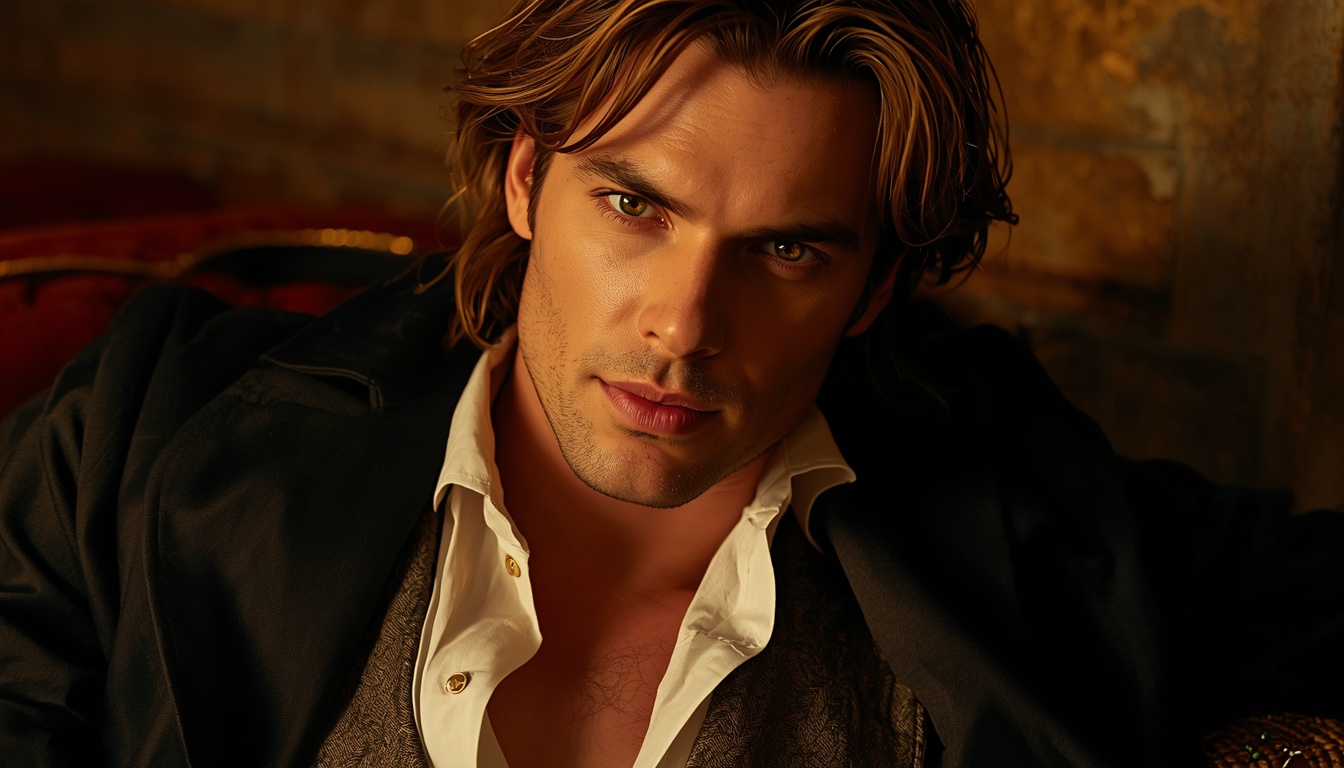 Gideon Pearsall, Lord Warton. CVM Sekai original art.
Gideon is the mirror image of Judith and the book builds him that way on purpose. She was married to a man who turned dangerous and will not say so. He was married for a single day to a woman who left, and he says so freely, constantly, and in the tone of a man telling an amusing anecdote. Both of them are managing one early marriage. She does it with silence and he does it with a punchline.
His defense is not scandal, it is discretion. He is famously discreet, which sounds like a courtesy and functions as a wall: a man who never discusses anything is a man who never has to answer for anything. Underneath it he is cynical and sharp-tongued in a way the book treats as a symptom rather than a personality.
The complication he cannot talk his way out of is arithmetic. He is the last Pearsall. If he does not produce an heir the line ends with him, and he knows it and says it out loud. That is what puts him in the marriage market at the exact moment he meets the one woman in London who has publicly sworn off marriage.
- The file
- The marriage that lasted a day
- The year after, which nobody calls a breakdown
- Discretion as a defense system
- The heir problem, stated out loud
- The Pearsall pattern his aunt has already watched twice
- The conservatory, and the one time he stops performing
- Where he ends up, according to book two
- What the book withholds
- Where he connects
- The RaeRae take
- Sources
The file
| Name in narration | Gideon, and Warton. Both are used and they are one person |
|---|---|
| Family name | Pearsall |
| Title | Lord Warton |
| Age | Thirty-two |
| Position in the family | The last of his line. Stated by him directly, and it drives his plot |
| Living relatives | One. His paternal aunt, Lady Radbury, whom he calls Aunt Louisa |
| Household | His London house. His aunt lives in it, in rooms in the opposite wing |
| Marital history | Married once, for no more than a day. An elopement, annulled immediately. The woman returned and married her original fiance |
| The first wife | Violet Smithfield, later Lady Braxton. Unnamed for most of the book. Susanna recalls the whole episode and cannot produce the name, and the novel withholds it until Violet returns in person |
| Children | None. This is the problem |
| Reputation | Cynical, sharp-tongued, and famously discreet. The discretion is genuine and is remarked on by others |
| Circle | The tontine, which he proposed. Founding four: Warton, Helmsley, Norcroft and Cavendish, one shilling each and a bottle of Cognac. Daniel Sinclair joined the circle later |
| First appearance | Chapter one, at Susanna’s party |
| Status at the end of the volume | Alive, and married to Judith, who becomes Lady Warton |
| Status later in the series | Married and, in the narration’s own word, blissfully happy. Book two’s prologue, April 1854, has him in the south of Spain with the new Lady Warton while his three friends sit in their club lamenting him |
| Book and series | A Little Bit Wicked, Last Man Standing book 1, by Victoria Alexander |
The marriage that lasted a day
Every element of that is humiliating and the book knows it. He did the romantic thing, he did it at speed, and it was undone before it had lasted a night. Then the woman he had run away with returned to her original fiance, which converts the episode from a tragedy into a story people tell at parties.
Her name eludes me at the moment.
Susanna is the character established as knowing everything about everyone, on the stated grounds that she has many brothers and sisters and therefore hears all of it. She can recall the elopement and the annulment in detail and she cannot recall the name. The defining event of Gideon’s adult life is remembered by society as an anecdote in which the other party is a blank.
She is Violet Smithfield, and she does not stay a blank. She returns later in the book, widowed, as Lady Braxton, and she is a problem rather than a footnote. The structure is doing something deliberate: the reader is trained for two hundred pages to think of her as a punchline with no name, and then she walks in with one.
Which also means the joke was never really about her. It was about how quickly the ton files a woman away, and Gideon has been repeating that filing every time he tells the story.
The year after, which nobody calls a breakdown
a raucous, drunken blur
The detail underneath that phrase is what matters. He abandoned proper society for the East End, Southwark and Seven Dials, and he was robbed and beaten more than once. Those are not fashionable vices. A gentleman of his rank going repeatedly into those districts, alone enough to be beaten, is a man who does not much mind what happens to him.
The novel presents this in the register of a rake’s backstory. Read literally, it is a year of self-destruction directly following a public humiliation, and it is the strongest evidence that the day-long marriage did real damage rather than merely embarrassing him. His later cynicism is not a pose he adopted for fun. It is what he built after the year he does not describe in any detail.
Discretion as a defense system
Gideon is known for never discussing his affairs. In a book whose entire social engine is gossip, that is a strategic position rather than a virtue. Judith solved the same problem by letting a false story grow until it kept people away. Gideon solved it by making sure there is no story at all.
The two solutions are opposite and they produce the same result, which is why the pair works. Neither of them has to explain themselves to the other, and neither of them is used to being read. When they meet somebody who can read them, the response in both cases is alarm rather than relief.
The heir problem, stated out loud
This is unusual and worth flagging. Most romance heroes with a succession problem are given it as an offstage pressure. Gideon names it himself. It makes him easier to like, because he is not pretending his interest in marriage is purely romantic, and it makes him harder to trust, because a man who needs an heir has a use for a wife that has nothing to do with wanting her.
It also puts a clock on the book. Judith cannot have children by a man she will not marry, and the one thing Gideon cannot get from an arrangement with a widow who refuses to remarry is the only thing he has said out loud that he requires. The obstacle is structural rather than emotional, which is why talking cannot dissolve it.
The Pearsall pattern his aunt has already watched twice
She is his sole living relative and she was a Pearsall by birth, sister to his father. That gives her a sample size he does not have. Her diagnosis is that Gideon believes deciding not to fall in love will prevent him from falling in love, and that she has watched Pearsall men make exactly that error before.
He ignores her, as does Judith when Lady Radbury tells her the equivalent truth about herself. Two scenes of accurate reading, two dismissals. See Aunt Louisa for the full account, including the sentence about Judith that the rest of the novel exists to prove.
The conservatory, and the one time he stops performing
He compares it to the Palm House at Kew, which is a real and specific compliment rather than a gallantry. It is also revealing about her: the conservatory is large enough to sustain the comparison, which tells you the scale of the house she runs on her own authority, and it is the part of that house he responds to honestly.
Small moment, but for a character whose whole method is deflection, the moments where the deflection drops are the character notes worth recording.
Where he ends up, according to book two
The tontine is the series spine: a shilling from each man and a bottle of cognac, held by whoever stays unmarried longest. In the opening pages of What a Lady Wants the surviving field is discussed, and Warton and Helmsley are both spoken of as men who would now argue that the love of a good woman is worth the sacrifice of some liberties.
So Gideon is married by book two, and content enough about it to be quoted as a convert by men still holding out. That is a series-level receipt rather than a book-one one, and it is the reason this profile is tagged to both books.
What the book withholds
His parents. His father is referred to via Lady Radbury being his father’s sister. Neither parent is developed, and no cause or date of death is given for either.
Why the annulment happened so fast. The mechanics are not laid out. That it was annulled immediately and that the woman returned to her fiance is all the book commits to.
The extent of the year in Seven Dials. Reported in summary. There is no scene of it, and no account of what stopped it.
The exact state of the Warton finances. He is a lord with a house and a circle wealthy enough to run a tontine on principle rather than need, but no figure is given.
Where he connects
A Little Bit Wicked
Last Man Standing book 1. Plot, arcs, tropes, reacts and the full cast.
CharacterJudith, Lady Chester
The other half of the mirror, and the marriage she will not describe.
CharacterAunt Louisa
His only living relative, and the one person who names the family pattern.
SeriesLast Man Standing
The tontine, the five books, and who falls in what order.
The RaeRae take
Gideon is the better half of this pairing to argue about, because his damage is hiding in plain sight and Judith’s is buried. Everyone in the novel knows about his day-long marriage. It is a running joke. Nobody, including him, ever treats the year in Seven Dials as what it obviously is, which is a man who spent twelve months not caring whether he came home.
Put the two of them side by side and the book’s real subject shows up. This is not a story about a rake and a widow. It is a story about two people who each survived one early marriage and built completely opposite public personalities out of the same instinct, and who are both correct that the other one is dangerous.
The heir requirement is what keeps it honest. He is not free to simply love her and let her keep her arrangement, and the book does not pretend otherwise. A romance that puts a real structural obstacle on the table and then makes both leads look at it is doing more work than the cover art suggests.
Sources
Primary source is the novel itself, read front to back on Kindle: A Little Bit Wicked by Victoria Alexander, Last Man Standing book 1, 374 pages. The book two material is from What a Lady Wants, Last Man Standing book 2, read from page one.
No secondary source, wiki, blurb or adaptation has been used. Where the book does not say something, this page says that it does not say it.