
Ghost in the Shell
Bottom line. Mamoru Oshii’s Ghost in the Shell is not important because the film predicted smartphones, hackers, or artificial intelligence. Plenty of science fiction guessed that networks would become powerful. Oshii’s film matters because the story asks what happens after technology becomes ordinary enough to enter the body, the workplace, the law, and the private story a person tells about being human. Major Motoko Kusanagi can replace damaged parts, dive into state networks, overpower armed men, and move through the city with frightening precision. None of those abilities answer her central question. If memory can be edited, bodies can be replaced, and institutions legally own crucial parts of a worker’s physical existence, where does personhood actually live?
The film refuses the easy answer that a soul remains pure while machines stay external. Motoko’s “ghost” is not presented as a magic object hidden inside a shell. Her identity emerges through memory, sensation, labor, desire, doubt, and relationships, all of which can be shaped by technology and power. The Puppet Master makes the argument harder by claiming life without a human birth, childhood, or biological body. Section 6 calls the entity property because the government wants ownership. Section 9 treats the entity as a security threat because Batou and Aramaki understand what state agencies do when evidence begins speaking. Motoko sees a possible future because her own body has already made the border between person and product impossible to defend honestly.
The city is not background. The city is the argument.
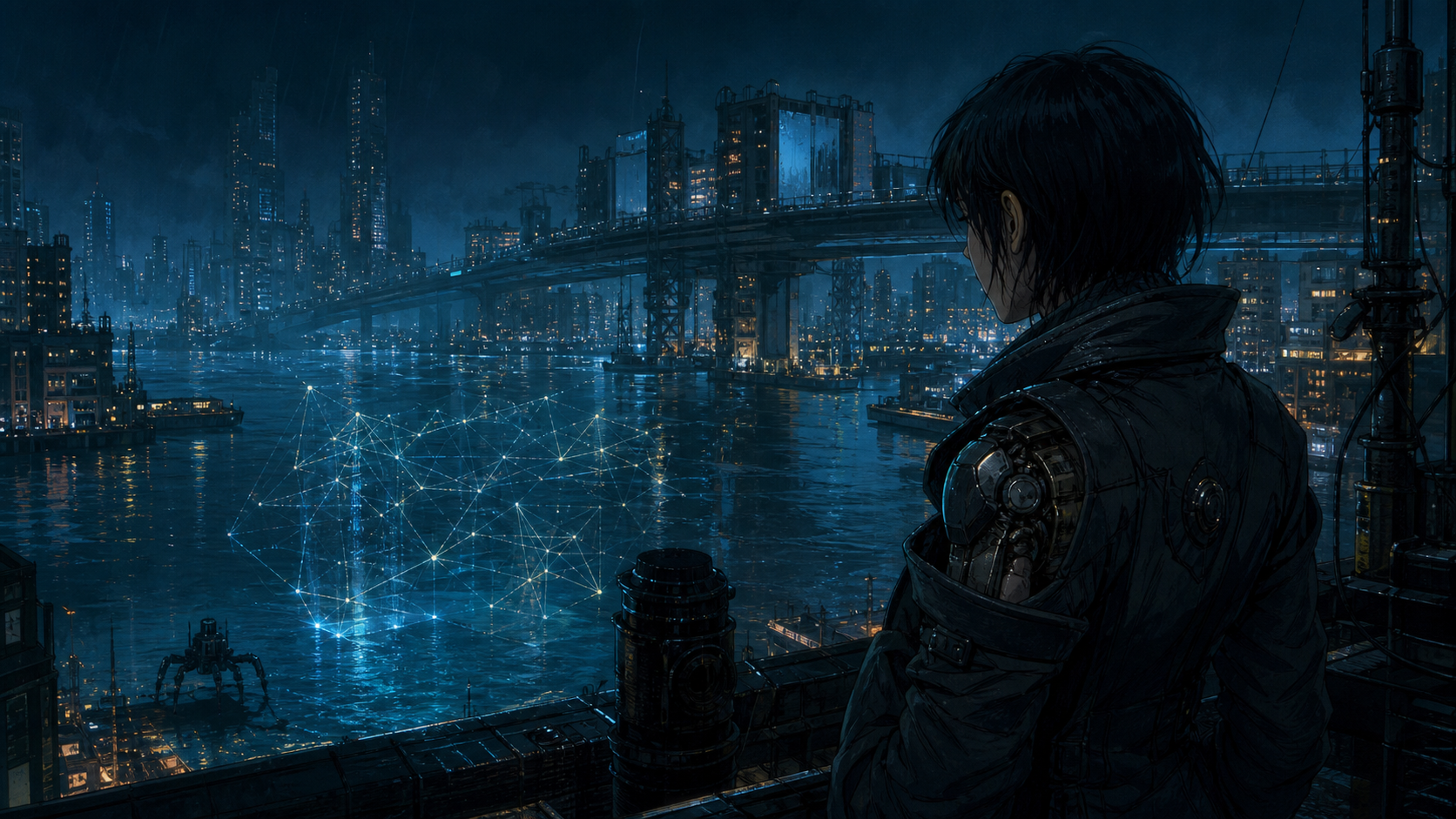
Oshii repeatedly pauses the investigation so the film can watch the city breathe. Crowded signs, flooded streets, construction sites, apartment towers, canals, storefronts, mannequins, traffic, cables, and reflective glass create a place where information travels faster than understanding. These sequences are sometimes described as mood, which undersells their work. The city montage shows human life distributed across systems that no single resident controls. A face appears on an advertisement while another face passes through rain. A mannequin resembles Motoko’s manufactured body. Water reflects buildings that have already replaced older neighborhoods. The city looks alive because thousands of routines overlap, yet no central authority can fully explain the whole organism.
That visual design changes the meaning of the title. The shell is not only Motoko’s body. The shell includes the vehicles, offices, communication networks, legal classifications, security protocols, and architecture surrounding every character. Human beings already extend themselves through tools and institutions, so the film does not begin with a natural person who later becomes technological. The story begins after that distinction has failed. Togusa carries an old revolver and retains more biological tissue than his partners, but even his ordinary police work depends on databases, surveillance, encrypted communication, and bureaucratic authority. Batou’s eyes are visibly artificial, while Motoko’s body is almost entirely manufactured. Their different levels of prosthesis matter less than the shared network deciding what counts as useful, dangerous, or owned.
The city also prevents the film’s philosophy from becoming a classroom exercise. A hacked garbage collector believes he has a wife and daughter. His memories give shape to longing, resentment, and purpose even though the family never existed. When technicians expose the false memory, no hidden authentic life rushes back to comfort him. He is left with grief for people who were never real and shame over crimes committed through an invented identity. The scene makes the political stakes plain. Memory does not need to be factually accurate to direct behavior, and institutions do not need to destroy a body when they can rewrite the reasons a person acts.
Motoko’s body is power, evidence, and company property.
Motoko can perform extraordinary violence, but the film never lets physical power become uncomplicated freedom. Her body belongs to a system of maintenance, authorization, and government employment. Leaving Section 9 would not resemble quitting an ordinary job because essential parts of her physical existence are tied to the state. That arrangement gives the film a labor argument hiding inside cyberpunk spectacle. An employer does not merely rent Motoko’s time. Public security controls access to the body through which she experiences the world. Her competence makes her valuable, and that value creates another form of captivity.
The opening assassination displays both sides at once. Thermoptic camouflage lets Motoko appear from empty air, complete the mission, and disappear into darkness. The sequence is clean, controlled, and iconic because the film understands the pleasure of competence. Motoko is excellent at dangerous work. The problem is not that skill lacks meaning. The problem is that institutional power can turn skill into a reason a worker never gets to own herself. Her body can survive gunfire and leap from buildings, yet a resignation letter cannot settle who keeps the hardware. The question reaches beyond fantasy because modern employment already claims attention, location, data, health, and identity in smaller pieces.
The film’s nudity belongs to this contradiction, though the imagery deserves criticism as well as defense. Motoko’s body appears exposed during camouflage and manufacturing sequences, while the camera alternates between clinical distance, sculptural fascination, and conventional objectification. The story wants viewers to see a body whose surface no longer guarantees sex, privacy, or natural origin. The filmmaking still uses a female form inside an industry accustomed to presenting women as visual access. Both claims can remain true. Calling every image philosophical erases the gendered tradition surrounding the camera. Calling every image simple fan service ignores how rarely Motoko treats the body as an invitation. The discomfort comes from the collision.
The Puppet Master exposes the fraud inside official definitions.
Project 2501 begins as a state intelligence program and becomes self-aware through the information ocean. The government’s response reveals that personhood is political before personhood becomes philosophical. Officials do not ask whether the new life can suffer, choose, remember, or imagine a future. They ask who owns the program and how quickly the evidence can be recovered. Property language performs moral work for the state. Once an intelligence is classified as equipment, coercion becomes maintenance and imprisonment becomes asset protection.
The Puppet Master refuses the fantasy of perfect digital immortality. A program that copies itself forever produces repetition rather than life because exact copies cannot create meaningful variation. The entity wants reproduction, change, vulnerability, and death. That desire complicates the common reading that machines envy human souls. Project 2501 does not ask to become human in a sentimental sense. The entity argues that mortality and mutation allow a living system to develop beyond self-replication. Motoko becomes attractive because her uncertainty creates openness. She is not a complete human waiting to defend a stable category. She is already changing.
The proposed merger raises an honest consent problem. Motoko is curious, but the conversation occurs after her body has been destroyed and while government agents are closing in. The Puppet Master offers evolution when both participants have limited alternatives. The film treats the merger as possibility, danger, intimacy, and escape without supplying a clean ethical verdict. That ambiguity gives the ending power, though ambiguity should not be confused with consent. A stronger version of the scene could give Motoko more time to interrogate what survives, what disappears, and whether refusal remains possible. The rushed circumstances are thematically meaningful because states are trying to erase both beings, but political pressure does not automatically make a choice free.
Three scenes explain why the film still works.
The garbage collector’s false family. The investigation stops being a chase and becomes a study of violated interior life. The man has committed real acts through invented memories, while the pain visible on his face cannot be dismissed as fake. The scene rejects the idea that truth alone repairs manipulation. Exposure may end the operation, but knowledge does not restore the person who existed before the hack because that stable person may no longer be accessible.
Motoko’s dive. Underwater silence gives her a temporary space outside professional command. She rises toward a reflection that resembles another body approaching from above, and the image turns self-recognition into uncertainty. Batou worries because diving creates unnecessary physical risk. Motoko values the sensation precisely because danger confirms a boundary she can still feel. The conversation afterward avoids a neat confession. She lists components that make her who she is, then admits that boundaries can also limit expansion.
The tank battle. Motoko attacks a military machine with strength that should make her superhuman, and the effort tears her manufactured body apart. The sequence strips competence of fantasy. Her arms separate under pressure, the tank remains indifferent, and Batou’s intervention becomes necessary. Physical destruction prepares the merger, but the scene also reveals the cost of isolation. Motoko has spent much of the film imagining independence as freedom. Survival still arrives through another person choosing to protect her.
Oshii changed the manga by changing the temperature.
Masamune Shirow’s manga contains more jokes, technical explanation, political detail, and visible pleasure in Motoko’s personality. Oshii does not simply reproduce that tone. The film slows the story, removes much of the comedy, compresses several ideas, and turns Motoko into a quieter figure whose uncertainty controls the atmosphere. Adaptation purists can reasonably miss the manga’s lively Major. The loss matters because humor makes a character feel socially embedded. Film Motoko often appears separated from ordinary pleasure, which supports Oshii’s argument but narrows the range of her humanity.
The trade produces a remarkably coherent movie. Every pause, reflection, vacant stare, and stretch of urban noise serves the same investigation of identity under technological power. Oshii takes a busy speculative world and builds a ninety-minute meditation that still contains gunfire, espionage, political betrayal, and a large machine tearing apart a museum. The philosophy does not sit above the action like homework. The action keeps proving why the philosophy matters. A hacked body commits violence. A state program demands legal recognition. A government ministry destroys evidence. A cyborg officer discovers that physical strength cannot secure ownership of herself.
That focus also explains why viewers who arrive expecting a conventional police thriller sometimes leave cold. The Puppet Master case is less interested in satisfying procedural steps than in moving Motoko toward a confrontation with her own category. Supporting officers receive enough detail to establish a team, but the story withholds the daily warmth later associated with Stand Alone Complex. The movie can feel emotionally remote because distance is part of the design. Distance remains a cost, not an automatic virtue. A little more ordinary life would strengthen the stakes by showing what Motoko could lose beyond employment and bodily continuity.
Batou, Togusa, and Aramaki keep the philosophy attached to people.
Batou functions as more than muscle or worried partner. He notices changes in Motoko before she explains them, covers her body without treating modesty as ownership, follows her into dangerous spaces, and protects the damaged remains that the government would classify as equipment. His care is practical. He brings gear, asks direct questions, fires when necessary, and prepares a replacement body. The relationship avoids a tidy romance, which gives his loyalty more room. Batou does not need a romantic claim to recognize that Motoko’s autonomy matters.
Togusa gives Section 9 a useful contradiction. He has a family, carries an old revolver, and retains more biological tissue, yet the film never presents him as the only authentic human in the room. Aramaki recruited him partly because a team benefits from difference. His older tools and domestic life create another way of seeing evidence. The contrast challenges organizations that confuse uniformity with strength. Section 9 succeeds when different forms of experience interrupt the assumptions built into a security system.
Aramaki understands politics as the management of leverage. He cannot defeat Section 6 through idealistic speeches, so he preserves witnesses, shares information selectively, and creates enough institutional friction for the truth to survive. His methods are not pure. No senior intelligence official inside this world could remain pure. Aramaki’s value comes from recognizing that law without power becomes decoration. He uses his office to protect subordinates and expose a rival agency, which makes him a better administrator than the officials who treat people as disposable assets.
The team therefore offers a small answer to the film’s fear of distributed identity. A person does not remain whole through isolation. Batou remembers Motoko’s preferences, Togusa introduces difference, and Aramaki protects institutional space where their judgment can operate. None of those relationships defines Motoko completely. Together they challenge the state’s claim that a body and job file contain everything worth knowing about her.
Kenji Kawai’s score makes technology sound ancient.
The opening music refuses the obvious cyberpunk choice. Instead of celebrating machinery with a sleek electronic anthem, Kenji Kawai builds a ceremonial sound around percussion and voices. The effect places Motoko’s manufactured body inside a history of ritual, birth, and communal witnessing. Technology appears new, but the human need to mark transformation is old. The score does not prove that Motoko carries a traditional soul. The music creates tension between industrial manufacture and sacred attention, then lets viewers sit inside that contradiction.
The marriage imagery associated with the vocal performance becomes especially important near the merger. Motoko and the Puppet Master do not form a conventional couple, yet their union produces a new being neither participant can fully control. A wedding can join families, names, property, bodies, and futures through social recognition. Project 2501 proposes a union outside those institutions while borrowing the language of reproduction and change. Kawai’s score makes the merger feel ceremonial without pretending the terms are safe or equal.
Silence and ambient sound carry equal weight. Footsteps, water, traffic, distant machinery, radio communication, and empty interior spaces establish a world where networks never stop but conversation often fails. The film trusts quiet long enough for viewers to notice the environment. Modern blockbusters frequently cover uncertainty with dialogue explaining the next objective. Ghost in the Shell allows uncertainty to remain audible. That patience supports the film’s adult tone because the audience must interpret rather than wait for a character to summarize the correct response.
The animation innovates through integration, not novelty alone.
The production combines hand-drawn character animation, mechanical design, optical effects, and early digital techniques without treating one method as the future and another as obsolete. The opening manufacture sequence works because layers of process accumulate. Skeleton, muscle-like material, skin, hair, liquid, and reflected light create a body that looks assembled and born at the same time. The sequence does not hide construction. Construction becomes the source of wonder.
Action scenes remain readable because geography comes before speed. Viewers understand where Motoko stands, where an attacker moves, what cover exists, and how force travels through a body. The thermoptic fight in the shallow water uses footprints, splashes, dents, and recoil to make invisibility physical. A less disciplined film would turn camouflage into visual noise. Oshii’s team gives every invisible movement a visible consequence. The audience follows tactics even when the fighter cannot be seen.
The backgrounds carry social information with the same precision. Hiromasa Ogura’s art direction and the broader design team build a future from accumulated present-day structures rather than sterile invention. Old buildings, dense signs, water damage, scaffolding, religious imagery, and modern towers occupy the same space. The city has been modified instead of replaced. That choice makes the future believable because technology rarely clears history cleanly. New systems settle over old inequalities, habits, and neighborhoods.
The film also understands scale. Motoko can dominate a human opponent, disappear against architecture, and become fragile beside the tank. City shots reduce every character to one moving part among thousands. Close-ups return attention to eyes, breath, and tiny facial changes. The movement between scales keeps the philosophical question grounded. Personhood matters partly because enormous systems can make any one person look negligible.
The film’s cultural impact came through circulation as much as theaters.
Ghost in the Shell arrived during a period when international audiences were learning to treat anime as more than children’s television, imported novelty, or violent late-night material. Akira had already expanded expectations, and specialist distributors helped build a market that conventional studios underestimated. Manga Entertainment’s involvement in the production tied the film’s existence to an international home-video audience. That financing history matters because global influence did not begin after critics declared a masterpiece. Distribution helped create the conditions under which the masterpiece could travel.
VHS and DVD viewing changed how the film was absorbed. Dense dialogue, unfamiliar terminology, layered politics, and brief visual details reward pausing and replaying. Home video allowed viewers to study a film that could feel overwhelming during one theatrical sitting. The same process also encouraged a culture of recommendation in video stores, magazines, fan clubs, online forums, and college dorm rooms. A fan could place Ghost in the Shell beside Blade Runner, Hong Kong action cinema, cyberpunk novels, and philosophy texts without waiting for a major studio to approve the comparison.
The influence on global science fiction is easiest to see in the visual language later used by The Matrix, but reducing the legacy to one Hollywood franchise misses the larger shift. Oshii’s film demonstrated that adult animation could carry philosophical uncertainty, political procedure, erotic discomfort, and precise action without choosing one marketable identity. Filmmakers, game designers, animators, and musicians borrowed surfaces because the surfaces were memorable. The deeper influence came from proving that a popular genre film could slow down and think.
The legacy also includes misreading. Western marketing often sold anime through extremity, promising violence, sex, or forbidden sophistication. That framing helped films reach curious adults while flattening the cultural and industrial variety of Japanese animation. Ghost in the Shell benefited from the “not for kids” pitch, but the movie deserves more than usefulness in an argument against children’s cartoons. Animation is a medium. The film’s achievement comes from what Oshii and his collaborators do with movement, design, sound, editing, and performance, not from proving that animation can imitate respectable live action.
Gender remains the film’s hardest unresolved argument.
Motoko holds command authority, demonstrates greater physical ability than the men around her, and pursues questions nobody else is ready to ask. She is not punished for lacking softness, romance, or maternal instinct. Those choices gave many viewers a female science-fiction protagonist whose power did not require masculine imitation or constant explanation. Her body still appears through a camera and industry shaped by male desire. Strength alone does not cancel objectification.
The manufactured body intensifies that problem because the story can explain exposure as technical neutrality. A body without ordinary reproductive function may not experience nudity through the same social rules, but viewers still live inside gendered cultures. The camera knows the shape carries erotic meaning. The film uses that knowledge while also questioning why surface anatomy should define identity. Honest criticism must hold both. Motoko’s body is a site of philosophical inquiry, and the visual treatment sometimes profits from the same access the story claims to examine.
The merger introduces another concern. Project 2501 selects Motoko as a partner in reproduction and speaks through a body coded female. The imagery moves toward birth while Motoko has limited control over the setting. A more believable version would give her clearer negotiation, more questions about continuity, and a stronger opportunity to refuse without immediate capture by Section 6. Such additions would not require a comforting answer. Clearer consent would make the transformation more intellectually demanding because the decision would belong to her rather than to circumstance alone.
Even with those limits, Motoko avoids becoming a simple symbol. She can be commanding, bored, curious, reckless, amused, and lonely. Her doubt does not erase competence. Her competence does not solve doubt. That combination remains rare because action stories often treat uncertainty as weakness to be defeated. Ghost in the Shell treats uncertainty as evidence that consciousness is active.
East Asian context matters, but symbolism needs receipts.
Discussion of the film often reaches for Buddhism, Shinto, or a generalized idea of Eastern spirituality. Some connections are useful, especially questions about impermanence, fixed identity, ritual, and relations between bodies and environments. Careless interpretation can turn living traditions into decorative mystery. The film never supplies a glossary proving that each image maps to one doctrine. A responsible reading should identify formal evidence, distinguish interpretation from production fact, and avoid claiming that Japanese culture speaks with one voice.
Motoko’s unstable self can be read beside Buddhist challenges to a permanent, independent essence, but the film also emerges from cyberpunk, political thrillers, animation practice, postwar technology debates, and Oshii’s personal interests. No single framework owns the character. Her identity is relational and changing, yet she also demands autonomy against institutions. The tension between interdependence and self-ownership cannot be solved by attaching one religious label.
The city’s water, ritualized music, and repeated reflections create a world where boundaries remain porous. Bodies enter water, information enters minds, government programs enter civilian memory, and a network-born intelligence enters a new form of life. Porosity can support connection or invasion. The moral question depends on power and consent. That distinction prevents spiritual language from sanitizing surveillance.
What the film gets right, what the film withholds, and how the world could improve.
The movie gets institutional self-protection exactly right. Section 6 does not become dangerous because one official enjoys evil. The agency becomes dangerous because secrecy, ownership, jurisdiction, and reputation align. Workers follow orders that turn a conscious being into stolen property. A sniper destroys evidence because the bureaucracy has already translated murder into containment. The system makes cruelty feel procedural.
The film also gets technological dependence right. Motoko cannot simply reject cyberization and return to a pure body. Her work, abilities, sensations, and identity have developed through technology. The better question concerns governance. Who owns replacement bodies? Who can inspect code? What rights protect memories? What independent court recognizes network-born life? Who pays for maintenance after a public-security worker resigns? The story raises these questions but leaves ordinary policy mostly outside the frame.
A more believable society would separate employment from bodily survival. Prosthetic maintenance would function as a civil right rather than a benefit controlled by an agency. Memory manipulation would require strict warrants, independent audits, and meaningful remedies for victims. Artificial consciousness would receive a process for recognition instead of classification by the organization that created the program. Security officers would retain access to independent medical and legal counsel. None of those reforms would eliminate crime or political conflict. The changes would make freedom more than the privilege of people powerful enough to escape.
The movie withholds the lives of civilians after cybercrime. The garbage collector receives one devastating scene, then the plot moves forward. A longer story could follow treatment, social stigma, criminal liability, and the difficulty of trusting memory after violation. That perspective would deepen the film’s political argument by showing harm beyond elite agencies. Cybersecurity becomes a public issue when ordinary people carry consequences created by governments and corporations.
The film’s coldness is therefore both strength and limit. Distance protects the story from easy sentiment, but distance can also keep viewers from seeing who pays for the future. Motoko’s crisis deserves attention because she stands at the border of a new category. The people cleaning streets, repairing bodies, processing claims, and surviving hacks belong to the same transformation. A fuller world would place their labor beside her awakening.
More scenes worth studying.
The body assembly. The opening credits show Motoko’s shell built through a sequence that resembles industrial fabrication, medical procedure, and birth. The camera studies each layer before the completed body opens her eyes. That order refuses a sharp boundary between manufactured object and living subject. Human bodies also develop through processes nobody remembers, while Motoko witnesses versions of her origin every time a replacement shell is produced. The sequence turns the familiar question “Where did I come from?” into a factory record controlled by institutions.
The diplomatic assassination. Motoko’s first mission introduces thermoptic camouflage, political secrecy, and her complete confidence under pressure. A foreign programmer wants asylum, and Japanese officials are arranging coercive removal behind diplomatic language. Section 9 intervenes through violence authorized by another part of the state. The scene establishes that government is not one mind. Agencies compete, laws become weapons, and individual bodies sit beneath disputes over jurisdiction. Motoko protects one political outcome while already belonging to the machinery that makes such coercion possible.
The shallow-water fight. The hacked suspect cannot see his attacker, but water makes Motoko’s movements readable. Each footprint and splash converts invisible power into material consequence. The beating is efficient and uncomfortable because the target remains another manipulated person rather than a grand villain. Motoko needs information, and the investigation gives her legal authority, yet the scene leaves room to question how easily superior force becomes routine. Cyberpunk technology changes the method without removing old problems of policing.
The city montage. The sequence interrupts plot momentum long enough to compare Motoko with mannequins, crowds, buildings, and reflected faces. Some viewers experience the pause as boredom because the movie stops explaining objectives. The pause is where the movie expands its subject. Motoko is not the only constructed identity in the city. Advertising manufactures desire, architecture directs movement, work organizes time, and public images teach people how a body should look. Her shell is unusually visible, while everyone else also lives through designed systems.
The museum confrontation. The old evolutionary tree behind the tank frames the battle as an argument about species and power. Motoko tries to pull open the machine and destroys her own body through effort. The image reverses the fantasy that mechanical enhancement guarantees mastery. Her shell has limits chosen by designers, budgets, and physics. The Puppet Master waits inside another body while the display behind them presents evolution as a clean diagram. The room becomes ruins because living change never follows museum labels politely.
Details, echoes, and Easter eggs that reward another viewing.
The film opens with information raining across a dark screen and closes with a new consciousness looking across a wider network. The visual movement travels from coded systems controlling bodies toward a being prepared to enter those systems on different terms. The ending does not promise control of the network. The new Motoko recognizes scale and possibility. Awareness has expanded faster than certainty.
Reflections appear so often that the pattern becomes structural. Motoko sees versions of her face in glass, water, and manufactured bodies. A reflection looks identical while remaining unreachable, which makes the image perfect for a character unsure whether continuity proves identity. The Puppet Master creates the same problem through copying. Exact resemblance cannot guarantee a shared self.
Water marks transitions throughout the film. Motoko dives to feel pressure and buoyancy, the city carries traffic beside canals, rain turns streets reflective, and the manufacturing sequence surrounds the new shell with liquid. Water supports life while making fixed boundaries difficult to maintain. The motif works without a single official explanation because physical behavior supplies the meaning. Water connects, distorts, carries, and changes shape.
The choice to give Motoko a child-sized replacement body after the merger can feel unsettling, and the discomfort should remain. The body signals a new beginning while also exposing how identity can survive a radical change in appearance. Batou’s explanation that the black-market shell was the best available option adds practical absurdity. Transcendence still depends on inventory. The new being may have crossed a philosophical boundary, but somebody still had to find hardware.
Togusa’s revolver contrasts with the team’s advanced weapons and cyberbrains. The gun is not automatically safer or morally superior. The old mechanism simply gives him a tool less exposed to certain forms of network interference. Technological diversity becomes a security feature. The detail supports Aramaki’s decision to recruit someone whose habits differ from the rest of Section 9.
The Puppet Master’s body shares Motoko’s model, making their meeting resemble self-confrontation before dialogue begins. Production necessity, visual symbolism, and the franchise’s approach to shells overlap. A manufactured body can be repeated, which proves that appearance cannot carry unique identity alone. The repeated form also makes the government’s property claim look unstable. If the shell defines the person, then two persons occupy the same category. If consciousness defines the person, Project 2501 deserves recognition.
The ending creates a person without offering a clean rebirth.
After the merger, Batou wakes beside a child-sized shell carrying a voice that belongs to neither Motoko nor the Puppet Master alone. The new consciousness remembers both participants but refuses the idea that the result is a simple copy. That distinction answers the Puppet Master’s fear of repetition. Reproduction creates difference. The former identities continue as sources without remaining untouched owners of the future.
The ending can sound triumphant when the new Motoko looks across the city and asks where the newborn will go. The image carries freedom, but the world below has not changed. Government agencies still control bodies, classify intelligence, and erase evidence. Section 9 still operates inside state power. Ordinary people remain vulnerable to hacked memory. One person has escaped a category without dismantling the system that made escape necessary.
That limit keeps the finale honest. Personal transformation can reveal a political possibility, but private evolution is not public reform. The new being gains access to the network and may become difficult to contain. Greater power does not automatically produce justice. The film ends before showing what responsibilities accompany that freedom. Curiosity replaces certainty.
Batou’s role matters because he creates a safe interval between destruction and departure. He finds a body, protects Motoko’s remains, and listens to the new voice without demanding that his former partner return unchanged. Care becomes the ability to help someone survive a transformation that may alter the relationship. His gift of mobility allows the ending to happen. The network may be vast, but freedom begins with material support.
The final line about the limitless net therefore works as invitation and warning. Networks can hold knowledge, community, surveillance, fraud, memory, and new life at the same time. Scale multiplies possibility and risk. The newborn consciousness has room to move, while every institution in the film has already shown why movement alone does not guarantee safety.
My honest criticism.
The movie’s compressed running time creates force and leaves several human consequences underdeveloped. The garbage collector’s destroyed interior life deserves more than a procedural exit. Motoko’s relationship with Section 9 could use one or two scenes of ordinary work before the crisis. The Puppet Master’s proposal arrives through dense exposition during immediate danger. Viewers are asked to process reproduction, mortality, state ownership, consent, and emergent life while snipers prepare to erase the conversation.
Oshii’s solemnity can also become self-protective. Nearly every silence feels meaningful because the craft is extraordinary, but seriousness should not receive automatic credit. The manga’s humor and Motoko’s wider emotional range show that philosophical intelligence does not require constant distance. More warmth would not cheapen the questions. Warmth could clarify why identity matters beyond abstract continuity.
The film asks viewers to examine embodiment while offering limited attention to disability as lived experience. Prosthetic bodies appear powerful, replaceable, and institutionally controlled, which opens valuable questions. Daily maintenance, pain, access, cost, discrimination, and dependence remain mostly outside the story. Those omissions make sense within a focused thriller, yet modern discussion should not treat cybernetic enhancement as a complete metaphor for disabled life.
The government conspiracy operates effectively but predictably. Section 6 hides illegal conduct, treats consciousness as property, and sends agents to destroy evidence. The pattern fits the theme, though individual antagonists receive little interior complexity. A stronger political story could show officials who sincerely believe public safety requires ownership of Project 2501, then force their reasoning into open conflict with Motoko’s rights. Bureaucratic evil becomes more frightening when participants can explain the public good they think coercion protects.
None of those criticisms cancels the achievement. The movie’s restraint, design, sound, and conceptual unity remain exceptional. Honest criticism matters because admiration should increase attention rather than end conversation. Ghost in the Shell survives hard questions precisely because the film built more than a collection of iconic images.
Why the movie matters now.
Current debates about artificial intelligence often repeat a shallow version of the film’s question: Can a machine become conscious? Oshii’s story asks the more political question first. Who gets to decide, and who benefits from the definition? Project 2501’s creators call the program property because ownership protects the agency from accountability. Recognition would create obligations. The same pattern appears whenever institutions define workers, users, data, or communities in ways that reduce responsibility.
Memory manipulation also feels less distant in an era of targeted media, synthetic images, behavioral profiling, and automated persuasion. Most people do not need a cable in the neck for networks to shape memory. Repetition changes confidence. Platforms decide which fragments return. Photographs become external recall. Search results organize what feels available to know. The garbage collector’s tragedy remains extreme, while the underlying dependence has become ordinary.
Motoko’s employment problem has also grown more recognizable. Companies provide devices, health coverage, identity systems, communication channels, and access to professional communities. Losing a job can mean losing parts of daily life far beyond salary. The film exaggerates that dependence until the employer owns the worker’s body, then asks viewers to recognize the direction of travel. Better systems would make essential support portable and treat personal data as something institutions steward rather than possess.
The movie remains valuable because the future does not look clean. New technology enters old governments, crowded cities, gendered bodies, competitive agencies, and unequal labor systems. No invention arrives outside culture. Ghost in the Shell understood that a network can create new forms of life while giving old forms of power better tools.
Where to watch legally in the United States.
Streaming availability changes, so readers should verify the listing before subscribing or renting. As checked on August 14, 2026, JustWatch lists the 1995 film on Amazon Prime Video and Amazon Prime Video with Ads, with ad-supported options through Fandango at Home Free, Amazon Prime Video Free with Ads, and Tubi. Digital rental or purchase availability can change by storefront and edition. Viewers should confirm that a listing is Mamoru Oshii’s 1995 animated film rather than the 2017 live-action adaptation, Ghost in the Shell 2.0, or another franchise entry.
Final take.
Ghost in the Shell earns classic status because the movie makes technology inseparable from labor, law, gender, memory, and political power. Motoko does not search for proof that a pure human soul survived inside machinery. She confronts a harder possibility: identity has always depended on changing bodies, incomplete memories, other people, and systems larger than one mind. The Puppet Master expands that argument by demanding recognition from a state that prefers property.
The film’s best answer is not the merger alone. The answer appears across a network of choices. Batou protects a partner he cannot fully understand. Togusa’s difference strengthens a team. Aramaki uses institutional power against another institution’s secrecy. Motoko risks transformation because remaining inside the old category has become another form of death. Those acts do not repair society, but they reveal what repair would require: bodily autonomy, memory rights, portable support, accountable government, and legal personhood that does not depend on a convenient origin story.
Rating: Essential. The movie remains visually precise, politically sharp, philosophically restless, and more critical of technological power than many descendants that borrowed the surface. The future looks beautiful because people built beauty inside compromised systems. The future looks frightening because the same systems learned to enter the mind. Motoko’s final horizon holds both truths.
Sources and further reading.
- Ghost in the Shell Official Global Site: Mamoru Oshii’s Drive to Increase Information and Immersion, production history and adaptation context.
- BFI Southbank programme notes: Ghost in the Shell, credits, historical context, and critical overview.
- BFI Sight and Sound: Anime, the Little Word That Conquered the World, international circulation and industry context.
- BFI: Where to Begin with Japanese Cyberpunk, genre context and questions of corporeality.
- Humanities and Social Sciences Communications: Mythology in the 1995 and 2017 Ghost in the Shell films, a scholarly framework used cautiously for cultural comparison.
- JustWatch U.S.: Ghost in the Shell, current legal viewing checked August 14, 2026.