
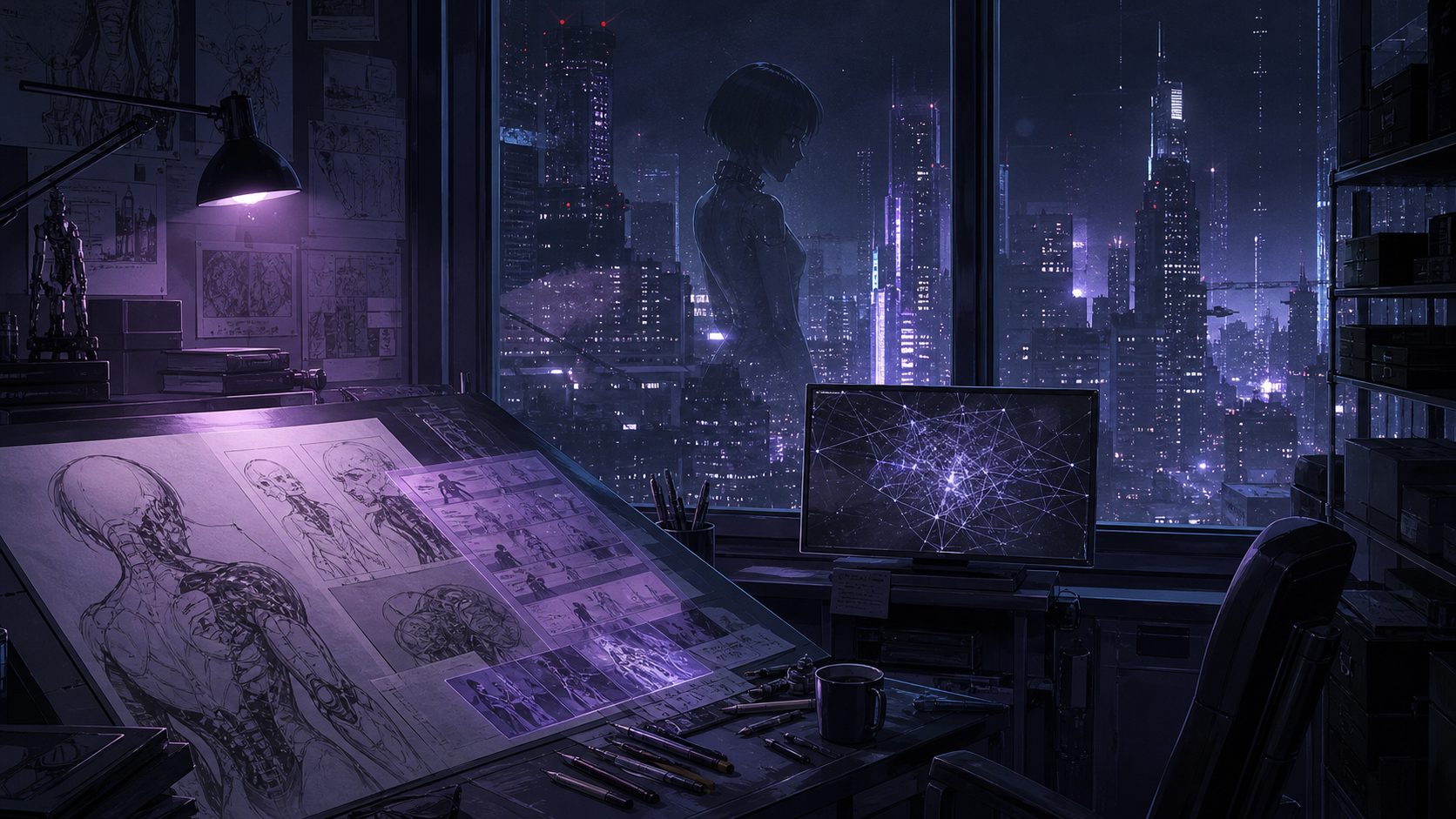
Ghost in the Shell Returns With Science SARU
The new series is no longer a distant announcement. THE GHOST IN THE SHELL premiered in Japan on July 7, 2026, with Science SARU rebuilding Section 9 from Masamune Shirow’s manga instead of tracing the visual habits of the 1995 film.
Bottom line first
Ghost in the Shell has returned with a new animated series, a new studio, and a reason for longtime fans to argue with their whole chest again. Science SARU is not presenting another continuation of Stand Alone Complex, Arise, or SAC_2045. The official story returns to 2029, Public Security Section 9, Motoko Kusanagi, and the Puppet Master, which places the new production close to the manga material that launched the franchise.
That choice matters because Ghost in the Shell has never had one single screen identity. Mamoru Oshii made the 1995 film quiet, philosophical, and severe. Stand Alone Complex built a procedural political world. Arise rewired the team’s beginning. SAC_2045 pushed the franchise into full CG. Science SARU now has the chance to make Shirow’s crowded, funny, technical, politically rude manga energy visible without pretending the earlier adaptations never happened.
The premiere also answers the biggest question surrounding the announcement. This is a real production with a real broadcast schedule, not anniversary smoke. The Japanese premiere arrived July 7, 2026. The official franchise site says the show airs Tuesdays at 11:00 p.m. on Kansai TV and the Fuji TV network. The official series page lists Prime Video distribution in more than 240 countries and regions, excluding Japan, mainland China, Russia, and Vietnam.
What the official announcement actually confirms
The official Ghost in the Shell site announced Science SARU as the animation studio and Mokochan as director. EnJoe Toh handles series composition and scripts. Shuhei Handa serves as character designer and executive animation director. Emi Katanosaka is art director, while Osamu Masuyama supervises the art. Those credits describe a production built around strong graphic choices and a team comfortable with movement that looks drawn instead of polished into lifeless perfection.
The story returns to Section 9’s formation. Motoko Kusanagi is a full-body cyborg who leads a combat unit assembled to stop threats before they spread. Daisuke Aramaki recruits her team into Public Security Section 9. Their cybercrime investigations lead toward the Puppet Master, an unidentified hacker whose existence threatens every comfortable definition of personhood, criminal responsibility, and state ownership.
The cast also makes the new route clear. Maaya Sakamoto voices Motoko. Kazuhiro Yamaji voices Aramaki. Hiroki Yasumoto is Batou, Yuichi Nakamura is Togusa, and Kikuko Inoue voices the Puppet Master. The official character list includes Ishikawa, Saito, Borma, Paz, the Operator, and the Fuchikoma AI think tanks. Science SARU is building a full Section 9 shelf, not reducing the franchise to Motoko posing against neon.
This version looks willing to be its own strange thing
The most exciting choice is not a casting announcement or a logo. The new series appears willing to let Ghost in the Shell look different. A franchise about identity should not spend thirty years wearing one face. The 1995 movie remains essential because Oshii turned cyberpunk into a lonely spiritual argument. Copying that film’s pace and surface would only prove the new team understands the merchandise value of memory.
Science SARU brings a history of elastic movement, sharp silhouettes, physical comedy, and sudden emotional violence. That range may fit the original manga better than fans expect. Shirow’s pages move between weapons diagrams, political schemes, jokes, sexuality, bureaucratic nonsense, and philosophical questions without asking permission to change tone. A successful adaptation needs enough confidence to keep those contradictions alive.
The Fuchikoma are an early sign of that route. Fans familiar with Stand Alone Complex may think first of Tachikoma, but the manga’s Fuchikoma have their own place in the franchise’s machine intelligence history. Their presence suggests the series is not merely repainting familiar television continuity. The production is reaching into the source and choosing which ideas deserve a new screen life.
That does not guarantee success. Returning to the manga can become another marketing phrase if the writing flattens Motoko into an invincible action figure or treats technical language as decoration. Ghost in the Shell works when the systems around the characters create pressure. Bodies have owners. Memories can become evidence. Artificial minds can demand political recognition. Section 9 can protect the public while serving a government capable of terrible secrecy. A new visual identity needs an equally serious institutional argument.
Why this return matters beyond nostalgia
Ghost in the Shell helped teach global audiences that animation could discuss the body, labor, surveillance, gender, warfare, corporate power, and consciousness without separating the philosophy from the action. The franchise became a reference point for filmmakers, game designers, musicians, fashion campaigns, and technology writing. That influence also created a problem. The visual language became easier to copy than the political questions.
A new adaptation arrives when cyberbrains no longer feel like distant fantasy. Phones track location. Employers monitor workers. Artificial intelligence systems imitate language and images. Governments purchase commercial data. Medical devices depend on software. People build identities across networks controlled by companies they cannot meaningfully challenge. Ghost in the Shell does not need to predict the exact hardware to remain relevant. The franchise asks who gains power when the border between person and system becomes difficult to see.
Science SARU also carries cultural weight because the studio has shown that popular animation can remain visually specific. Fans are tired of every expensive project being sanded into the same digital surface. Ghost in the Shell should feel authored. The machinery, city, uniforms, interfaces, and bodies should reveal a point of view. A story about copied consciousness cannot afford to look copied.
The music announcement adds another layer. King Gnu performs the opening song, “GO GHOST.” MILLENNIUM PARADE features Saya Gray and Daniel Caesar on the ending song, “Blue.” Both projects are led here by Daiki Tsuneta, giving the series a musical identity tied to contemporary Japanese art pop rather than a generic prestige-anime package.
Where fans can watch
The official series page says THE GHOST IN THE SHELL is available through Prime Video in more than 240 countries and regions, with Japan, mainland China, Russia, and Vietnam excluded from that specific statement. Japanese viewers can follow the Tuesday television broadcast and listed domestic streaming services. Availability can still vary by account and region, so the platform page is the cleanest place to confirm access.
The official franchise site is also publishing episode news, character information, production credits, videos, and release updates. That matters because social posts can strip dates and regions from announcements. A real source is less exciting than a rumor screenshot, but a real source does not make readers untangle somebody else’s engagement bait.
RaeRae’s early verdict
The tea is good because the production has already moved past the announcement stage. Science SARU has a broadcast series, a defined creative team, a complete Section 9 lineup, and a clear relationship to Shirow’s original premise. The project still has to prove that its political brain is as alive as its animation.
The best possible outcome is not a replacement for the 1995 movie. Fans do not need another adaptation to defeat the old ones in an imaginary tournament. The franchise becomes stronger when each continuity reveals a different pressure point. Oshii gave us the lonely body. Stand Alone Complex gave us the political machine. Science SARU may be able to give us the unruly manga mind.
That possibility is worth watching because Ghost in the Shell should never feel embalmed. A franchise obsessed with evolution has to risk changing shape.
Receipts
Ghost in the Shell Official Global Site: premiere date, Science SARU, staff, story, and third visual