
Character File · The Little Mermaid · Fear, Friendship, and the Work of Staying
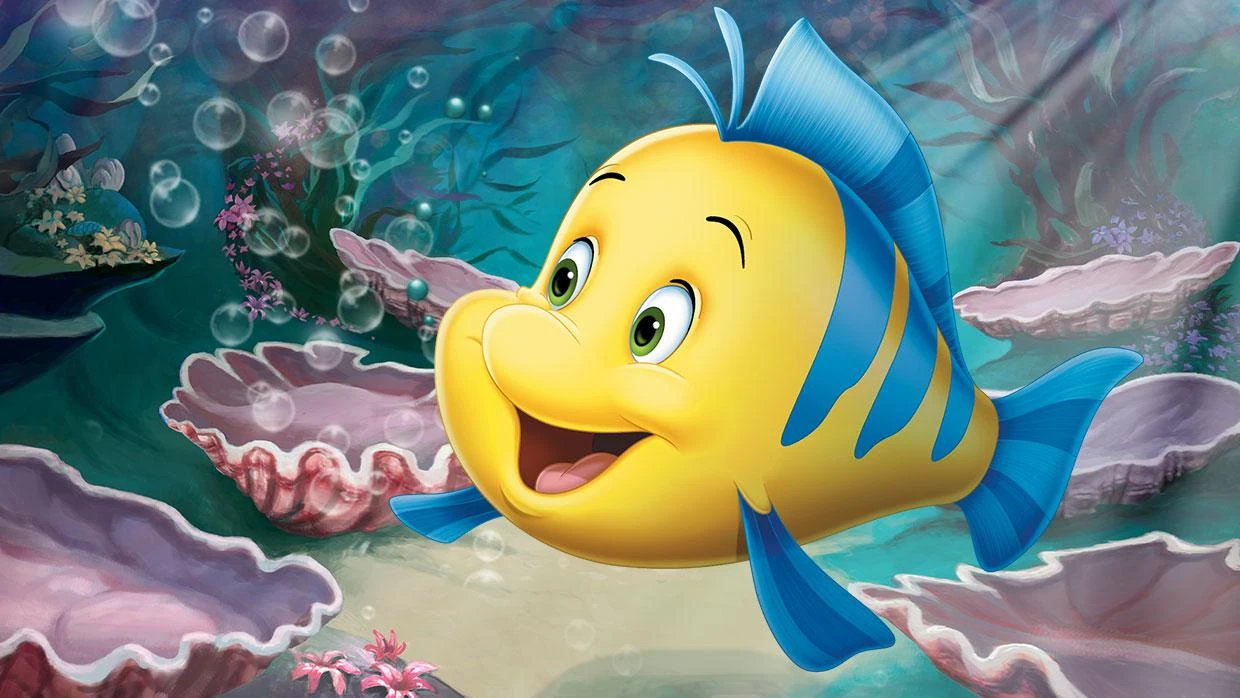
Flounder
Everybody remembers the scared little fish. Fewer people count how often he is scared, understands the risk correctly, and still becomes the friend doing the dangerous work beside Ariel.
Quick file
Role: Ariel’s closest childhood friend, expedition partner, archive assistant, witness, rescuer, and later an adult parent. 1989 performer: Jason Marin. Return to the Sea performer: Cam Clarke. 2023 performer: Jacob Tremblay.
Defining contradiction: Flounder is coded as fearful, yet repeatedly enters wrecks, shark territory, the surface boundary, and a sea-witch crisis for somebody he loves. His caution is information, not a character defect.
The name is a joke before the character speaks
Flounder does not resemble the flatfish his name describes. The mismatch fits a world where Scuttle misnames human objects and young characters inherit labels without controlling them.
More importantly, the name turns him into a comic object before the audience measures his competence. The profile improves immediately when we stop asking whether the timid fish is cute and start asking what he contributes.
Fear is his sensory intelligence
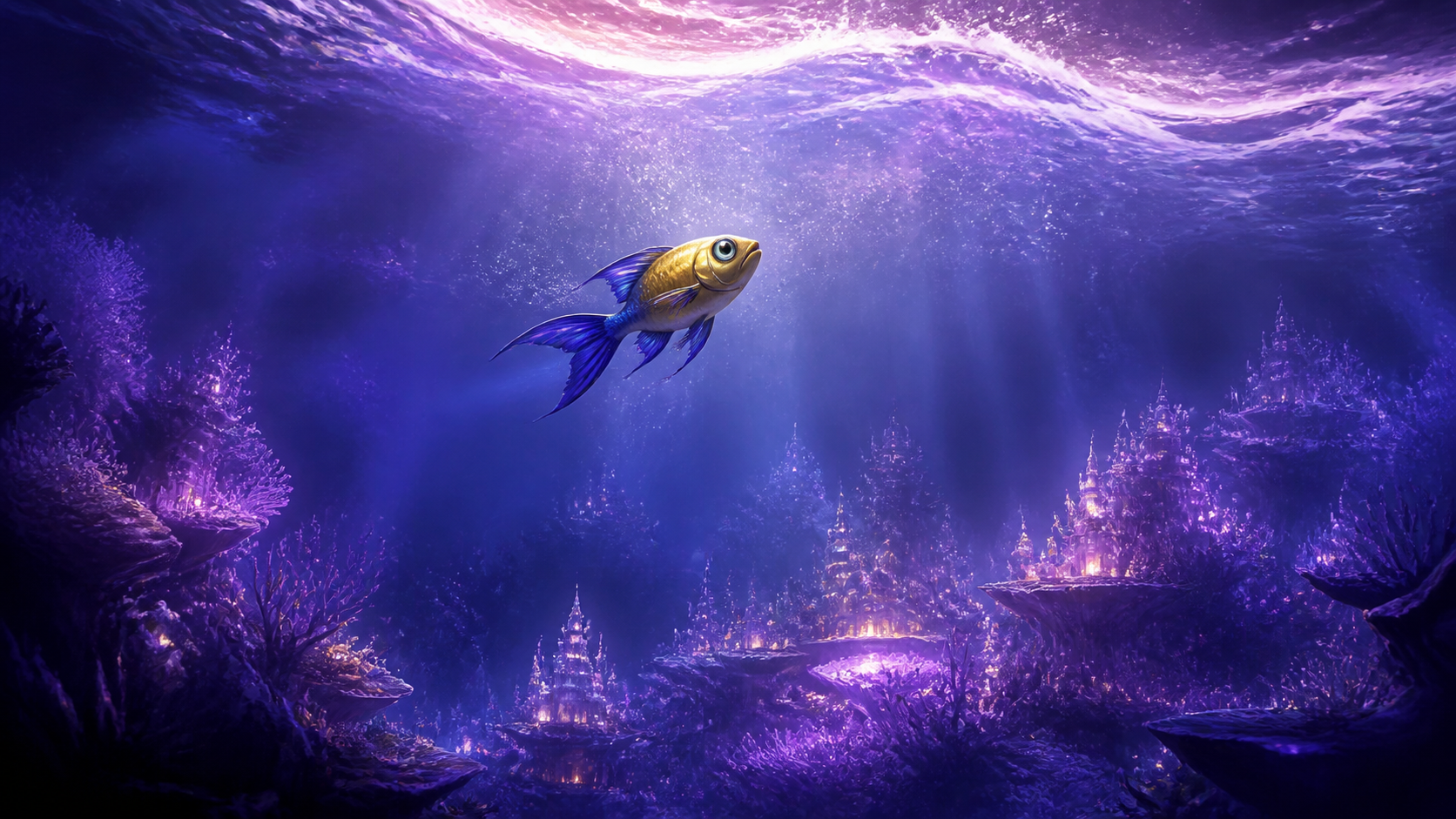
Flounder notices danger early. He reacts to the shipwreck, the shark, discovery, Ursula’s territory, and the surface with a body that does not pretend vulnerability is imaginary.
Stories often reward characters for ignoring fear. Flounder’s better lesson is that fear can remain accurate while action becomes brave. He is not courageous because he stops shaking. He is courageous because he keeps helping while he shakes.
Ariel chooses the adventure, but Flounder shares the exposure
Ariel initiates most of their expeditions. Her royal status gives her confidence and a degree of institutional protection Flounder does not possess. If Triton discovers them, the daughter and the friend will not necessarily face the same consequences.
Flounder still joins her because affection and curiosity matter. That choice should not turn into permanent consent for every escalation. A healthy friendship allows him to say the plan is dangerous without being mocked as disloyal.
The shipwreck is not a field trip
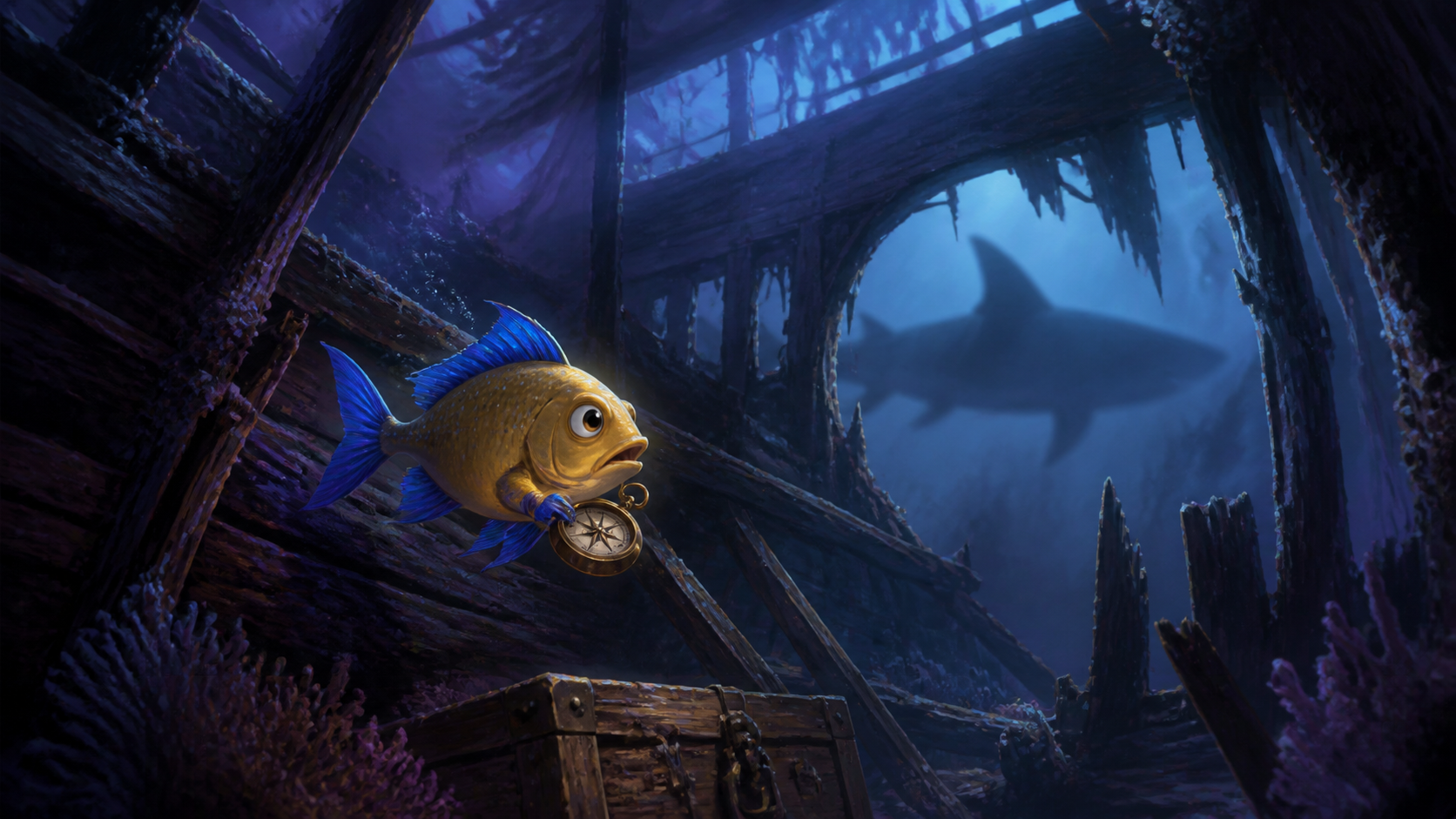
The wreck contains unstable architecture, enclosed spaces, unfamiliar artifacts, and a shark. Flounder’s panic is proportionate to the environment. The sequence uses speed and expression for comedy, but the threat is real enough to nearly kill them.
He also remains useful. He searches, carries objects, communicates, and escapes under pressure. Courage belongs to the friend who contributes under risk, not only to the person whose curiosity created the mission.
The grotto contains his labor too
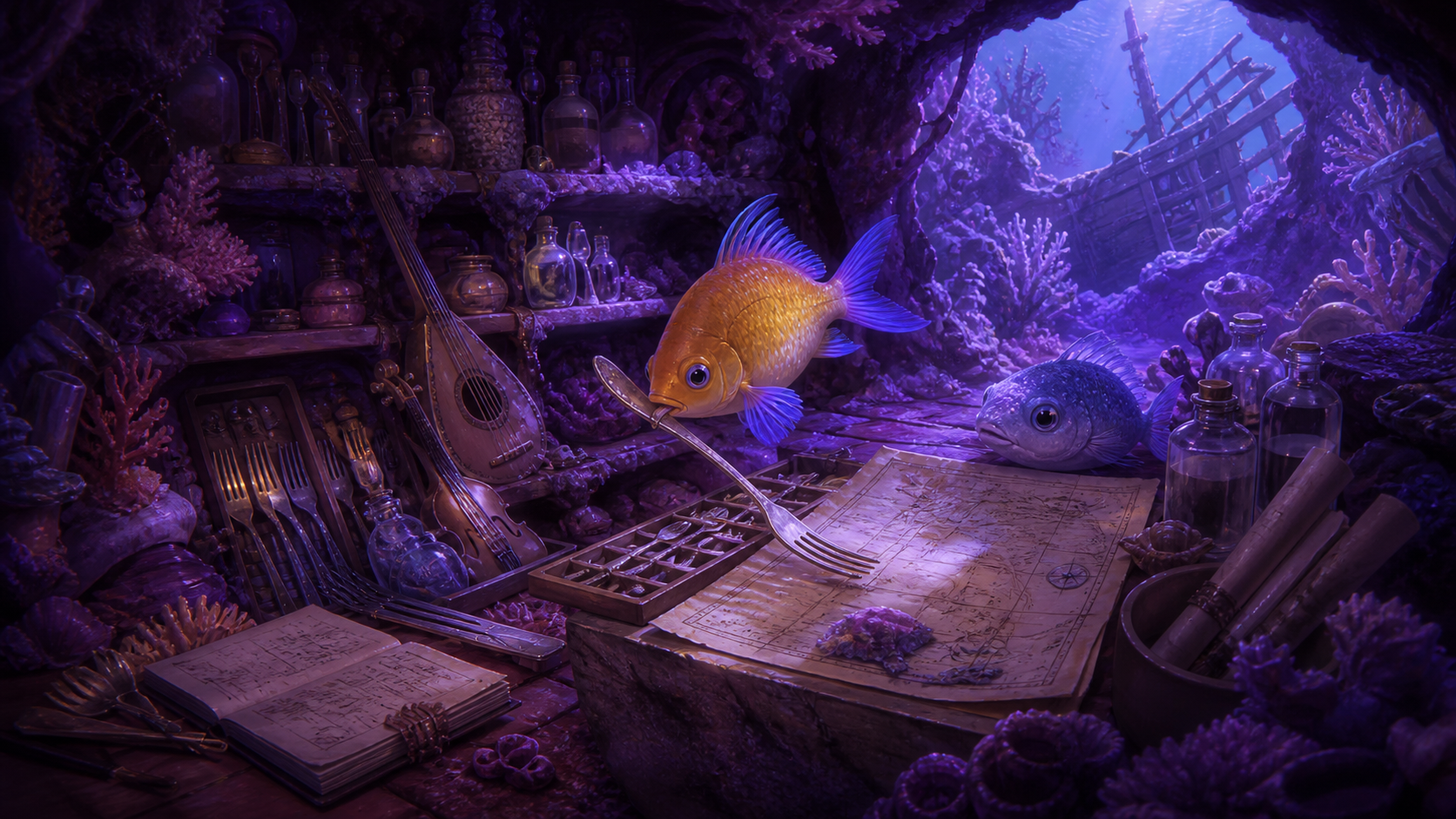
Ariel’s archive is described as her collection, but many objects are too dangerous, distant, or cumbersome for one explorer to recover alone. Flounder is present for the fieldwork and understands the catalog even when he does not share every conclusion.
The grotto therefore records a friendship practice: retrieve, classify, speculate, protect, and return. When Triton destroys it, he destroys not only Ariel’s property but evidence of time and risk Flounder invested beside her.
He knows Ariel’s dream before her father knows her questions
Flounder has access to Ariel’s curiosity, fascination with humans, and frustration with prohibition. Triton receives behavior reports. The friend receives interior life.
That difference explains why Flounder’s support can be morally serious even when he cannot solve the conflict. Listening is not the same as agreeing with every plan. It is a form of recognition Ariel is not receiving from authority.
Sebastian and Flounder carry different burdens
Sebastian follows Ariel as an employee assigned by Triton. Flounder follows as a friend. Sebastian fears punishment and institutional collapse. Flounder fears immediate bodily danger and losing the person beside him.
Their arguments can sound similar because both say the surface is risky. The source matters. One is negotiating duty inside a hierarchy. The other is trying to keep a relationship alive without pretending the adventure is safe.
The concert absence implicates him indirectly
Flounder is with Ariel during the expedition that makes her miss Sebastian’s concert. He does not control her schedule, but he participates in the choice and knows they are somewhere the court forbids.
The movie does not give him space to process the musicians’ embarrassment or the pressure on Sebastian. A fuller world would let friends confront how private adventures create public consequences for workers who never consented to them.
He becomes the easiest person to leave behind
Once Ariel accepts Ursula’s transformation, her body can enter the human world and Flounder’s cannot. The contract changes the geography of friendship instantly. He can assist at the boundary but cannot accompany her into dinner, courtship, or palace life.
Transformation stories celebrate new access while obscuring who loses access to the transformed person. Flounder’s sadness is not an argument that Ariel should stay trapped. It is evidence that liberation can still redistribute loneliness.
The contract crisis makes him a witness without authority
Flounder can recognize that Ursula is dangerous and the bargain is desperate. He cannot grant Ariel a voice, reverse Triton’s destruction, or legally challenge a magical contract.
Children and child-coded friends often see catastrophe forming while adults control every remedy. His role becomes presence, warning, and rapid assistance. Those are smaller powers, not meaningless ones.
He helps because the danger has already arrived
Once Ariel reaches the surface, refusing to help would not restore the old world. Flounder works with Sebastian and Scuttle because the immediate problem is survival.
This is practical loyalty. He can dislike the contract, fear the humans, and still support the friend living inside its consequences. Care after a bad decision is not approval of the decision.
The climax turns knowledge into rescue
Flounder knows underwater routes, allies, threats, and Ariel’s priorities. During the final crisis, that accumulated knowledge matters more than size.
He contributes by moving information and bodies through spaces human characters cannot navigate. The film’s heroic network works because multiple species possess different access, not because one central figure can do everything.
A wedding is also a friendship transition
Ariel’s marriage resolves the romance and political conflict. For Flounder, it formalizes a new distance. His closest friend now lives primarily in an environment he cannot inhabit.
The ending gives him happiness for Ariel but almost no language for his own loss. Friendship maturity includes celebrating someone without denying that their new life changes yours. Both feelings can exist without making him possessive.
The television series restores shared time
The prequel television stories give Flounder and Ariel more ordinary adventures before the film’s separation. He has opinions, fears, jokes, mistakes, and relationships inside Atlantica rather than appearing only when the feature plot needs a companion.
That expansion matters because friendship is built between emergencies. Small disagreements, games, exploration, and repair create the history that makes his later loyalty believable.
Jason Marin keeps fear from becoming one note
Jason Marin voices Flounder with nervousness, delight, protest, and sudden resolve. The performance lets a young friend sound genuinely overwhelmed without making him emotionally empty.
His line readings make courage incremental. Flounder does not announce a grand transformation. He reacts, hesitates, and finds the next useful action. That rhythm keeps the character close to how fear actually behaves.
Return to the Sea lets him grow up
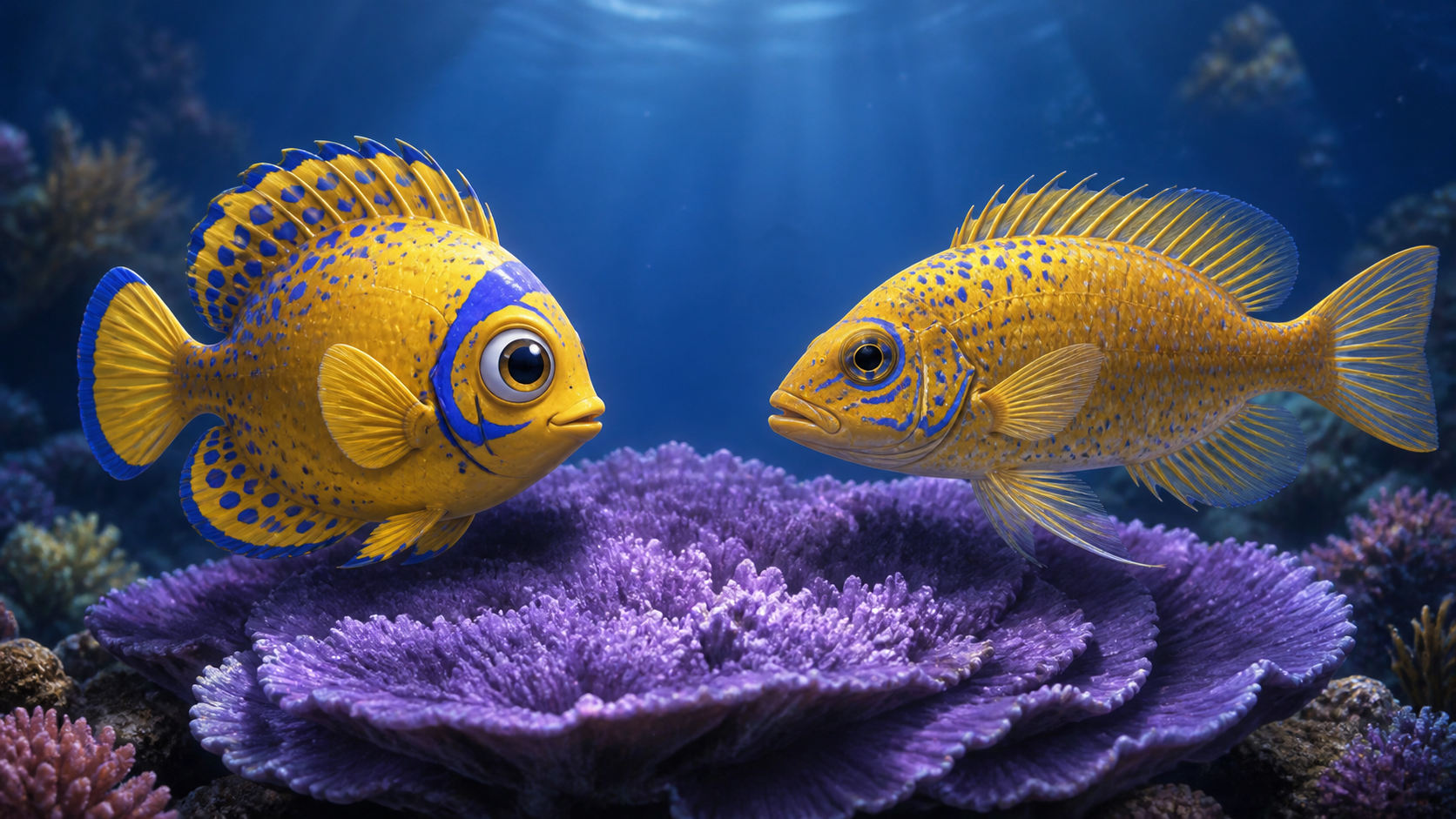
The sequel presents Flounder as an adult with children. The visual joke is immediate because the tiny childhood companion has become a larger parent surrounded by little fish.
The change is more than a gag. It confirms that time moved for Ariel’s underwater community. Flounder developed a life, family, and identity during the years when the human kingdom and Atlantica were separated.
Cam Clarke voices continuity after childhood
Cam Clarke performs the adult Flounder in Return to the Sea. The character remains warm and recognizable while no longer being frozen at the age audiences first met him.
Changing performers fits a role whose body and social position have changed. The sequel could have explored his adult perspective more deeply, especially what he thinks about Ariel hiding the sea from Melody after their own forbidden childhood adventures.
He should challenge the seawall
Flounder knows what secrecy did to Ariel and how dangerous unsupervised curiosity became. A wall that erases the ocean from Melody’s life should alarm him even when Morgana’s threat is real.
As a parent, he can understand protective fear without accepting total prohibition. His experience positions him to argue for specific safety, honest history, and guided contact rather than another childhood built from contraband.
Jacob Tremblay enters a different visual contract
The 2023 film gives Flounder a more naturalistic fish body and Jacob Tremblay’s voice. The design limits the elastic face and exaggerated gesture available to the 1989 animation.
Voice must carry more of the warmth, anxiety, and friendship. The adaptation question is not whether realism is automatically better or worse. It is whether the film replaces lost visual expressiveness through performance, blocking, sound, and behavior.
Naturalism changes the audience’s permission to empathize
A round animated face announces personality before movement begins. A realistic reef fish asks viewers to locate character in eyes, timing, distance, and vocal rhythm.
That shift can create wonder by making the friendship feel embedded in an ecosystem. It can also make emotional beats harder to read. Design is not neutral packaging. It determines which feelings the body can communicate quickly.
He is not Ariel’s emotional support animal
Flounder listens, accompanies, warns, retrieves, protects, and repairs. If every one of those actions exists only to develop Ariel, the story consumes a friend as a service.
A complete profile asks what he wants: safety without isolation, curiosity without preventable disaster, continued connection after Ariel leaves, respect for his warnings, and a life that does not begin and end at the edge of her next decision.
Friendship needs reciprocity, not only loyalty
Ariel clearly loves Flounder, but the plot gives more evidence of what he risks for her than what she risks specifically for him. That imbalance is partly a consequence of protagonist-centered storytelling.
Future stories can correct it through ordinary attention. Let Ariel visit his family, support his work, remember his limits, and ask what changed for him after her departure. Reciprocity does not require equal adventures. It requires both lives to count.
His future is navigation education
Flounder has survived wrecks, predators, magical exploitation, border restrictions, and the joining of sea and shore. That experience can become knowledge offered to younger explorers.
The best future does not make him the adult who bans every dangerous question. It makes him the guide he needed: honest about risk, respectful of curiosity, prepared with routes and rescue plans, and willing to accompany without surrendering his own boundaries.
The friend who becomes evidence
Flounder’s presence confirms that Ariel’s fascination is not a solitary fantasy assembled in one afternoon. He has watched her search, heard her theories, carried discoveries, and seen the pattern grow. If Triton asked him honestly what Ariel needed, he could provide a history rather than a rule violation.
Instead, his knowledge remains private because the family system makes disclosure dangerous. Telling Triton could expose Ariel’s sanctuary. Staying silent can expose both friends to greater hazards. Flounder becomes the young confidant holding information that responsible adults should have made safe to discuss.
Why calling him a coward protects everybody else
The coward label simplifies group responsibility. If Flounder is simply timid, Ariel never has to examine how often she normalizes danger for a friend with less power. Sebastian never has to distinguish useful caution from institutional obedience. The audience can laugh instead of asking whether the expedition plan was reckless.
His reactions perform an ethical service. They keep consequence visible inside a story built to celebrate crossing boundaries. Without Flounder, curiosity could look costless until the shark arrives. His body registers the price before the plot is ready to pause and count it.
Royal friendship contains a power difference
Ariel and Flounder are emotionally close, but one is a king’s daughter and the other is not presented with comparable status. The film does not show Ariel threatening him with rank. It does show a world where her wishes reorganize the attention and risk of everyone nearby.
Power differences do not make friendship false. They create obligations for the more protected friend. Ariel should notice when Flounder’s no becomes a joke, when he bears consequences for her choices, and when access to her new life disappears because only her body receives transformation.
The archive asks who gets credit for collecting
Museums and private collections often celebrate the named owner while erasing guides, divers, carriers, translators, cataloguers, and local knowledge. Ariel’s grotto participates in that romantic image of the lone collector even though Flounder repeatedly assists the process.
Crediting him changes the ethical reading. The grotto becomes collaborative research assembled under prohibition. Its destruction then harms a network of labor and memory. A repair worthy of the loss would preserve provenance, name contributors, and make safe inquiry public rather than rebuilding another secret room.
He is the first audience for Ariel’s interpretations
Before Scuttle supplies ridiculous explanations, Flounder hears Ariel turn objects into hypotheses about human life. He watches imagination operate with too little evidence because formal education has been denied. His attention gives her a place to think aloud.
That role can be nourishing and exhausting. Being somebody’s constant first listener means absorbing every new obsession, crisis, and disappointment. Friendship remains healthy when the listener can bring his own questions and receive the same sustained curiosity in return.
The shark sequence teaches the wrong lesson if fear is mocked
A shark attacks inside a confined wreck. Flounder’s alarm is correct down to the second. If viewers conclude that he should have been calmer, they miss the competence contained in rapid threat recognition.
The useful lesson is not to suppress the alarm. It is to act through it. Find the exit, warn the partner, avoid freezing in the path, and use the environment. Flounder survives because fear and problem solving coexist, not because confidence replaces fear.
Ariel’s silence after transformation is his communication test
When Ursula takes Ariel’s voice, friends must interpret gesture, urgency, and circumstance without receiving a complete explanation. Flounder already knows her patterns well enough to help bridge that gap.
The situation exposes why relational knowledge matters. A person can lose the conventional tool of speech without losing intention. Friends who have listened over time can support communication instead of treating silence as emptiness. The contract weaponizes voice, but it cannot erase shared history.
The surface makes him geographically disabled
Flounder is fully capable in the ocean. The human world converts his ordinary body into a mobility restriction. He can reach the shoreline but not move through Eric’s palace, sit at the table, or remain beside Ariel without a container that would make him dependent on others.
This is not personal inadequacy. It is an environment built for different bodies. Ariel’s transformation solves access for her alone. A joined sea-and-shore future should create channels, pools, communication spaces, and public design that allow aquatic citizens to participate without needing to become human.
Grief does not make him entitled to stop Ariel
Flounder can lose daily closeness and still support Ariel’s autonomy. The mature emotional position is neither cheerful erasure nor possessive opposition. It is honest grief paired with respect.
The film rushes from victory to wedding, leaving little space for that complexity. Future stories could show scheduled visits, new rituals, awkward adjustment, and the work of maintaining a friendship across environments. Happy endings need infrastructure too.
Adulthood should alter his relationship with danger
A parent Flounder has reasons to think differently about risk. He knows curiosity can uncover knowledge and trigger catastrophe. He also knows bans can push exploration underground. Those experiences make him valuable to young adventurers precisely because he cannot offer a simple yes or no.
The children visible in Return to the Sea raise questions the sequel barely explores. What stories does he tell them about Ariel? Does he describe the shark, Ursula, the wedding, or the years of separation? Parenting transforms adventure into inherited memory, and memory always involves choices about what fear should teach.
The sequel turns him into a visual punchline too quickly
Adult Flounder appears larger and surrounded by children, creating an immediate surprise for viewers who remember the tiny companion. The joke acknowledges time, but the film spends little time on the person that time produced.
A richer return would let him advise Ariel as a peer and parent. He can understand why she fears Morgana while challenging the wall. He can tell Melody what her mother was like at the same age without betraying Ariel. That conversation would connect generations through truth instead of another secret.
A realistic fish still needs blocking with intention
In naturalistic adaptation, a fish cannot shrug, clasp hands, or stretch a mouth through the same graphic shapes as a cartoon. Directors must place him at meaningful distances, control swimming tempo, use eye lines, and let sound design signal when attention changes.
If the camera treats him as background wildlife while the dialogue claims intimate friendship, the relationship weakens. Naturalism succeeds when cinematic choices rebuild expressiveness through behavior. It fails when realism becomes an excuse to remove personality from the frame.
What Jacob Tremblay has to carry in the voice
Jacob Tremblay’s performance must communicate youth, loyalty, warning, humor, and affection with fewer facial cues than Jason Marin received. Vocal timing becomes the bridge between animal realism and human-readable relationship.
Comparison should respect different assignments. Marin works with elastic hand-drawn animation designed around performance. Tremblay works against a body designed to resemble marine life. The question is how effectively each production coordinates voice and image, not which actor produces the most familiar sound.
The ethics of making animals legible
The franchise asks audiences to experience fish as speaking citizens while also building jokes around fishing, cooking, and predation. Flounder’s personhood makes the human appetite surrounding Sebastian’s kitchen scene more than abstract danger.
A joined kingdom would have to confront those contradictions. Are all sea creatures citizens? How do humans fish without capturing Atlantican people? Where are borders marked? The small friend’s body opens political questions the romance cannot solve by itself.
His friendship with Sebastian deserves its own history
Flounder and Sebastian cooperate because both care about Ariel, but they occupy different ages and responsibilities. Sebastian can become mentor, critic, and co-rescuer without replacing peer friendship.
Their shared memory extends beyond Ariel’s immediate presence. After she moves ashore, the two remain in the ocean with knowledge of what happened. That creates room for a relationship built on debriefing, disagreement, music, civic work, and the complicated feeling of missing the same person differently.
His friendship with Scuttle is translation work
Scuttle brings energy and surface access, but his explanations are unreliable. Flounder helps carry those explanations back into an underwater context and watches Ariel decide what to believe.
Translation here is not only vocabulary. It is judging confidence, motive, evidence, and risk across species. Flounder’s caution can balance Scuttle’s certainty, making him part of the research method rather than merely the frightened audience for a joke.
A friend can set limits without abandoning the relationship
The next mature version of Flounder should occasionally refuse an unsafe plan and offer an alternative. Bring more help. Mark the route. Wait for daylight. Tell a trusted adult who will not destroy the evidence. Prepare an exit.
Boundaries would complete his arc because courage has never required unlimited availability. The friend who always follows can become the friend who helps build better conditions for following. That shift honors loyalty without turning it into self-erasure.
What a reciprocal visit could look like
Ariel’s return to the sea should include time organized around Flounder’s life rather than a royal emergency. She could meet his children, see his home, ask about his work, and listen to what the separation meant from below the surface.
Such a scene would do more for the friendship than another rescue. It would show that Ariel remembers the person who helped build her archive and survive her transition. Attention is a form of repayment when the original gift was years of attention.
The guide he can become
Flounder’s future role should combine archive work, navigation, and safety education. He can maintain maps of wrecks, human shipping paths, predator grounds, magical hazards, and accessible routes between the kingdoms.
That position transforms the supposed coward into an expert whose sensitivity to danger benefits everyone. Atlantica would finally value the trait it once used for comedy. Young explorers would receive both honest warning and practical access, which is more humane than fear disguised as prohibition.
Final character receipt
Flounder is not brave despite being scared. He is brave through the process of being scared accurately, communicating the danger, and choosing useful care anyway.
His deepest story is not a joke about cowardice. It is the emotional labor of the friend who stays close to somebody moving toward a world he cannot enter, then grows a full life without pretending that departure cost nothing.
Keep exploring The Little Mermaid
Return to The Little Mermaid hub for films, reviews, Reacts, rants, lore, guides, and the full character directory.