
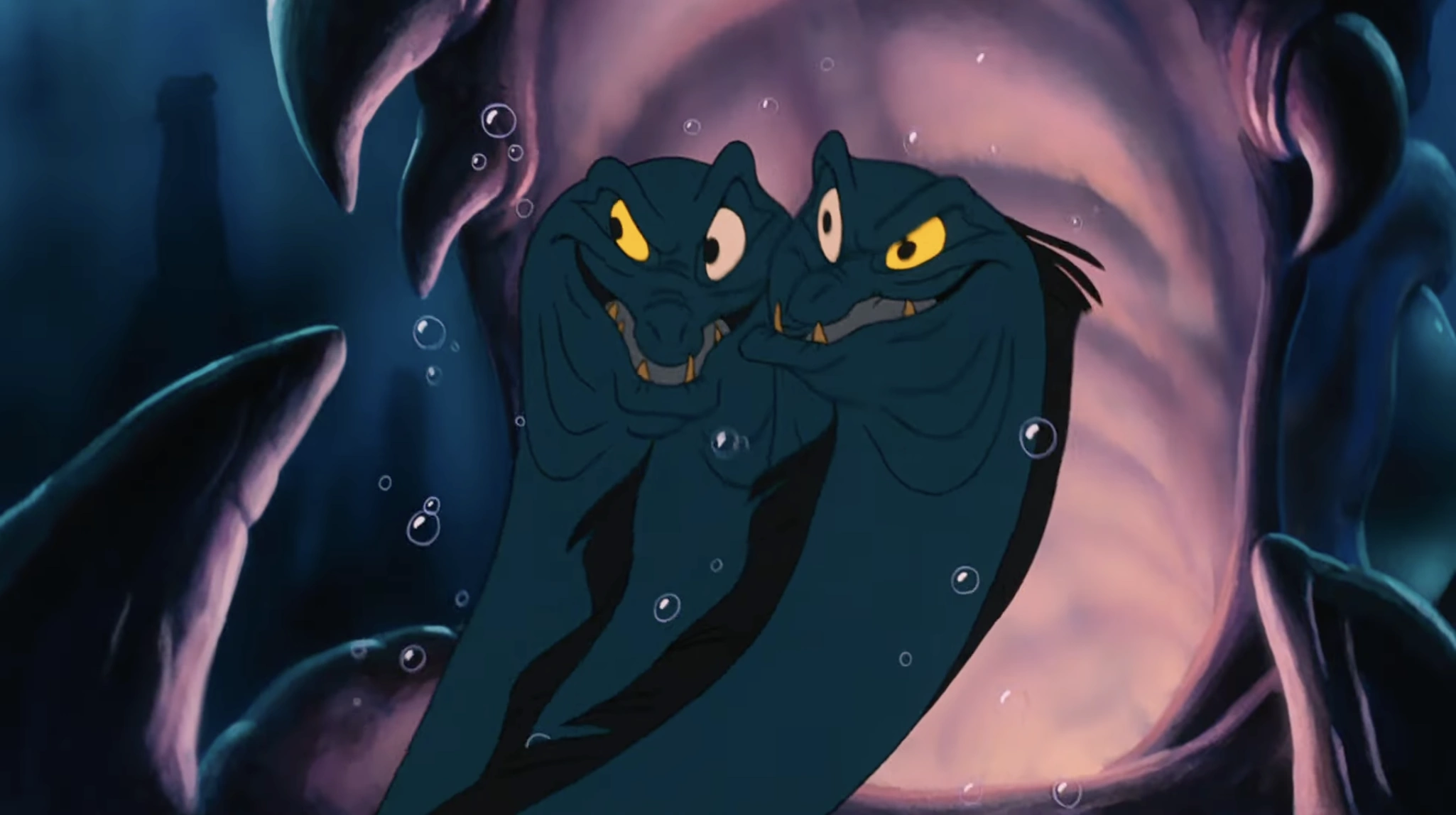
Character File · The Little Mermaid · Surveillance, Paired Identity, and Ursula’s Disposable Eyes
Flotsam and Jetsam
They look like Ursula’s pets until their eyes begin showing her everything. Then the affection starts looking like a management system.
Quick file
Film: The Little Mermaid (1989). Performer: Paddi Edwards voices both eels, and Disney’s official film page lists Edwards twice in the cast, a production receipt consistent with the paired performance. Employer: Ursula. Functions: surveillance, recruitment, intimidation, sabotage, and physical enforcement.
Distinguishing feature: the eels operate as a matched pair whose magical eyes relay what they see to Ursula. Later media and stage interpretations expand them differently, but this profile centers the animated film and uses adaptation material only where it clarifies the original design.
The names tell you they are what a system discards
Flotsam and jetsam are maritime terms associated with wreckage and cargo in the sea. Giving the eels those names frames them as debris before the plot has even decided how much inner life they possess. They are useful, mobile, and ominous, but also linguistically disposable.
That naming becomes cruelly accurate at the climax. The pair help Ursula pursue power, yet their bodies are the ones caught in the conflict. A leader who calls subordinates beloved can still treat them as replaceable material.
They are two characters and one instrument
The film distinguishes the eels enough for the pair to have separate names, bodies, positions, and movements. At the same time, Ursula uses them as a single apparatus. They arrive together, flank together, see together, and complete each other’s surveillance field.
A combined profile respects that structural pairing without claiming they have no individuality. The important question is why the story gives them individuality only in fragments. Their employer benefits when difference never becomes enough to support independent judgment.
Paddi Edwards builds a matched menace
One performer voicing both eels makes their unity audible. Edwards does not need long speeches to establish intelligence, pleasure in intimidation, and the unsettling coordination of two agents who seem to finish the same intention.
The shared performance reinforces the system metaphor. Ursula does not merely have two employees. She has a duplicated extension of herself, a pair whose voices and movements arrive as synchronized pressure around the person she wants to control.
Ursula calls them babies because control can sound affectionate
The language of affection matters. Calling subordinates babies can communicate genuine attachment, ownership, infantilization, or all three at once. It lets Ursula present command as family while keeping the authority to decide where they go and what danger they absorb.
Family language inside unequal power can make refusal feel like betrayal rather than a workplace boundary. The eels may experience closeness as real. That does not make the arrangement equal or safe.
Their eyes convert privacy into a resource
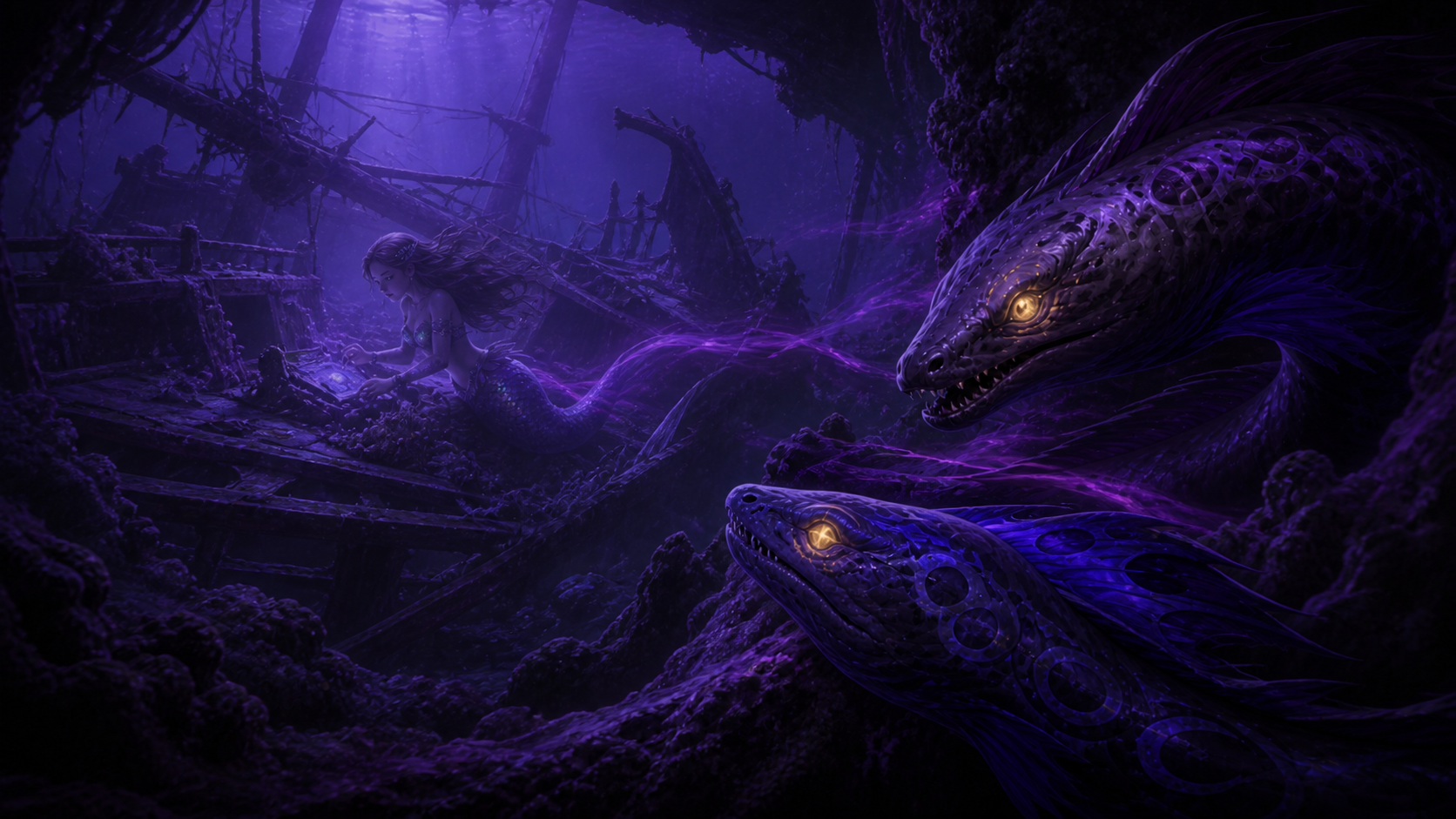
Ariel’s private exploration becomes visible to an adult antagonist through the eels’ magical sight. She does not know she is being observed, cannot consent to the transmission, and cannot control how the information is stored or interpreted.
Surveillance is not passive because it changes who holds possibility. Ursula learns what Ariel wants, where conflict with Triton is growing, and when vulnerability is highest. The information becomes the raw material for a targeted offer.

The shipwreck is where curiosity becomes a file
Ariel experiences the wreck as discovery, danger, and fascination with human objects. Flotsam and Jetsam experience the same space as an observation post. Their hidden position turns a teenager’s curiosity into evidence of disobedience and emotional leverage.
The scene matters because the eels do not create Ariel’s longing. They monitor it until an employer can exploit it. Predatory systems are often most effective when they wait for a real desire instead of inventing a fake one.
They wait for the family rupture
Ursula’s recruitment strategy becomes viable after Triton destroys Ariel’s collection. The eels approach when the teenager is shocked, grieving, angry, and isolated from the parent who normally controls access to power.
Timing is part of coercion. A proposition can use technically voluntary movement while selecting the moment when the person’s capacity for reflection is lowest. The eels make the next step appear immediate and compassionate.
Manufactured help is more effective than capture
The pair do not need to drag Ariel through the ocean. They position Ursula as the adult who can solve what Triton broke. That framing turns a dangerous lair into the only room apparently willing to take the teenager’s desire seriously.
The manipulation works because it contains a truth. Triton did refuse to listen and used violence against Ariel’s possessions. Honest grievance becomes the doorway through which dishonest help enters.

They function as a moving corridor
As Ariel follows them, the eels shape where she can look, how quickly she moves, and which alternatives remain visible. Their bodies create a path toward Ursula while making retreat feel like rejecting the first beings who responded to her pain.
Architecture does not always require walls. A pair of guides can narrow choice through pace, proximity, confidence, and the certainty that they already know where the solution is.
The contract room is not neutral
Ursula performs the bargain as though Ariel has entered a private negotiation between two parties. Flotsam and Jetsam remain present as armed atmosphere. Their bodies and gaze remind the teenager that she is inside the employer’s territory.
Consent is weakened not only by false terms but by the environment surrounding the signature. A client cannot freely deliberate when the seller controls information, exit, witnesses, enforcement, and the intimidating agents circling nearby.
One watches while the other closes the gap
Paired agents can divide attention. One eel can monitor Ariel’s reaction while the other protects Ursula, blocks movement, or prepares to intervene. The coordination increases pressure without requiring explicit violence.
That division also diffuses personal responsibility. Each individual can imagine the other was the primary threat, the employer designed the plan, and the victim still moved voluntarily. The system accumulates harm through pieces small enough for every participant to minimize.

They enforce a bargain built on asymmetric information
The eels know Ursula’s intentions better than Ariel does. They participate while the sea witch withholds the deeper purpose of the voice, the plan for Eric, and the route toward Triton’s power.
Silence in that context is not neutral. Subordinates who understand material deception and continue to secure the transaction contribute to the coercion, even if they did not write the terms.
The rowboat sabotage is violence disguised as weather
When Ariel and Eric approach the kiss that could satisfy the bargain, the eels overturn the boat. The intervention targets bodies, animals, and the limited time remaining while preserving Ursula’s plausible distance from the scene.
Sabotage is especially effective when victims interpret it as accident. Instead of recognizing an adversary, they blame clumsiness, timing, or fate. The system remains invisible and therefore free to strike again.
They attack intimacy because the contract depends on failure
Ursula pretends to offer Ariel a chance while deploying agents to prevent success. The bargain is not a risky opportunity. It is a rigged process whose author changes conditions whenever the client approaches the promised outcome.
Flotsam and Jetsam make the rigging operational. Their labor proves that the contract’s apparent fairness was never intended to survive contact with Ariel’s agency.

Their shared vision is power and enclosure
The magical eye connection gives the pair extraordinary reach and makes them valuable to Ursula. It may also mean that seeing is never fully private. Their perceptions are routed into an employer’s mirror and interpreted through her goals.
A tool that grants capability can still colonize the user. If the eels cannot choose when to disconnect, their senses have become company property. The film does not answer that question, but the design makes it worth asking.
Constant pairing can prevent dissent
Being inseparable may offer safety, companionship, and coordination. It can also make independent thought harder if every reaction is immediately mirrored, judged, or absorbed into a shared task.
Ursula gains from a pair that never develops separate constituencies, memories, or routes of escape. Two agents who see themselves only as a unit may find it difficult to imagine one refusing before the other.
Subordination explains pressure without granting innocence
Flotsam and Jetsam serve a more powerful sorceress and may have limited room to refuse. That context matters when assigning responsibility. It does not make Ariel’s surveillance, grooming, intimidation, and sabotage harmless.
Moral analysis can hold both truths. The employer owns the plan and greatest power. The agents still make choices inside that structure and cause direct harm. Coercion can reduce culpability without reducing the victim’s injury.
The film gives us little evidence of refusal
Viewers may imagine fear or dependence because the power imbalance is obvious, but the eels often appear eager and aligned with Ursula’s goals. A serious profile marks the difference between plausible interpretation and established behavior.
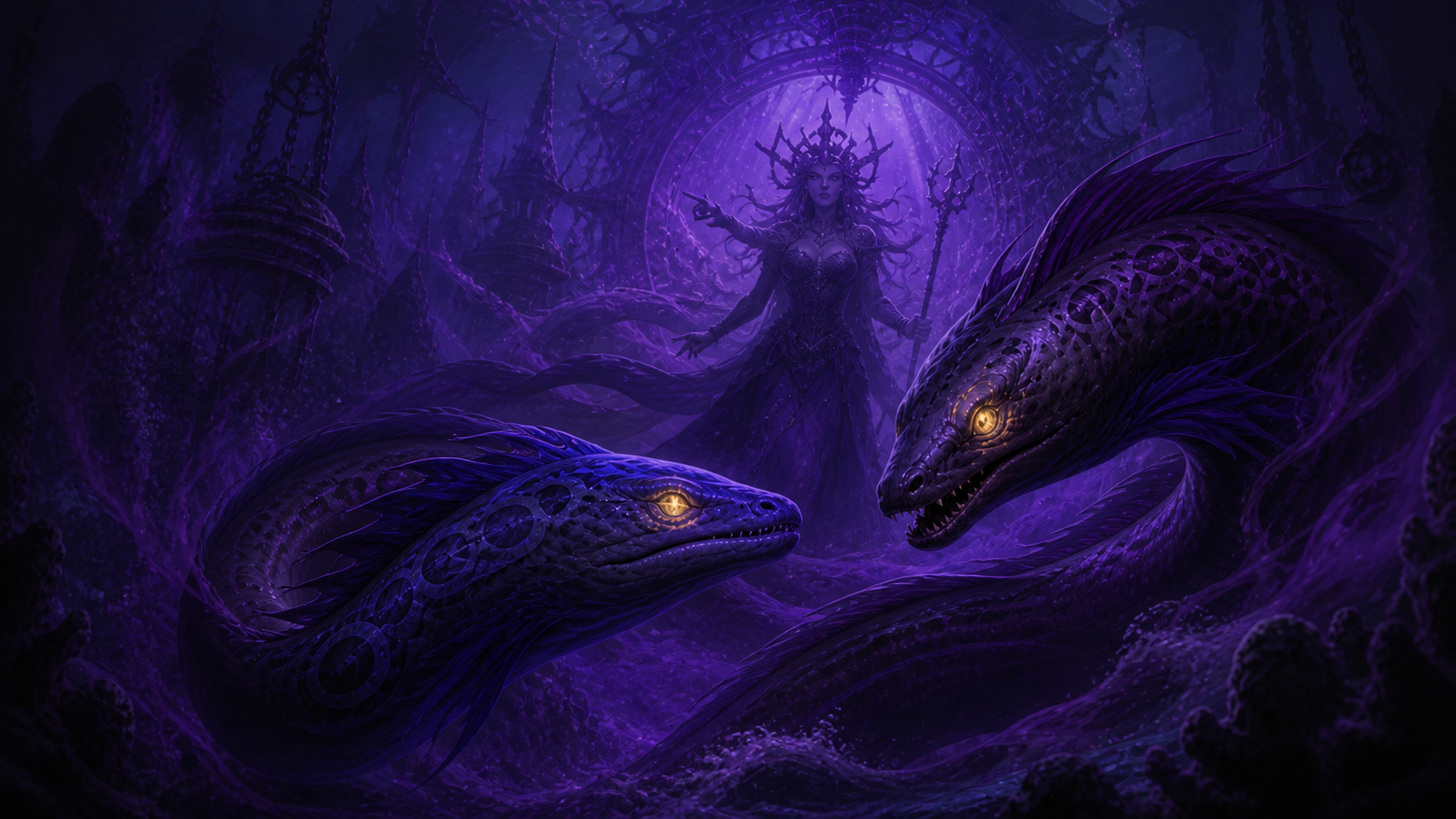
The alternate art explores a fearful glance as a question, not a canon claim. The published analysis should not manufacture hidden goodness merely because the agents die. Tragedy does not require retroactive innocence.
They are more than comic henchmen
The eels lack the verbal comedy assigned to many animated sidekicks. Their silence and movement preserve menace while allowing Ursula to remain theatrical. They do the quiet work that makes her large performance effective.
That division of tone is part of the villain system. Ursula can seduce, joke, sing, and bargain because Flotsam and Jetsam carry surveillance, pursuit, and physical threat around the edges.
The climax spends the agents first
During the struggle involving Triton’s power, Flotsam and Jetsam are struck and killed. Their deaths provoke Ursula’s rage, suggesting attachment, but attachment arrives too late to create safety.
The pair entered the battle as extensions of her plan and became casualties of power they did not control. The moment exposes the difference between being valued for usefulness and being protected as a person.

Ursula’s grief does not cancel her management choices
Her reaction to losing them can be emotionally real. Villains can love selectively, and abusive leaders can grieve subordinates they also endangered. The two facts are not mutually exclusive.
The important question is what the relationship required before death. Did affection permit dissent, safety, and independent life, or did it intensify loyalty while leaving risk entirely with the eels?
The 2023 adaptation removes the named pair
The 2023 film does not preserve Flotsam and Jetsam as named eel agents. Ursula’s magical surveillance and manipulation become more solitary or are redistributed through other mechanisms. The absence changes the architecture of her power.
Without the pair, responsibility concentrates more directly in Ursula. The adaptation loses the unsettling image of a villain outsourcing vision and force to creatures she calls family, but it also avoids spending subordinate animal bodies in the climax.
Absence is an adaptation choice with consequences
Removing characters is not automatically simplification or improvement. It changes pacing, visual symbolism, labor distribution, and the number of moral relationships the antagonist carries.
A full review should ask what the modern film gains by making Ursula more self-contained and what it loses by erasing the surveillance duo’s eerie mixture of intimacy and infrastructure.

Merchandise often turns threat into decoration
Flotsam and Jetsam are visually striking, which makes them easy to reproduce as villain accessories, fashion motifs, ride elements, and collectible companions. The transformation can flatten surveillance and coercion into glamorous loyalty.
Enjoying the design is not a moral failure. Analysis simply keeps the original function visible. The glowing eyes are beautiful because the artists made them so, and terrifying because those eyes belong to someone else while Ariel believes she is alone.
An accountability path cannot begin with “we were ordered”
If the pair survived, repair would require returning captured memories, identifying every target, disclosing how information moved, dismantling the mirror network, and accepting consequences for recruitment and sabotage.
They could explain coercion without using it as acquittal. Victims would not owe forgiveness, and separation from Ursula would be the beginning of responsibility rather than its completion.
They would need separate names that mean more than debris
Rehabilitation would also require individual identity. Each eel would need private memory, independent consent, relationships outside the pair, and the right to disagree without making separation feel like death.
The original names can be reclaimed, but the system that defined them as wreckage must end. A duo becomes healthier when connection is chosen by two complete selves rather than installed as an employer’s convenience.
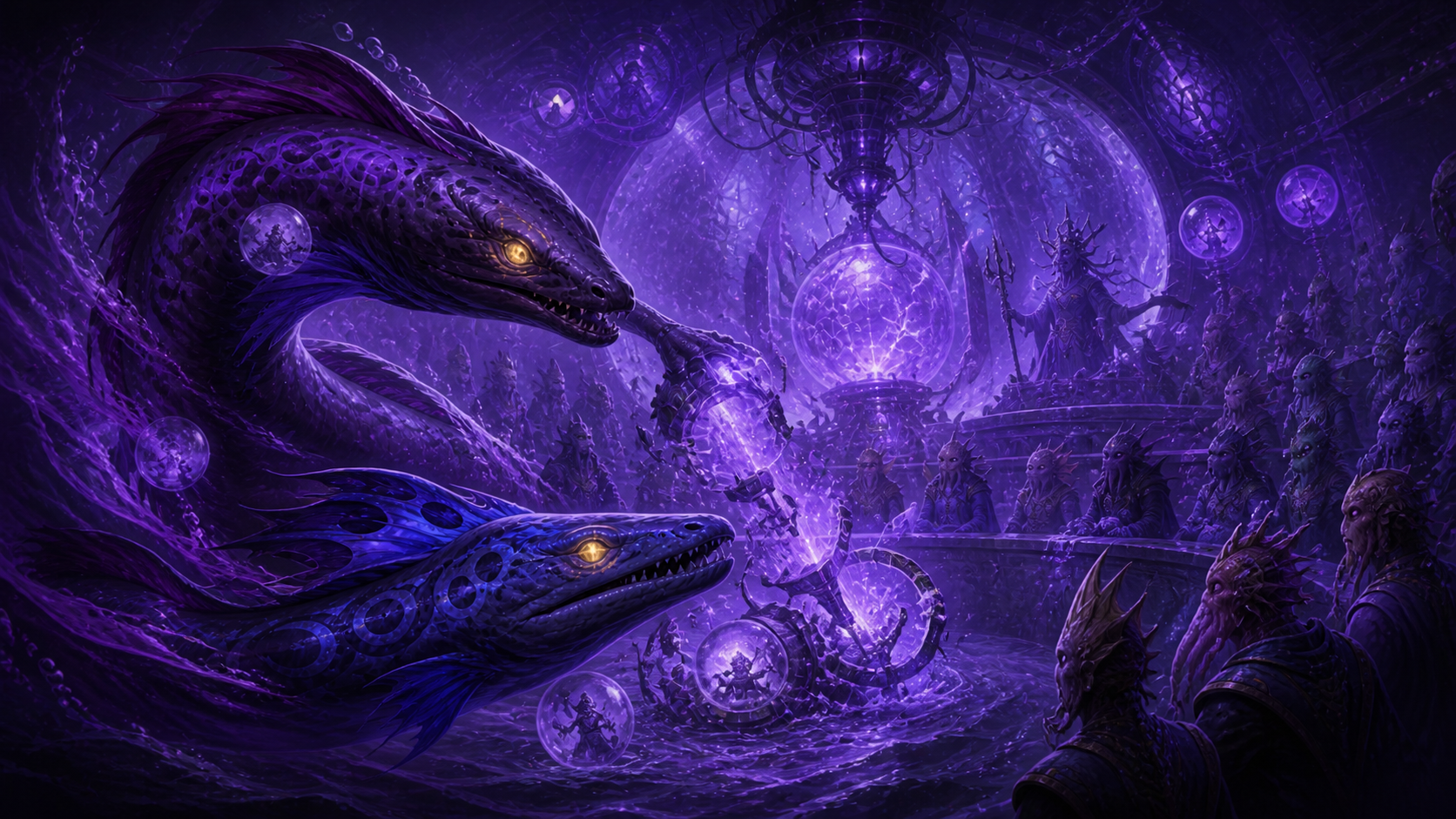
Surveillance changes behavior even before the target knows
Ariel cannot react to observers she has not detected, but the audience’s knowledge changes the shipwreck scene. Curiosity no longer unfolds in an empty place. Every gesture may become a data point interpreted by somebody hostile, and the freedom of exploration has already been compromised before any visible confrontation begins.
That dramatic irony makes Flotsam and Jetsam more frightening than ordinary pursuers. A chase begins when the target recognizes danger. Surveillance begins earlier, during the period the target believes belongs only to her. The theft is not simply information. It is the unobserved self Ariel thought she was allowed to have.
Ursula collects context, not only images
The value of the eel network is not that Ursula sees a teenager swimming past objects. She can connect scenes across time: Ariel’s fascination with humans, Triton’s prohibition, the emotional intensity of the collection, the rescue of Eric, and the destruction that leaves Ariel isolated. Context turns observation into prediction.
A single image may be ambiguous. A sequence allows the employer to infer which pressure will move the target. This is why privacy analysis must consider aggregation. Harmless facts can become dangerous when one powerful actor combines them into a behavioral profile.
The pair make Ursula feel omnipresent without requiring omniscience
Ursula’s theatrical authority depends on appearing as if she already understands Ariel. The eels do the reconnaissance that lets the sorceress perform intuition. Their labor disappears into her charisma, and the target experiences calculated research as supernatural personal insight.
That structure resembles many manipulative institutions. The person delivering the pitch looks uncannily perceptive because unseen workers gathered the history, segmented the vulnerability, and prepared the script. Flotsam and Jetsam are the hidden research department behind “I know exactly how you feel.”
Animal coding makes exploitation easier to overlook
Because the agents are eels rather than humanoid courtiers, viewers may treat their labor, consent, and deaths as less morally complicated. Their bodies are visually available for menace and destruction without requiring the film to pause over funeral, biography, or community.
The choice also strengthens Ursula’s marine domain and gives animation fluid shapes that can coil around Ariel. Both things can be true. The design is artistically effective, and the nonhuman form makes it easier for the narrative to spend them.
Plausible deniability is built into every mission
Hidden observers can deny the target proof. Helpful guides can claim they merely offered a route. Contract guards can say they never wrote the terms. Boat saboteurs can disappear beneath the surface. Every assignment separates Ursula from the immediate act and gives the eels a smaller description of their own responsibility.
The harm becomes systemic precisely because no single step sounds like the whole crime. Accountability must reconstruct the chain: who selected the target, who collected information, who approached during distress, who controlled the room, who interfered with success, and who benefited.
The kiss deadline makes sabotage an enforcement action
The contract creates a deadline that appears to place performance risk on Ariel. Once the eels intervene, the deadline is revealed as an enforcement mechanism controlled by the seller. Ursula can create the condition, obstruct satisfaction, and then claim the penalty followed the agreement.
Flotsam and Jetsam are therefore not random villains interrupting romance. They are collections agents protecting a fraudulent business model. Their rowboat mission ensures that the client’s failure can be described as contractual outcome rather than deliberate interference.
Paired identity can conceal unequal experience
The film gives little evidence about differences between Flotsam and Jetsam, which tempts analysis to treat every motive as perfectly shared. Yet matched roles do not guarantee matched feelings. One could be more afraid, more loyal, more ambitious, or more willing to question the work.
The absence of evidence should not become invented canon, but it reveals what Ursula’s system erases. When two subordinates are always named together, evaluated together, and deployed together, the institution loses the ability to hear dissent that might exist in only one.
Their deaths transform affection into possession
Ursula’s fury after the trident blast demonstrates that the eels mattered to her. It does not tell us what kind of mattering existed. Grief can arise from love, dependence, wounded ownership, lost capability, or a mixture the grieving person cannot separate.
The word “babies” becomes darker after the deaths because a protective parent would design danger around keeping dependents alive. Ursula instead places them between her ambition and Triton’s weapon. The emotional claim is large. The safety structure is absent.
Ariel never receives a full account of the surveillance
The plot resolves Ursula’s immediate threat, but Ariel does not receive a transparent record of how long she was watched, what the eels transmitted, or whether any magical images remain. Victory stops the villain without repairing informational harm.
A responsible post-crisis process would disclose the scope, destroy or return captured memories, identify other targets, and examine how Atlantica allowed a surveillance network to operate near the royal family. Personal courage cannot substitute for institutional learning.
Triton’s blast carries its own responsibility
Flotsam and Jetsam serve Ursula and move within an active battle, but the fatal strike still raises questions about force, targeting, and who is treated as recoverable. Triton’s power has already been shown as emotionally reactive when he destroys Ariel’s collection.
The film’s climax moves too quickly for adjudication, and the eels are immediate threats. A nuanced reading can recognize defensive urgency while refusing the idea that villain affiliation makes every subordinate death ethically simple.
The 2023 Ursula becomes lonelier and more directly culpable
Removing the eel agents strips away the employer-subordinate relationship that complicated the animated Ursula. The modern antagonist cannot hide coercive work inside beloved pets or share immediate blame with named enforcers. More of the manipulation appears as her own magic and planning.
That concentration can sharpen culpability but flatten organizational texture. The animated film understands that charismatic power scales by giving its eyes and hands to others. The adaptation gains a solitary witch and loses a miniature institution.
What a separated future would actually require
If one eel chose to leave before the other, safety planning would be essential. Ursula controls information, magical access, and likely the surrounding territory. Departure could expose the dissenter to retaliation while the remaining partner experiences separation as abandonment.
Repair would need independent housing, protection, private communication, trauma care, and the ability to build a name outside the pair. Liberation is not complete when the employer disappears if the subordinates have never practiced being selves.
They are an Easter egg only when the callback says something
Later appearances, designs, and villain collections often place the pair beside Ursula because their silhouettes instantly identify her world. A deep review should verify those callbacks individually rather than calling every pair of eels a reference. The useful Easter egg is the one that preserves a function: mirrored eyes, coordinated movement, surveillance, or the language of beloved subordinates.
That rule protects the editorial review from trivia inflation. Recognition alone is not analysis. A callback matters when it changes how the new scene distributes responsibility, remembers the deaths, or turns an old instrument of control into decoration.
The pair remain memorable because the animation never lets beauty and threat separate cleanly. Their bodies move with elegance, their eyes glow like jewels, and every graceful curve closes another route around Ariel. The design does not merely say danger. It shows how danger becomes easier to follow when it arrives looking coordinated, intimate, and certain of the way.
They are not scenery. They are the surveillance system learning to swim.
Final character receipt
Flotsam and Jetsam are effective because the film turns two creatures into the bridge between Ursula’s theatrical promise and her hidden enforcement. They watch the desire, select the wound, guide the target, guard the bargain, sabotage success, and absorb the final blast.
Their story asks what remains of a subordinate after an employer owns the mission, the senses, the partnership, and the language of love. The answer is uncomfortable: enough agency to cause harm, not enough power to survive the system they helped operate.
Keep exploring The Little Mermaid
Return to The Little Mermaid hub for films, reviews, Reacts, rants, lore, guides, and the full character directory.
Flotsam and Jetsam make Ursula’s surveillance feel intimate because they turn distance into access. Their obedience is not friendship. They are instruments inside a system that collects vulnerability before the person being watched understands that a bargain is already forming.