
The Five Houses: How Terror Across Osten Ard Powers One Ritual
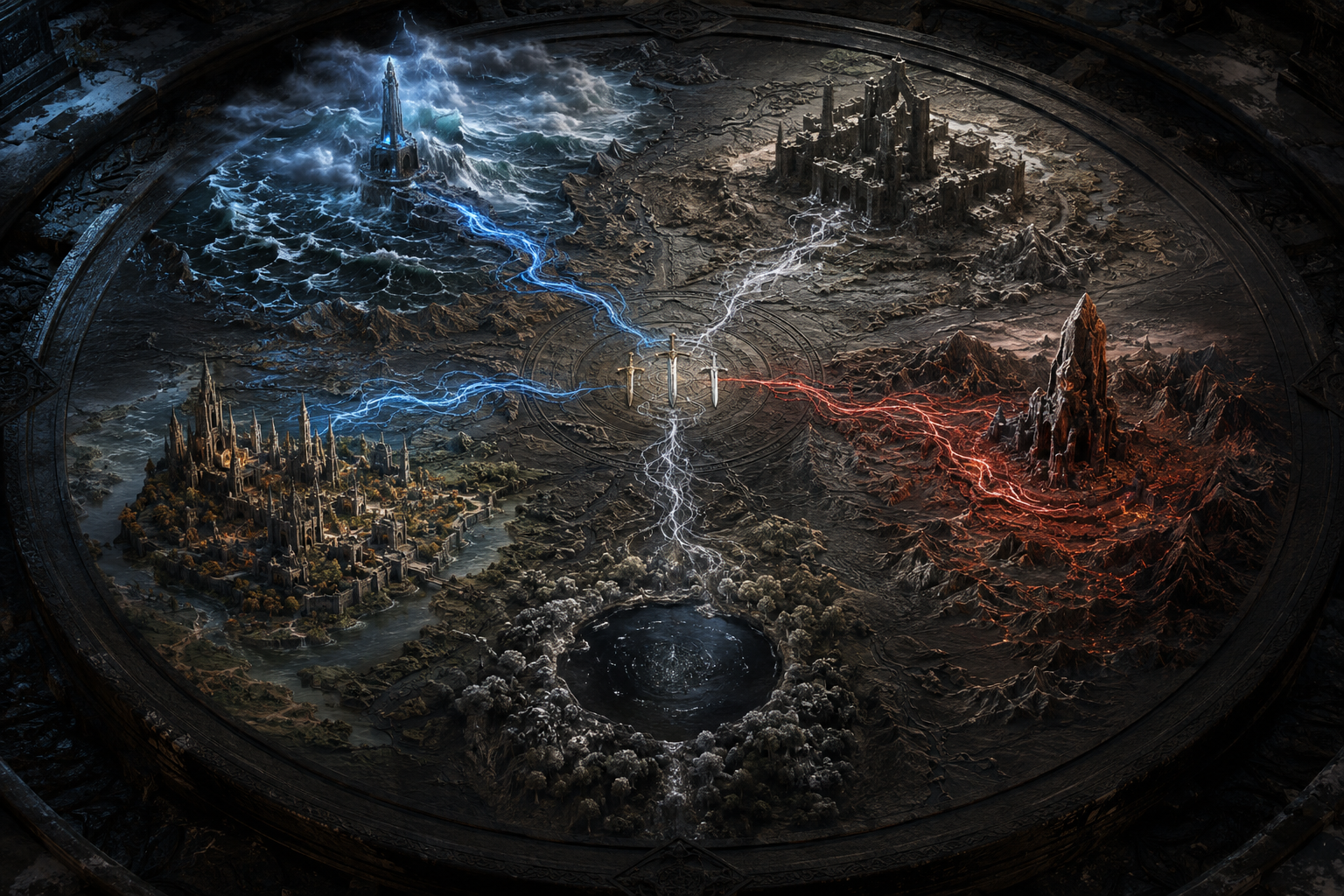
The finale does not happen in one bell chamber. Pryrates turns five distant atrocities into a synchronized circuit, uses the Three Swords to close it, and opens Time at the exact wound Ineluki never released.
The short answer
Pryrates and the Red Hand prepare five sites across Osten Ard. Each site accumulates fear, death, rage, or supernatural strain. When all five Houses are open and the Three Swords meet inside Asu’a, the stored force supports the Words of Unmaking.
Those Words do more than summon a ghost. They reverse Time toward the moment of Ineluki’s banishment so the Storm King can cross into Elias, alter the founding catastrophe, and remain embodied in the present.
The ritual is continental because the grievance is historical. One tower cannot supply five centuries of engineered hatred by itself.
The five ritual stations
First House · Hayefur shore
Norns open the First House at the northern shore. The location ties the circuit to the Hikeda’ya campaign and the violence moving outward from Stormspike.
Second House · Naglimund
A Red Hand servant opens the Second House in the captured fortress. Naglimund’s fall, occupation, dead, and continuing terror become usable ritual history rather than background tragedy.
Third House · Wailing Stone
Utuk’ku opens the Third House. The site places the Norn Queen’s ancient grief and power directly inside the network.
Fourth House · Asu’a
The Hayholt’s older Sithi identity becomes the Fourth House. Green Angel Tower is the convergence chamber, but the entire buried city supplies the ritual architecture.
Fifth House · Pool of Three Depths
The Pool opens last. It completes the system and fixes Utuk’ku there long enough for the failed crossing to rebound against her power.
Why “House” matters
The owned-edition reference layer identifies A-Genay’asu as Houses of Traveling Beyond. That language frames each site as constructed passage, not a random magical hotspot.
A House has a threshold, an interior logic, and something invited across. Five Houses let one ritual occupy separated places at once. The system makes distance useful instead of inconvenient.
That also explains why the final battle cannot be reduced to who stands under the bells. The people at Naglimund, the Wailing Stone, the shore, Asu’a, and the Pool are already inside the event.
The Three Swords close the circuit
Thorn and Sorrow meet first, forming a point of black nullity and freezing the chamber. Bright-Nail completes the contact. Forces and Words of Making imprisoned inside the blades tear at Camaris, Elias, and Simon while the breach widens.
Jiriki later clarifies that the swords possess a kind of life. They hunger to join and must choose their bearers. Ineluki’s servants therefore herd people, manipulate routes, and preserve likely heirs. They cannot simply place three inert tools on a table.
The quest is part of the enemy plan because the heroes’ sincere choices can be engineered toward the required geometry.
The Words of Unmaking attack history itself
Pryrates uses the assembled force to reach backward to Ineluki’s banishment. The goal is not resurrection in the ordinary sense. It is revision: reopen the original wound, give Ineluki Elias’s body, and allow the present to absorb a different outcome.
This is why memory is not decorative in the title. Sorrow has been cultivated as energy. Thorn has been carried as duty and pain. Bright-Nail has been buried, inherited, rejected, and recovered. Their meanings are emotional records before they become ritual components.
The Five Houses convert collective experience into power; the Words attempt to dictate what that experience will mean.
Why the network fails
Pryrates misjudges the person he expects to control. Ineluki destroys him rather than honoring the immortality bargain.
More importantly, the ritual assumes hatred will reproduce itself. Simon recognizes Ineluki’s suffering without surrendering to him. Camaris offers forgiveness. Elias recovers enough agency to expel the Storm King from his body at the cost of his life. Simon refuses the remaining cold presence.
Once the expected emotional responses change, the human circuit stops behaving like machinery. The swords dissolve into dust, the tower falls, the unnatural winter releases, and Utuk’ku survives stripped of the ageless power that made her grief look eternal.
What the Five Houses explain elsewhere
The system retroactively connects repeated local horrors without flattening them into one event. Naglimund’s occupation remains a political and human catastrophe even while it is also a ritual station. Utuk’ku’s preserved grief remains personal even while she weaponizes it. The Hayholt remains a contested home even while Asu’a wakes beneath it.
Good mechanism reading adds relationships. It does not erase the lives inside the diagram.
On the record
This guide is grounded in the complete owner-accessed Kindle reading of To Green Angel Tower, Part II, ASIN B0GYH6FNDN, through location 12,850. It reconciles the Chapter 32 bell-chamber explanation, Chapter 33 aftermath, and the owned-edition definition of A-Genay’asu.