
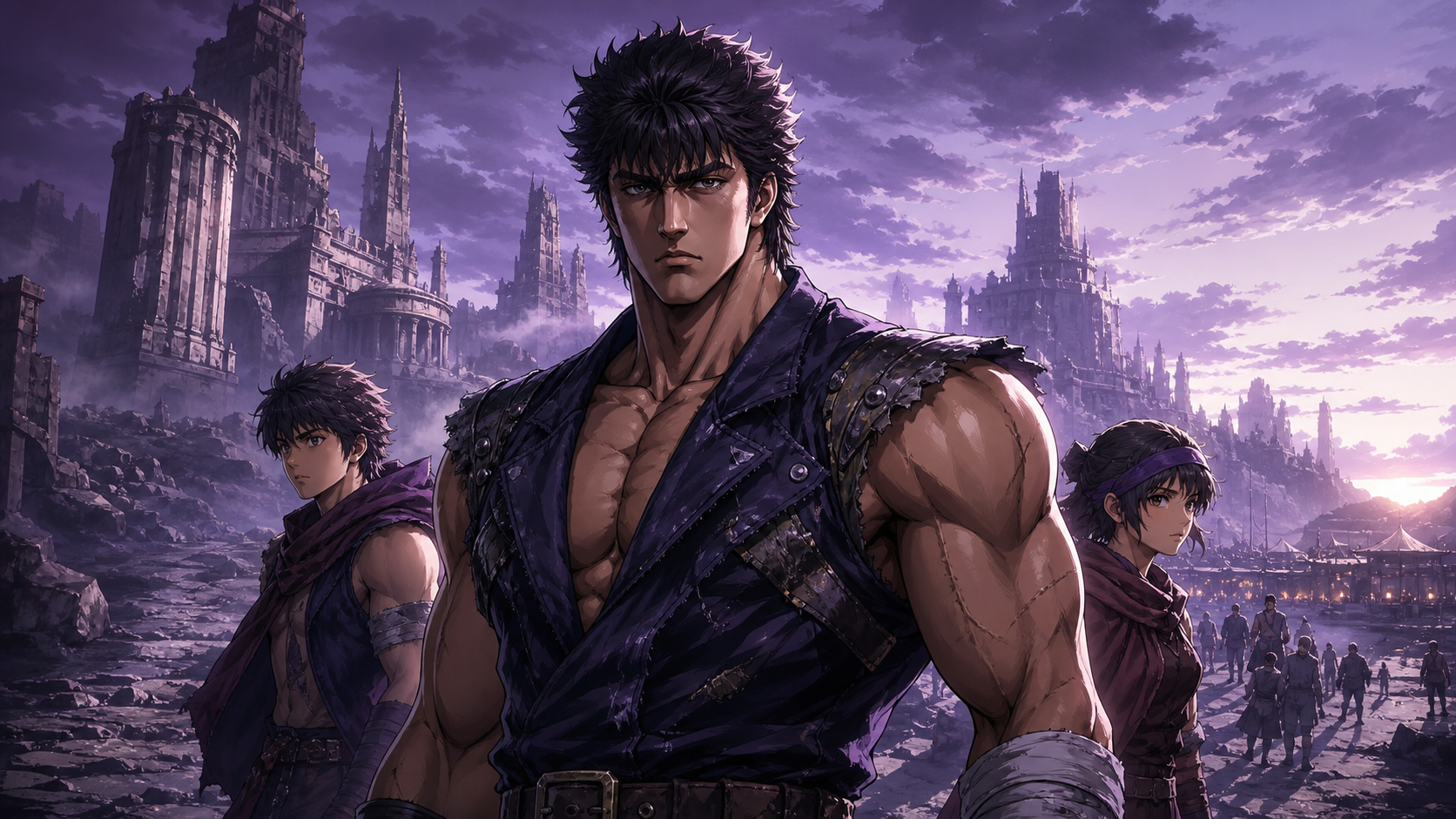
Fist of the North Star 2 Review: The Children Built a Resistance Before the Savior Returned
The savior is late, and that delay changes everything. Fist of the North Star 2 opens after Bat and Lin have grown into people capable of building the Hokuto Army without Kenshiro. Their resistance is not decorative preparation for his entrance. It is the season’s most important political fact: children who once traveled behind a legend have learned to organize while the legend is absent.
Spoilers: This Review discusses episodes 110–152, including the Celestial Emperor and Land of Shura conflicts.
What remains after the definitive ending refuses to remain definitive
The first series closes the Raoh conflict with the emotional scale of an ending. Continuing afterward risks converting completion into franchise maintenance. The second series answers by moving time forward and changing who is allowed to act before Kenshiro appears. Bat and Lin are no longer children receiving lessons from adult catastrophe. They have inherited catastrophe, interpreted it, and built an organization whose existence complicates the savior structure.
The sequel therefore begins with a necessary discomfort. If Kenshiro solved the wasteland, why does empire return? The honest answer is that defeating a ruler is not the same as dismantling the conditions that make rule by terror reproducible. Roads, scarcity, military habits, political myths, and frightened populations remain. The second series becomes worthwhile when recurrence reads as institutional diagnosis rather than an excuse to stage another stronger enemy.
Bat and Lin do not wait correctly; they organize imperfectly
The Hokuto Army’s name connects the resistance to Kenshiro’s legend, but its labor belongs to people who cannot execute a divine technique. They recruit, travel, communicate, protect civilians, survive mistakes, and maintain courage while rumors suggest Kenshiro may be dead. Their work exposes how much heroic stories usually compress. Somebody must build the network through which liberation becomes more than an isolated rescue.
The organization is not automatically democratic because its cause is just. The season gives us reasons to ask who makes decisions, how civilians consent to risk, and whether invoking Kenshiro encourages agency or dependence. Bat and Lin earn admiration not because every decision is flawless, but because they accept responsibility in a world where adults once asked them only to survive. Their growth changes the moral center before the plot changes geography.
The hungry child becomes a leader without pretending hunger taught only noble lessons
Bat’s early opportunism was intelligence formed under scarcity. As an adult, he turns that intelligence toward logistics, judgment, and the protection of others. The transformation works because the series does not erase his roughness. He remains practical in ways Kenshiro cannot be, aware that a resistance needs information, timing, supplies, and people willing to continue after inspiration fades.
Leadership makes his old survival instincts answerable to a collective. Suspicion can prevent an ambush and can also narrow trust. Improvisation can save a mission and can also expose others to consequences they did not choose. Bat becomes compelling when the story lets responsibility complicate competence. He is not Kenshiro’s replacement. He represents the kind of ordinary, learned authority a world needs if salvation is ever going to outlive one man.
Hope becomes political when Lin stops being asked merely to symbolize it
Lin’s adult role is the sequel’s clearest opportunity and one of its most revealing limitations. She has witnessed coercion, empire, tenderness, sacrifice, and the repeated arrival of men who believe power grants jurisdiction over another person’s future. That history should make her more than the emotional standard by which male characters are measured. It gives her a theory of rule grounded in what power felt like from below.
The season allows her courage and leadership, yet later returns too much of her narrative weight to bloodline, destiny, and romantic management. The contradiction is painful because the opening demonstrates another possibility. Lin can command attention through judgment and solidarity without becoming a prize, prophecy, or vessel for inherited meaning. Every time the plot constrains that agency, viewers should remember that the resistance already proved she could help build history herself.
An entrance can rescue people and still recenter a movement that existed without him
Kenshiro’s return delivers the mythic reassurance the franchise promises. His physical presence changes the scale of danger, and the staging knows exactly how long viewers have waited for certainty to take human form. The catharsis is earned. It is also politically complicated. A movement led by Bat and Lin can become supporting evidence for Kenshiro the moment his silhouette enters the frame.
The season is strongest when his power enlarges their work rather than replacing it. Kenshiro can break an execution system, defeat a commander, or open a route the resistance could not hold alone. He cannot retroactively become the author of their courage. The distinction matters because heroic intervention should return decisions to the people already risking their lives. Protection becomes ethical when it recognizes prior agency instead of rewriting it as waiting.
Sacred legitimacy becomes a prison when officials monopolize access to the sacred
The Celestial Emperor arc turns political symbolism into an instrument of administration. Authority is presented as something descending from a protected figure, while Jako and the people around him control information, punishment, and proximity. The arrangement lets cruelty claim it is merely enforcing a higher order. Subjects are asked to obey an image of legitimacy they cannot question or directly encounter.
This is more sophisticated than a villain ruling because he is physically strongest. The system depends on mediation: officials interpret the sovereign, guards enforce interpretations, and frightened people repeat the language that makes coercion sound lawful. Kenshiro can destroy the bodies sustaining the arrangement, but the arc’s deeper warning concerns any structure where access to the symbol of authority belongs to those profiting from its silence.
Cowardice becomes dangerous when institutions give fear a chain of command
Jako lacks the magnificent self-possession associated with Raoh, which makes him easy to dismiss as a smaller antagonist. His fear is precisely the point. He constructs harm not from serene confidence but from terror of what he cannot control. Bureaucracy lets that terror travel through other bodies. Orders, cells, hostage logic, and manipulated legitimacy make one frightened man socially enormous.
The contrast with Kenshiro clarifies two responses to vulnerability. Kenshiro carries grief without requiring the world to deny it. Jako converts insecurity into policy and forces strangers to pay for every imagined threat. A ruler does not need grandeur to produce empire. He needs institutions willing to treat his private fear as public necessity. The arc is at its sharpest when cowardice is not comic relief but a governing technology.
Duty becomes tragic when loyalty to an office outlives loyalty to the people the office exists to serve
Falco embodies the season’s central conflict between honor and obedience. His discipline, sacrifice, and concern for others make him legible as a good man, yet the system uses those virtues to extend its violence. He remains inside a compromised structure because departure appears to threaten people he wants to protect. The result is not simple hypocrisy. It is the tragedy of ethical qualities captured by an institution.
Respect for Falco should not make compliance disappear. Every order still reaches somebody’s body. The question is whether responsibility can be reduced because refusal carried terrible risk. The series allows both truths to remain visible: coercive systems deliberately recruit honorable people, and honorable people still shape what those systems can do. Falco’s dignity lies in finally making conscience more authoritative than role, not in having obeyed beautifully.
The sequel remembers that resistance requires relationships beyond inherited schools
Ain brings swagger, humor, selfish performance, and developing loyalty into a narrative that could otherwise drown in solemn bloodline. His bond with Asuka exposes the future as a person rather than an abstract era. Responsibility becomes intimate: the world should change because a child deserves a life not organized around one adult’s ability to win.
Returning figures such as Mamiya connect the sequel to communities that survived the first era. Their presence can prevent history from looking like a clean succession of famous battles. Continuity is most meaningful when it records care networks, unfinished grief, and people maintaining ordinary life. The second series benefits whenever it remembers that the wasteland was inhabited between finales, not suspended until another chosen conflict began.
Changing geography should change the theory of power, not only the strength of opponents
The movement toward the Land of Shura promises a world beyond the familiar wasteland and tests whether the franchise can make distance intellectually meaningful. Crossing water alters logistics, information, myth, and the social assumptions carried by travelers. Kenshiro does not enter empty territory. He enters a place with its own histories of discipline, hierarchy, resistance, and stories about Raoh.
A new land becomes narratively valuable when it resists being reduced to a higher difficulty setting. The Shura conflict sometimes succeeds, revealing how legend changes when exported and how populations organize around anticipated conquest. It sometimes returns to escalation, measuring danger through stronger techniques and more absolute declarations. The tension between world-building and power ranking defines the back half.
A conqueror’s legend can become protection for people who never consented to his empire
Raoh’s absence does not remove him from the sequel. In the Land of Shura, stories about his promised return possess political force independent of the man’s actual choices. For some people, his name represents terror; for others, the possibility that terror might answer a worse regime. Legend detaches from biography and becomes a resource communities use under pressure.
This transformation does not redeem conquest. It demonstrates how memory simplifies power when current suffering is desperate enough. A population may imagine a former threat as salvation because the new order has made alternatives unthinkable. Kenshiro inherits the consequences of his brother’s image as well as his family’s technique. The season becomes psychologically rich whenever it asks whether a symbol can protect people without laundering the history attached to it.
A society that trains everyone for violence does not eliminate vulnerability; it industrializes it
The Land of Shura treats martial cruelty as culture, hierarchy, and developmental expectation. Violence is not merely what rulers do to opponents. It structures who may mature, speak, travel, and be recognized. The system promises that relentless testing will produce strength, but its actual product is dependence on rankings maintained by people who benefit from perpetual fear.
The most important people in this landscape are not the strongest Shura. They are those required to live beneath a social order that calls domination tradition. Training can produce extraordinary bodies while shrinking the range of lives those bodies are permitted to imagine. Kenshiro’s challenge therefore concerns more than defeating elite fighters. He must expose a culture that confuses surviving abuse with proving abuse was necessary.
The man who uses a legend must decide whether the people inside the plan remain people
Shachi survives through strategy in a society designed to make direct resistance suicidal. He understands rumor, timing, symbolic power, and the enormous political value of Kenshiro’s arrival. That intelligence makes him more than a guide. It also tempts him to treat the successor as a weapon whose trajectory can be managed. Resistance creates its own ethical danger when desperation makes instrumental thinking feel identical to leadership.
His relationship with Leia prevents the calculation from becoming his entire person. Love gives him a future he cannot reduce to victory, while guilt records the cost of choices made under occupation. Shachi matters because courage and manipulation coexist inside the same commitment. The season does not need to purify him to make his sacrifice meaningful. It needs to remember every person who had less control over the risks his strategy distributed.
Teaching children another language of strength is revolutionary work the fight hierarchy barely knows how to measure
Leia rejects the Land of Shura’s claim that violence is the only serious education. Her school preserves literacy, gentleness, imagination, and the ability to recognize another person without ranking them. In a culture that trains children to become instruments, teaching them to remain human is direct resistance. The classroom is not a pause from the political conflict. It is where the conflict’s desired future becomes visible.
The narrative still gives martial intervention more spectacular weight because animation can stage a blow more easily than years of patient teaching. That imbalance belongs to genre and should not dictate our verdict. Kenshiro may create the physical space in which children survive. Leia helps ensure survival does not reproduce the system that endangered them. Her work answers the season’s central question about what comes after a tyrant falls.
A stolen memory does not erase responsibility, but it changes where responsibility must be located
Hyoh’s tragedy depends on the invasion of his mind and the conversion of affection into a vulnerability others can weaponize. The man capable of tenderness remains present beneath imposed hatred, which makes recognition emotionally potent and ethically difficult. If manipulation removes all agency, judgment becomes meaningless. If manipulation changes nothing, the violation disappears. The season asks viewers to live inside the space between those conclusions.
Responsibility belongs in layers. Kaioh and the structures enabling coercion carry responsibility for manufacturing the conditions of Hyoh’s violence. Hyoh still participates in consequences experienced by real bodies, even when his capacity to interpret choice has been damaged. Repair therefore requires more than recovered memory and fraternal recognition. It requires facing what occurred while the self was being controlled, without pretending victimhood and harm cannot occupy one person simultaneously.
Hatred becomes theology when a wounded ruler needs the universe to certify his injury
Kaioh does not merely commit cruelty. He develops a worldview in which domination reveals truth and tenderness proves contamination. His demonic performance turns injury into cosmic entitlement, allowing private grievance to claim historical necessity. Like Souther before him, he tries to escape vulnerability by building a world where vulnerability is punishable. The scale is larger, but the emotional mechanism remains recognizable.
The danger of this writing is that a late explanation can feel like reimbursement. A tragic origin may invite viewers to experience the ruler’s pain with more duration than the pain of people beneath him. The stronger reading treats biography as evidence about the manufacture of tyranny. Kaioh knew deprivation and humiliation, then chose to make those experiences governing principles. Understanding the wound makes the choice more legible, not less consequential.
A rival discipline becomes political when technique trains a relationship to self and power
Hokuto Ryuken expands the martial cosmology and risks turning philosophy into another ladder of stronger moves. Its most useful function is ethical. The discipline’s relationship to demonic energy, control, and destabilized identity asks what happens when power rewards the practitioner for treating interior fracture as mastery. Technique does not sit outside character. It rehearses a way of understanding the body, the opponent, and the limits of permission.
Hokuto Shinken is not automatically moral because Kenshiro uses it well, just as Ryuken is not reducible to evil because Kaioh seeks domination. Schools transmit knowledge through institutions, teachers, succession choices, secrecy, and myths about worthiness. Every inheritance contains judgments about who may know, who may decide, and whose body becomes the test. The sequel grows when martial lore remains accountable to those social questions.
The revelation of origin enlarges history and threatens to shrink chosen relationship
The Land of Shura material deepens Kenshiro’s connection to the past through family and school history. Revelation can make earlier mysteries coherent, but it can also recast moral worth as the property of lineage. Kenshiro did not become protective because blood commanded him to be. Bat and Lin did not become leaders because ancestry selected them. Their relationships were built through witnessed choices.
Bloodline works best as obligation rather than proof of superiority. Inheriting harm means receiving a responsibility to interrupt it, not a certificate that one was destined to rule. The more the season explains conflict through ancient family structures, the more carefully viewers should protect the importance of chosen kinship. The people who traveled together became family because they repeatedly answered one another’s vulnerability. No revelation should demote that labor.
Remembering the correct past cannot restore the choices coercion already removed
Memory in the second series is a contested territory. Personal recollection, family history, political legend, and institutional secrecy decide how characters understand themselves before any battle begins. Restoring truth matters because manipulation depends on isolating people from alternative accounts. Yet revelation often arrives with the emotional efficiency of a cure, allowing recognition to compress the work that follows.
A recovered memory can explain love, guilt, origin, or betrayal. It cannot automatically rebuild trust, return the dead, or decide what a survivor owes the person they remember. The season’s most painful encounters carry this excess. Knowledge opens the possibility of agency and does not complete it. After truth arrives, characters still need time, consent, and relationships capable of surviving what the false history made them do.
The sequel understands recurrence but occasionally mistakes a larger map for a deeper system
Moving from the Celestial Emperor to the Land of Shura prevents the second series from remaining one prolonged rebellion. The shift offers different institutions: sacred legitimacy, military administration, martial caste, controlled education, bloodline mythology, and the political afterlife of Raoh. Those differences prove that domination can wear more than one costume.
Escalation becomes less persuasive when each new hierarchy exists mainly to certify the next enemy as stronger. Power levels are a genre pleasure and a limited political language. A society is frightening not only because its ruler can defeat the previous ruler. It is frightening because ordinary life has been reorganized around compliance. The second series earns its darkness whenever roads, schools, families, rumors, and bodies show that reorganization.
Agency repeatedly appears, then destiny tries to repossess it
Lin and Leia demonstrate leadership through organization, teaching, moral judgment, and refusal. Lui’s position exposes the violence of symbolic sovereignty, while women surrounding the resistance sustain information and care. These roles broaden the season beyond martial succession. They also reveal how quickly the plot can convert a woman from actor into bloodline, hostage, romantic answer, or proof of a man’s emotional depth.
The problem is not that love, captivity, or kinship may matter to women. It is that those conditions too often become the boundary of what the narrative wants to know about them. A deeper version of the season would ask what Lin believes government should become, what Lui chooses after being used as legitimacy, and how Leia’s educational resistance changes community life. Their existing actions make those questions available even when the plot moves past them.
Romance fails when destiny treats consent as an administrative detail
The later relationship machinery surrounding Lin reveals one of the franchise’s most persistent weaknesses. Love is praised as the ethical opposite of domination, then romantic destiny can begin making decisions over the beloved person. Memory, sacrifice, bloodline, and noble intent create emotional intensity without creating permission. The distinction should be obvious in a series so alert to captivity elsewhere.
Bat’s devotion gains dignity when it recognizes Lin as a person whose answer matters, not a reward for years of loyalty. Any rival arrangement must meet the same standard. Nobody earns another human being through suffering correctly. The season’s emotional power increases when affection remains accountable to freedom and collapses when sacrifice becomes a hidden invoice.
More powerful techniques do not automatically create more meaningful consequence
The second series inherits an audience already fluent in delayed pressure-point death, monumental confrontation, and the language of named schools. Familiarity raises the burden on each fight. Spectacle must reveal a relationship, alter a political structure, or force a moral judgment; otherwise escalation becomes numerical even when no numbers are spoken.
The best confrontations carry history inside movement. Falco’s discipline shows duty under strain. Shachi’s risk exposes calculation becoming devotion. Hyoh’s technique carries fractured identity. Kaioh’s force attempts to make hatred look metaphysical. Kenshiro’s restraint measures whether grief has matured into care. Bodies remain spectacular, but meaning comes from what each body has been trained to believe it may do to another.
The last battle closes inherited fate more neatly than it closes the lives arranged around it
Kenshiro’s victory over Kaioh completes the martial argument with the authority expected of a finale. The confrontation resolves lineage, technique, memory, brotherhood, and the ruler’s claim that hatred can become destiny. It is emotionally satisfying because the season has made those ideas physical. The risk is that closure concentrates once again in the men whose bodies can represent history.
The people of Shura still require a political future after the final technique. Children need education without indoctrination, communities need distribution without martial caste, and survivors need truth that does not become another sacred monopoly. The finale gestures toward release more readily than reconstruction. That gap does not invalidate victory. It identifies the work every heroic ending leaves outside the frame.
Kenshiro sounds older because restraint now contains a history the audience already knows
Toshio Furukawa’s performance enters the sequel carrying everything Kenshiro survived before the time jump. The voice does not need to announce maturity through constant heaviness. It appears in the measured distance between observation and judgment, in the calm that refuses a tyrant’s theatrical frame, and in moments when recognition softens control. Kenshiro sounds like a man for whom grief is no longer a revelation, though it has never become ordinary.
That continuity protects the sequel from reducing him to a returning weapon. An invincible entrance can flatten personhood if the voice supplies only certainty. Furukawa keeps sorrow, patience, fatigue, and anger distinguishable inside the iconic register. The performance reminds us that restraint is active labor. Kenshiro does not lack destructive feeling; he repeatedly decides what that feeling is permitted to do.
Narration turns a complicated sequel into ritual without pretending complication has disappeared
Shigeru Chiba remains one of the franchise’s essential architects. His narration bridges recap, escalation, absurdity, urgency, and sincerity with a tonal range that prevents the series from becoming either unintentional comedy or suffocating scripture. In the sequel, that guidance matters because viewers must cross a time jump, new institutions, unfamiliar schools, and increasingly dense family history.
The voice can make exposition feel like event, but charisma does not solve every information burden. When lineage explanations accumulate, narration may intensify material that still needs dramatic space. Chiba’s achievement is not making all exposition invisible. It is keeping the audience emotionally oriented while the story reorganizes its cosmology. He tells us when history has become pressure and when the pressure is allowed to be thrilling.
The Golden General’s dignity lives in the effort required to keep obedience from sounding empty
Falco needs a voice capable of authority without sadism, loyalty without naïveté, and regret without collapse. His dramatic problem is audible before it becomes explicit: every controlled declaration must carry awareness that the office he serves has been corrupted. If performance makes him merely noble, complicity vanishes. If it makes him merely cold, the later conflict loses its moral cost.
The character works because duty sounds inhabited rather than decorative. Pauses and shifts in pressure suggest a person continually measuring which obligation can still be honored. That makes his violence harder to dismiss and harder to excuse. Falco is not tragic because goodness makes him innocent. He is tragic because goodness remains perceptible while his actions continue giving a harmful system force.
A demonic register must reveal the frightened human being without shrinking the threat
Kaioh’s scale invites vocal performance to become uninterrupted thunder. The more interesting work appears when contempt, humiliation, pleasure, fear, and desperate self-certification occupy different textures. His doctrine of hatred requires constant performance because it is built to prevent tenderness from becoming evidence against him. Authority must be renewed in every scene or the injury beneath it risks showing.
Late revelations place additional pressure on the voice. The audience must recognize continuity between ruler and wounded person without treating one as a disguise for the other. Kaioh was always human, including while he chose atrocity. A strong performance makes that recognition disturbing rather than absolving. Humanity increases accountability because it removes the fantasy that domination came from a species incapable of another choice.
Growth becomes credible when design, behavior, and responsibility change together
Adult Bat and Lin provide the most immediate visual proof that time has moved. A taller body or older face would be cosmetic if the story returned them to their childhood functions. The opening arc earns the transition by giving them organization, risk, and decisions. Their designs carry remembered features without trapping them inside nostalgia, allowing viewers to recognize the children and encounter the adults simultaneously.
Kenshiro changes less visibly, which fits a character already rendered as myth. His development must appear through relation: how he looks at Bat, listens to Lin, responds to new rulers, and carries the absence of people who shaped him. Time in a sequel should not be a number between broadcasts. It should alter what each person knows, fears, owes, and can no longer plausibly misunderstand.
The second series makes institutions larger, then must work harder to keep individuals visible
Imperial halls, massed forces, fortified compounds, the sea, and the monumental landscapes of Shura expand the world beyond scattered gangs and villages. Scale gives the sequel its own identity and communicates that domination has matured into administration. The threat is no longer always a local brute controlling one well. It can be an order traveling across territory through symbols and trained intermediaries.
Large compositions can also turn civilians into texture. An army looks impressive precisely because individual faces disappear into pattern. The direction regains ethical focus when it cuts from system to person: a child inside a labor regime, a guard deciding whether to obey, a citizen interpreting rumor, or Lin confronting the consequence of leadership. Scale explains reach. Close attention explains what reach does.
Gold, black, fire, and ruined earth distinguish authority while ordinary life keeps asking for softer colors
The Celestial Emperor material uses ceremonial visual language to separate official power from the landscape it governs. Gold and architectural form suggest legitimacy even when the people exercising it are corrupt. Shura darkens and hardens the palette, making martial order feel environmental rather than merely administrative. These choices help viewers feel the change in political system before every term is explained.
The most important contrast belongs to ordinary life: fabric, skin, water, classrooms, domestic fire, and the quieter colors surrounding care. If every image remains monumental, liberation has no visible destination. Softer spaces show what violence interrupts and what resistance tries to preserve. CVM’s page colors remain purple, black, lavender, and white because editorial identity should frame the artwork rather than imitate whichever scene happens to dominate it.
Economy becomes authorship when stillness directs attention instead of merely postponing motion
The weekly production continues to rely on held drawings, repeated movement, reaction shots, speed effects, and selective bursts of animation. Age makes these devices visible to contemporary viewers accustomed to different schedules and digital compositing. Visibility is not the same as failure. A held face can make moral recognition last longer than fluid movement would, while a repeated gesture can turn technique into ritual.
Economy fails when an episode cannot create new emphasis and simply extends time. The distinction lies in direction: framing, timing, sound, and sequence must give the limited image a reason to remain. The second series is uneven because television production is uneven, yet its authored peaks prove that resource constraint and artistic decision are not opposites. Style emerges from how limitation is interpreted.
A sequel theme has to announce continuity and convince us history has started moving again
Music at the beginning of a continuing saga carries unusual pressure. The audience must feel the franchise’s identity without hearing a weaker imitation of an anthem already attached to formative memory. The sequel’s opening language pushes forward, aligning the time jump with renewed motion and a changed generation. It tells viewers that the legend remains, but the world has not waited in the same pose.
Theme sequences also function as weekly argument. Character groupings, antagonistic silhouettes, recurring gestures, and the rhythm of revelation teach us which relationships will organize attention. Repetition turns those images into expectation. A review should notice how the opening prepares emotional hierarchy, including which figures are centered as actors and which appear mainly as stakes inside somebody else’s conflict.
Forty-three episodes compress the journey and expose every place the story mistakes explanation for development
The second series is substantially shorter than the first, which gives its major route more urgency. The Celestial Emperor rebellion establishes the adult generation, Falco, and institutional legitimacy before the narrative crosses into Shura’s deeper martial history. That momentum can be exhilarating. It also means revelations sometimes arrive faster than the relationships needed to absorb them.
Weekly broadcast pacing differs from modern consecutive viewing. Recap, preview, repeated premise, and cliffhanger were tools for audiences returning after seven days. Binge viewing makes redundancy conspicuous and can make dense stretches feel paradoxically rushed. A fair verdict considers both experiences while still asking whether the episode itself changes our understanding. Broadcast context explains a rhythm; it does not make every use of that rhythm equally successful.
Comic swagger becomes moral courage when performance stops protecting the self from attachment
Ain initially presents himself through confidence, opportunism, and a style of masculinity less solemn than the inherited-school warriors surrounding him. That tonal difference matters. The franchise needs men whose value is not certified by bloodline or secret technique. His relationship with Asuka gives every boast an ethical horizon: the future is not an abstraction because one child will have to inhabit it.
His development avoids the idea that love magically replaces personality. Swagger remains part of how he moves through danger, but it no longer exists only to keep vulnerability offstage. Courage becomes the willingness to accept consequence for people who cannot repay the risk. Ain’s emotional force comes from choosing responsibility without being cosmically selected for it.
A sovereign used as a symbol reveals why representation without agency is another form of captivity
Lui’s position within the Celestial Emperor system demonstrates that being revered does not guarantee power. A sacred figure can become the justification for decisions she neither makes nor controls. Officials monopolize access, interpret silence, and use captivity to convert her symbolic legitimacy into practical authority for themselves. The structure resembles devotion while functioning as erasure.
Rescue must therefore do more than restore the correct person to the correct place. If the office remains designed for mediation without accountability, another official can repeat the seizure. Lui deserves political agency, information, and the ability to refuse what others claim to do in her name. The arc opens that question more clearly than it answers it, which makes her condition an important measure of whether liberation reaches beyond personnel.
Love for Falco does not require silence about what duty has made him do
Myu’s relationship with Falco gives the Golden General a life beyond office and battlefield. Her care reveals the person institutions exploit when they turn duty into identity. Yet love should not function only as evidence that a compromised man is secretly good. It can also become the relationship within which truth is spoken and the cost of obedience remains visible.
The franchise often asks women to humanize powerful men while providing less space for what those women believe about the systems involved. Myu matters in her own right as a person living with the consequences of Falco’s impossible position. Her fear, judgment, and future should not be reduced to the emotional lighting around his sacrifice. Devotion becomes ethical when it preserves both people’s moral voices.
Secondary opponents reveal whether the regime produces believers, careerists, or frightened functionaries
A political arc gains depth when commanders do not all serve for identical reasons. Solia’s martial loyalty, Shoco’s coercive position, and the varying people within imperial power show how institutions recruit through honor, fear, opportunity, and attachment. These distinctions affect what refusal costs and what accountability should require.
Disposable treatment can flatten that potential, especially when an episode needs a body for Kenshiro or Falco to overcome. The second series is more convincing whenever a subordinate’s decision reveals the regime’s operating logic. A ruler becomes socially powerful through the many private calculations that turn command into action. Understanding those calculations helps explain how the system might actually be dismantled.
Calling Kenshiro a legend can mobilize resistance and postpone the belief that ordinary people possess authority
The Hokuto Army gains cohesion through a name associated with protection. In desperate conditions, shared symbols reduce isolation and help strangers imagine themselves inside one struggle. Kenshiro’s legend gives language to courage before his body returns. That is real political power, and the opening uses it effectively.
The same symbol can produce dependency if people learn that their labor matters only as preparation for a chosen man. Bat and Lin complicate that logic because their organization already acts. The healthiest version of the legend is catalytic: it helps people recognize that domination can be opposed, then returns the center to their own decisions. Salvation becomes dangerous when the symbol requires everyone else to remain supporting cast.
A rebellion is made from routes, food, information, and trust before it is made from victories
The Hokuto Army’s visible courage rests on labor action storytelling often treats as background. People must learn which road is watched, where a wounded fighter can recover, how a warning travels, who can share food, and whether a stranger’s claim is credible. None of those tasks looks like Kenshiro’s signature technique. Together they determine whether one successful confrontation changes anything beyond the immediate frame.
Bat’s practical intelligence belongs here, as does Lin’s ability to create solidarity across fear. A resistance that cannot feed civilians or protect dissent risks reproducing the governing habits it opposes. The sequel gives enough evidence to imagine this infrastructure and rarely stays long enough to examine it. That absence matters because liberation is not only the removal of a command. It is the creation of reliable alternatives to obeying it.
Rumor can carry hope across occupied territory and can become another authority nobody is permitted to question
Kenshiro’s possible death, the savior’s anticipated return, the Emperor’s sacred status, Raoh’s promised invasion, and controlled accounts of martial history demonstrate that information is never neutral in the sequel. People act on what they can know, and powerful figures shape which sources remain available. A rumor may help a village resist before proof arrives. It may also expose people to danger based on somebody else’s strategic need.
The ethical question is not whether every claim can be verified under occupation. It is who bears the risk when it cannot. Resistance requires secrecy, yet secrecy can reproduce hierarchy inside the movement. Trust becomes durable when leaders explain as much as safety allows, accept accountability for withheld information, and do not treat followers as expendable because they lacked the full plan.
Captivity protects the regime from alternatives by controlling bodies, testimony, and time
The sequel continues the franchise’s interest in prisons as political technologies. A cell prevents physical departure, but it also interrupts relationships and the circulation of knowledge. Holding Lui lets officials speak through the authority they have silenced. Capturing resistance members makes uncertainty spread through the network. Imprisonment turns absence into an instrument: people outside must decide what the missing person would want without being allowed to ask.
Breaking a gate is necessary and incomplete. Survivors leave with injury, lost time, disrupted trust, and memories that may not fit the triumphant rhythm of rescue. Institutions also leave guards, records, routines, and spaces that can be repurposed by the next ruler. Aftercare is part of prison abolition in the wasteland because freedom has material requirements. A person released without safety or community remains vulnerable to the system’s return.
The sequel lets former child survivors lead and still places new children inside adult political debts
Bat and Lin demonstrate that children absorb more than trauma from the worlds around them. They learn models of protection, habits of attention, and the difference between power that demands and power that makes room. Their adult leadership is moving because it converts witness into responsibility. It should not be misread as evidence that the danger they endured was beneficial or necessary preparation.
Asuka, Leia’s students, and children living under imperial or Shura rule keep the developmental stakes visible. Adults repeatedly claim to fight for the future while using children as hostages, symbols, labor, or reasons for sacrifice. A future-centered politics must protect children’s present lives, including learning, play, care, and the right not to become extraordinarily brave. Survival does not create a debt to admire the conditions survived.
A school can resist empire by teaching that knowledge is shareable rather than a weapon of rank
Martial traditions in the franchise often organize knowledge through secrecy, succession, and restricted worthiness. Leia’s teaching offers another model. Knowledge becomes communal capacity rather than a prize guarded by one lineage. Children learn forms of attention the ruling culture cannot easily convert into combat hierarchy. That is why a classroom can threaten an empire even when nobody inside it can defeat a Shura.
Education is not automatically liberating. Curriculum can reproduce myth, erase victims, and train obedience as efficiently as a barracks. The ethical distinction lies in whether students may question what they receive and apply it beyond the teacher’s control. Leia’s gentleness matters because it imagines authority responsible for expanding another person’s agency. The season should measure reconstruction by whether that model survives.
When status depends on violence, every relationship becomes an audition for dominance
The Land of Shura naturalizes ranking by making combat capability the primary evidence of personhood. Such a system does not merely reward the strongest. It teaches everyone to evaluate vulnerability as failure and assistance as contamination. People learn to hide need, perform cruelty before cruelty is demanded, and treat those below them as rehearsal material for encounters above.
Kenshiro’s superior force can break the caste’s claim that its elites are invincible, but victory alone can accidentally confirm the premise that legitimacy belongs to whoever wins. His ethical difference must appear in what follows: he refuses ownership, recognizes people without rank, and treats power as an obligation to reduce fear. The distinction between defeating the hierarchy and becoming its new summit is the season’s most important unspoken test.
A damaged body should not have to become miraculous before the story considers it valuable
Injury in the second series records combat, coercion, sacrifice, and the costs institutions transfer onto individuals. The franchise often beautifies heroic damage while using bodily difference in minor antagonists as grotesque shorthand. That unequal framing teaches audiences which altered bodies deserve interiority. A dignified wound belongs to a named man; an unusual body becomes a joke or warning.
The ethical correction is not to remove damage from a violent world. It is to separate bodily condition from moral worth and grant care without requiring extraordinary usefulness. Falco deserves compassion beyond his ability to fight. Prisoners deserve recovery without becoming soldiers. A child harmed by the system does not owe the narrative inspirational resilience. Bodies carry history, but history does not assign a soul’s value.
The sequel’s empires still depend on ordinary resources their grand myths cannot produce
Celestial legitimacy and demonic martial history sound enormous, yet every army, prison, school, and settlement depends on water, food, shelter, medicine, and maintained routes. Myth can disguise distribution and cannot replace it. A ruler who controls access decides whose body may remain in the territory long enough to claim a future.
The Hokuto Army’s success should therefore be judged partly through what becomes available after a battle. Can a liberated population keep a well open, move supplies without tribute, and care for people who cannot fight? The anime often leaves those questions just beyond the ending image. They remain essential because scarcity is where political philosophy becomes daily experience. Whoever decides who eats is already governing.
Protection stops being love when the protected person loses the right to shape the protection
The sequel repeatedly places people under plans designed for their safety. Lui is hidden and used through symbolic distance. Lin’s future becomes entangled in arrangements justified by devotion and fate. Fighters conceal information because loved ones might object to the risk. Some secrecy is unavoidable under surveillance, but good intention cannot erase the person whose choices have been removed.
Consent is not a modern distraction imposed on the story. It is the principle distinguishing Kenshiro’s protection from the possession practiced by many antagonists. If love is the franchise’s answer to domination, love must leave the beloved capable of refusing. Sacrifice offered freely can be profound. Sacrifice assigned to another person is a demand wearing the language of care.
Bat and Lin become most legitimate when followers can remain participants rather than witnesses to their courage
The sequel’s generational promise depends on leadership becoming more distributed. Bat and Lin have symbolic connection to Kenshiro and practical credibility earned through action. Neither quality should make disagreement disloyal. A resistance capable of replacing empire must contain ways to question strategy, share knowledge, address harm, and survive the loss of a charismatic figure.
Kenshiro’s presence can support that development by refusing permanent command. His strength protects the conditions under which others decide, rather than becoming the answer to every decision. The story sometimes recenters him because genre expects it. Its political imagination appears in the moments when leadership circulates—through scouts, teachers, caregivers, local organizers, and people whose names will never become techniques.
The sequel distinguishes tragic opponents from disposable enemies through narrative attention more consistently than through ethics
Falco, Hyoh, Shachi, and even Kaioh receive history, conflict, recognition, and emotional duration. Minor enforcers frequently receive swift bodily punishment after little interior access. This hierarchy produces satisfying momentum and an unequal theory of mercy. Famous men are allowed to be complicated before consequence; ordinary participants may become grotesque examples of what power deserves.
Different choices do warrant different judgments. A coerced officer, enthusiastic torturer, architect of policy, and frightened recruit are not ethically identical. The problem arises when fame rather than action determines who receives context. Kenshiro’s best interventions read motive and threat with precision. The weekly format sometimes replaces that discernment with spectacle, leaving critical viewers to restore the distinctions the camera skipped.
An enemy’s collapse provides catharsis and does not automatically tell us what justice has accomplished
The pressure-point grammar lets arrogance continue speaking after defeat has already occurred. This delay reverses power theatrically and gives victims a moment in which the ruler’s certainty becomes ridiculous. Catharsis matters, especially after an episode has made helplessness feel unbearable. It is not the same as repair.
Justice should ask what punishment stops, reveals, deters, or makes possible. Destroying an active killer may protect immediate lives. It cannot restore the dead, distribute resources, heal prisoners, or teach institutions to resist another command. The series is mature enough to survive that distinction. Violence can be necessary inside its world without becoming a complete political program.
The emotional truth of liberation begins after the soundtrack believes the scene has ended
People emerging from imperial rule need burial, treatment, food, testimony, decisions about collaborators, and the ability to grieve without being recruited into another symbolic story. Fighters need care that does not depend on returning quickly to usefulness. Children need adults willing to make ordinary safety more important than heroic memory.
The second series rarely remains for this labor because its route must continue toward the next institution. Leia’s school, resistance networks, domestic relationships, and returning communities offer glimpses of what aftercare could mean. Those glimpses are not side material. They are the proof that a finishing move created possibility instead of another vacancy at the top.
The sequel broadens the kinds of men who matter and still gives dying men its most elaborate emotional permission
Kenshiro’s restraint, Bat’s practical leadership, Falco’s duty, Ain’s swagger, Shachi’s calculation, Hyoh’s wounded tenderness, and Kaioh’s defensive domination create multiple masculinities rather than one muscular ideal. Their differences make the season richer. Strength can mean remaining gentle, revising loyalty, accepting dependence, or refusing to make grief another person’s problem.
The franchise nevertheless grants men extraordinary emotional clarity near death. Final words resolve love, regret, loyalty, and self-knowledge that living relationships were denied time to negotiate. These scenes are powerful and suspiciously efficient. A man should not need a beautiful sacrifice before vulnerability becomes narratively respectable. Survival deserves interiority too, including the slow work of apology and change.
A world worth saving must contain people doing more than waiting for the next famous body to arrive
The sequel’s political scale can make communities look like territory transferred between rulers. Its humane moments resist that abstraction. Civilians hide people, pass information, teach children, care for the injured, interpret rumors, and decide whether the resistance has earned trust. Those actions give every battle a social context.
When communities disappear after liberation, the story risks turning suffering into a stage built for Kenshiro. When they retain names, conflicts, and labor, victory acquires a future. The savior’s value lies in making communal agency more possible, not in becoming the permanent center around which everyone else orbits. Bat and Lin understand this because they learned the wasteland from the level of the road.
The Celestial Emperor route gives the sequel its clearest generational argument
The opening thirteen episodes establish the time jump through action rather than narration alone. Bat and Lin lead the Hokuto Army under imperial pressure, Kenshiro returns to a movement that already exists, and Falco embodies the distance between service and conscience. The arc’s structure is efficient because each relationship illuminates the governing system. Lui’s captivity explains symbolic authority; Jako’s fear explains bureaucratic cruelty; resistance explains how ordinary people answer both.
This route is the sequel at its most politically coherent. The villains do not merely occupy stronger bodies. They control access, information, prisons, names, and the appearance of legitimacy. Its weakness is the speed with which liberation can return the center to Kenshiro and move onward. The opening promises a sustained story about Bat and Lin as adult organizers; the transition to Shura allows that promise to recede too soon.
Crossing the sea replaces familiar certainty with rumor, testing whether Kenshiro can enter another people’s story
The voyage and first encounters in Shura reset the scale. Kenshiro arrives where Raoh’s name has traveled farther than either brother’s direct relationships, and where martial hierarchy structures daily expectation. Shachi’s strategy and Leia’s resistance provide local knowledge the outsider cannot possess. This prevents the new land from becoming meaningful only when Kenshiro sees it.
The arc gains tension from uncertainty about who controls the legend. People invoke Raoh as promised conqueror, possible liberator, and historical force. Kenshiro must act inside expectations created by someone absent. The revelation that Shura connects to his own origin intensifies the conflict and risks making local suffering another chapter in the hero’s bloodline. The episodes work best when those histories remain in dialogue rather than one replacing the other.
Kaioh’s first dominance makes the savior physically vulnerable and philosophically legible
Kaioh’s entrance needs to do more than certify a new power ceiling. His control of the environment, performance of demonic authority, and ability to destabilize Kenshiro make hatred feel institutional and intimate at once. The apparent defeat matters because a savior myth that cannot survive vulnerability is only another advertisement for invincibility.
Kenshiro’s recovery and adaptation should not be read as a simple training correction. He must understand what Kaioh’s power believes about the self, history, and love. The stronger fighter is not automatically the better interpreter, but interpretation changes the fight. These episodes become compelling when martial discovery is also moral discovery: hatred can organize enormous force and remains dependent on refusing evidence that tenderness exists.
Brotherhood, memory, and sacrifice converge while the people of Shura wait beyond the family drama
The final stretch intensifies Hyoh’s damaged memory, Shachi’s commitment, Kaioh’s history, and Kenshiro’s connection to inherited conflict. Recognition arrives with operatic force because family has been fragmented by manipulation and time. The emotional architecture is effective, especially when brothers recover tenderness inside circumstances that cannot return what was lost.
Concentration on lineage creates a narrowing effect. Shura’s population risks becoming the landscape across which one family resolves ancient pain. Leia and the children keep another future visible, reminding viewers that the final battle matters because people need freedom from martial caste, not because bloodline deserves closure. The ending succeeds emotionally and leaves reconstruction as an obligation the camera cannot complete.
The sequel is more compact and institutionally ambitious, yet less patient with the ordinary world its ideas require
The original television run accumulated social density through repetition. Villages, minor enemies, travelers, prisoners, healers, and children gave its legend a long road to cross. The second series moves with greater concentration and introduces political structures that can be more complex than a local gang. Its Emperor arc in particular understands domination as mediation rather than personality.
Compactness produces urgency and reduces afterlife. Characters such as Bat, Lin, Lui, Myu, Leia, and Shachi could support longer examinations of leadership, education, consent, and reconstruction. The sequel often returns to succession and elite combat before those questions mature. It is not merely a lesser continuation. It is a sharper but narrower argument whose best opening insight remains larger than the time given to fulfill it.
Raoh’s death closes a rivalry; Kaioh’s defeat attempts to close a history
The first series finale has extraordinary clarity because Kenshiro and Raoh embody paths developed across a long shared journey. Their final confrontation resolves not only strength but how each man treated grief, weakness, love, and people without comparable power. The second finale carries a more elaborate burden: ancient lineage, stolen memory, rival schools, birthplace, demonic technique, and a foreign society’s liberation.
Greater explanatory scope does not guarantee greater emotional force. Kaioh’s conclusion can feel cosmically complete while remaining socially incomplete. The finality belongs to inherited martial history, whereas Shura’s citizens need a beginning. This difference explains why the first ending often feels more definitive even though the sequel tackles wider mythology. Closure is strongest when the scale of explanation matches the relationships viewers have lived beside.
Knowing the revelations makes early gestures more legible and exposes which mysteries were carrying too much weight
A second viewing clarifies Falco’s hesitation, the political machinery around Lui, Shachi’s calculations, and the ways Kaioh performs certainty against feared vulnerability. Knowledge lets the viewer notice how often the season announces its themes through posture, silence, and who is permitted to speak for another person. It also reveals where suspense once disguised thin development.
Rewatching strengthens the Celestial Emperor arc because its system remains coherent after surprise disappears. Shura varies more. Its richest material—Leia’s school, Raoh’s legend, Hyoh’s violated identity, and the culture of martial caste—continues opening questions. Dense lineage explanations can feel less necessary once their answers are known. The season rewards viewers most where character consequence, not mystery alone, holds the scene together.
A work from 1987 deserves historical understanding precise enough to include criticism
Broadcast rhythm, production constraint, censorship language, gender assumptions, and ideas about heroic masculinity belong to the period in which the series was made. Context explains why certain patterns recur and why some formal choices were practical. It does not require contemporary viewers to pretend those patterns have no effect now.
Historical respect means distinguishing limitation from intention and achievement from nostalgia. The sequel can be admired for adult Bat and Lin, institutional antagonism, vocal performance, visual iconography, and the moral complexity of Falco while being criticized for constraining women, romanticizing sacrifice, and allowing bloodline to overtake community. Serious attention is a form of preservation because it keeps the work available for more than unexamined repetition.
A future adaptation should restore neglected agency without pretending modern polish is moral progress by itself
New animation can improve motion, compositing, consistency, and access for viewers who find the older television language distant. Those gains do not automatically deepen the story. A remake could reproduce every gendered constraint in higher resolution or turn political ambiguity into cleaner hero branding. Technology changes the available surface, not the ethical interpretation.
The second series offers obvious opportunities: keep Bat and Lin central after Kenshiro returns, give Lui and Myu political interiority, let Leia’s school shape reconstruction, distinguish consent from romantic destiny, and show what Shura becomes after martial caste collapses. None requires discarding the franchise’s identity. It requires following insights the original already opened and did not have time or inclination to complete.
The sequel should not be remembered only as the part after Raoh or the place where enemies became stronger
Franchise memory naturally concentrates around iconic peaks, and the first Raoh conflict casts a long shadow. That can reduce Fist 2 to appendix, escalation, or a collection of later techniques. Such compression misses the importance of seeing Bat and Lin as adults, Falco’s compromised honor, institutional legitimacy, Leia’s educational resistance, and Raoh’s transformation into political legend after death.
Critical fandom can preserve these elements without inflating the sequel into perfection. Remembering well means retaining contradiction: the opening’s generational promise and its later retreat, the richness of Shura’s social premise and the dominance of bloodline, the dignity of sacrifice and the cost of using death as emotional resolution. A complicated memory keeps the work alive.
Kenshiro carries the title, but Bat and Lin give the continuation its reason to exist
The sequel could begin with another threatened village and another Kenshiro entrance. Instead it begins with the children who once followed him, now leading people through his absence. That choice answers the basic question of continuation. The world mattered enough for people inside it to grow, interpret what they witnessed, and act without waiting correctly.
The narrative eventually gives Kenshiro and inherited martial history most of the climax. Bat and Lin nevertheless remain the season’s ethical owners because they embody consequence across time. They prove that protection can become capacity in the protected person rather than permanent dependence on the protector. Every branch of the ecosystem should preserve that insight instead of presenting Fist 2 as a list of stronger opponents.
Destiny, sacrifice, and escalation sometimes close questions the season was brave enough to open
The weakest passages rely on revelation to manufacture depth after relationships needed more lived time. Bloodline can substitute for chosen connection, romantic fate can move around consent, and a beautiful death can resolve a man more efficiently than survival would. Shura’s increasingly powerful hierarchy can make society feel like a tournament bracket rather than a culture people must inhabit.
These failures are frustrating because the season repeatedly demonstrates better instincts. It knows legitimacy can be stolen through mediation, that education is resistance, that honorable obedience can sustain cruelty, and that children can grow into organizers rather than symbols. Criticism should hold the work to the intelligence it already possesses. The problem is not that Fist 2 lacks ideas. It is that its mythology sometimes interrupts them.
The sequel makes inheritance social before it makes inheritance biological
Adult Bat and Lin are the decisive achievement. Their opening establishes that Kenshiro’s legacy is not a technique passed through chosen blood but an example interpreted by people who survived beside him. Falco extends the theme through duty, Lui through symbolic authority, and Leia through education. Even Raoh’s legend shows inheritance escaping the control of the person who produced it.
This social understanding gives the later bloodline material something to argue against. The audience has already seen chosen relationship create action. No ancient revelation can fully erase that knowledge. Fist 2 succeeds when it remembers that a legacy is what other people can do after encountering power, not the monument power builds to itself.
A necessary, uneven sequel whose best idea is that the children did not spend the time jump waiting
Fist of the North Star 2 cannot reproduce the emotional accumulation of the original Raoh saga, and its attempt to enlarge mythology sometimes crowds out the society that mythology governs. The Land of Shura contains formidable imagery, painful brotherhood, and serious questions about coercion, education, memory, and caste. It also leans too heavily on bloodline, sacrifice, and escalating revelation.
The Celestial Emperor opening gives the continuation its enduring justification. Bat and Lin have grown into leaders, built resistance, and made Kenshiro’s absence politically meaningful. The savior returns to a world that did not stop developing without him. At its best, the season understands that protection succeeds when the protected become authors of collective life. That is more profound than any claim about the strongest fist.
8.4 out of 10 — politically sharper than its reputation, emotionally less complete than its inheritance
The rating honors a sequel with distinctive institutional conflicts, strong Japanese performances, a compelling generational opening, memorable new figures, and a Shura mythology capable of serious interpretation. It also accounts for compressed development, constrained female agency, overreliance on noble death, and the tendency for lineage to recenter history inside famous men.
This is not a recommendation to skip the second series after Raoh. It is an invitation to watch with the right question. Do not ask only whether Kenshiro meets stronger opponents. Ask what Bat and Lin built before he returned, what each institution requires ordinary people to surrender, and whether victory leaves those people more capable of governing their own lives.
Watch the second series as a generational argument before treating it as another power ladder
Begin by watching what Bat and Lin do before Kenshiro returns. Notice who carries information, who chooses risk, how the Hokuto Army earns trust, and what Falco must ignore to remain loyal. When the story crosses the sea, track the difference between Shura as a society and Shura as a sequence of powerful opponents. Leia’s classroom, Shachi’s strategy, Hyoh’s memory, and Raoh’s legend reveal more about the land than rankings alone.
The companion episode Reacts should preserve that sequence one decision at a time, while this Review judges the completed season as one work. Neither format replaces the other. The Reacts capture surprise, pacing, and immediate moral pressure; the Review can compare patterns across forty-three episodes and ask what remains after revelation. Together they make the branch a route into the fandom rather than a single verdict standing alone.
Official records and the boundary between fact and criticism
Toei Animation’s official episode directory anchors the episode sequence from 110 through 152 and its Japanese synopses. The official pages for episode 110, the complete directory, and episode 152 establish the opening, route, and ending used here.
All judgments about power, gender, coercion, adaptation, performance, and political meaning are CVM Sekai editorial criticism. They are not official production claims, and factual summaries never substitute for the Review’s independent argument.