
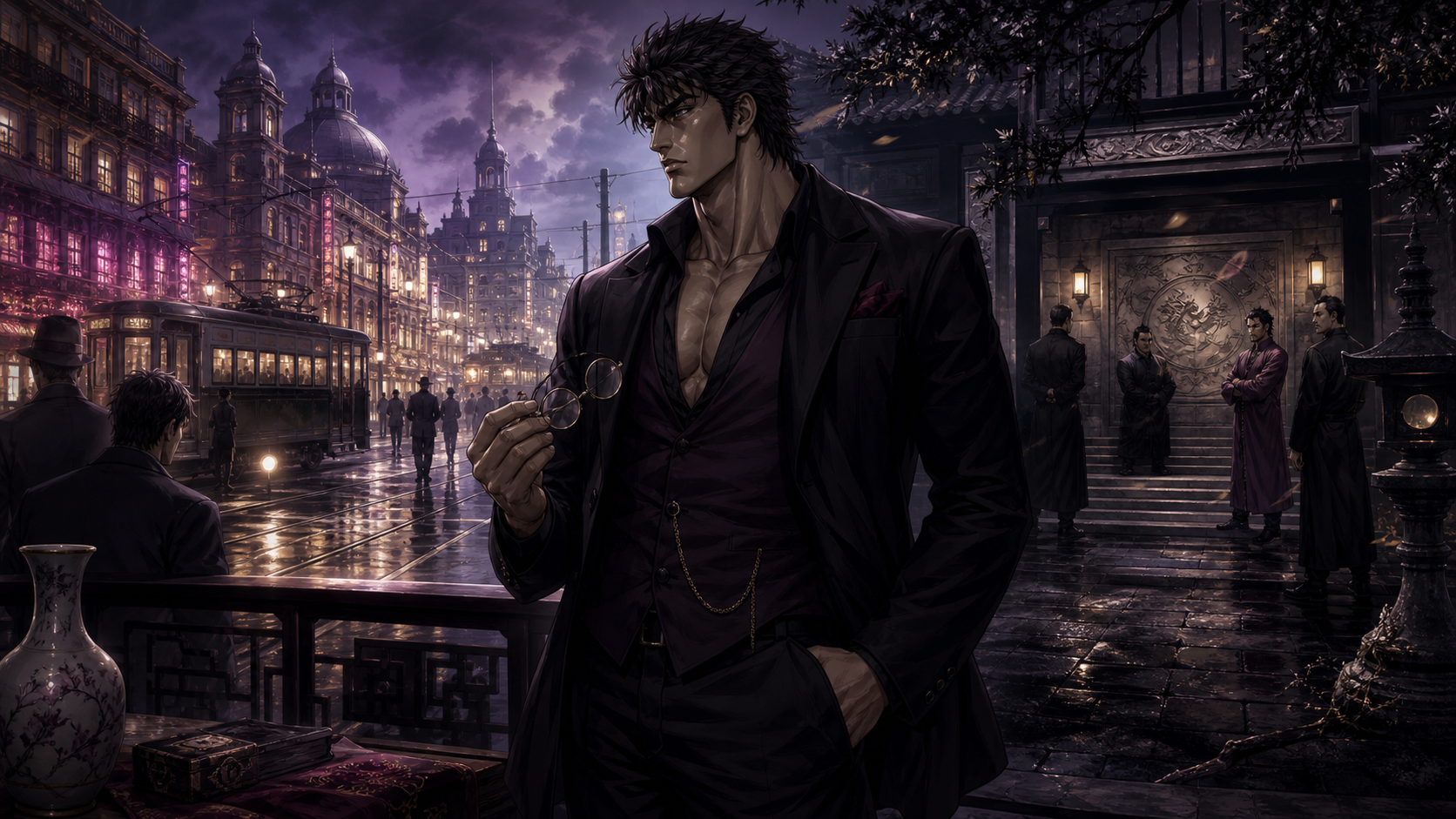
Fist of the Blue Sky (2006) Review: Shanghai Gives Hokuto a History Before Kenshiro
The 26-episode 2006 prequel follows Kenshiro Kasumi through 1930s Shanghai. This review examines inheritance, colonial power, organized crime, friendship, adaptation compression, and the danger of treating history as exotic scenery.
Bottom Line First
Fist of the Blue Sky changes more than the date. Its 1930s Shanghai setting moves Hokuto Shinken into a city where empire, commerce, migration, policing, and organized crime overlap. Kenshiro Kasumi is not Kenshiro with spectacles pasted on. He is a different successor whose appetite for friendship and pleasure makes inherited violence feel socially embedded rather than mythically solitary.
The 26-episode 2006 series is uneven and compressed, yet it earns attention whenever it lets history behave like a system instead of decoration. The central question is whether an art built for killing can protect relationships without becoming another private government.
What This Anime Is
This is a television prequel centered on Kenshiro Kasumi, an earlier Hokuto successor. It is not Episode 0 of the 1984 series and should not be inserted directly before Kenshiro’s wasteland journey as mandatory setup.
The animation adapts the earlier manga route through Shanghai conflicts, rival schools, criminal organizations, and friendships whose obligations repeatedly collide with succession.
Shanghai Is Not a Costume
Rain, neon, suits, temples, and period vehicles create immediate atmosphere. Atmosphere becomes meaningful only when the anime acknowledges who holds legal authority, who profits from concessions, who crosses borders, and whose violence receives official permission.
The city’s beauty should increase scrutiny rather than turn occupation and criminal power into fashionable texture.
Kasumi Makes Inheritance Social
His humor, affection, teaching, and appetite prevent mastery from looking like pure isolation. He inherits technique inside relationships.
That warmth also makes his violence more complicated: charisma can humanize a successor while encouraging viewers to excuse the private authority he exercises.
Friendship Is the Real Continuity
The series repeatedly asks whether loyalty means obedience, rescue, revenge, memory, or telling a friend that his chosen path harms other people.
Hokuto survives not only through secret technique but through people who remember what a successor promised before power made reinterpretation convenient.
Where the Adaptation Struggles
Compression turns political factions and martial lineages into names moving toward confrontations before their communities feel inhabited. Older digital production can flatten motion and space exactly when the story needs material history.
A stronger version would spend more time with workers, women, families, translators, and residents whose city becomes the field on which elite men resolve inheritance.
Japanese Performance
Kōichi Yamadera gives Kenshiro Kasumi warmth, mischief, authority, and sudden danger. The performance helps distinguish him from Akira Kamiya’s iconic Kenshiro without denying family resemblance.
Japanese vocal continuity belongs in the character record by era; this review treats performance as interpretation rather than trivia.
Verdict
Fist of the Blue Sky is worth entering as a historical side road, not a continuity obligation. Its pleasures come from Kasumi’s social energy and from seeing Hokuto placed inside a dense political city.
Its failures arrive when history becomes décor and supporting lives collapse into fuel for succession. The anime matters because it proves the North Star was never born in an empty wasteland; power always had institutions around it.
A runoff earns its own judgment because relationship is not continuity. The page names what the animation is, what it changes, and why its formal choices matter before asking whether familiarity alone can carry it.
The canonical artwork is original and local. It remains the featured image, top hero, directory card, Open Graph image, and Twitter image for this editorial; no unrelated branch image is borrowed.
Sources and Viewing Notes
Format record: The 2006 television adaptation comprises 26 episodes and follows Kenshiro Kasumi in the prewar Shanghai route.
Coverage rule: This page reviews the 2006 anime separately from the 2018 REGENESIS continuity.