
Fairy Tail Episode 97 React: Best Partner
Ambition reveals who treats a partner as a person, who treats them as a ladder, and which histories still need accountability.
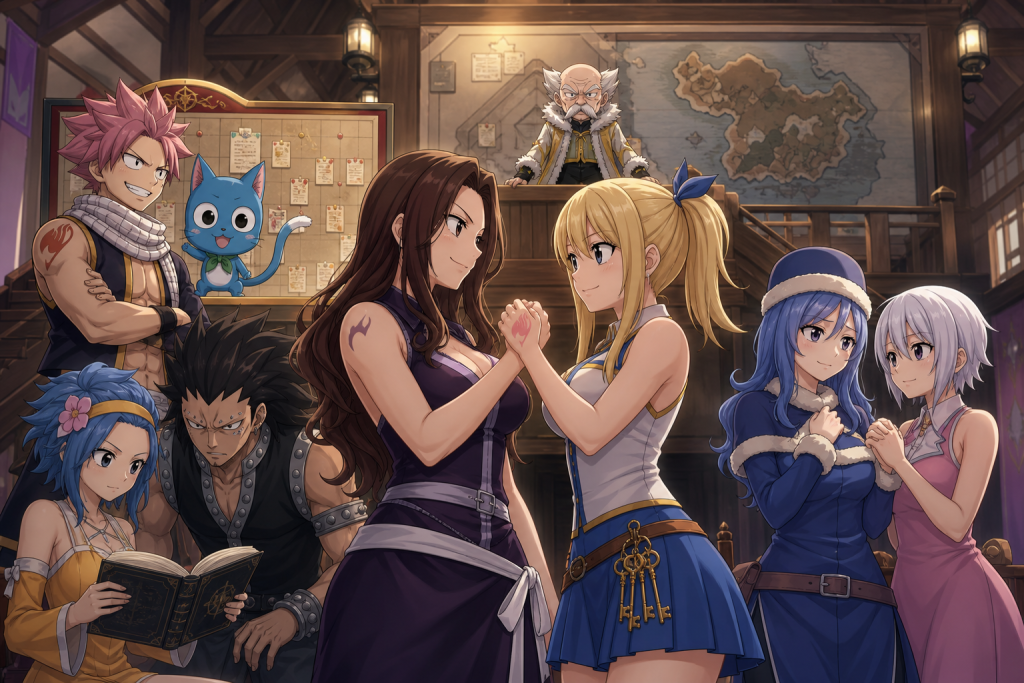
Bottom line: Fairy Tail Episode 97 says S-Class is not a solo power trophy. Eight candidates are selected, but each must choose one guild partner. The test will measure strength, judgment, trust, and what people do when ambition depends on somebody else’s body.
That makes the pairings more revealing than the announcement. Natsu chooses Happy without hesitation. Gray honors a promise with Loke. Levy accepts Gajeel after a history the story cannot erase. Cana asks Lucy for help only after admitting another failure will make her leave Fairy Tail.
The title sounds sweet. The structure is a pressure test.
The receipt box
- Episode: 97
- English title: “Best Partner” / licensed variant “Best Partners”
- Japanese title: ベスト パートナー
- Romanization: Besuto Pātonā
- Original Japanese broadcast: September 17, 2011
- Continuity: Adapts manga Chapters 201 and 202.
- Trial location: Tenrou Island, Fairy Tail’s sacred ground.
- Candidates: Natsu Dragneel, Gray Fullbuster, Juvia Lockser, Elfman Strauss, Cana Alberona, Freed Justine, Levy McGarden, and Mest Gryder as he is presented in this episode.
- Partner rules: One partner must be chosen within a week; the partner must belong to Fairy Tail and cannot be an S-Class wizard.
- S-Class obstacles: Erza Scarlet, Mirajane Strauss, and Gildarts Clive will stand in the candidates’ way during the trial.
- Pairs: Natsu/Happy; Gray/Loke; Juvia/Lisanna; Elfman/Evergreen; Cana/Lucy; Freed/Bickslow; Levy/Gajeel; Mest/Wendy.
- Cana boundary: She tells Lucy she has failed repeatedly and will leave the guild if she fails again. Her deeper family motive is not revealed here.
- Carla’s warning: Carla receives fragmented future images tied to Tenrou, including distress, a great tree, and the mysterious black-haired young man.
- Episode boundary: The group gathers at Hargeon for departure. Trial routes and Tenrou events belong to Episode 98 onward.
- Streaming route: Watch on the official Crunchyroll Episode 97 page.
Everybody starts performing before Makarov announces anything
Lucy notices guild members taking jobs, working harder, and advertising their accomplishments. She does not know why the room suddenly feels like an election campaign with more punching.
The annual S-Class selection explains it.
Makarov chooses the candidates, so members spend the lead-up making competence visible. Their performance is not necessarily fake. The work still gets done. The incentive changes how loudly they display it.
That is a useful workplace observation under the comedy.
When advancement depends on private judgment, people try to become legible to the judge. Quiet labor can be overlooked. Social confidence becomes an advantage. Existing relationships shape who receives attention.
Fairy Tail treats Makarov as a trusted master, but trust does not make the process objective.
The episode invites excitement. It also shows the politics before the rules are spoken.
S-Class is institutional authority, not just a power level
The candidates want the S-Class title because it grants recognition and access to harder, better-paid work. It represents competence inside the guild.
That means the trial evaluates more than who can throw the largest attack.
An S-Class wizard may accept missions with higher public stakes, guide less experienced teammates, and represent Fairy Tail beyond its walls. Judgment matters because raw power without judgment is how buildings become receipts.
The partner requirement makes that standard visible.
A candidate must coordinate with someone who can be hurt by bad planning. They have to communicate, distribute risk, and respond when a teammate’s strengths differ from their own.
Fairy Tail is correct to reject the idea that leadership is solitary dominance.
Whether this particular trial measures those qualities fairly is another question.
Makarov selects eight people, and selection itself creates a hierarchy
Natsu, Gray, Juvia, Elfman, Cana, Freed, Levy, and Mest are named.
The list mixes frontline fighters, technical specialists, newer members, long-term members, and one person presented as Mystogan’s disciple. It is not a simple ranking of combat strength.
Gajeel is notably absent. He complains, especially because Juvia was also once associated with Phantom Lord.
Erza points toward the trust problem.
Gajeel has contributed to Fairy Tail, protected comrades, infiltrated Raven Tail for Makarov, and fought in Edolas. He also joined after attacking Levy, Jet, and Droy. Trust cannot be reduced to one heroic mission or one old crime.
His exclusion shows that institutional repair moves slower than battle acceptance.
That may feel unfair to him. It is not irrational.
S-Class authority requires people to believe his judgment will remain stable beyond a crisis.
Juvia's selection recognizes growth without rewriting Phantom Lord
Juvia is chosen after joining Fairy Tail from Phantom Lord. She has fought beside the guild, protected Cana during the Battle of Fairy Tail, worked in coalition battles, and increasingly acted from her own moral judgment.
Her candidacy does not prove every issue is resolved.
Juvia’s fixation on Gray can still distort her choices and relationships with other women. The exam gives her a chance to operate through a partnership not centered on him.
That is why Lisanna becomes an interesting match.
The guild recognizes Juvia’s capacity. The partner structure tests whether she can turn that capacity toward a teammate’s needs instead of a romantic fantasy.
Selection should open scrutiny, not close it.
Natsu chooses Happy because their teamwork predates the title
Natsu picks Happy immediately.
The choice is obvious for reasons deeper than Aera flight. Happy hatched beside Natsu, grew up with him, traveled on missions with him, and has repeatedly carried him into attacks that neither could perform alone.
Their partnership includes trust under speed, height, and combat pressure.
It also has limits. Happy is physically vulnerable compared with many candidates, and his Aera has stamina boundaries. Choosing him requires Natsu to protect the partner who gives him mobility.
The exam cannot treat Happy as equipment.
He is a participant whose judgment affects routes, timing, and retreat.
Natsu’s confidence is strongest when it recognizes that interdependence instead of assuming friendship makes every risk safe.
Gray and Loke build on a prior promise
Loke partners with Gray because they made a promise the previous year. He temporarily operates outside Lucy’s normal contract arrangement and uses his own power to cross the gate.
That detail keeps Loke’s agency visible.
Lucy is his contracted wizard, not his owner. He can form friendships and obligations beyond her while remaining accountable to the contract they share.
Gray and Loke have complementary strengths. Ice-Make gives Gray construction, control, and tactical adaptation. Regulus gives Loke close-range force and Celestial Spirit durability under its own limits.
The promise also tests whether older bonds remain meaningful after the guild changes around them.
Gray is not borrowing Lucy’s property. He is working with a person who chose him.
Juvia almost withdraws because Gray chose somebody else
Juvia reacts badly when Gray partners with Loke and considers leaving the trial. Her disappointment is played for comedy.
It also exposes a real weakness in her candidacy.
If her participation depends on access to Gray, then her ambition is not yet her own. S-Class responsibility cannot collapse because the person she wants picked a different teammate.
Lisanna offers partnership.
The offer gives Juvia a route back into the exam without validating entitlement to Gray. Lisanna does not compete with her for romance or shame her for wanting connection. She asks Juvia to act as a wizard.
That is a better form of support than arranging the world around the obsession.
Juvia accepts, and the pair now has to build trust without Gray as the center of every decision.
Lisanna chooses participation soon after returning
Lisanna has only just come home after two years in Edolas. She volunteers to support Juvia in a high-stakes guild trial.
The choice shows that reintegration is active, not merely ceremonial.
She is not waiting to recover her exact old place. She forms a new partnership with someone who joined during her absence.
That matters because returning characters are often trapped in nostalgia. Lisanna could be reduced to Natsu’s childhood, Happy’s egg, and the Strauss family reunion. Partnering Juvia lets her act in the present.
Her Animal Soul Take Over and social awareness may support Juvia in ways brute force cannot.
The episode also avoids framing Lucy as a romantic rival. Lisanna speaks warmly about Natsu’s growth and Lucy supports him. Two women can recognize the same man without the story demanding a cage match.
Blessedly basic, somehow still rare.
Elfman and Evergreen turn suggestion into consent
Lisanna encourages Elfman to ask Evergreen. Their relationship has carried suggestive tension, pride, and tactical history since Tenrou-era setup began around them.
Evergreen agrees to become his partner.
The important part is that she chooses.
Elfman does not claim her because Lisanna proposed the match. Evergreen is not assigned as the elegant woman who will improve him. They enter a partnership with distinct abilities and unresolved interpersonal tension.
Stone Eyes, Fairy Magic, and Elfman’s Take Over create useful options. They also carry accountability histories. Evergreen helped hold guildmates hostage during the Battle of Fairy Tail. Elfman’s uncontrolled transformation injured Lisanna years earlier.
Neither history disappears because the pairing is cute.
The exam can show whether both use power with better judgment now.
Freed chooses Bickslow because the Thunder God Tribe has shared history
Freed and Bickslow pair naturally through the Thunder God Tribe, also localized as the Raijinshū.
Their coordination is proven. During the Battle of Fairy Tail, that coordination served Laxus’s coercive takeover. Afterward, both remained in the guild and had to demonstrate changed conduct.
The trial gives them a chance to use established teamwork for a legitimate goal.
It does not automatically prove rehabilitation.
Freed’s Jutsu Shiki and Dark Écriture create structured control. Bickslow’s Seith Magic and five doll vessels create distributed pressure. Together they can dominate a battlefield if judgment fails.
The question is not whether they are effective.
It is whether effectiveness now serves teammates rather than trapping them.
Levy accepting Gajeel carries the heaviest relationship receipt
Levy chooses Gajeel as her partner after he offers support.
This pairing cannot be discussed as cute enemies-to-lovers shorthand.
Gajeel attacked Levy, Jet, and Droy during Phantom Lord and displayed their injured bodies publicly. That harm is foundational. Later protection, guild service, and mutual trust do not make it imaginary.
Levy’s choice is still hers.
She has watched Gajeel’s conduct change across multiple crises. She can decide he is the person whose strength and instincts best complement her Solid Script without owing the audience forgiveness on command.
The partnership works when both truths remain visible: Gajeel harmed her, and Levy now chooses to rely on him.
Agency is not less real because fandom finds the result romantic. Accountability is not less necessary because the relationship develops.
Mest chooses Wendy through an identity the episode asks us to accept
Mest presents himself as Mystogan’s disciple and asks Wendy to partner with him. Carla distrusts the situation.
At this episode boundary, the guild accepts him as a candidate and member. His deeper identity and Magic Council role are later revelations.
The React should not collapse the suspense by narrating future facts as if Wendy knows them now.
Her decision is based on the information available: a supposed connection to Mystogan, guild recognition, and an invitation to participate.
Carla’s discomfort matters because she has just learned how badly official stories can distort identity. Distrusting an adult’s convenient history is not paranoia after Edolas.
The pair creates a consent problem the arc must answer. Wendy is younger and Mest controls information she does not possess.
Partnership requires informed trust. His hidden purpose puts that standard under pressure before the trial even begins.
Cana asks Lucy after the performance stops
Lucy finds Cana drunk and distressed away from the guild’s excitement. Cana says she has attempted the exam repeatedly and will leave Fairy Tail if she fails again.
The deeper reason remains unrevealed in Episode 97.
That boundary matters because Cana’s behavior should not be diagnosed from future information as if Lucy already knows it. What Lucy sees is a capable friend turning one institutional result into a condition for belonging.
Lucy agrees to become her partner.
The choice is generous. It also creates responsibility on both sides.
Cana cannot treat Lucy as a tool for a private goal she refuses to explain. Lucy cannot promise victory or emotional rescue. They can prepare, communicate, and enter the trial honestly with the information currently shared.
The pairing will test whether Cana values Lucy’s safety as much as the rank she wants.
Repeated failure has become Cana's identity crisis
Cana has attempted the S-Class trial more than once. Each failure accumulated into shame. She now frames another loss as proof she should leave the only guild that has been her home.
That is not healthy ambition.
It is conditional belonging turned inward.
Makarov did not announce that unsuccessful candidates are expelled. Cana created that rule for herself because the title carries a personal meaning she is not ready to share.
The episode does not resolve the motive. It gives us enough to see the danger.
When achievement becomes the price of staying loved, teammates become instruments and failure becomes exile.
Lucy says yes because she cares. The trial will show whether Cana can accept care without converting it into another performance metric.
Carla's foresight refuses the celebratory mood
Carla receives fragments of a disturbing future: a great tree, tears, Natsu’s alarm, and the black-haired figure introduced in Episode 96.
She does not yet have enough context to explain the images.
The sequence respects what Episode 95 established. Foresight is partial. It is not omniscience, memory, or a divine instruction manual.
Carla’s challenge is to treat the vision as warning without letting fear invent a complete story.
That is growth after the false mission. She can communicate uncertainty rather than deciding she knows everybody’s hidden purpose.
The audience now knows the cheerful exam will not remain contained. The vision does not tell us exactly how or why.
Foreshadowing works because it creates questions without pretending ambiguity is evidence.
Tenrou Island turns guild advancement into heritage
Makarov identifies Tenrou Island as Fairy Tail’s sacred ground. The trial will happen inside the guild’s history, not a neutral arena.
That gives advancement symbolic weight. Candidates are not only proving they can accept difficult jobs. They are being evaluated in a place tied to Fairy Tail’s origins.
Heritage can inspire responsibility. It can also make institutional judgment feel unquestionable.
The island’s sacred status should not excuse dangerous trial design or turn Makarov’s choices into fate. Tradition is a source of meaning, not automatic moral authority.
Episode 97 sets that tension without resolving it.
The candidates are heading toward a place where the guild’s past will become physically relevant.
The S-Class exam uses danger as pedagogy
Erza, Mirajane, and Gildarts will obstruct the teams. The guild treats this as normal because previous S-Class wizards endured similar tests.
There is logic behind high-pressure evaluation. S-Class missions can be lethal, and candidates need evidence that they can think under fear.
There is also a lazy institutional phrase hiding nearby: “We suffered through it, so you should too.”
Tradition does not prove every hazard is necessary.
The exam should evaluate judgment without manufacturing avoidable injury. Partners make the ethical stakes higher because some participants are supporting another person’s promotion rather than seeking the title themselves.
If the guild controls the danger, it owes every partner meaningful consent and safety boundaries.
The invasion that later interrupts the trial is not part of Makarov’s design. This episode has not reached it.
Adaptation notes
Episode 97 adapts Chapters 201 and 202. The structure moves from workplace performance to formal selection, then into intimate partner conversations and Hargeon departure.
The anime shifts Lucy’s bathing scene to nighttime and uses the week of preparation to give pairings room to register as relationships rather than a list.
What Episode 97 changes
By the end of “Best Partner”:
- Fairy Tail’s annual S-Class trial has been announced for Tenrou Island.
- Eight candidates have been selected.
- Each candidate must bring one non-S-Class Fairy Tail partner.
- Erza, Mirajane, and Gildarts will obstruct the candidates.
- All eight candidate-partner teams have formed.
- Gajeel’s exclusion has exposed that strength and guild trust are not identical.
- Juvia has chosen to remain in the trial with Lisanna instead of centering Gray.
- Levy has chosen Gajeel with their accountability history still relevant.
- Cana has told Lucy she will leave Fairy Tail if she fails again.
- Lucy has agreed to support Cana without yet knowing her deeper motive.
- Carla has received a fragmented warning connected to Tenrou and the mysterious black-haired man.
- The teams have gathered at Hargeon for departure.
RaeRae's verdict
“Best Partner” understands that ambition reveals relationships faster than romance does.
Who do you trust with your promotion? Who can tell you no? Who becomes a tool when you are scared? Who knows your limits? Who carries a history you cannot clean up with one heroic rescue?
The eight pairs give eight different answers.
Natsu and Happy have practiced interdependence for years. Gray and Loke honor a promise. Lisanna invites Juvia into ambition that belongs to Juvia. Levy chooses Gajeel without making Phantom Lord disappear. Lucy says yes to Cana before Cana can tell her the whole truth.
That last pair worries me most, which means the episode did its job.
S-Class is supposed to prove someone can carry bigger responsibility.
The first test is whether the candidate remembers the partner is a person, not a ladder.
Sources
WordPress publication package
### Post identity
- Post title: Fairy Tail Episode 97 React: Best Partner
- Slug: `fairy-tail-episode-97`
- Excerpt: Fairy Tail selects eight S-Class candidates, but the real test begins when every ambition must choose a partner and carry that person’s risk.
- Meta title: Fairy Tail Episode 97 React | Best Partner
- Meta description: RaeRae reacts to Fairy Tail Episode 97 as eight S-Class candidates choose partners and Cana asks Lucy to carry a goal she cannot yet explain.
- Focus keyphrase: Fairy Tail Episode 97 React
- Canonical URL: `https://cvmsekai.com/fairy-tail-episode-97/
### Categories and taxonomy
- Categories: Anime; Anime Series; Reacts
- World: Anime
- Series: Fairy Tail
- Content type: Episode React
- Arc: Tenrou Island
- Characters: Natsu Dragneel; Happy; Gray Fullbuster; Loke; Juvia Lockser; Lisanna Strauss; Elfman Strauss; Evergreen; Cana Alberona; Lucy Heartfilia; Freed Justine; Bickslow; Levy McGarden; Gajeel Redfox; Mest Gryder; Wendy Marvell; Carla; Makarov Dreyar
- Episode number: 97
- Episode type: Manga canon
- Adapted chapters: 201–202
### Internal links
- Series hub: `/fairy-tail/`
- Episode directory: `/fairy-tail-2009-episodes/`
- React hub: `/fairy-tail-episode-reacts/`
- Tenrou Island arc hub when live.
- Previous: `/fairy-tail-episode-96/`
- Next: `/fairy-tail-episode-98/` only after Episode 98 is live.
- Link character names only when their live short-slug profiles exist.
### Canonical image brief
- Filename: `cvm-sekai-fairy-tail-episode-097-best-partner-react-hero.png`
- Canvas: 1536 × 1024, original 3:2 editorial fan artwork.
- Composition: An image-led S-Class selection scene inside Fairy Tail. Center Cana and Lucy clasping forearms as the emotionally important new partnership. Arrange three other readable pair silhouettes around them: Natsu with Happy, Levy with Gajeel, and Juvia with Lisanna. Makarov stands elevated in the background beside a restrained Tenrou Island map or emblem. Keep the crowd limited and organized, not a full sixteen-character wall.
- Identity controls: exactly one of each depicted character. Lucy has blonde hair and Celestial Spirit keys; Cana has long brown hair and Magic Cards; Levy has blue hair and an open book; Gajeel has long black hair and facial piercings; Juvia has blue hair and modest attire; Lisanna has short silver-white hair; Happy is one blue Exceed.
- Crop rule: Cana/Lucy, Natsu/Happy, and Levy/Gajeel remain readable in tight mobile/card crops. The Tenrou cue survives full desktop hero.
- Prohibited: text, logos, watermarks, sexualized framing, bathing scene, alcohol glamorization, duplicate characters, all sixteen participants crowded together, extra limbs, invented guild marks, generic school-exam imagery.
### Media Library metadata
- Media title: Fairy Tail Episode 97 Best Partner React Hero
- Alt text: Cana and Lucy form an S-Class trial team while Natsu and Happy, Levy and Gajeel, and Juvia and Lisanna choose partners
- Caption: Eight S-Class candidates discover that ambition has to carry another person’s trust.
- Description: Original CVM Sekai editorial fan artwork for the Fairy Tail Episode 97 React. The image centers Cana Alberona and Lucy Heartfilia forming their S-Class trial partnership, with selected supporting pairs and a restrained Tenrou Island cue. This single WordPress attachment must remain featured image, top hero, episode-directory card, carousel, Open Graph, Twitter, and schema image. Source/rights: original transformative editorial fan artwork for CVM Sekai. Local master: D:CVM SekaiCVM Sekai WebsiteWebsiteWebsite ImagesFairy TailEpisode ReactsEpisode 097 – Best Partnercvm-sekai-fairy-tail-episode-097-best-partner-react-hero.png
- FileBird folder: Anime / Fairy Tail / Episode Reacts
- Attachment World: Anime
- Attachment Series: Fairy Tail
- Attachment Characters: Cana Alberona; Lucy Heartfilia; Natsu Dragneel; Happy; Levy McGarden; Gajeel Redfox; Juvia Lockser; Lisanna Strauss
- Attachment Role: Episode React Hero
### Publication gates
- Generate and inspect the unique hero at full 3:2 and tight card/mobile crops.
- Search Media Library for the exact filename before one upload.
- Complete all metadata, source/rights, local path, attachment taxonomy, and FileBird placement.
- Use one attachment for featured, top hero, directory/card/carousel, OG, Twitter, and schema.
- Confirm no Uncategorized residue.
- Preserve the exact eight candidates, partner rules, and final pairings.
- Do not reveal Cana’s deeper family motive or Mest’s later identity as knowledge available in Episode 97.
- Preserve Levy’s agency and Phantom Lord accountability; do not force Lisanna/Lucy rivalry.
- Confirm no placeholders, mojibake, em dashes, or Episode 98 leakage.
- Confirm desktop and 375px mobile rendering with no horizontal overflow.
- Verify every internal link and the direct Crunchyroll episode route.
- Publish only when the matching directory and React hub cards are ready to use the same attachment and live URL.