
Fairy Tail Episode 8: The Strongest Team
Victory is real. So is the property damage.
RaeRae Reacts • Fairy Tail Episode 8
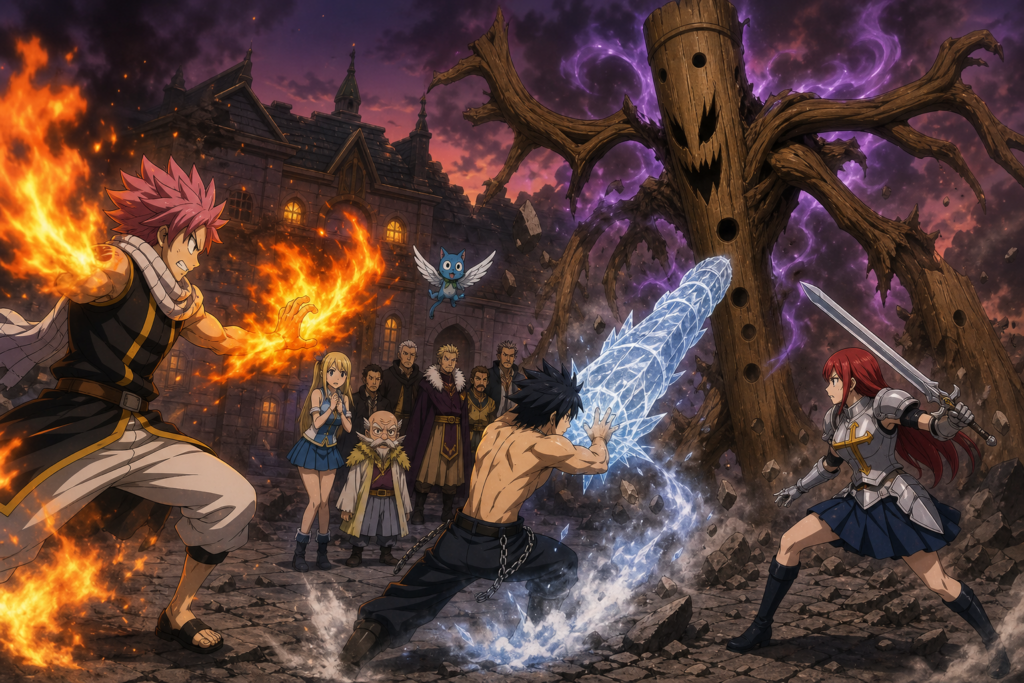
Bottom line: Episode 8 calls Natsu, Gray, and Erza Fairy Tail’s strongest team, then immediately proves that strength is not the same thing as clean heroism. They beat Erigor, stop Kageyama from becoming a murderer, destroy the Lullaby demon, and also demolish the Guild Masters’ meeting hall. The victory is real. So is the property damage. Fairy Tail earns its reputation in both directions at once.
Receipt Box
- Episode: 8
- English title: The Strongest Team
- Japanese title: 最強チーム!!!
- Romanization: Saikyō Chīmu!!!
- Japanese broadcast: November 30, 2009
- Series era: Fairy Tail (2009–2013)
- Story arc: Eisenwald
- Episode type: Manga canon
- Manga material: Chapters 19 through 21 are the commonly documented adaptation range
- Official watch route: Crunchyroll
- Original Japanese leads: Tetsuya Kakihara as Natsu, Aya Hirano as Lucy, Rie Kugimiya as Happy, Yūichi Nakamura as Gray, Sayaka Ōhara as Erza, Shinpachi Tsuji as Makarov
- Continuity boundary: Episode 8 completes the Lullaby crisis and establishes the early Natsu, Gray, Erza, Lucy, and Happy team configuration. Later members and later uses of “Team Natsu” belong to later continuity.
RaeRae's verdict
This is the episode that sells the franchise’s favorite argument: Fairy Tail works because its people are strongest together. I buy it, but not for the lazy reason.
Natsu does not win because fire is automatically superior to wind. Happy helps him identify how Erigor’s wind defense works. Natsu turns his emotional heat into a tactical response. Kageyama does not stop because somebody scares him harder. Makarov talks to the part of him that still knows choosing mass murder will not repair what the guild system did to Eisenwald. Lullaby does not fall to one signature finishing move. Natsu, Gray, and Erza attack different parts of the threat until the demon breaks.
That is teamwork with actual jobs inside it.
The episode also refuses to let victory become tidy. The strongest team saves the Guild Masters and wrecks their building. Lucy watches the veterans become legendary while also learning that joining Fairy Tail means developing a working relationship with consequences, invoices, and emergency exits.
Natsu versus Erigor finally becomes a battle of systems
Episode 7 establishes the mismatch. Erigor controls air, distance, and movement. Natsu’s fire crashes into wind that can redirect or contain it. Episode 8 gives the fight a tactical answer.
Happy notices what Natsu’s anger is doing. As Natsu’s flames intensify, the air feeding Erigor’s wind defense changes. Fire consumes oxygen and alters the current Erigor depends on. The show uses a simplified fantasy version of that interaction, not a physics lecture, but the important writing choice is clear. Natsu wins by changing the environment around the spell.
That matters because Dragon Slayer Magic can easily become protagonist permission. Natsu is loud, determined, and emotionally sincere, so the plot could simply announce that his flames got bigger. Instead, the episode lets support observation and elemental interaction matter.
Happy also knows how to motivate him. Suggesting Gray might be better suited to the fight hits Natsu exactly where his competitive pride lives. It is manipulative. It is also funny because Happy understands his partner perfectly.
I am not turning that into a healthy communication seminar. Natsu does not suddenly regulate his emotions like a well-rested adult with a color-coded planner. He gets mad. The useful part is that his emotion becomes directed effort instead of random destruction.
Then he causes plenty of random destruction later, because growth in Fairy Tail rarely travels alone.
Kageyama reaches the part of the plan nobody can choose for him
Kageyama survives his guild’s attempt to silence him, escapes with Lullaby, and reaches the Guild Masters. At that point the episode changes scale. Stopping him is no longer about winning a fight. He has to decide whether he will play the flute.
Makarov’s response is important because he does not deny the grievance underneath Eisenwald’s rage. Legal guilds and their masters occupy power. Dark guild members experience exclusion, punishment, and a system that often treats them as disposable. The story does not need to claim Eisenwald is politically correct to admit the system has failures.
Makarov separates grievance from action. Being hurt does not make mass murder repair. Killing people who represent the system will not create the belonging Kageyama was denied.
This is where the episode’s Confucian family lens becomes useful, as long as we do not turn it into a greeting-card quote. Makarov behaves like an elder who understands authority creates duties. He does not demand obedience because he is old. He speaks to Kageyama as somebody still capable of moral choice. The family model here is not blood. It is correction without disposal.
There is also a Buddhist consequence lens. Kageyama is trapped in a cycle where injury produces resentment and resentment seeks another injury. Playing Lullaby would not end suffering. It would multiply it and bind him more tightly to the harm done to him. Makarov offers interruption, not absolution.
Kageyama’s hesitation matters. He is still responsible for everything that brought him to this point. Refusing the final act does not erase the station takeover, the attempted assassinations, or his participation in Eisenwald. It does keep him from becoming the murderer Erigor wants him to be.
Lullaby reveals what borrowed hatred becomes
The flute does not accept Kageyama’s change of heart politely. Lullaby takes demonic form and attempts to consume souls directly.
That transformation turns the arc’s theme into a body. Eisenwald believes it can use hatred as a weapon while remaining in control of the target. Lullaby proves otherwise. A weapon built to consume human life does not become harmless because the person holding it hesitates. Violence develops momentum.
The demon’s wooden flute body also makes the object history visible. Lullaby is not just a random monster arriving for the final boss slot. The flute itself becomes the threat. The sound-based curse no longer needs a performer who agrees with it.
My interpretation is that Lullaby represents what happens when grievance becomes an institution. Individual people can change their minds. The structure built around their anger can continue producing harm after that change.
Fairy Tail’s answer is not philosophical debate at this point. The demon is trying to eat souls. Erza, Gray, and Natsu hit it.
Sometimes analysis has to respect the emergency.
“The strongest team” is a division of labor
Lucy watches Natsu, Gray, and Erza fight Lullaby and understands why the guild talks about them differently.
Natsu brings force, improvisation, and refusal. He attacks the threat like hesitation personally insulted him.
Gray brings constructed control. Ice-Make gives shape to the battlefield and creates attacks that can target the demon’s body with precision.
Erza brings disciplined weapon use, armor, experience, and the ability to coordinate while fighting.
Happy contributes mobility and tactical observation. Lucy contributes the perspective that recognizes the team as a team, along with the Celestial Spirit expertise that got them out of Oshibana in the first place.
This is why I do not read “strongest” as a permanent power-ranking spreadsheet. The title is structural. Their abilities cover different problems, and their habits force each other into motion.
It is also an early configuration, not the final roster. Fans often use Team Natsu to describe the later core group that includes Wendy and Carla. Episode 8 is not secretly introducing future membership. It is establishing the foundation: Natsu, Gray, Erza, Lucy, and Happy have now completed a crisis together.
The franchise will build an enormous amount of emotional memory on top of that foundation. Later sacrifices, arguments, separations, reunions, and world-ending battles work because the audience remembers when this group was still learning how to travel without destroying one another before reaching the villain.
Lucy's position is more important than the final hit
Lucy does not join the three-person assault on Lullaby, and that does not make her decorative.
She is the newest member and the audience anchor. Her recognition gives the “strongest team” label meaning because she has watched each person’s strength become useful across the mission. She also sees the cost. The same people who save the Guild Masters tear apart the meeting place.
Lucy is learning Fairy Tail’s central contradiction. These wizards protect people through conduct, but they are not polished public servants. Their care can be genuine while their methods remain expensive and reckless.
That distinction matters for her later role. Lucy becomes the person who remembers, records, interprets, and reconnects the guild’s scattered history. Episode 8 does not announce all of that. Later continuity makes the pattern visible. She is already positioned as the observer who turns chaotic action into a story about belonging.
The episode also avoids pretending that only the fighter in the largest frame matters. Lucy and Happy made the escape possible in Episode 7. Without that route, the strongest team never reaches this battle.
Property damage is not a personality substitute
The destruction of the Guild Masters’ meeting hall is funny. It is supposed to be funny. Powerful adults watch Fairy Tail defeat a demon, feel impressed, and then realize the heroes have shredded the building around them.
The joke works because the episode has already proven the stakes. Nobody is laughing instead of saving people. The laughter arrives after the threat is stopped and exposes Fairy Tail’s lack of restraint.
Still, I do not want to romanticize wreckage just because the soundtrack feels victorious. Repeated property damage means somebody rebuilds. Somebody pays. Somebody loses access to a public or professional space while repairs happen.
Fairy Tail uses destruction as part of its brand. The guild’s power exceeds its planning. That can be charming until the story forgets ordinary people live in the places being destroyed.
Episode 8 keeps the joke honest enough because the Guild Masters are visibly angry. The team does not receive a clean hero pose with no social consequence. They have to run.
That ending protects the show’s tone from becoming self-important. Natsu can defeat a demon and remain completely unaware that he is part of the reason everyone is fleeing the scene.
Adaptation and performance notes
The episode combines material commonly mapped to manga Chapters 19 through 21. Structurally it has three escalating endings: Natsu defeats Erigor, Kageyama chooses not to play the flute, and Lullaby becomes a demon anyway.
That design could feel repetitive, but each ending answers a different question. Can Natsu overcome wind? Can Kageyama reject Erigor’s plan? Can the new team destroy the curse after human choice is no longer enough?
The anime benefits from the contrast between elemental motion and character stillness. Natsu and Erigor move violently through open air. Kageyama’s decisive moment depends on hesitation and Makarov’s calm. The Lullaby battle returns to group action.
Tetsuya Kakihara gives Natsu’s fight the reckless upward drive that defines early Dragon Slayer combat. Yūichi Nakamura keeps Gray’s participation controlled and competitive rather than turning him into a second Natsu. Sayaka Ōhara gives Erza weight without slowing her attack rhythm. Shinpachi Tsuji makes Makarov sound authoritative without performing contempt toward Kageyama. Aya Hirano lets Lucy’s amazement remain specific rather than becoming generic screaming from the sidelines.
These are observations about the Japanese performances in the episode sequence, not claims about private actor intent.
What Episode 8 changes
The Eisenwald assassination plan ends.
Kageyama sees that refusing the final act remains possible even after serious wrongdoing.
Natsu proves his fire can become tactical when support and elemental conditions matter.
Natsu, Gray, and Erza fight together for the first time as the group Lucy recognizes as Fairy Tail’s strongest team.
Lucy and Happy become part of that team structure through knowledge, mobility, and the decisions that made the final battle possible.
Makarov demonstrates why Fairy Tail’s idea of family has moral force. He corrects without discarding.
The wider guild world gets evidence that Fairy Tail can save everyone and destroy the venue in the same afternoon.
Final verdict
Episode 8 earns the title “The Strongest Team” because nobody’s strength is complete by itself.
Natsu needs Happy’s observation. The team needs Lucy and Virgo’s escape route. Kageyama needs an elder who speaks to his choice instead of treating him like waste. Lullaby requires Natsu, Gray, and Erza to combine different forms of force. The victory belongs to a chain of people.
Then the building falls apart.
That final joke is not separate from the thesis. Fairy Tail’s strongest team is powerful, loyal, inventive, and wildly in need of liability insurance. The series is not asking us to choose one truth. It is asking us to live with all of them.
Sources and continuity
- Crunchyroll Episode 8 listing for the official English title, release date, Japanese audio availability and synopsis.
- TV Tokyo home-media archive for the Japanese title and episode placement.
- Kodansha K MANGA Fairy Tail edition for manga continuity used in adaptation tracing.