
Fairy Tail Episode 79 React: Fairy Hunting
A familiar guild survives by moving, a familiar Erza hunts it, and a living Lisanna forces grief to respect the boundary between resemblance and ownership.
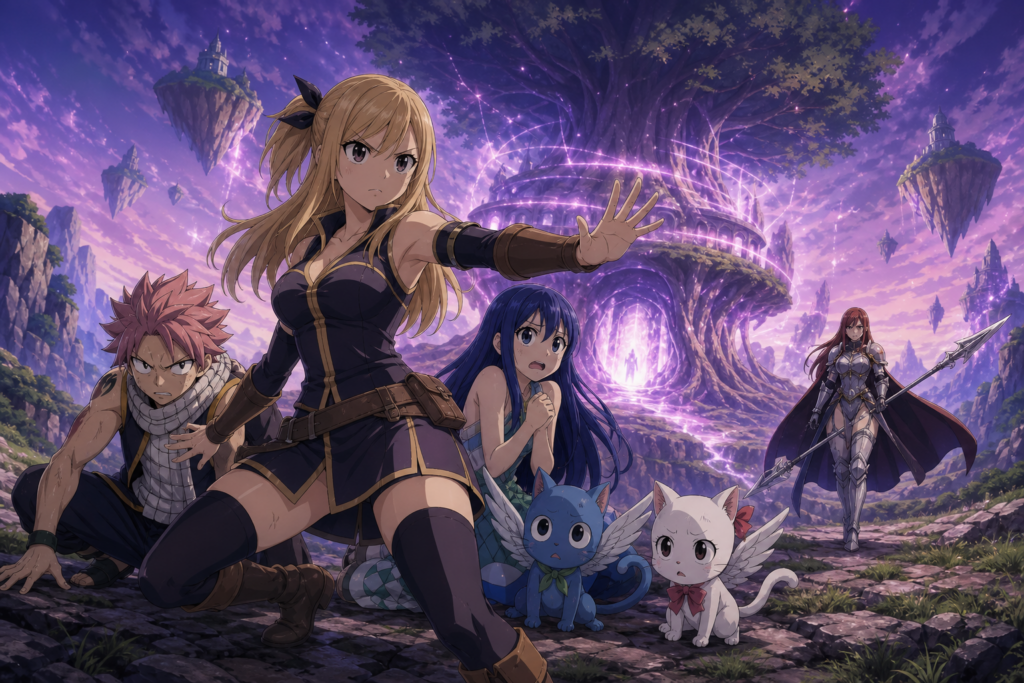
The faces are familiar. The power relationships are not. “Fairy Hunting” turns the parallel guild from a personality game into a survival story, then gives Natsu and Happy the most dangerous kind of resemblance: a living Lisanna who is not theirs to reclaim.
The receipt box
- Episode: 79, “Fairy Hunting”
- Original Japanese broadcast: May 14, 2011
- Story position: Edolas arc
- Manga basis: Chapter 170
- Streaming route: Watch Fairy Tail Episode 79 on Crunchyroll
Lucy Ashley recognizes a Natsu who is not here
Lucy Ashley greets Natsu with the physical confidence of someone who expects him to understand the rules between them. He does not. Her familiarity belongs to Natsu Dragion, the Edolas version whose place Earth Land Natsu has accidentally occupied.
That mismatch drives the comedy, but it also establishes the episode’s central boundary. A counterpart is not a spare copy. Lucy Ashley’s history, affection, impatience, and authority belong to relationships built in Edolas. Natsu shares a face with someone she knows, not a claim on that person’s life.
The same rule must work in both directions. The visitors cannot reduce Edolas Fairy Tail to amusing distortions of their friends. These guild members recognize one another through experiences the audience has not lived. Their differences are not errors waiting to be corrected by Earth Land originals.
The personality reversals reveal different permissions
Gray wears too many clothes and openly pursues Juvia. Cana is restrained. Elfman is timid while Jet and Droy push him around. Alzack and Bisca are honest about wanting each other. The reversals initially look like a checklist of jokes.
Then the episode reveals the guild’s legal position, and the behavior gains context. This Fairy Tail survives as a Dark Guild after the kingdom abolishes Mage Guilds. People living under pursuit learn different ways to take space, avoid attention, protect one another, and discharge fear.
Not every trait needs a political explanation. Parallel worlds can have ordinary variation. But the episode is smarter when it lets environment matter. Confidence is not an essence assigned to one face. It can be encouraged, punished, or made necessary by the room around that person.
Happy and Carla are read as power
The Edolas guild reacts to Happy and Carla as Exceeds, not pets. Mirajane and Elfman inspect them, trying to decide whether appearance equals authority. The visitors have entered a hierarchy they still do not understand.
Happy’s confusion remains important. Carla has spent two episodes treating buried origin as destiny, while Happy continues to demonstrate that identity also comes from lived choices. The guild members’ fear cannot tell us who he is. It tells us what Exceeds mean inside Edolas.
The distinction protects the story from biological inevitability. Wings and origin may place Happy within a political system, but they do not automatically make him loyal to it. A body can be categorized by the state without surrendering the person’s relationships to that category.
Lisanna is not a grief-delivery device
Lisanna walks into the guild, and Natsu and Happy react before analysis can catch up. Their joy is immediate because grief is physical. For one breath, the impossible appears to have corrected itself.
It has not. This Lisanna belongs to Edolas. Her resemblance opens Natsu and Happy’s wound, but it does not make her available to close it. Their impulse to embrace her is understandable; Lucy Ashley stopping them is also understandable. From Lisanna’s perspective, unfamiliar people are rushing toward her with a history she never shared.
This is where the parallel-world premise stops being a novelty. A face can trigger real memory without carrying the person remembered. Natsu and Happy must honor their grief without turning another Lisanna into treatment for it.
Carla supplies the boundary everyone needs
Carla states what emotion has made difficult to hold: these are different people. The Edolas versions resemble Fairy Tail members, but they are not the stolen friends the group came to rescue.
Her clarity is useful even after her earlier cruelty toward Happy. Carla often understands systems before she understands people. Here the system-level explanation prevents Natsu and Happy from collapsing two lives into one.
It also refines the mission. The presence of a Fairy Tail emblem does not mean the rescue is over. Earth Land Magnolia remains missing, and Edolas Fairy Tail is facing its own threat. The visitors have found potential allies, but alliance will require respecting the danger these people already live with.
A Dark Guild is sometimes just an organization the state outlawed
Edolas Fairy Tail is not “dark” because its members abandoned one another or adopted a criminal ethic. It carries the label because the kingdom abolished Mage Guilds and criminalized their continued existence.
That matters. Institutional language often pretends to describe moral reality when it actually describes compliance. The kingdom says legal guilds no longer exist; Fairy Tail keeps organizing anyway. The label tells us who holds enforcement power, not who deserves trust.
The guild’s survival is collective. Members maintain warning systems, accept relocation as routine, and remain together despite being hunted. Earth Land Fairy Tail fights loudly because it can occupy public space. Edolas Fairy Tail has learned how to make belonging portable.
The guildhall is infrastructure, not decoration
When Nab warns that the Fairy Hunter is approaching, Levy relocates the entire guildhall. The building disappears before the attack arrives and returns elsewhere with the community intact.
It is a wonderful fantasy mechanism because it turns architecture into mutual aid. A fixed address would let the kingdom destroy the guild. Mobility allows the members to preserve records, shelter, and one another. Their home survives because it can move.
The scene also challenges the usual heroic preference for standing ground. Retreat is not cowardice when an armed state hunts a vulnerable community. The successful outcome is not defeating every pursuer. It is denying the pursuer a target and keeping people alive.
Erza Knightwalker makes familiar strength frightening
The Fairy Hunter misses the relocated guild, and the visitors learn her identity: Erza Knightwalker, commander in the Royal Army. Earth Land Erza uses overwhelming power to protect Fairy Tail. Her Edolas counterpart uses comparable authority on behalf of the institution hunting it.
The reversal works because strength has never been morally self-interpreting. Discipline, courage, and combat skill become protective or oppressive through allegiance and action. A familiar face does not soften the spear aimed at a fugitive guild.
Natsu’s group now faces an especially destabilizing enemy. They know how Earth Land Erza moves and what she means to them. That knowledge may help tactically, but emotionally it creates hesitation the Royal Army does not need to share.
The giant lacrima makes theft administratively clean
Sugarboy reports that the Earth Land Fairy Tail has been transformed into a giant lacrima and orders the commanders back to the capital. Magnolia’s people have been converted into stored magic.
Transformation lets the kingdom hide violence inside resource language. A lacrima sounds like an object. The audience knows it contains a town. Once people become fuel, officials can discuss transport, allocation, and orders without naming the lives trapped inside.
This is the sharpest escalation in the episode. Rescue is not only about finding a displaced population. The heroes must reverse a process designed to erase the distinction between person and commodity.
Fairy Tail exists differently under pressure
Earth Land Fairy Tail and Edolas Fairy Tail share an emblem and a stubborn commitment to community. Everything around that commitment differs. One guild occupies Magnolia with noise and institutional recognition. The other survives through secrecy, warning calls, and a building engineered to flee.
The parallel does not ask which guild is the real one. It asks what values remain recognizable when circumstances change. The answer is not clothing, personality, or even legal status. It is the repeated choice to keep a place for one another.
That is why the Edolas guild can become more than a gag. Its members have built belonging under conditions designed to dissolve it.
What this episode changes
Episode 79 introduces the Edolas counterparts as independent people, reveals that Mage Guilds are outlawed, identifies Erza Knightwalker as the Fairy Hunter, and confirms that Earth Land Magnolia has been converted into a giant lacrima.
It also gives the rescue a local political context. Natsu’s group cannot simply cross a border, retrieve friends, and leave. They are moving through a world where the people most likely to help them are already targets of the same state responsible for the theft.
RaeRae's verdict
“Fairy Hunting” gets the easy laughs out of the way and then asks the question that matters: what does a guild look like when the government decides the guild should not exist?
It looks mobile. It looks nervous. It looks like Levy moving an entire home before Erza Knightwalker can put a spear through it. Retreat keeps the doors open, and that counts as resistance.
The Lisanna scene is the episode’s emotional test. Natsu and Happy deserve compassion for the wound that opens. Edolas Lisanna still does not belong to them. Grief does not create ownership. The episode is strongest when it lets both truths stand at once.
Sources
WordPress publication package
- Post title: Fairy Tail Episode 79 React: Fairy Hunting
- Slug: `fairy-tail-episode-79`
- SEO title: Fairy Tail Episode 79 React | Fairy Hunting
- Meta description: Fairy Tail Episode 79 introduces Edolas Fairy Tail, reopens Natsu’s grief for Lisanna, and reveals Erza Knightwalker hunting the outlawed guild.
- Focus keyphrase: Fairy Tail Episode 79 React
- Canonical hero filename: `cvm-sekai-fairy-tail-episode-079-fairy-hunting-react-hero.png`
- Media title: Fairy Tail Episode 79 React Hero | Fairy Hunting
- Alt text: Lucy Ashley shields Natsu, Wendy, Happy, and Carla as Erza Knightwalker approaches the mobile Edolas guild.
- Caption: Edolas Fairy Tail prepares to move as Erza Knightwalker closes in on the outlawed guild.
- Media description: Original CVM Sekai editorial artwork for the Fairy Tail Episode 79 React. Depicts Lucy Ashley protecting Natsu, Wendy, Happy, and Carla while Erza Knightwalker approaches through the floating landscape of Edolas. No official frame recreation.
- FileBird folder: Anime / Fairy Tail / Episode Reacts
- Attachment World: Anime
- Attachment Series: Fairy Tail
- Attachment Characters: Lucy Ashley, Natsu Dragneel, Wendy Marvell, Happy, Carla, Erza Knightwalker
- Attachment Role: Episode React Hero
- Post categories: Anime; Anime Series; Reacts
- Post World: Anime
- Post Series: Fairy Tail
- Post Character terms: Natsu Dragneel, Wendy Marvell, Happy, Carla, Lucy Heartfilia, Lisanna Strauss, Levy McGarden, Erza Scarlet
- Episode type: Manga canon
- Manga source: Chapter 170