
Fairy Tail Episode 78 React: Edolas
Anima turns scarcity into extraction, Carla turns fear into a loyalty test, and a familiar guild becomes the least reliable thing in sight.
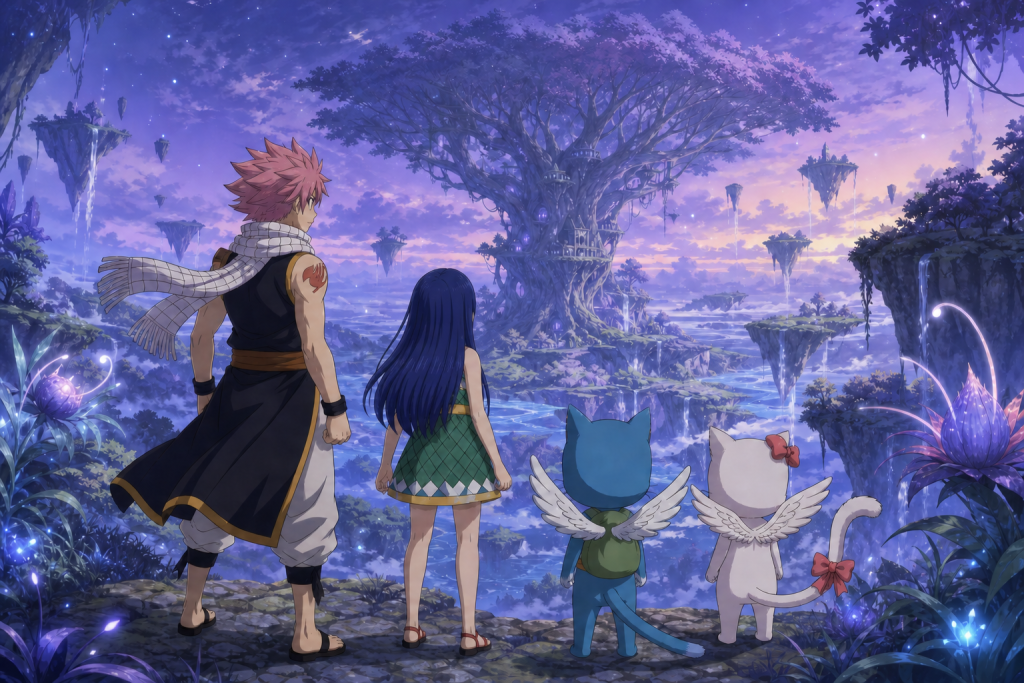
Magnolia is gone, and the rescue begins with Carla admitting that knowledge is not the same thing as consent. “Edolas” moves Fairy Tail into a parallel world where magic is rationed, cats are treated like authorities, and familiar faces can no longer be trusted on sight.
The receipt box
- Episode: 78, “Edolas”
- Original Japanese broadcast: May 7, 2011
- Story position: Edolas arc
- Manga basis: Chapter 169, with an expanded arrival sequence
- Streaming route: Watch Fairy Tail Episode 78 on Crunchyroll
Carla finally explains the theft
Carla names the system that stole Magnolia. Edolas is a parallel world running out of magic, and Anima is its answer: open a passage into another world, take the magic there, and bring it home. That is not trade or rescue. It is extraction.
The distinction matters because scarcity does not make the victims less real. Edolas may have a genuine crisis, but its kingdom has decided that another population can absorb the cost without being consulted. Magnolia was not an empty reservoir. It was a town full of homes, work, memory, and people.
Mystogan spent years closing smaller Anima openings. His private resistance delayed the harm, but it never gave Earth Land the knowledge to prepare together. Episode 78 inherits that failure. The survivors begin their rescue with almost no map because the people who knew the danger treated secrecy as protection.
Happy learns that ignorance can be assigned to you
Carla says she and Happy were sent from Edolas six years earlier. She carries implanted knowledge about the world and their mission; Happy carries no conscious memory of either. Her anger lands on him anyway.
That imbalance is cruel precisely because Happy cannot solve it by trying harder. He did not choose to forget. He grew up with Natsu, built a life in Fairy Tail, and understood himself through relationships rather than an inherited order. Carla treats that ordinary belonging as evidence that he has failed a duty he cannot remember accepting.
The episode does not make Carla’s fear meaningless. She has lived with knowledge that isolates her and now believes Magnolia vanished partly because of their arrival. But fear explains her severity; it does not make Happy responsible for information withheld from him.
Carla's conditions turn rescue into a loyalty test
Carla agrees to guide Natsu and Wendy through the remaining Anima only after setting conditions. They must hide from the kingdom, accept that she cannot truly navigate a world she has never visited, and stop asking about the mission. Most brutally, Natsu and Wendy must kill Happy and Carla if either cat betrays them.
That demand is not operational wisdom. It is Carla trying to control uncertainty by writing the harshest possible ending in advance. If she can define betrayal and punishment before they leave, she does not have to admit how little she understands about the orders inside her own body.
Natsu does not organize his relationships that way. Happy is not a possible enemy on probation. He is family. The rescue works because Natsu and Wendy travel with the cats, not because they accept Carla’s suspicion as truth.
The wings become a road home
Happy and Carla’s wings have usually meant mobility inside Earth Land. Here they become the key to crossing between worlds. The image quietly revises what an ability can mean: the same wings that made the Exceeds unusual in Magnolia are also evidence of an origin neither one chose.
Their passage through Anima is not a triumphant portal shot. Four young people cling to one another while entering a system designed to steal from them. Natsu and Wendy bring Dragon Slayer durability. Happy and Carla bring the route. No member of the group can make the crossing alone.
That dependency is the healthier answer to Carla’s loyalty test. Trust is not certainty about what someone will never do. It is the decision to move together when everyone holds a different necessary piece.
Edolas makes scarcity visible in the landscape
Floating islands, rivers suspended in the sky, oversized plants, and impossible distances make Edolas beautiful before the episode explains how tightly its magic is controlled. That beauty is important. An exploitative kingdom does not require an ugly world.
When Happy and Carla’s wings fail, the rule becomes physical. Magic here is finite and cannot be used freely. Natsu cannot solve the first danger by throwing fire. Wendy cannot default to support magic. The team has entered a culture where magical power is an object, a ration, and a political resource.
Fairy Tail often treats magic as an expression of character. Edolas asks what happens when a state treats it as fuel. The answer begins with dependence on tools, permission, and whatever power can be stored or seized.
Being recognized as an Exceed changes the room
The travelers they meet do not see Happy and Carla as cute companions. They see Exceeds and immediately respond with fear and submission. Happy has spent his life being underestimated; now strangers grant him authority he neither understands nor wants.
That reversal exposes how social status is manufactured. Nothing about Happy’s character changed during the crossing. Only the story other people attach to his body changed. Carla knows more than he does, but even she has never experienced this treatment firsthand.
The scene also warns the group that disguises will not solve every problem. Clothing may hide Natsu and Wendy. Wings, ears, and cultural assumptions make the cats legible in a different and more dangerous way.
No magic means Natsu has to run
The expanded anime material lets Edolas refuse Natsu’s usual grammar. Strange wildlife attacks, magic does not answer, and the group escapes through improvised movement rather than a named attack.
It is funny, but it is not disposable. Natsu’s confidence often comes from knowing that his body and fire can meet a threat directly. Edolas removes that certainty before he understands the local tools that might replace it. He is still brave; he is no longer automatically equipped.
The sequence also gives the landscape time to become a place instead of a single portal destination. Rescue will require learning how people travel, fight, hide, and organize under scarcity. The heroes cannot treat a parallel world as a hallway to their captured friends.
Familiar faces become unreliable evidence
The Fairy Tail emblem should be the safest sign Natsu could find. It leads instead to a guild full of people who look familiar and behave wrong. Gray is buried in clothes. Juvia rejects him. Cana is restrained. Jet and Droy bully Elfman. Alzack and Bisca say what their Earth Land counterparts avoid.
The reversals are funny because recognition arrives before understanding. The team knows the faces and therefore assumes the relationships. Edolas immediately punishes that shortcut.
Parallel versions are not replacements for the stolen guild. They are people formed by a different world, different pressures, and different choices. The episode’s final reveal works because home appears to be present while remaining completely out of reach.
Lucy Ashley controls the first impression
The Edolas version of Lucy discovers the visitors beneath a table and turns the guild’s attention toward them. Her confidence sharply contrasts with the Earth Land Lucy Natsu first met, but the point is not that one version is authentic and the other is an inversion gag.
Lucy Ashley belongs to a fugitive guild in a world where magic organizations have a different relationship to power. Her aggression reads as social armor before the next episode supplies the full political context. She recognizes a version of Natsu; he has no idea which expectations arrived with that recognition.
The cliffhanger makes identity practical. Looking like a friend can get someone close enough to help, accuse, or expose you. Natsu’s group needs information from these strangers, but resemblance alone cannot establish trust.
What this episode changes
Episode 78 establishes Edolas as a magic-scarce parallel world, identifies Anima as state extraction, and reveals that Happy and Carla originated there. It removes the heroes’ normal magic, changes the social meaning of Exceeds, and introduces an alternate Fairy Tail.
More importantly, it shifts the arc from disaster response to political rescue. Magnolia was not destroyed by weather or an uncontrolled spell. A kingdom took it. Saving the guild will mean confronting the structure that turned another world into supply.
RaeRae's verdict
“Edolas” understands that a parallel-world story needs more than flipped personalities. Its best idea is scarcity. Magic is not background sparkle here; it is the resource a government has chosen to ration at home and steal abroad.
Carla is difficult in exactly the way the episode needs. She knows enough to frighten everyone and not enough to free herself from the mission planted inside her. Her demand that Natsu and Wendy kill the cats if they betray the group is not admirable discipline. It is a child trying to make uncertainty obey.
Happy offers the counterargument simply by being Happy. His life with Natsu is not fake because it happened after someone erased or buried his instructions. Chosen belonging counts. The entire rescue depends on it.
Sources
WordPress publication package
- Post title: Fairy Tail Episode 78 React: Edolas
- Slug: `fairy-tail-episode-78`
- SEO title: Fairy Tail Episode 78 React | Edolas
- Meta description: Fairy Tail Episode 78 sends Natsu, Wendy, Happy, and Carla into magic-scarce Edolas, where Anima, Exceed authority, and a parallel guild reshape the rescue.
- Focus keyphrase: Fairy Tail Episode 78 React
- Canonical hero filename: `cvm-sekai-fairy-tail-episode-078-edolas-react-hero.png`
- Media title: Fairy Tail Episode 78 React Hero | Edolas
- Alt text: Natsu, Wendy, Happy, and Carla overlook the floating islands and immense central tree of Edolas.
- Caption: Natsu, Wendy, Happy, and Carla enter Edolas, where magic is scarce and familiar faces cannot be trusted on sight.
- Media description: Original CVM Sekai editorial artwork for the Fairy Tail Episode 78 React. Depicts Natsu, Wendy, Happy, and Carla overlooking Edolas with floating islands, suspended waterways, and a vast inhabited tree. No official frame recreation.
- FileBird folder: Anime / Fairy Tail / Episode Reacts
- Attachment World: Anime
- Attachment Series: Fairy Tail
- Attachment Characters: Natsu Dragneel, Wendy Marvell, Happy, Carla
- Attachment Role: Episode React Hero
- Post categories: Anime; Anime Series; Reacts
- Post World: Anime
- Post Series: Fairy Tail
- Post Character terms: Natsu Dragneel, Wendy Marvell, Happy, Carla, Lucy Heartfilia, Gray Fullbuster, Juvia Lockser, Cana Alberona, Elfman Strauss
- Episode type: Manga canon with anime expansion
- Manga source: Chapter 169