
Fairy Tail Episode 6: Fairies in the Wind
Lullaby turns listening into a public threat.
RaeRae Reacts • Fairy Tail Episode 6
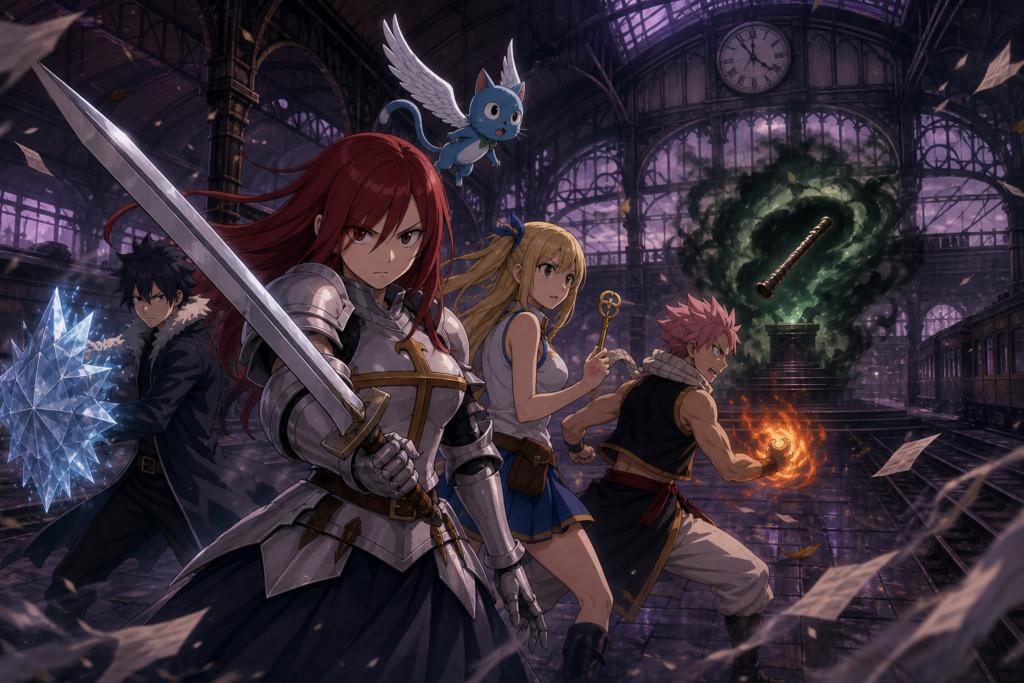
Bottom line: Lullaby turns listening into a public threat. That is why Episode 6 cannot be solved by asking which Fairy Tail wizard hits hardest. Eisenwald has seized a railway station, trapped ordinary people inside a guild conflict and introduced a flute whose curse magic can kill everyone who hears it. The real test is whether Erza’s newly assembled team can protect people who never volunteered to become part of the fight.
Episode 5 made Erza’s authority visible. Episode 6 makes it answerable. Looking commanding in a guild hall is one thing. Leading through an occupied station while a dark guild controls movement, information and fear is a different job.
The receipt box
- Episode: 6
- English title: Fairies in the Wind
- Japanese title: 妖精たちは風の中
- Original Japanese broadcast: November 16, 2009
- Story position: Eisenwald and Lullaby mission at Oshibana Station
- Official watch route: Crunchyroll
- Manga anchor: Chapter 11, “Natsu on the Train,” by Hiro Mashima; the exact full chapter span remains a clean boundary until directly mapped
- RaeRae’s verdict: Fairy Tail’s strongest-team talk means nothing unless strength reduces harm for civilians.
Crunchyroll’s official listing gives us the core facts. Lullaby is a flute carrying mass-murder curse magic. Anyone who hears its melody can be killed. Erigor and Eisenwald seize Oshibana Station. Erigor announces his plan to play the flute for people in the area, then leaves while the battle begins with Erza taking the lead.
That setup is already enough. The flute is not a stronger sword. It is a delivery system. It makes distance, sound and public space part of the weapon.
A station is supposed to move people, not trap them
Oshibana Station matters because it is ordinary infrastructure. People enter a station expecting routes, schedules and shared rules. Eisenwald converts that trust into leverage.
The takeover is not only a dramatic location change. It is an attack on collective life. A station connects strangers who have no relationship to one another beyond being in transit. Lullaby turns that accidental community into a potential casualty list.
RaeRae inference: this is why the episode’s threat feels larger than the Everlue mansion. Everlue controlled a private property and used money to dominate a writer. Eisenwald occupies a public node and makes everyone nearby vulnerable to a guild’s agenda.
The power lens is sitting right there. Whoever controls transportation can control who leaves, who arrives, who receives information and who becomes exposed. Erigor does not need every person in the station to understand his grievance. He needs them unable to escape the consequences.
That is terrorism in the plain-language sense of the word: violence aimed beyond a direct opponent so fear and mass harm can do political or organizational work.
The show should not let the crowd become wallpaper. Civilians are not there to prove the villain is serious and then disappear from the moral math. If Fairy Tail wins a battle while ignoring the people placed at risk, the guild has failed the public part of its name.
Lullaby removes consent from sound
Sound is communal. You can close a book. You can refuse a handshake. Hearing does not always offer that clean choice.
Lullaby corrupts that fact. Its curse does not require a fair duel or even a willing target. The flute’s melody can make listening fatal.
That changes the team’s tactical problem. Natsu’s fire, Gray’s Ice-Make, Erza’s Requip and Lucy’s Celestial Spirit magic can defeat opponents. They cannot punch a melody after it has already reached a crowd. Prevention matters more than retaliation.
The curse also creates an ethical contrast with Lucy’s magic. Celestial Spirit contracts are not simple or automatically equal, but Lucy’s best use of them depends on relationship, recognition and cooperation. Lullaby is the opposite. It uses a shared sensory channel to erase choice.
That is a useful way to separate magic systems by values, not only effects. Two spells can both be powerful while organizing relationships differently. One magic asks who can be called and what a contract means. The other treats every listener as material.
The title “Fairies in the Wind” sounds light until the episode turns wind into reach. Air carries sound. Movement spreads risk. The fairies are not floating through a cute adventure. They are operating inside the same environment that can deliver the weapon.
Eisenwald is an institution, not a spooky adjective
Calling Eisenwald a dark guild tells us its legal and social position. It does not explain every member’s choices.
Episode 6 works better when Eisenwald is treated as an organization. Members participate in a station seizure. They support a plan involving mass-killing curse magic. Those are actions with victims and consequences.
The “dark guild” label should not become a moral shortcut that removes agency. Institutions can normalize conduct, reward obedience and turn individual grievance into coordinated harm. Members still make decisions inside those systems.
That distinction matters because Fairy Tail is also a guild. It also gathers powerful people beneath one name. Episode 1 established that a guild’s reputation can be stolen. Episode 6 shows that a guild’s real conduct can become a public threat.
The difference between Fairy Tail and Eisenwald cannot be that one group has prettier branding and protagonists. It has to be what the members do with collective power.
Eisenwald captures a public space and uses strangers as leverage. Fairy Tail’s response should be judged by whether it protects those strangers rather than treating them as the background behind a cool fight.
Erza's leadership finally has a bill
Erza’s Episode 5 entrance made people behave. Episode 6 asks whether that authority can become operational care.
Leadership in an occupied station means priorities. Who needs protection? What information does the team have? Which threat can be contained? Who pursues Erigor, and who remains to keep Eisenwald from harming the people still inside?
The official listing says the battle begins with Erza taking the lead. That matters because the episode is no longer asking whether Natsu or Gray accepts her reputation. It is asking what she does with their abilities.
Erza has to coordinate a team whose members solve problems differently. Natsu attacks directly. Gray builds and restrains. Lucy works through contracts and judgment. Happy can provide mobility. Erza’s own Requip gives her tactical range.
The easy version of leadership is “everybody follow the strongest woman.” The useful version is matching a person’s ability to the problem without making that person disposable.
Fear may stop Natsu and Gray from fighting each other. It cannot replace communication during a hostage crisis. If Erza wants more than short-term obedience, she has to make the mission intelligible.
That is the shift Episode 6 begins. Authority got the team on the train. Leadership has to get people out of danger.
Natsu and Gray need roles, not matching personalities
Natsu and Gray do not have to stop being rivals. They have to stop making everyone else pay for the rivalry at the wrong time.
Inside Oshibana Station, their differences can become useful. Fire and Ice-Make create different tactical possibilities. Direct force and constructed restraint are not redundant.
The episode’s team question is whether those abilities serve a shared plan. If Natsu treats every enemy as a personal challenge and Gray treats every exchange as another chance to compete, Erza does not have a team. She has two weapons arguing over who gets swung first.
Episode 5 used their sudden manners as comedy. Episode 6 raises the cost. People may die if the mission becomes another guild-floor brawl.
Natsu’s motion sickness also remains part of readiness. His body can reduce him during travel even when his magic is enormous. That limitation is not a moral failure and should not be treated as proof that he is weak. It is operational information the team has to respect.
A good team plans around members’ limits instead of shaming them for having bodies.
Gray’s constructed magic can help make space, block movement or control an environment, but exact Episode 6 techniques should remain tied to what the episode shows. A React does not become smarter by importing a complete spell catalog into every scene.
Lucy is not just watching anymore
Lucy joined the Eisenwald mission after four episodes that established her judgment. Episode 6 places that judgment inside a crisis whose scale is larger than any job she has completed.
She is still the newest member. That does not make her the least relevant.
Lucy understands that magical objects can hide meaning and that contracts can conceal stakes. Lullaby combines both problems. It is an object with a lethal function, and the people exposed to it never agreed to any contract.
That makes her perspective valuable even before a specific Celestial Spirit attack is counted. She is the team member most recently forced to ask whether completing instructions would cause harm.
The show should also resist assigning Lucy the entire emotional-management job. She can mediate. She can observe. She can choose to support Natsu and Gray. None of that means their behavior becomes her responsibility because she is the available woman.
Erza and Lucy together offer two forms of female competence. Erza manages force and mission structure. Lucy notices relationships, hidden terms and moral consequences. Neither woman needs to be reduced so the other can look strong.
Happy's mobility should remain practical
Happy can fly. In a station takeover, that is a real tactical advantage.
Mobility can help with reconnaissance, access and moving around blocked routes. It can also make Happy vulnerable if the story treats him as equipment instead of a team member.
The useful question is not “can the flying cat solve this?” It is how the team uses his ability without pretending flight removes risk.
Happy also carries social information. He knows Natsu’s limits, understands the guild’s habits and can read the difference between a normal fight and a situation that needs coordination.
Exact actions stay episode-bound. The larger point is already visible: the team is more capable because its members do not all move through space the same way.
Erigor controls the announcement
Erigor does not quietly hide the threat. He announces that he will use Lullaby.
That declaration turns information into another weapon. The team knows enough to fear mass harm but not enough to control the whole situation. Erigor chooses what they learn, when they learn it and what urgency the knowledge creates.
Then he leaves.
That departure matters. He separates leadership from the immediate fight and forces Erza’s team to divide attention between the occupied station and the person carrying the wider plan.
The official description hints that Erigor has another goal. Episode 6 should preserve that boundary. Later knowledge does not belong in the episode’s mouth before it speaks.
This is where recap discipline matters. A fan directory can tell viewers what happens in Episode 6 without turning the React into a spoiler dump for Episode 7.
Adaptation craft: wind, sound and station geometry
The anime has tools the manga cannot reproduce in the same way. Sound is the obvious one.
A cursed flute becomes more threatening when the audience can anticipate hearing it. Silence, breath, wind and the possibility of a note can create tension before the melody arrives.
The station adds geometry. Platforms, corridors, gates and tracks create routes that can be blocked or opened. The environment can make the team look separated, cornered or coordinated.
Wind is not decorative weather. It moves papers, hair, sound and bodies. It can visualize Erigor’s presence and make the episode title feel active.
The production challenge is keeping the public-risk story readable while fights begin. Spectacle should clarify the problem, not bury it. Viewers need to understand where Erigor went, what Eisenwald controls and why Lullaby cannot be allowed to play.
I am not assigning individual episode direction, storyboard or animation-direction credits without a primary end-roll source. TV Tokyo confirms the Japanese title and home-media placement. Crunchyroll confirms the official synopsis and release date. Those receipts support the factual floor without pretending they support every production name.
What Episode 6 changes
Fairy Tail’s work is public now.
The Everlue mission involved a private client and an abusive patron. Oshibana Station turns guild conduct into a visible emergency. People outside Fairy Tail may live or die based on what the team does.
That changes the meaning of the guild name. Membership is not only belonging. It is responsibility backed by dangerous power.
Erza’s team is also no longer theoretical. Episode 5 assembled them. Episode 6 places their differences inside one operational problem.
They do not become the strongest team because a title card says so. They become a team if they can coordinate magic, manage limits, communicate stakes and protect people who cannot protect themselves.
RaeRae's final take
“Fairies in the Wind” understands that the scariest weapon is not always the one with the largest explosion. Lullaby turns an ordinary act, hearing music, into involuntary exposure.
That makes the episode a leadership test. Erza has authority. Natsu, Gray, Lucy and Happy have different kinds of power. None of it matters if the station’s civilians remain disposable.
Eisenwald uses public space and shared sound to remove choice. Fairy Tail has to prove its collective name means the opposite: power organized around protection rather than control.
Episode 6 does not finish that argument. It puts the team inside it and closes the exits.