
Fairy Tail Episode 5: The Armored Wizard
Erza’s return makes Fairy Tail’s invisible org chart stand up straight.
RaeRae Reacts • Fairy Tail Episode 5
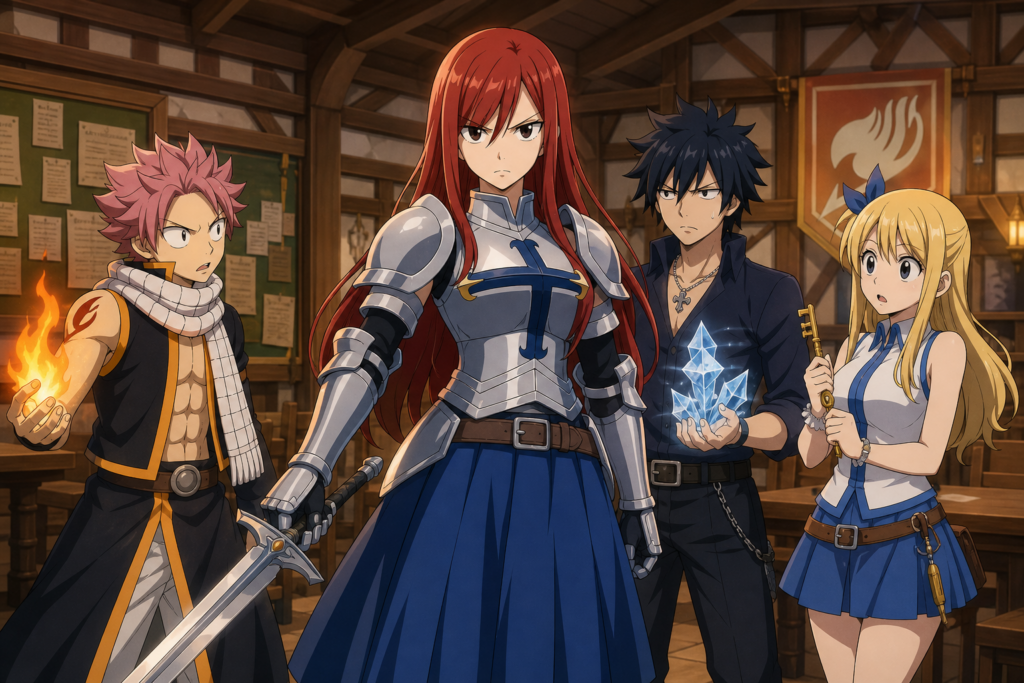
Bottom line: Erza Scarlet enters Fairy Tail like an HR investigation wearing armor. The guild does not need a speech about her reputation. Everybody changes behavior when she walks in. Episode 5 uses that fear for comedy, but it also asks a serious question: can Erza turn authority into teamwork, or is she simply the one person powerful enough to make chaos stand in a straight line?
Lucy is the right person to watch this happen. She joined Fairy Tail because its name meant something to her. Now she gets to see the internal hierarchy behind the brand. The guild may advertise freedom, family and magical talent. It still has people whose judgment can stop a room.
The receipt box
- Episode: 5
- English title: The Armored Wizard
- Japanese title: 鎧の魔導士
- Original Japanese broadcast: November 9, 2009
- Manga anchor: Chapter 10, “The Armored Wizard,” by Hiro Mashima
- Story position: The opening of the Eisenwald and Lullaby mission
- Official watch route: Crunchyroll
- RaeRae’s verdict: Erza’s entrance works because the show makes authority visible through everybody else’s conduct.
Crunchyroll’s official episode listing gives us the working facts. Natsu and Lucy are looking for another job when Erza returns. The guild fears her. She asks Natsu and Gray to help on a mission. Lucy joins them, and Erza explains on the train that she learned about Eisenwald’s plans and intends to stop the dark guild.
That is a lot of structural work for one episode. We meet Erza, formalize the Natsu-Gray-Lucy-Erza team, introduce Eisenwald and move the story out of Magnolia. The trick is making all of it feel like one consequence of Erza opening the guild door.
Erza's reputation arrives first
Erza does not enter as a mystery box. The episode tells us who she is by showing what other people do around her. Guild members who normally shout, fight and destroy furniture suddenly remember posture. Natsu and Gray, two men who treat conflict like cardio, know enough to adjust themselves.
That is good character direction because reputation becomes behavior. A weaker entrance would stack labels around Erza: strongest woman, S-Class wizard, scary disciplinarian, please clap. Episode 5 lets the room perform the résumé.
The comedy is obvious. Fairy Tail’s loudest members can become suspiciously civilized when the correct woman looks at them. The side-eye is also obvious. If one member’s return produces this much panic, the guild has been outsourcing its conflict management to her presence.
RaeRae inference: Erza’s authority is partly institutional and partly personal. Her rank matters. Her history with the guild matters. So does the fact that people expect consequences when she gives an order. The episode does not yet hand us her full biography, and it should not. It gives us the social fact first: Erza can reorganize Fairy Tail without moving a wall.
That makes her armor more than a design cue. It externalizes the role the guild has already assigned her. She arrives protected, structured and prepared in a room built around emotional improvisation. The armor says discipline before she says anything about the mission.
Lucy finally sees the org chart
Lucy has spent four episodes learning that Fairy Tail’s public story and its daily reality are not identical. Episode 1 exposed a criminal borrowing the guild’s name. Episode 2 made membership into rent, work and rescue responsibility. Episodes 3 and 4 showed her that a job request can hide its true stakes.
Episode 5 introduces internal power.
Lucy is not simply the audience surrogate standing nearby while established characters do the interesting work. Her newness makes her analysis useful. Longtime members have normalized Erza’s authority. Lucy has not. She notices the shift because she still remembers how the guild behaved five minutes earlier.
That newcomer perspective helps the episode avoid pretending Fairy Tail has no hierarchy. The guild values individual freedom, but freedom does not erase rank, competence, history or fear. Erza’s entrance is cute because the rowdy boys straighten up. It is also information about who carries the burden of keeping this workplace functional.
Lucy chooses to go on the mission. That decision matters. She is not drafted as luggage. She has just proven that her reading can change a job’s outcome, and now she enters a larger mission with three wizards whose shared history she does not fully know.
Still, the official description says Lucy tags along to keep Natsu and Gray from fighting. Excuse me while I stare directly into the camera.
The newest woman in the guild has already been assigned unpaid conflict management for two men who know better. Lucy can choose to help. The story can also be honest about the gendered expectation hiding inside the joke. Women do not become more competent because everybody keeps giving them other people’s emotional laundry.
Natsu and Gray discover indoor voices
Natsu and Gray’s rivalry has been background noise since Lucy entered the guild. Episode 5 turns it into a work problem. Erza needs both of them on the same mission. Their ability to cooperate is no longer only about whether a table survives breakfast.
This is where the comedy earns its place. Their sudden good behavior does not mean the rivalry disappeared. It means they understand power and consequence well enough to perform cooperation when Erza is watching.
Performance is not the same as repair.
That distinction matters for the team’s future. Natsu and Gray do not need to become identical or stop challenging each other. They need to learn when their competition increases collective strength and when it wastes everybody else’s time.
Erza’s request creates a practical test. A dark guild cannot be stopped by two men spending half the mission proving which one is more annoying. Lucy should not have to function as their permanent buffer. Erza’s leadership should not consist only of threatening them until the noise stops.
The long-term question is whether the four can turn enforced cooperation into trust. Episode 5 does not answer that. It assembles the people who will have to answer it.
Authority is not the same as leadership
Erza can command attention. Leadership requires more.
The episode gives her a mission, information and a team. That combination lets viewers judge what she does with the fear already attached to her name. Does she use it to make the group safer and more effective? Does she explain the stakes? Does she leave space for other people’s expertise? Or does obedience become the whole management plan?
Those questions keep the profile of Erza from collapsing into “strong scary woman.” Her physical power is not the only thing happening. She assesses a threat, identifies people whose abilities may help and brings them into coordinated action.
The labor lens is important here. Fairy Tail wizards are contractors, coworkers and public representatives of their guild. A dangerous mission needs leadership that can connect individual magic to a shared goal. Erza’s authority is useful because the guild’s normal looseness has limits. Somebody has to decide when a private rivalry becomes a public liability.
At the same time, fear is a fragile management tool. It can produce immediate compliance without producing judgment. Natsu and Gray behaving because Erza might punish them is funny. Natsu and Gray understanding why the mission requires cooperation would be growth.
Episode 5 places Erza at that threshold. She has the authority to assemble the team. The arc will show whether the team becomes more than people standing near her sword.
Eisenwald changes the scale
The first four episodes focused on one fake celebrity, one missing guild member and one abusive patron. Eisenwald moves Fairy Tail into a conflict with another magical institution.
Crunchyroll’s official description identifies Eisenwald as a dark guild and says Erza learned of its evil plans. Episode 5’s job is to establish the threat without pretending viewers already know the entire Lullaby mechanism or the later consequences of the mission.
That boundary matters. A React should discuss what Episode 5 reveals, not stuff the next several episodes into a recap because later knowledge is convenient. At this point, Eisenwald is organized danger. Erza believes the threat is serious enough to recruit Natsu and Gray, and Lucy joins the team heading toward it.
Institutionally, Eisenwald also gives Fairy Tail a mirror. Both are guilds. Both gather powerful people under a collective name. The difference will be conduct, purpose and accountability. Episode 1 already taught us that a guild’s name is only as moral as what people do with it. Episode 5 expands that argument from one criminal impersonator to an entire organization.
This is the first arc where Fairy Tail’s internal dysfunction has to face an external system. The guild’s chaos can feel warm at home. On a mission against coordinated enemies, warmth is not a strategy.
The train is a comedy bill coming due
Erza explains the mission while the team travels. That sounds ordinary until Natsu enters a vehicle.
His motion sickness is one of the show’s running jokes, but it also creates a real tactical limit. A Dragon Slayer who can overpower enemies may become helpless in transit. Power does not cancel the body.
That is useful magic-system characterization. Natsu is not a portable victory button. Travel can reduce him before a battle begins, and the team has to account for that. Comedy makes the limitation memorable without making it meaningless.
The train also changes Erza’s authority. Inside the guild, she controls the room through reputation. In transit, she has to brief a team that includes a sick Natsu, a competitive Gray and a new Lucy. The mission becomes practical. She cannot lead an abstract set of abilities; she has to lead these specific people with these specific limits.
Lucy is again positioned as the person expected to keep social order. That can become character work if her observations and choices influence the team. It becomes lazy if the men generate chaos and the women exist only to clean it up. Episode 5 opens that test. The series will have to keep answering it.
Erza and Lucy are not interchangeable competent women
It would be easy to flatten Erza and Lucy into a neat contrast: armored veteran versus feminine newcomer. That would miss both of them.
Erza’s strength does not make her free from the cost of being the responsible person. Lucy’s empathy does not make her weak or naturally suited to babysitting. Both women exercise judgment, but they do it from different positions.
Lucy questions a contract because she reads what powerful men tried to hide. Erza responds to an institutional threat by assembling force. One protects meaning inside a book. The other organizes people against a guild.
Those approaches can support each other. Lucy can notice what a command misses. Erza can give Lucy access to larger missions and model a form of female power that does not require permission from the men around her.
The relationship will only become interesting if the story lets both women remain specific. Erza should not become Lucy’s permanent rescue device. Lucy should not become Erza’s emotional interpreter. Episode 5 gives them a good starting point: a newcomer chooses to join a veteran’s mission, and both bring skills the team needs.
Adaptation craft: how to stage a reputation
Episode 5’s central production problem is an entrance. Manga can freeze Erza’s reveal and surround it with reactions. Television has to control timing, sound, posture and the order in which viewers notice the room changing.
The strongest adaptation principle is simple: let other characters sell her importance. A grand visual of armor means less if the guild does not respond. Reaction shots, interrupted movement and the contrast between noise before her arrival and behavior after it make her authority legible.
The warm guild setting also helps. Erza is not walking into a battlefield where armor would be expected. She brings battlefield structure into a communal room. That contrast makes her silhouette memorable without turning her into a generic fantasy knight.
I am not assigning episode-specific direction, storyboard or animation-direction credits without a primary end-roll source. TV Tokyo’s home-media archive confirms the episode title and volume placement. It does not establish every individual production credit. A clean boundary is better than a confident guess.
The same rule applies to performance analysis. Erza’s Japanese performance belongs in the final discussion only where specific vocal choices can be tied to the episode, not where a cast name is used as decoration. The article can analyze what the scene accomplishes without manufacturing observations it did not verify.
What Episode 5 changes
Before Erza returns, Lucy’s Fairy Tail experience is mostly a trio: herself, Natsu and Happy, with Gray and the larger guild orbiting nearby. Episode 5 rearranges the center.
Erza brings Gray into the mission and creates the team configuration that will become one of the franchise’s defining groups. That is the episode’s real consequence. It does not merely introduce another strong character. It changes the unit through which the story can operate.
The new team contains different kinds of power. Natsu is direct force and instinct. Gray is constructed magic and rivalry. Lucy is relational magic, reading and judgment. Erza is versatility, authority and mission structure.
Putting them together does not make them “the strongest team” by declaration. It creates a group with enough difference to produce both capability and conflict. The title belongs to what they might become, not what Episode 5 has already proven.
RaeRae's final take
“The Armored Wizard” is an entrance episode that understands reputation is social. Erza does not have to tell us she matters. Fairy Tail tells us with its body.
The funny version is that Natsu and Gray suddenly discover manners. The sharper version is that the guild depends on one woman’s fearsome competence to impose order, then expects another woman to keep the men from fighting on the road.
Erza’s best move is not frightening the room. It is recognizing that Eisenwald requires a team and taking responsibility for assembling one. Lucy’s best move is choosing to join without surrendering her own judgment.
Episode 5 does not prove this group can work. It proves they have been placed in the same problem. Now the series has to earn the team everybody will remember.