
Fairy Tail Episode 33 React: The Tower of Heaven
The Tower of Heaven
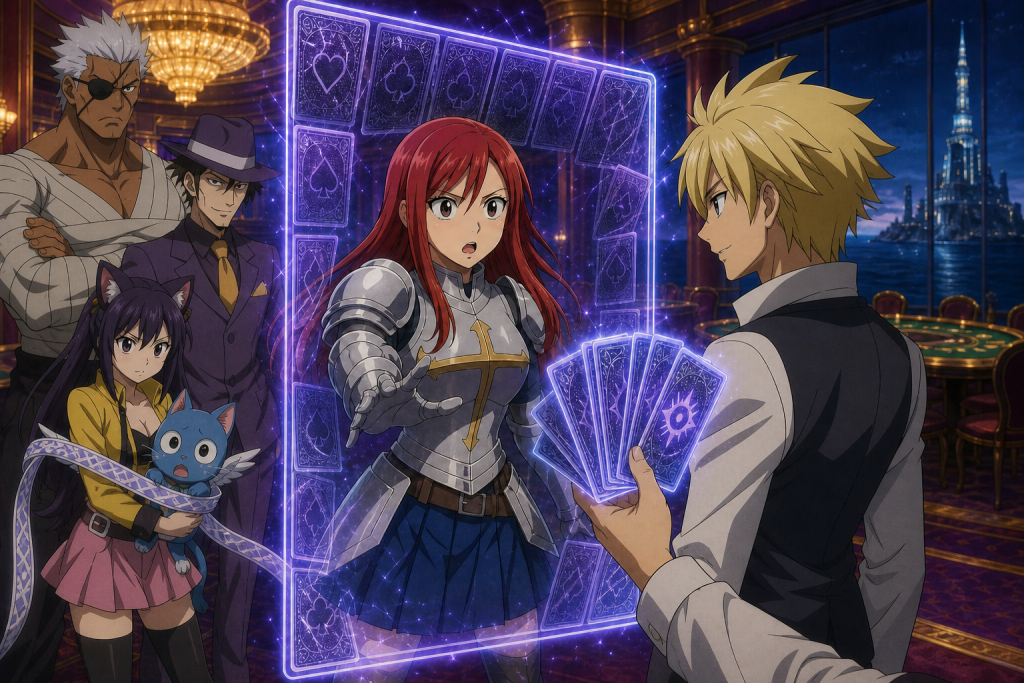
Bottom line: Episode 33 turns a gifted resort trip into Erza’s worst kind of ambush: the attackers know her, blame her, and can reach the child she buried under armor. Sho, Simon, Wally, and Millianna kidnap Erza and Happy, while Natsu, Lucy, and Gray discover that their strongest teammate has a history she never gave them permission to see.
The Tower of Heaven arc begins by asking whether secrecy protected Erza or simply left everyone else available for manipulation.
The receipt box
- Episode: 33
- English title: The Tower of Heaven
- Japanese title: 楽園の塔
- Romanization: Rakuen no Tō
- Original Japanese air date: June 7, 2010
- Series: Fairy Tail (2009–2013)
- Episode type: Manga canon
- Manga material: Chapter 75 from page 6, Chapters 76–77
- Arc: Tower of Heaven
- Opening: “Ft.” by Funkist
- Ending: “Gomen ne, Watashi.” by Shiho Nanba
- Where to watch: Watch The Tower of Heaven on Crunchyroll
Fairy Tail vacations remain a workplace hazard
Loke gives the team resort tickets after returning to the Celestial Spirit World. The gift is supposed to be a thank-you and a chance to rest. For a few minutes, Akane Resort offers exactly that: food, games, casino lights, and the dangerous fantasy that Team Natsu can enter a leisure facility without causing an arc.
They cannot.
The comedy at the resort has a structural job. It shows the team relaxed enough for an attack to reach them. More importantly, it gives us Erza in a social space where she is not directing a mission. Her armor may still communicate readiness, but the group expects pleasure rather than war.
That makes the interruption feel invasive. The attackers do not challenge Erza outside under a villain spotlight. They enter the space where her friends are laughing and pull a sealed history into public view.
Rest is not wasted screen time here. It establishes what Erza is about to lose.
Sho's cards do more than capture a body
Sho uses Card Magic, a power that can contain people and objects within cards. The visual is clever because Erza has spent years containing herself.
She organizes fear into rules. She converts vulnerability into armor. She turns memory into a locked compartment and carries on as Fairy Tail’s dependable S-Class mage.
Sho’s magic makes that emotional strategy literal. The woman who controls her presentation becomes an image inside somebody else’s hand.
That does not mean Sho understands her. Possessing a card with Erza inside it is not the same as possessing the truth. He has a history, a grievance, and a version of what happened after the child workers escaped the tower. His pain is real. His information has been shaped by someone else.
The episode’s first lesson is brutal and useful: shared trauma does not guarantee shared facts.
Erza recognizes them before her team understands anything
Sho, Simon, Wally, and Millianna are not random mercenaries. Erza knew them as children in the Tower of Heaven. Their faces interrupt her present identity because they belong to the period before “Titania,” before Fairy Tail, and before armor became her public language.
Her reaction carries recognition, guilt, and fear faster than she can explain any of it. The sudden change in Erza’s authority tells us that these people have access to a part of her life ordinary enemies cannot reach.
Natsu, Lucy, Gray, and Happy see the reaction before they receive the history. That gap creates danger. Erza’s teammates know how she fights. They do not know why she might hesitate, submit, or prioritize the captors’ feelings over her own safety.
Secrecy has kept Erza from having to relive the tower in conversation. It has also denied her team the context required to support her when the tower comes back.
Both things can be true.
Simon is the first sign the group is not emotionally uniform
The four childhood companions arrive as a unit, but the episode does not flatten them into identical revenge machines.
Sho carries the sharpest accusation. Millianna’s cat fixation and binding magic make her outwardly playful, but she participates in kidnapping Happy and Erza. Wally brings a stylized confidence to the operation. Simon is more restrained, and that restraint matters.
He recognizes the situation’s danger and does not read Erza with the same uncomplicated hostility. The episode has not yet given us his complete judgment, so this React will not import later actions and call them obvious from the beginning. What we can say is that the group already contains tension between loyalty, memory, and doubt.
That is how manipulation works best. It does not require everybody to believe exactly the same thing. It only requires enough shared hurt to keep the group moving in the direction the manipulator wants.
Millianna's affection does not cancel coercion
Millianna loves cats, so Happy becomes an immediate object of attention. The gag is readable: Happy is a talking blue cat with wings, and Millianna reacts with overwhelming enthusiasm.
The coercion remains real. Happy does not consent to being captured, handled, or carried away. Calling the behavior affection does not change the power relationship.
This may sound like an intense sentence about a cat joke. Good. Fairy Tail repeatedly asks us to distinguish fondness from respect. Jude believed his desire to bring Lucy home justified force. Karen treated Aries as a tool while holding a contract. Millianna can genuinely adore cats and still violate Happy’s autonomy.
Intent tells us why a character acts. It does not decide whether the action is harmless.
Happy also matters strategically. Taking him removes the team’s flight support and gives the captors leverage. He is not only a cute hostage. Aera changes mobility, rescue options, and battlefield access.
The attack is tailored to the team
The ambush works because each attacker has a method suited to disruption. Card Magic contains. Binding magic restrains. Ranged and physical attacks divide attention. Familiarity with Erza creates hesitation no ordinary opponent could force.
This is not a fair tournament match. It is an extraction.
Natsu’s instinct is to pursue. Gray reads the tactical problem. Lucy has to process another crisis tied to a teammate’s hidden family-like history only days after confronting her own father. The group’s different responses remain useful because the story has finally assembled a team whose strengths are not interchangeable.
The attack also proves that Erza’s reputation cannot protect her from people who knew her before it existed. “Titania” may frighten guild mages. It does not settle an accusation held since childhood.
The Tower of Heaven is forced labor wearing sacred language
The title introduces the Tower of Heaven before the episode gives the complete history. We know enough to reject its name at face value.
The tower was built through enslaved labor under a cult devoted to reviving Zeref. Children, including Erza and the four people now confronting her, were forced to work there. The project used religious and magical language to make exploitation sound transcendent.
That is not paradise. It is an institution turning bodies into construction material.
The Japanese title Rakuen no Tō carries the paradise/heaven language directly. The name exposes the ideological trick: promise a sacred destination while creating hell for the people ordered to build it.
Episode 33 does not yet provide every detail of Erza’s escape, Jellal’s role, or the friends’ belief that she abandoned them. The React should not solve the mystery ahead of the characters. The ethical boundary is already clear: the tower’s system abused children, and its aftermath still organizes their adult choices.
Trauma does not create one correct personality
Erza escaped and built a life inside Fairy Tail. Sho, Simon, Wally, and Millianna remained connected to the tower and to one another. Their different paths produced different coping strategies.
Erza became disciplined, protective, and intensely controlling. Sho became vulnerable to a story in which Erza betrayed the group. Millianna wrapped danger in playfulness. Wally turned style into distance. Simon appears to carry doubt more quietly.
None of those responses proves who suffered most. Trauma is not a personality contest.
What matters is conduct. Pain can explain why Sho wants answers and still fail to justify kidnapping. Erza’s guilt can explain why she hesitates and still fail to make her responsible for every false story told in her absence.
The arc will need to hold those distinctions or it will turn “hurt people hurt people” into an excuse generator. That phrase describes a pattern. It does not absolve the next act of harm.
Erza's secrecy was survival before it became a liability
It would be easy to scold Erza for never telling Team Natsu about the tower. That response ignores what disclosure costs.
Erza did not owe casual access to her enslavement, torture, grief, or escape. People who survive institutional violence often control the story because control was taken from them everywhere else. Silence can preserve the ability to function.
The liability appears when the past becomes an active threat to other people. Happy is taken. The team is attacked. The captors use information Erza’s allies do not possess.
At that point, secrecy stops affecting only Erza. She will need to decide what her teammates require to make informed choices. The team, in turn, must prove they can hear the history without seizing ownership of it.
That is a consent problem, not a demand for a confession scene.
Lucy is positioned to understand without pretending sameness
Lucy has just confronted coercive family power and defended Loke against an institution that flattened context. She enters Erza’s arc with fresh experience listening to a complicated causal story.
Her history is not the same as Erza’s. Wealthy family control is not child enslavement. Lucy should not collapse the difference into “I know exactly how you feel.”
What she can recognize is the structure: someone else has built a story about who Erza is, what she owes, and where she belongs. That story is being enforced through force.
Lucy can support Erza without claiming equivalence. That is better empathy than turning another person’s trauma into a mirror.
Natsu will want a target before he has the facts
Natsu’s loyalty is immediate. Erza and Happy are taken, so he wants pursuit. That decisiveness is one reason Fairy Tail survives crises.
It can also become a problem. A punch cannot separate the captors’ real memories from the lies wrapped around them. Treating all four childhood friends as disposable enemies would repeat the failure Lucy challenged in Episode 32: judgment without context.
Natsu does not need to become a therapist. He does need to learn that saving Erza may require listening to choices she made before he knew her.
His instinct says nobody takes his friend. The arc will test whether that loyalty can include Erza’s agency rather than only Natsu’s need to act.
Adaptation notes
Episode 33 adapts the back portion of Chapter 75 and all of Chapters 76 and 77. The resort’s leisure spaces become the site of a coordinated extraction, moving the story from ensemble comedy into the opening of Erza’s forced-labor history.
The episode needs the resort material because it establishes genuine rest before the ambush. The contrast also makes Erza’s loss of control legible without requiring the story to disclose the complete tower history immediately.
The distant tower works as a destination and a symbol. It is physically offshore, separated from ordinary life, yet its influence reaches directly into the resort. Erza escaped the location. She did not escape the network of memory around it.
RaeRae's verdict
Episode 33 is a strong arc opener because it attacks Erza through contested memory instead of raw power.
Sho, Simon, Wally, and Millianna knew her before Fairy Tail. They carry real trauma and a false or incomplete account of what Erza did after the escape. Their pain deserves attention. Their kidnapping plan remains a kidnapping plan.
Erza’s silence protected her until the past reached Happy and the rest of the team. Now survival requires a different kind of control: choosing what to tell, whom to trust, and whether her friends can support her without taking over.
The resort trip lasts about as long as dignity at a Fairy Tail guild meeting. The tower is waiting. More importantly, the child Erza left there has never stopped waiting either.
Continue the watch
- Previous: Fairy Tail Episode 32 React: Celestial Spirit King
- Next: Fairy Tail Episode 34 React: Jellal
- Browse every Fairy Tail episode
- Open the Fairy Tail Episode Reacts hub
- Return to the Fairy Tail hub
Sources
- Crunchyroll: Fairy Tail Episode 33, “The Tower of Heaven”
- Fairy Tail manga, Chapter 75 from page 6 through Chapter 77 by Hiro Mashima