
Fairy Tail Episode 2: Fire Dragon, Monkey, and Bull
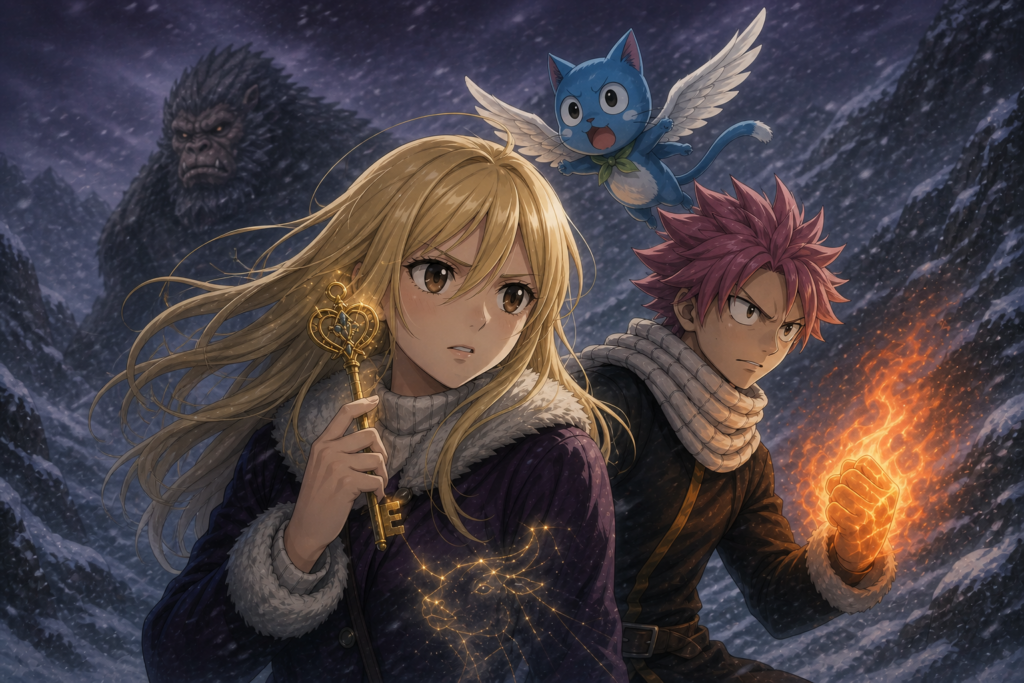
Lucy joins the guild and immediately meets the cost of belonging.
RaeRae Reacts • Fairy Tail Episode 2
Bottom line
Lucy gets into Fairy Tail and has about five minutes to enjoy it before a crying child asks why nobody brought his father home.
That is the right second episode.
“Fire Dragon, Monkey, and Bull” could have spent its whole runtime touring the guild hall and introducing every loud person with a name card. Instead, it makes Lucy learn what membership costs. Fairy Tail is warm, chaotic and full of people she has admired from a distance. It is also a workplace that sends human beings into dangerous jobs. When one of them disappears, the guild’s rules, pride and idea of family stop being cute background details.
Natsu goes after Macao because Romeo’s anger hits a wound he already carries. He knows what it means to wait for a father who does not come back. Lucy follows because joining a chosen family means somebody else’s emergency can become yours before you feel ready.
The episode is still funny. Happy is still Happy, and the mountain-monster premise keeps dignity from surviving for long. But underneath the monkey and bull jokes is a serious question: who absorbs the cost when dangerous labor goes wrong?
Lucy finally reaches Fairy Tail
Episode 1 sold Fairy Tail through conduct before Lucy saw the building. Episode 2 has to cash that promise.
Lucy enters the guild as both a new member and an audience surrogate. She has imagined this place, collected its reputation and attached a dream to the name. The hall does not behave like a polished institution waiting for her arrival. It behaves like a room where relationships already have history. People argue, fight, work, boast and know one another’s limits. Lucy has access now, but access is not the same as belonging.
That difference gives the episode its energy. The guild hall is not a character catalog. It is a culture already in motion. Lucy has to notice who carries authority, how jobs enter the room, and how quickly somebody else’s emergency can interrupt her first-day excitement.
Makarov matters because he is the first institutional authority Lucy meets inside the dream. He is small enough for the anime to build a visual joke around him, yet the guild reads his decisions as real. That contrast is not merely character design. It tells Lucy that authority here does not dress itself like Bora’s celebrity performance. Makarov does not need a crowd spell or a stolen nickname to make the room listen.
He also has to answer Romeo.
Romeo is not interrupting the fun
Romeo Conbolt enters the guild hall carrying the consequence everybody else can postpone. His father, Macao, took a job and has not returned for more than a week, according to Crunchyroll’s official episode summary. Romeo does not care that dangerous work is normal for wizards. He cares that his father is gone.
The guild can understand the rules and still fail the child standing in front of it.
The official records available here establish Romeo’s problem and Natsu’s response, but they do not preserve Makarov’s exact wording. My criticism is therefore about the structure the episode creates, not an invented quote or a claim that Makarov feels nothing.
This is the episode’s first useful accountability problem. A guild mediates jobs, but what does it owe members who do not return? Does it wait because a wizard accepted the risk? Does it send another person into danger? Who decides when absence becomes an emergency?
Fairy Tail loves calling itself a family. Families can become an excuse to ignore systems: somebody will handle it because somebody always does. Romeo’s grief forces the room to notice that “we care about each other” is not the same thing as having a reliable rescue protocol.
That is my RaeRae inference from the setup, not a claim that Mashima wrote an occupational-safety hearing. Still, the episode puts a child in front of the guild master and asks what collective care looks like when somebody has already fallen through the gap. The question is earned.
Natsu recognizes the missing-father wound
Natsu’s response makes emotional sense before the episode explains all of it.
He is searching for Igneel. Episode 1 made that search funny when he mistook Bora’s Salamander name for a clue. Romeo removes the joke. Here is another child whose father left for reasons tied to magic and has not come home.
The parallel to Igneel is my later-informed reading of Natsu’s immediate action. The licensed synopsis proves that he leaves to find Macao. It does not prove that he explains the choice through Igneel in dialogue.
Natsu does not solve Romeo’s fear with a speech. He leaves for Mount Hakobe.
That choice is generous, but it is also impulsive. A blizzard, an unknown monster situation and an overdue guild member are not a clean solo errand. The same instinct that makes Natsu morally reliable can make him operationally reckless. Fairy Tail will spend a lot of time treating those two truths as if they cancel each other. They do not.
Lucy follows. Crunchyroll and Apple TV Japan both frame her motive as curiosity, with Apple even placing a question mark beside it. She is the new member. She has no long history with Macao. Going anyway is one of the first acts that can turn guild access into guild participation.
Mount Hakobe makes the job physical
The move from a crowded hall to a blizzard changes the meaning of wizard work.
Inside Fairy Tail, jobs are paper on a board, money figures and stories people tell after returning. Mount Hakobe is a blizzard in every licensed synopsis, and that matters before a monster appears. Magic does not erase weather, fatigue or bad planning.
Macao’s assignment involved defeating a dangerous Vulcan. That is the boundary the official records prove. I am not naming a requested count, a hidden mechanic or the exact state in which the rescuers find him without the episode itself. Even at that narrower level, the contrast is useful: the guild hall can treat the job as paperwork, while Romeo experiences it as a week without his father.
Lucy's curiosity is doing real work
The licensed summaries put a question mark beside Lucy following out of curiosity, as if the episode knows the motive sounds flimsy. I do not think it is.
Lucy has spent a long time wanting the name Fairy Tail. She has barely entered the building before Natsu shows her what the name requires away from the cheering crowd. Curiosity is how she starts replacing fantasy with knowledge. She needs to see where jobs lead, what other members risk, and whether the loud boy who invited her into the guild behaves the same way when nobody is applauding.
That does not make her a trained rescue worker. It does not make following Natsu into a blizzard sensible. It does make the choice hers. She is not dragged into Fairy Tail’s culture by paperwork. She walks toward its consequences because she wants to understand what she joined.
There is also a class and labor point hiding under the adventure. Lucy arrives with enough knowledge to care about guild status and magical tools, but status does not complete a job. Somebody still has to travel, face the weather, confront the monster and return. Romeo cannot feed his fear with the idea that Macao belongs to a famous guild. The brand that impressed Lucy in Hargeon cannot tuck him into bed.
Episode 2 therefore makes curiosity more useful than expertise. Lucy does not need to know everything yet. She needs to keep looking when the glamorous version of wizard life gives way to unpaid emotional cost, dangerous conditions and a child asking adults to take his missing father seriously.
Power has rules, and rules create teamwork
Episode 1 introduced conditional magic. Episode 2 deepens it.
Natsu’s fire, Lucy’s Celestial Spirit Magic and Happy’s Aera belong to three different magic systems. They should not be flattened into one team power score or supplied with later-series limits that Episode 2 never states. What matters here is how each demonstrated ability changes the rescue, not how impressive its wiki entry looks.
The point is not to build a wiki table in paragraph form. The point is that each power changes the ethical problem. Fire can rescue or injure. Celestial Spirit Magic brings another person’s agency into the work. Aera changes who can move through dangerous terrain. Those differences matter more than a neat ranking chart.
Fairy Tail’s team battles work when powers do not simply stack. They create obligations.
Macao comes home, but the job still happened
The warm ending is important. Romeo needs his father. Macao needs to return as more than a mission result. Natsu needs to see that a missing father can come back, even if his own search remains unresolved.
That warmth cannot become an eraser.
Macao was gone for more than a week. Romeo had to confront the guild. Natsu and a brand-new member entered a blizzard to look for him. The rescue does not erase any of those facts.
The final scene offers “family restored,” but the cost still sits beside it. A happy reunion is a consequence. So is the fact that the system depended on a grieving child and an impulsive young guild member to trigger it.
That does not make Fairy Tail a bad guild. It makes it a believable institution whose warmth is stronger than its procedures. The series will often ask the warmth to cover the gap. RaeRae is going to keep looking at the gap.
Manga to anime: the second episode has two jobs
K MANGA identifies Chapter 2 as “The Master Appears!” and lists it at 49 pages. Its official Chapter 3 page identifies “Fire Dragons and Monkeys and Cows” and lists it at 30 pages. Together they form the manga comparison shelf for the guild arrival and Mount Hakobe rescue. Those official records establish the source shelf, but not a scene-by-scene change list. This React does not invent cuts or reordered beats from memory.
The anime has two structural jobs: introduce Lucy to Fairy Tail’s ensemble and move her into the Macao rescue. Those jobs can compete. Too many guild introductions stall Romeo’s urgency. Too little time in the hall makes Lucy’s dream feel like a hallway she runs through on the way to the mountain.
The television episode still has two structural jobs we can judge without inventing a change list. It must let Lucy encounter the institution she idealized, then let Romeo’s fear interrupt that welcome before Fairy Tail becomes a theme park. The interruption is the point. It teaches Lucy that the job board, the guild master and the jokes all sit beside obligations that do not wait for a convenient episode.
The credit we can actually name
TV Tokyo’s official rebroadcast record credits Atsuhiro Tomioka with the Episode 2 script. That is the episode-level creative credit the public archive establishes. It also names Shinji Ishihira as series director, Masashi Sogo as series composer, Yasuharu Takanashi for music, and A-1 Pictures with Satelight for animation production. Its broadcast cast list names the principal Japanese ensemble, but a list is not a performance review. This React does not assign vocal choices to performers without audible episode evidence.
Those credits are not interchangeable. Ishihira’s series-director credit does not prove he storyboarded or directly handled this episode. The public record does not expose Episode 2’s storyboard, episode-direction or animation-direction names. Those belong to the Japanese end roll, not to a guess built from the series staff page.
The distinction matters because adaptation is made by people, not by a floating object called “the anime.” Tomioka’s script has to connect Lucy’s guild arrival to Romeo’s interruption and the Mount Hakobe rescue inside one television slot. The public staff record supports analysis of that writing assignment. It does not support borrowed storyboard or episode-direction credits.
What Episode 2 adds to the promise
Episode 1 said a guild name has to mean something. Episode 2 says meaning creates responsibility.
Lucy wanted Fairy Tail because it looked like freedom, fame and adventure. Her first day shows her the invoice. Members take jobs. Jobs fail. Children wait. Friends make reckless choices because formal systems move too slowly. Magic can solve a monster problem and still expose a family problem underneath it.
Natsu brings Macao home because he cannot ignore Romeo. Lucy follows because she is beginning to understand that joining Fairy Tail is not receiving a destination. It is accepting a share of the mess.
That is how the guild starts becoming hers.
Receipt box
- Official English episode page: Crunchyroll, Episode 2, Fire Dragon, Monkey, and Bull
- Original release date: October 19, 2009, per Crunchyroll’s official episode listing
- Official Japanese title and home-media record: TV Tokyo archive, 火竜と猿と牛 (Karyū to Saru to Ushi)
- Episode 2 script and series-level staff: TV Tokyo official April 11, 2013 rebroadcast record
- Licensed Japanese title, runtime and synopsis: Apple TV Japan Episode 2 page
- Manga starting point: Hiro Mashima, Fairy Tail Chapter 2, The Master Appears!, 49 pages on K MANGA
- Series staff: A-1 Pictures official work page