
Fairy Tail Episode 13 React: Natsu vs. Yuka the Wave User
Yuka can cancel magic. Natsu has to remember he brought hands, judgment, and Gray.
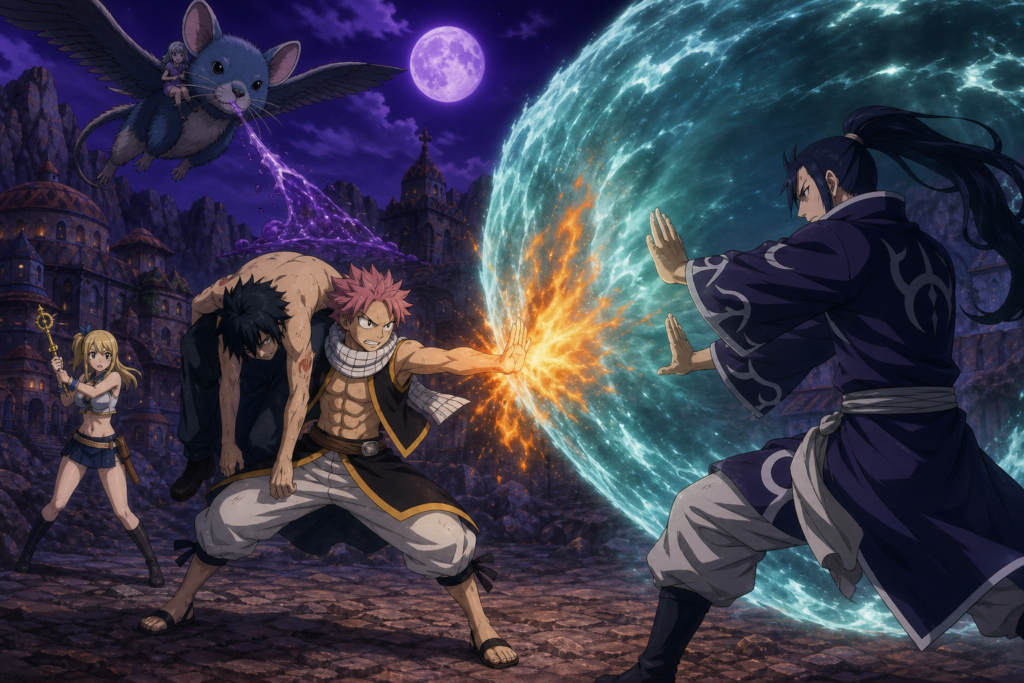
Bottom line: Episode 13 is not really asking whether Natsu can throw a bigger fireball. It asks what he does when fire is the wrong answer. Yuka’s Wave magic is built to cancel other magic, Gray is injured, the village is about to be drowned in poison, and Lucy has her own ugly matchup to survive. Natsu wins the important part of this episode by thinking with his body before his temper can waste everybody’s time. That is growth. It is not maturity yet. Let us not get carried away.
Receipt box
- Episode: 13
- English title: Natsu vs. Yuka the Wave User
- Japanese title: ナツ vs. 波動のユウカ
- Romanization: Natsu vs. Hadō no Yūka
- Original Japanese air date: January 11, 2010
- Story arc: Galuna Island / Sub-Zero Emperor Lyon
- Manga material: Chapter 30 from page 15, then Chapters 31 through 33, according to the episode adaptation ledger
- Japanese principal cast in this episode: Tetsuya Kakihara as Natsu, Aya Hirano as Lucy, Yūichi Nakamura as Gray, Yūichi Iguchi as Yuka, Saori Hayami as Sherry, and Daisuke Kishio as Loke
- Opening / ending: “Sense of Wonder” / “Tsuioku Merry-Go-Round”
- Where to watch: Fairy Tail on Crunchyroll
- Episode type: Manga canon
The fight is a test of judgment, not volume
Yuka arrives with the kind of power designed to embarrass a wizard who thinks every problem is solved by turning up the output. Wave can neutralize magic. Natsu’s fire crashes into that defense and gets swallowed. The first exchange matters because it removes the easy fantasy. Natsu cannot simply be the loudest person in the frame and collect a victory for effort.
This is where the episode gives him more credit than his usual chaos suggests. Natsu notices the rule. He does not keep feeding fire into a wall that eats it. He closes the distance and makes the fight physical. His magic still shapes who he is, but it does not replace his ability to read a matchup.
That distinction is important. A lot of battle anime pretend strategy means somebody explains the obvious after punching harder. Here, the counter is clean enough for a child to understand: if Yuka stops magic, stop handing him magic. Natsu’s answer is not complicated, but it is earned because he changes behavior. The boy who started this mission by treating an S-Class warning like decorative wallpaper finally listens to a limit.
I said a limit. He has not suddenly become the guild’s risk manager.
Gray is not luggage, even when Natsu carries him
Natsu returns toward the village with Gray injured after Gray’s confrontation with Lyon. The physical image is blunt. Gray has been trying to carry this history alone, and now he cannot carry his own body back to the people in danger. Natsu does it for him.
That does not make Gray weak. It makes the cost visible. Gray went into the ruins with old grief, incomplete information, and the belief that he could manage Lyon by himself. Episode 12 exposed the emotional trap. Episode 13 puts that trap on Natsu’s shoulder.
Natsu does not stop to conduct a therapy session. Thank goodness, because he would be terrible at it. His care is practical. Get Gray out. Get back to the village. Fight the people bringing poison. The series often makes found family believable through this kind of labor. Fairy Tail members say wild things about friendship, but the claim only matters when somebody carries weight that is not convenient.
There is still accountability here. Natsu, Lucy, Happy, and Gray accepted a forbidden S-Class job. The danger now facing the villagers did not begin with them, but their choices put them inside a crisis they did not understand. Protecting the village is the right response. It is not proof that the original decision was wise. Fairy Tail can let its heroes do something brave without rewriting the mess that brought them there.
The poison turns a private grudge into public violence
Lyon’s group is not merely defending a ritual site. Their attack targets the village. Sherry rides Angelica, the giant flying rat, while the group moves poisonous jelly toward people who have no control over Lyon and Gray’s history. The method is grotesque because it is impersonal. Drop the poison from above, erase the witnesses, and keep the Moon Drip ritual moving.
That is the moment Lyon’s project loses any remaining claim to being a private act of grief or ambition. He wants to defeat Deliora and prove himself greater than Ur. Fine. His followers are willing to poison a village to protect that goal. The villagers become acceptable losses in a contest they did not enter.
Yuka, Toby, and Sherry have distinct personalities and abilities, but they are not innocent employees trapped by a confusing memo. They participate. The episode can be funny about Toby’s claws and theatrical about Yuka’s confidence while still showing the consequence of their work. Charm does not erase responsibility. A cool spell name does not either.
This is also why Natsu’s anger lands. He is not only mad that somebody countered his fire. He sees an attack aimed past him. The village is the target. His fight becomes protective rather than competitive, even if his face still says he would enjoy winning.
Lucy gets the matchup that attacks her relationships
Lucy is fighting Sherry while Sherry’s Doll Attack magic interferes with Lucy’s Celestial Spirits. That is a particularly nasty counter for Lucy because her magic depends on contracts with people, not disposable tools. Sherry’s power tries to turn those relationships into access points.
The problem is not simply that Lucy may lose control of a summoned Spirit. The insult is deeper. Lucy opens a gate through agreement, keys, timing, and magical capacity. Sherry treats the Spirit as something that can be seized and redirected. The fight pressures the difference between a contract and ownership.
Fairy Tail has not always handled Lucy’s Spirit relationships with perfect seriousness. The comedy can wobble. Episode 13 still gives the underlying system a useful ethical shape. Lucy’s strength is relational, so an enemy who controls bodies and choices attacks the foundation of her practice.
Loke’s involvement makes the point harder to ignore. He crosses into the situation with more independence than Lucy expects from a contracted Spirit. The episode is planting a question it will answer later: what exactly is a Celestial Spirit when nobody is holding the key? At this point, the show does not give Lucy or the audience the full file. It gives us behavior that does not fit the simple rule.
That is good foreshadowing because it creates friction before explanation. Loke does not arrive with a lecture titled “Please Remember Me for a Future Arc.” He acts strangely enough to make the current fight interesting and the later truth feel prepared.
Magic has conditions, and conditions create character
Episode 13 is full of powers with rules.
Yuka’s Wave disrupts magic, but it does not make him untouchable. Sherry can control nonhuman targets with Doll Attack, but that ability does not make every relationship in the scene meaningless. Toby’s Paralyze Claw is dangerous because contact matters. Lucy’s keys require access and magical capacity. Natsu’s fire is powerful, but a direct magical answer can be canceled.
These limits do more than make the fights less boring. They reveal habits. Natsu adjusts by moving closer. Lucy looks for agency inside a corrupted contract situation. Yuka trusts his counter so much that physical improvisation can surprise him. Sherry treats living beings as pieces she can reposition.
Power systems are at their best when they expose values. A rule should change what a character chooses, not sit in a wiki box looking important. Episode 13 understands that.
Natsu's masculinity works because it bends
Natsu performs strength loudly. He charges, yells, burns things, and treats hesitation like a personal enemy. That kind of shōnen masculinity can become a cage if a story confuses stubbornness with courage.
This fight gives him a better version. He protects Gray without shaming him. He recognizes that his preferred attack is failing. He changes methods. None of those choices make him less forceful. They make his force useful.
There is a quiet lesson here about pride. Yuka’s defense is supposed to make a magic user helpless. Natsu does not protect his ego by insisting his fire should work. He protects people by doing something else. Flexibility is not surrender. Sometimes the most masculine thing this genre can let a boy do is stop proving the wrong point.
The episode does not announce that lesson, and I appreciate the restraint. Natsu would probably eat the lesson if somebody put it on a plate.
Japanese performance: pressure without losing the comedy
Tetsuya Kakihara keeps Natsu’s anger bright rather than solemn. His delivery has the forward push of somebody whose thoughts and body tend to arrive together. When the Wave defense blocks him, that energy does not disappear. It changes direction. The performance helps the tactical switch feel like Natsu’s decision instead of a writer handing him a solution.
Yūichi Nakamura gives Gray’s injured state weight without turning him into a helpless prop. Gray is physically compromised, but his presence still carries the unfinished argument with Lyon. Aya Hirano keeps Lucy alert and irritated inside a fight that threatens her control. Lucy does not sound like she is waiting for Natsu to finish the episode for her.
Saori Hayami’s Sherry has a polished, almost playful surface that makes the coercive magic nastier. The tone and the conduct do not match, which is the point. Yūichi Iguchi gives Yuka the confidence of somebody who believes he has solved the category of “wizard” itself. That certainty makes Natsu’s physical answer satisfying without needing Yuka to become stupid.
The ensemble balance is doing real work. Natsu’s fight can be funny, Gray’s injury can matter, and Lucy’s danger can stay active in the same episode. Nobody needs to borrow a completely different show.
Adaptation: several manga chapters, one television pressure line
Episode 13 adapts material spanning the end of Chapter 30 and Chapters 31 through 33. The television version organizes that material around simultaneous pressure. Gray is down. The village is under threat. Natsu faces an anti-magic specialist. Lucy faces a control specialist. The ritual continues above all of them.
That parallel structure is the episode’s main adaptation advantage. Manga panels can cut quickly between fights, but television adds timing, voice, music, and the visual recurrence of the purple moon. The audience feels that these are not separate tournament matches. They are parts of one operation.
The anime also leans into contrast. Natsu’s warm fire hits Yuka’s cool Wave barrier. Lucy’s golden keys sit against Sherry’s manipulation. Angelica’s ridiculous giant-rat silhouette carries a genuinely ugly weapon. The production does not need elite sakuga in every shot to keep the matchups readable. Clear staging does most of the labor.
That clarity matters because the episode has a lot of moving parts. It does not need five speeches explaining the battlefield. We can see the village, the poison, the injured teammate, the defensive Wave, and Lucy’s separate problem. The plot is busy without becoming mush.
The cultural read: the group name is earned through conduct
Japanese group stories often care about the reputation carried by a school, club, household, company, or guild, but I am keeping this as a RaeRae reading of the episode, not pretending one scene proves a universal rule about Japan.
Fairy Tail’s name is already famous. The guild also has a reputation for property damage, recklessness, and loud members who turn public space into a repair bill. On Galuna Island, Natsu and Lucy have to decide what that name means when nobody from headquarters is there to supervise them.
Their answer is conduct. Carry the injured member. Defend the villagers. Adjust when the first plan fails. Protect a Spirit’s agency. The guild symbol does not automatically make those choices moral. The choices give the symbol meaning.
That is a much stronger found-family argument than simply saying everybody loves each other. Families, guilds, and teams become real through repeated obligations. Episode 13 shows the obligation under pressure.
RaeRae's verdict
Episode 13 works because every major fight is also a question about control. Yuka wants to control what kinds of power count. Sherry wants to control living beings. Lyon’s operation wants to control the island’s future by sacrificing the villagers’ safety. Natsu and Lucy answer with adaptation and relationship, not clean dominance.
Natsu gets the headline, and he earns it. He carries Gray, reads Yuka’s defense, changes tactics, and keeps the village in view. Lucy’s parallel struggle keeps the episode from becoming another loud-boy showcase. Her magic is vulnerable precisely because it is built on bonds, and that vulnerability is also what gives it meaning.
The episode does not absolve the Fairy Tail team for taking a forbidden job. It shows what accountability can look like after a reckless choice: stay, protect people, and do the work in front of you. That is not a redemption speech. It is a shift.
Yuka thought he had a defense against magic. He did. Natsu just remembered that a wizard is still a person with hands, feet, judgment, and somebody else’s weight on his shoulder.