
Fairy Tail Episode 12: Moon Drip
Gray finds the sacrifice somebody else has decided to undo.
RaeRae Reacts • Fairy Tail Episode 12
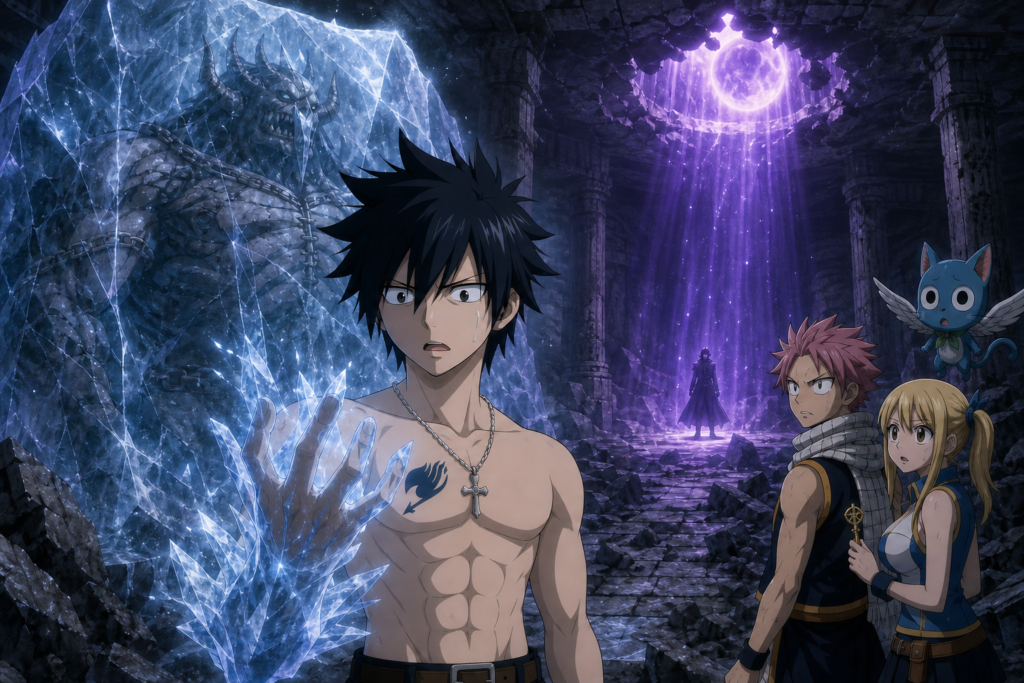
Bottom line: Episode 12 turns Gray’s private grief into public infrastructure. Deliora is not a memory he can avoid anymore. The demon is physically present under Galuna Island, sealed inside the ice created by Ur’s sacrifice, while strangers pour Moon Drip onto that sacrifice like it is an obstacle in their personal growth plan. “Moon Drip” is about the violence of reopening what someone else paid everything to contain.
Receipt Box
- Episode: 12
- English title: Moon Drip
- Japanese title: 月の雫(ムーンドリップ)
- Romanization: Tsuki no Shizuku (Mūn Dorippu)
- Japanese broadcast: January 4, 2010
- Series era: Fairy Tail (2009–2013)
- Story arc: Galuna Island, commonly localized as the Sub-Zero Emperor Lyon arc
- Episode type: Manga canon
- Official watch route: Crunchyroll
- Core discovery: The team finds Deliora sealed beneath the island’s temple while Moon Drip magic is being used to weaken the ice
- Series-level Japanese staff: Director Shinji Ishihira, series composition Masashi Sogo, character design Aoi Yamamoto, production by A-1 Pictures and Satelight
- Japanese leads: Yūichi Nakamura as Gray, Tetsuya Kakihara as Natsu, Aya Hirano as Lucy, Rie Kugimiya as Happy
- Continuity boundary: Episode 12 connects Gray, Ur, Deliora, and the voice of Reitei. It does not yet give Lucy and Natsu the complete history, the full ritual plan, the identities and motives of every enemy, or the ultimate condition of Deliora.
The official archive verifies the broadcast title and series-level production. It does not expose the complete Episode 12 end-credit slate, so unverified episode-specific names stay out.
Gray recognizes the thing everybody else calls a mystery
Lucy, Natsu, and Happy enter the temple looking for the cause of Galuna’s curse. Gray enters a room containing the worst day of his life.
That difference reorganizes the team immediately.
For Natsu, Deliora is a dangerous demon trapped in strange ice. For Lucy, it is evidence connecting the temple, the moonlight, and the villagers’ suffering. For Happy, it is enormous and frightening. For Gray, it is the creature that destroyed his home and triggered the chain of events that ended with Ur turning herself into the seal around it.
The reveal works because the episode does not begin with a lecture. Recognition arrives in Gray’s body first. His face changes. His voice tightens. The room becomes personal before the others know why.
Yūichi Nakamura’s Japanese performance carries that transition without making Gray suddenly sound like a different character. The shock is controlled until it cannot be. Gray’s usual irritation has outward direction. Here, the emotion folds inward. He is not only afraid of Deliora. He is confronting the fact that a sacrifice he treated as final has been moved, displayed, and attacked.
This is why chronology matters. Deliora is not a random boss preview. It is the physical object around which Gray built shame, discipline, and a dangerous belief that self-erasure can count as protection.
Ur’s sacrifice has been turned into somebody else’s raw material
Ur used Iced Shell to stop Deliora. The spell did not create an ordinary prison that she could later inspect or repair. It converted her body into the ice that sealed the demon. The ice is Ur’s sacrifice in material form.
Moon Drip is being used to melt or weaken that seal.
That makes the ritual more than villain technology. It is an attack on a dead woman’s final decision. The people performing it may have their own grief, ambition, or theory about what defeating Deliora will prove. None of that grants them ownership over Ur’s body or the consequences she contained.
This is one of Fairy Tail’s recurring moral problems: a powerful person decides that another person’s sacrifice is available for reuse. The language may be destiny, strength, research, revival, or completion. The structure is the same. Somebody who cannot consent becomes a resource.
Gray’s anger is therefore not simple fear of the demon returning. He is watching strangers undo Ur.
The episode does not yet give the team every detail needed to say that aloud. RaeRae can identify the structure while keeping the knowledge boundary clean. Gray knows what the ice means. Lucy and Natsu do not know enough yet.
Moon Drip is a ritual of collective labor
The magic descending through the ruined ceiling looks celestial, but it is not passive moonlight. It is a sustained ritual. People gather, chant, direct power, and repeat the process over time.
That production choice matters. Deliora is not being released by one impulsive spell. The project requires organization. Somebody planned it, recruited participants, secured a remote location, maintained secrecy, and accepted the risk to Galuna’s residents.
Large harm often looks like this. The person with the grand goal receives the narrative spotlight. The workers who keep the system operating become robes in the background. Episode 12’s temple imagery allows us to see that obsession needs logistics.
The violet beam also complicates the villagers’ account. They believe the moon curses them. The team discovers that lunar magic is being concentrated through the temple. Their explanation may not be technically complete, but it is not foolish. They have correctly connected the visible moonlight to the harm shaping their lives.
A respectful investigation begins there. Do not mock people because they name a mechanism imperfectly. Trace what they experienced, identify the system producing it, and revise the explanation with evidence.
Lucy is good for this kind of work because Celestial Spirit Magic has already taught her that names, contracts, timing, and conditions matter. She cannot treat every light in the sky as one generic magic source.
Natsu wants to break the machine before he understands the room
Natsu’s first useful instinct is often destruction. If a weapon is hurting people, destroy the weapon. If a wall protects an enemy, break the wall. If a ritual is releasing a demon, stop the ritual.
That instinct is not wrong here. Moon Drip should be interrupted.
The danger is that Natsu does not yet understand what the ice contains, what breaking the temple could damage, or why Gray’s reaction is so intense. Action without context can reproduce the harm it intends to stop.
Episode 12 uses the team’s imbalance well. Natsu supplies urgency. Lucy looks for conditions. Happy provides mobility and observation. Gray carries historical knowledge. No one person has the complete answer.
The strongest team language from Episode 8 becomes more complicated on Galuna. Strength is not combining attacks against one visible demon. It is allowing the person with relevant trauma and knowledge to affect the plan.
Natsu’s loyalty to Gray will eventually matter. In this episode, listening must come before the heroic punch. That is harder for him.
Tetsuya Kakihara keeps Natsu’s alarm active rather than solemn. His voice pushes the scene forward. That pressure is useful, but the direction lets Gray’s quieter shock interrupt it.
Lucy’s key cannot solve a history nobody has explained to her
Lucy arrives on Galuna partly because the S-Class reward includes a rare key. Episode 12 refuses to let the reward remain the story’s center. Once she sees the temple, villagers, and sealed demon, the job becomes ethical before it becomes profitable.
She still contributes through observation and Celestial Spirit Magic. Her keys are not universal answers. Each spirit has conditions, abilities, and a relationship with her. That limitation keeps Lucy’s magic from becoming a vending machine for plot solutions.
It also makes her dependence on accurate information visible. A contractor cannot choose the right spirit if teammates conceal the problem. Gray’s secrecy is understandable because the history is painful. It is still operationally dangerous once the team is standing beside Deliora.
Lucy does not deserve every private detail on demand. She does need the information necessary to avoid breaking Ur’s seal or helping the ritual by mistake.
That is a useful boundary for teams and families. Privacy is not the same as withholding safety-critical information. The person with trauma controls their story, but shared danger creates a duty to communicate what others need to survive.
Aya Hirano’s performance keeps Lucy’s concern practical. She is frightened, but she continues asking what the magic is doing. That is competence without pretending fear disappeared.
Reitei’s voice turns Gray’s history into a relationship problem
The man directing the project calls himself Reitei, the Cold Emperor. Gray reacts to his voice because recognition exists before the full identity reveal.
The episode is careful with that partial knowledge. The audience understands that Reitei is connected to Gray’s past. It does not yet need the entire relationship ledger.
What matters now is the structure: someone who shares part of Gray’s magical lineage is attacking Ur’s seal. This is not an outsider failing to understand the sacrifice. It is conflict inside a legacy.
Teachers do not only pass techniques. They create relationships among students who may interpret the same lesson differently. One student can treat a teacher’s death as a boundary never to cross. Another can treat it as an unfinished challenge.
That is why inherited power does not produce inherited values. Gray and Reitei can share Ice-Make roots while disagreeing about what Ur’s life and death mean.
The hidden face and familiar voice also make the episode’s mystery interpersonal instead of mechanical. The question is not only “Who is melting the ice?” It is “Why does Gray know the person willing to do it?”
Grief becomes dangerous when victory is asked to rewrite it
Deliora destroyed lives. Wanting the demon defeated is not irrational. The problem is believing a later victory can retroactively make the original loss acceptable.
If Reitei releases Deliora and wins, Ur is not restored. Gray’s family is not restored. The dead do not become less dead because a survivor proves they grew stronger.
This is where the arc’s masculinity critique begins. A young man can be taught that grief must become competition: defeat the enemy, surpass the teacher, prove the pain produced power. That framework offers motion but not mourning.
Gray is vulnerable to the same logic. His own history includes the belief that sacrificing himself might repair what his choices helped unleash. The later Lost Iced Shell material grows from this seed. Episode 12 does not need that future name to show the pattern: when Gray feels responsible, disappearance starts looking like payment.
Ur’s sacrifice saved him. If he learns only the sacrifice and not the care underneath it, he may repeat the form while missing her reason.
From a Buddhist lens, attachment to a corrective outcome keeps the wound active. Releasing Deliora to defeat it turns grief into a project that demands more suffering. Letting go does not mean forgetting Ur or accepting Deliora’s harm. It means refusing to make new victims serve the fantasy that one victory can settle the past.
The temple’s design makes violation visible
The underground chamber is built around contrast. Deliora’s prison is cold blue-white. Moon Drip falls in violet columns. The ruins are old, heavy, and broken. Gray stands small between a sealed catastrophe and a ritual large enough to alter it.
The visual design tells the argument before exposition finishes. Blue ice means containment, memory, and Ur. Violet light means intrusion, repetition, and outside force. The colors are not a new website palette. They are the episode artwork. The CVM page around them remains plum, lavender, and white.
The scale also prevents Deliora from becoming an ordinary opponent. The demon fills the ice. Gray cannot treat it like a guild-yard match. Its presence changes his breathing before it moves at all.
Good direction understands that a sealed monster can be more frightening than an attacking one. Motion would turn attention toward combat. Stillness forces attention onto what release would mean.
The distant Reitei silhouette gives the ritual a human center without answering every question. The episode needs recognition, not a full biography dump.
The islanders’ suffering cannot become background for Gray’s arc
Gray’s history gives the episode emotional depth, but Galuna’s residents remain the clients. Their bodies, homes, and social isolation are affected by the ritual. The arc must not use them only as atmosphere for two men processing Ur.
This matters because shonen stories often move from local suffering to rival confrontation and quietly leave the locals behind. The villagers’ request brought the team here. Solving Gray’s relationship conflict without ending the harm would not complete the job.
Lucy is the character most likely to keep that obligation visible because she entered through the request rather than Gray’s past. Natsu will protect whoever is in front of him. Happy notices immediate danger. Lucy can keep asking whether the client’s stated need has actually been met.
The later truth of Galuna will revise the curse explanation. It should not erase the fear the villagers lived with. Being wrong about cause does not mean nobody suffered.
RaeRae’s verdict
Episode 12 is where Galuna stops being a forbidden adventure and becomes an argument about who owns a sacrifice.
Ur turned herself into the ice sealing Deliora. Moon Drip treats that ice as a lock to pick. Gray recognizes the violation before his teammates understand it, and the familiar voice behind the ritual proves the conflict lives inside his magical family.
Natsu wants action. Lucy wants facts. Happy wants everyone safe. Gray needs to speak before grief chooses the plan for him.
The episode’s best decision is keeping Deliora frozen. Nothing has to attack for the danger to be real. A room full of people are already working to undo the person who stopped it.
That is enough reason to fight. It is also a reason to ask whose victory the release is supposed to serve.