
Fairy Tail Episode 1: The Fairy Tail
The guild name has to mean something.
RaeRae Reacts • Fairy Tail Episode 1
Bottom line
Fairy Tail does not introduce its guild by giving us a clean tour and a laminated membership brochure. Thank God, because that would be boring. It introduces Fairy Tail through a stolen name.
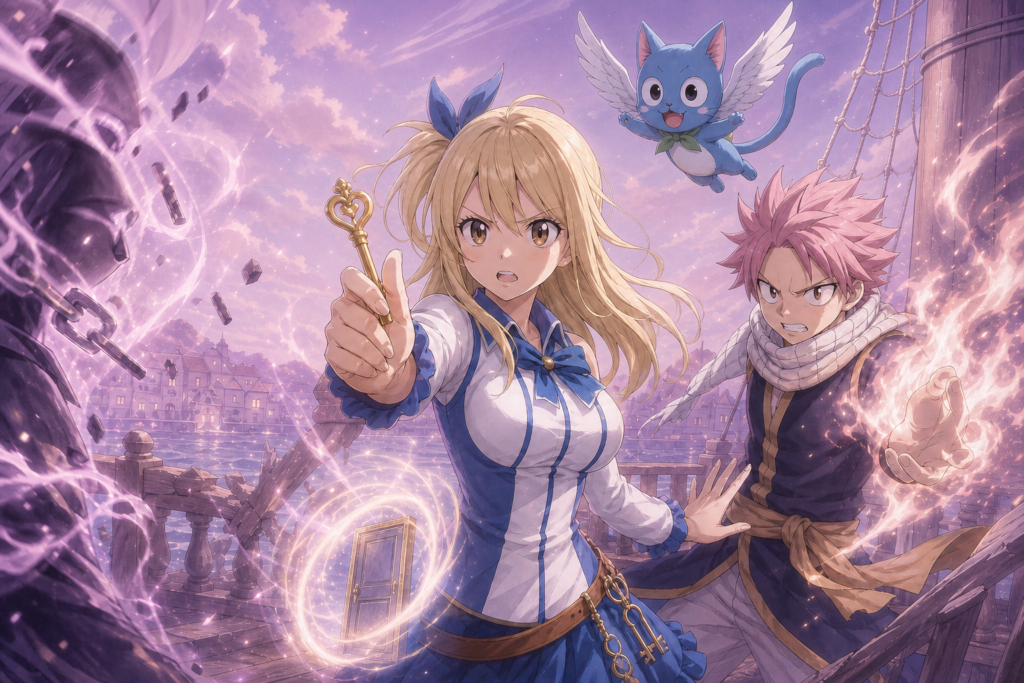
Lucy Heartfilia arrives in Hargeon desperate to join the most famous wizard guild in Fiore. That desire makes her easy to impress, but it does not make her stupid. The minute a man calling himself Salamander uses Fairy Tail’s reputation to lure women onto a ship, the premiere turns Lucy’s dream into a test. Does she want access badly enough to ignore what access is costing her?
The answer is no. Lucy gets embarrassed. She gets trapped. She needs help. She still recognizes that Bora’s invitation is poison once the glamour breaks. Natsu and Happy handle the rescue, but Lucy supplies the moral point of view. Fairy Tail’s name matters only when somebody is willing to defend what it is supposed to mean.
That is a strong first episode. It is loud, shameless, a little horny, and already much sharper about celebrity than its jokes make it look.
What happened in Hargeon
Lucy comes to the port town with a practical goal and a romantic picture in her head. She wants Fairy Tail. She also knows magic shops mark up their wares, and she is willing to haggle over a Celestial Spirit key instead of smiling politely while somebody robs her. That early shop scene matters. It tells us Lucy is not wandering through the world waiting for a man to explain it to her. She understands money, magical tools, and the difference between wanting something and paying any price for it.
Then Hargeon starts screaming about Salamander.
Bora has built a crowd around a borrowed reputation. Women gather because they believe a famous Fairy Tail wizard has appeared in town. His magic pushes that attraction further. TV Tokyo’s official 2013 rebroadcast record calls the spell Charm, identifies it as forbidden magic and says it steals Lucy’s heart. Apple TV Japan’s licensed episode record gives the same rule in more clinical language: Charm draws the target’s heart toward the caster, and Natsu and Happy’s arrival lets Lucy escape its immediate effect. Those records prove what the spell does and that the interruption breaks its hold. They do not prove that Lucy diagnoses the magic herself, so this React does not give her dialogue the licensed summaries do not establish.
Natsu hears the name Salamander and runs toward the crowd for a completely different reason. He hopes the man might be Igneel, the dragon who raised him. Instead, Bora is just a fraud with red hair, a stage persona, and entirely too much confidence for somebody committing crimes on a boat.
Natsu’s disappointment is funny because it is immediate and physical. He does not play cool. He crashes emotionally in public, eats Lucy’s thank-you meal, and moves on with Happy. The episode gives us pieces of his history without stopping for a lore lecture. He is searching for Igneel. Fire and dragons are personal to him. The rest can wait.
Lucy later accepts Bora’s invitation after he claims he can get her into Fairy Tail. The important distinction is that she does not board because his charm still controls her. She boards because he puts her dream on the table. That is social manipulation, not just magical manipulation. Bora studies what she wants and sells himself as the gatekeeper.
Once Lucy is isolated, he drops the celebrity act. The ship is not taking hopeful recruits to a guild. Kodansha’s official Volume 1 description calls Bora’s group an unsavory pirate gang, while Crunchyroll’s licensed listing says the phony wizard lures Lucy aboard with a promise of Fairy Tail access. That is enough to establish an organized trap. I am not inflating it with a destination, victim count, or criminal plan that the official records available here do not state.
Natsu and Happy arrive, and the rescue immediately runs into Natsu’s least glamorous limit: he cannot function on moving transportation. Happy can fly, but only for a limited time. Lucy is not carrying a spell that can ignore every condition either. She summons Aquarius with a water-compatible key, and Aquarius answers the crisis with the attitude of an employee called on her day off.
Aquarius’s wave throws the ship back toward land. Her appearance establishes the practical shape of Lucy’s magic without turning this premiere into a full Celestial Spirit rulebook: Lucy uses a key, calls a person rather than a faceless weapon, and does not control that person’s attitude. Once Natsu’s feet are no longer on a moving vessel, the joke ends. He eats Bora’s fire, identifies himself as a Dragon Slayer, and turns the false Salamander’s stolen image against him.
The port pays for it. Natsu is not a discreet rescuer. His attack wrecks property on a scale that makes Lucy’s introduction to Fairy Tail look less like a recruitment meeting and more like fleeing a crime scene with excellent branding.
Then he offers her the real thing: not a private favor, not access in exchange for obedience, and not a promise designed to isolate her. He tells Lucy to come with him to Fairy Tail.
Lucy is not the prize in somebody else's entrance
It would have been easy for this premiere to treat Lucy as a pretty suitcase Natsu carries into the plot. The episode flirts with that danger because she is charmed, captured, dropped, soaked, and rescued in less than half an hour. Yet Lucy remains the person whose judgment organizes the story.
We know what Fairy Tail means before Natsu explains it because Lucy tells us what she believes it could mean. We understand Bora’s fraud because she understands the value of the name he stole. We feel the danger shift when she stops treating his invitation as a lucky break and recognizes the trap. Natsu wins the fight, but Lucy gives the fight its ethical stakes.
Her ambition is also allowed to be messy. Lucy wants proximity to fame. She is thrilled by the idea of meeting a celebrity wizard. She nearly lets the promise of guild access outrun her caution. That does not cancel her competence. It makes the competence visible because she has to use it while wanting something very badly.
That is the part a thin recap misses. Lucy does not prove she is strong by never being fooled. She proves she has a self by recovering her judgment after somebody targets the exact thing she longs for.
Bora is selling borrowed trust
Bora’s most useful weapon is not fire. It is Fairy Tail’s reputation.
He understands that a respected name can make strangers lower their guard. The crowd supplies excitement. The Salamander nickname supplies celebrity. Fairy Tail supplies legitimacy. Charm magic pushes attraction, but the scam works because the culture around famous guilds has already done half the labor for him.
This is where the premiere gets culturally interesting. A guild is not merely a workplace in Fairy Tail’s world. It is a public identity. Members wear marks, names travel between towns, and one wizard’s conduct can stain the group. My bounded RaeRae inference is that the episode asks us to read Natsu as a representative of his collective, not just a freelancer defending a trademark. The evidence is inside the episode: Bora trusts the guild name to lower strangers’ guard, while Natsu treats misuse of that name as harm to his home and the public. That is enough. I do not need to staple a sweeping claim about Japanese society onto a blue cat.
Natsu’s rage makes sense inside that structure. Bora is not only lying about his work history. He is using Natsu’s home as bait for coercion. Protecting the guild name becomes a way of protecting people who trusted it.
And yes, Bora has celebrity cologne, a stolen nickname, and a yacht full of crimes. Sir, pick a struggle.
The real Salamander looks ridiculous until it matters
Natsu’s introduction is built on contrast. Bora performs status. Natsu performs hunger.
Bora wants people looking at him. Natsu wants food, information about Igneel, and solid ground. Bora surrounds himself with admirers. Natsu travels with one tiny blue cat who announces things with complete confidence whether they help or not. Bora borrows fire as an image. Natsu’s relationship with fire is bodily, trained, and tied to family.
The switch does more than surprise us. The comedy lowers our guard without making Natsu incompetent. His weakness is specific. Once the transport condition disappears, the same body that looked useless becomes the proof Bora cannot fake.
Magic arrives with conditions
Episode 1 introduces several kinds of magic, but it refuses to make power one smooth blue beam.
Lucy uses keys and contracts. Her magic depends on a relationship with a Celestial Spirit and, in Aquarius’s case, a usable water source. Aquarius has personality, preferences, and leverage. She is not a decorative attack animation Lucy owns.
Happy can fly with Aera, but the spell has a limit. He can get Lucy off the ship and still run out before the rescue is finished. That limit creates the next problem instead of solving the whole scene.
Natsu identifies himself as a Dragon Slayer, consumes Bora’s fire, and turns that fire back into strength. The premiere also makes him helpless on moving transportation. Later episodes explain more of the system, but Episode 1 already gives us the rule that matters in this fight: Bora’s most impressive attack becomes fuel once Natsu reaches solid ground.
The common thread is dependence. Lucy depends on contracts and conditions. Happy depends on endurance. Natsu depends on terrain and the kind of element available. Power is relational from the first episode. Nobody is strong in every situation, and the rescue succeeds because three limited abilities overlap.
That is Fairy Tail’s future team logic in miniature.
Manga chapter to television episode
The anime adapts Hiro Mashima’s long opening chapter, The Fairy’s Tail. K MANGA lists that chapter at 81 pages, so the television staff had to turn a large opening statement into one broadcast episode. That is not a neutral transfer, but I am also not going to call a scene “anime-original,” “reordered,” or “cut” without a panel-to-screen comparison. What the television version clearly prioritizes is Lucy’s desire first, Bora’s borrowed celebrity second, and Natsu’s real identity as the payoff. The episode teaches us what Fairy Tail means through the person trying to enter it before it gives us the guild itself.
Series director Shinji Ishihira and series-composition writer Masashi Sogo shaped the production as a whole. TV Tokyo’s official rebroadcast record also credits Sogo with Episode 1’s script. The page names Snow Fairy by FUNKIST as the opening and Kanpeki Gū no ne by Watarirouka Hashiritai as the ending. A-1 Pictures and Satelight produced the series, with Aoi Yamamoto’s character designs and Yasuharu Takanashi’s music helping define the adaptation’s look and pulse. Storyboard, episode-direction and animation-direction names stay out until a primary credit record confirms them.
The craft question is not whether the anime copied the chapter. It is what the anime teaches us to notice first. Does it lead with Lucy’s desire, Natsu’s comedy, Bora’s celebrity, or the danger underneath? Editing decides whose story the premiere feels like.
What Episode 1 promises, and what it does not
The premiere promises that Fairy Tail will be a story about chosen belonging. It also warns us that belonging can become a brand, and brands can be exploited.
It promises fights with readable power rules, comedy that lives inside danger, and property damage nobody will be allowed to forget for at least five minutes.
It does not yet prove every future speech about friendship. It does not explain Igneel, Dragon Slayers, Celestial Spirit society, or the institution behind wizard guilds in full. Later episodes will add those layers. Episode 1 only needs to make the invitation feel earned.
Lucy accepts Natsu’s invitation because he has already shown the difference between claiming Fairy Tail and acting like Fairy Tail. Bora offered private access and demanded control. Natsu makes the guild louder, messier, and public. He does not grant Lucy a favor. He opens a road.
That distinction is the premiere’s real magic.
Receipt box
- Official English episode listing: Crunchyroll, Episode 1, The Fairy Tail
- Manga basis: Hiro Mashima, Fairy Tail Chapter 1, The Fairy’s Tail, collected in Volume 1
- Official production record: A-1 Pictures Fairy Tail work page
- Licensed Japanese episode record: Apple TV Japan, Episode 1,
妖精の尻尾, October 12, 2009, 22 minutes - Official Japanese rebroadcast record: TV Tokyo,
妖精の尻尾, with the Charm premise, Masashi Sogo script credit, Snow Fairy opening and Kanpeki Gū no ne ending - Official Japanese cast confirmation: Fairy Tail anime-site interview with Yoshimitsu Shimoyama
- Continuity: main 2009 television-anime adaptation of the original manga