
Evangelion Episode 9: Both of You, Dance Like You Want to Win!
Evangelion Episode Reaction
NERV turns teamwork into choreography after Shinji and Asuka lose in public. The dance works, but nobody asks why humiliation is the organization’s favorite teaching tool.
Bottom Line
The perfect routine cannot repair a broken partnership
Episode 9 turns an Angel battle into a dance rehearsal, and the idea works because the joke sits on top of a real institutional problem. Israfel splits into two bodies that must be destroyed at the same instant. NERV owns two active Evangelions and has two pilots who cannot stand sharing attention. The technical answer is synchronization. The human answer should be trust, practice, and clear communication. Misato chooses forced cohabitation, public pressure, and an endless music loop because NERV needs results in six days.
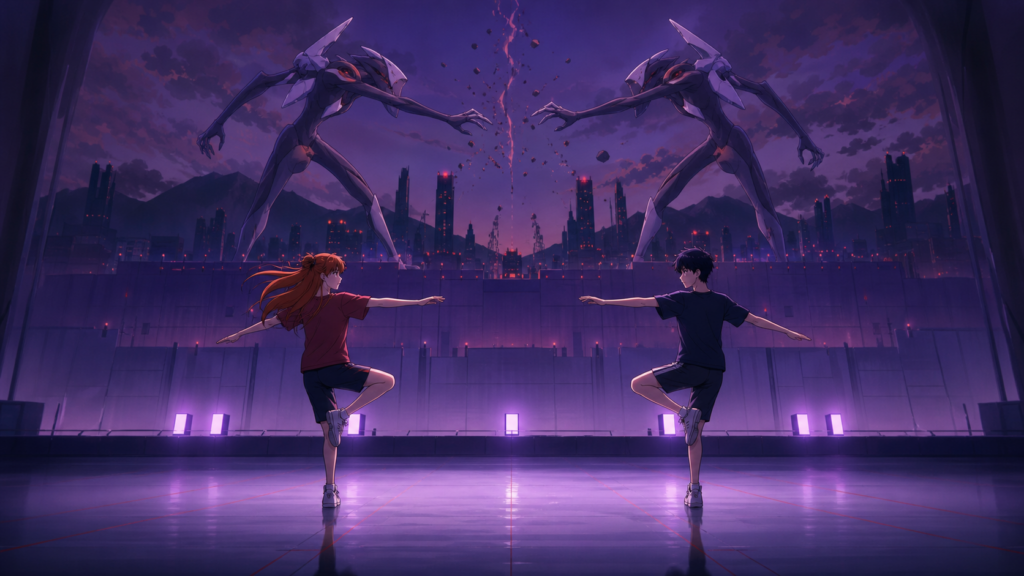
The final battle is one of early Evangelion’s most memorable action sequences. Unit-01 and Unit-02 move like mirrored dancers, attacking the divided Angel to a timed score while every kick and turn lands in sequence. The beauty of the routine almost hides the ugliness of the preparation. Shinji and Asuka become effective partners by learning to erase visible differences for sixty-two seconds. Once the music ends, they fall into the same argument.
The complaint is not that Misato uses an unusual training method. A synchronized enemy requires synchronized pilots, and choreography gives two teenagers a concrete rhythm they can rehearse. The problem is that adults keep designing emergency solutions around children’s emotional limits without providing the stability that might expand those limits. NERV trains bodies and synchronization scores. NERV does not teach conflict resolution, consent, or recovery after failure.
What the episode gets right is how cooperation can exist without affection. Shinji and Asuka do not need to become friends before they can complete a task. They need shared timing, honest feedback, and a goal neither can reach alone. The episode refuses a sentimental breakthrough. Their victory is real. Their relationship remains unfinished.
Public Failure
Two talented pilots lose because neither accepts a partner
The first confrontation with Israfel looks easy. Asuka rushes forward, cuts the Angel in half, and celebrates before understanding what she has done. The halves regenerate into two coordinated bodies. Shinji and Asuka attack separately, collide, and lose within seconds. Their Evangelions end up embedded in the landscape while military forces delay the Angel’s advance. The image is funny because the failure is so complete. The consequences are serious because an entire region must absorb the cost of their mistake.
Asuka blames Shinji immediately. Shinji lacks the confidence to redirect the accusation, but his silence does not make him innocent. Both pilots respond to threat through isolation. Asuka moves first so nobody can question her value. Shinji waits for instructions so nobody can accuse him of choosing wrong. Put together, those strategies create a pair where one person dominates and the other disappears. Neither behavior produces coordination.
NERV’s response adds humiliation to the tactical failure. The pilots are criticized, watched, compared, and ordered to fix themselves under a countdown. Nobody begins with a calm debrief about what each person saw or why their movements conflicted. The organization treats embarrassment as motivation because embarrassment is cheap. A better system would separate the battle error from the children’s worth, identify the communication failure, and train the skill without turning the household into a pressure chamber.
The episode also shows why public failure hits Asuka harder. Shinji expects to disappoint people. Failure confirms the story he already believes about himself. Asuka expects competence to protect her. Losing in front of NERV, Misato, and Shinji threatens the identity she uses as armor. Her insults become louder because the fear underneath them becomes harder to contain.
The Training Week
A home becomes a rehearsal room
Misato moves Asuka into her apartment and rebuilds the children’s schedule around synchronization. They wear matching clothes, eat together, move together, and repeat the same dance until the routine replaces thought. The method recognizes that partnership is physical. People who share a cockpit or battlefield must understand pace, balance, and reaction without holding a committee meeting during every movement.
The same method ignores privacy. Asuka has just arrived in Japan and receives no gradual transition into a new home, school, or command structure. Shinji already has little control over his living space. Misato converts the apartment into an extension of NERV because the mission deadline outranks domestic boundaries. The choice produces funny scenes, but the humor depends on children being unable to refuse adult decisions.
Hikari, Toji, and Kensuke become an audience for the training. School life and military life overlap until classmates casually observe preparations for planetary defense. That overlap is part of Evangelion’s strange normality. Teenagers discuss crushes, lunch, and synchronized Angel combat within the same afternoon. The adults have normalized crisis so thoroughly that children carry it into ordinary social space.
Rei’s brief rehearsal with Shinji changes the emotional temperature. She can match him quickly because both pilots respond to instructions with restraint. Asuka watches and understands the result as replacement. The scene proves that synchronization is not only about skill. Compatible defenses matter. Shinji and Rei withdraw in similar ways, so their movements align before they need to negotiate. Asuka cannot accept that ease because she hears a verdict about her value.
The real training begins when Asuka stops assuming Shinji must fit her timing and Shinji stops waiting for Asuka to carry every decision. The episode does not explain that lesson aloud. Their bodies show it. They learn the routine through failure, correction, and repetition. Music gives them an external standard neither can control, which temporarily removes the fight over who leads.
Shinji and Asuka
Similarity frightens them more than difference
Shinji and Asuka look opposite because their defenses point in opposite directions. He makes himself smaller. She makes herself impossible to ignore. Both are terrified that another person will confirm they are unwanted. Shinji avoids asking for closeness. Asuka demands attention and punishes anyone who gives the wrong kind. The dance forces them into proximity without offering language for the fear underneath.
Asuka’s nighttime vulnerability is the clearest example. She sleeps close to Shinji, speaks about her mother, and leaves him unsure whether the moment is intimacy, accident, or another test. Shinji almost crosses a boundary, then stops. The scene is uncomfortable because curiosity, loneliness, and consent sit beside each other without guidance. Both children want connection and lack the emotional tools to negotiate it safely.
The next day, performance returns. Asuka can dismiss Shinji, complain about Rei, and focus on the routine. Shinji can hide behind obedience. Their defenses survive the night because nobody names what happened. Evangelion understands that shared space does not automatically create understanding. People can live inches apart while protecting completely different versions of the same moment.
The final routine works because they agree to one temporary reality. The tempo decides when to move. The Angel decides where to strike. Misato’s plan decides the sequence. For one minute, neither pilot has to negotiate identity. They only have to trust the count. The relief is visible in the precision of their movements.
Then the Evas crash together after the victory, and the pilots immediately argue over responsibility. The joke prevents the sequence from becoming a false cure. One successful performance does not resolve resentment. Cooperation is a skill, not a personality transformation. NERV gets the result it needed and leaves the relationship maintenance to two exhausted teenagers.
The six-day deadline also explains why the solution feels both brilliant and cruel. Misato cannot wait for trust to develop naturally because the Angel will resume moving. Emergency command compresses every human process into measurable output. The children either synchronize by the scheduled attack or cities remain exposed. That reality does not excuse the lack of long-term care. The believable improvement is not a softer battle plan. The improvement is a permanent support structure waiting after the battle, when the timer stops and the pilots must live with what the emergency required.
The Dance Battle
Style becomes evidence, not decoration
The battle’s presentation matters because the choreography allows viewers to feel synchronization before the plot announces success. Split screens, mirrored poses, matching strikes, and music replace the usual command-room rhythm. The sequence looks playful while remaining mechanically precise. Every movement has a partner. A missed beat would allow one half of Israfel to regenerate the other.
The animation also makes equality visible. Unit-01 and Unit-02 occupy the frame as a pair. Asuka does not become Shinji’s assistant, and Shinji does not become Asuka’s passenger. Their bodies alternate emphasis. The fight answers the earlier cockpit scene by giving each pilot a separate machine inside one coordinated plan. Partnership improves when proximity no longer means one person controlling the other’s space.
Israfel is the perfect enemy for this lesson because division is its strength. Cutting the Angel in half multiplies the threat. The pilots must answer division with coordination. Evangelion often turns psychological conflict into battle mechanics, and this episode does so with unusual clarity. Shinji and Asuka cannot defeat the enemy while acting like separate centers of the universe.
The victory still depends on an enormous support system. NERV studies the Angel, creates the timing, repairs both Evangelions, coordinates power, and schedules the attack. Conventional forces hold Israfel back long enough for training. The famous dance belongs to the pilots, but the conditions for the dance belong to hundreds of workers. The episode celebrates individual performance while quietly documenting collective labor.
Misato’s Method
Good strategy, questionable guardianship
Misato sees the tactical answer faster than anyone. She understands that killing both Angel cores simultaneously requires synchronization more exact than ordinary military coordination. She translates that requirement into music and movement teenagers can practice. Her creativity saves lives. Her willingness to challenge standard procedure remains one of NERV’s greatest assets.
Guardianship demands more than mission success. Misato controls the pilots’ home, schedule, clothing, and sleep during the training week. She uses competition with Rei to push Asuka harder, even though she can see the jealousy forming. The method works because Misato understands each child’s pressure points. Using that knowledge without repairing the resulting damage is manipulation, even when the larger goal is survival.
The impossible part of Misato’s job deserves attention. She is simultaneously operations director, battlefield commander, landlord, guardian, and emotional first responder. NERV gives her conflicting responsibilities and then evaluates the result through mission outcomes. A believable organization would separate command authority from daily guardianship, provide therapists who are not in the chain of command, and create consent boundaries for training outside work. NERV instead depends on Misato improvising every system at once.
Verdict
They learn the steps before they learn each other
Episode 9 earns its reputation because the dance is not a gimmick pasted onto the battle. Synchronization connects the Angel’s biology, the pilots’ conflict, the training structure, and the final visual language. The story asks whether two people can cooperate before they trust each other. The answer is yes, briefly, when the task is specific and the standard is shared.
The episode also exposes the limit of task-based intimacy. Shinji and Asuka can memorize a routine, defeat Israfel, and still return to insults. Their bodies learn faster than their relationship. NERV accepts that imbalance because the organization needs pilots who function, not children who heal. Viewers get a triumphant sequence and a reason to worry about everything that triumph leaves untouched.
Asuka remains the engine of the episode. Her pride causes the first defeat, energizes the training, complicates every interaction, and helps deliver the final victory. Shinji’s quieter adaptation makes the partnership possible. Neither child is the problem alone. The system places two vulnerable people together, supplies a deadline, and calls the resulting friction training.
RaeRae verdict: The routine is perfect because the relationship is not. Evangelion lets Shinji and Asuka win without pretending victory taught them how to live together.
Episode File
Original air date: November 29, 1995
Angel: Israfel
Core conflict: Shinji and Asuka must synchronize simultaneous attacks.
Watch: Netflix
Next: Episode 10, Magma Diver